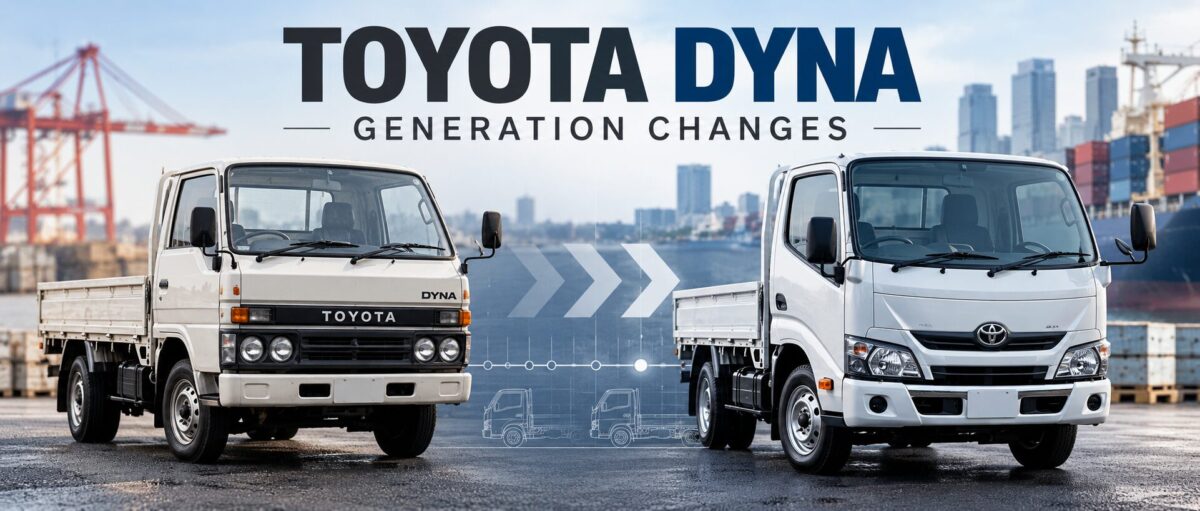

The Toyota Dyna has evolved from a simple cab-over work truck into a modern commercial vehicle offered in multiple payload classes, diesel and hybrid configurations, 2WD and 4WD versions, and a wide range of specialist bodies. For overseas buyers, however, the most important difference between generations is not appearance alone. Model code, engine family, payload, drivetrain, electronics and body equipment can change significantly.
The Dyna name was adopted in Japan in 1959, and Toyota continues to offer Dyna commercial trucks in 2026. Older U-series and Y-series trucks can appeal to buyers seeking straightforward work vehicles, while XZU and later models offer newer engines, emissions systems and safety technology. This guide explains those changes and shows how to choose a Dyna by Country × Vehicle × Use.
Toyota Dyna Generation Changes: Quick Overview
| Period / Dyna Era | Representative Changes | Used Buyer Focus |
|---|---|---|
| 1959–1970s | Dyna name established; cab-over layout developed as a core commercial-truck design | Mainly historic / collector interest today |
| 1980s | U80/U90 and Y50/Y60-era trucks; diesel commercial use expanded | Mechanical condition, corrosion and older-parts availability |
| 1990s | U100/U200 and Y100-series development; wider commercial configurations | Engine family, payload, body type and chassis condition |
| 1999–2010 | Joint development with Hino increased; XZU and KDY families became important | N04C, S05C, 1KD and other engine/model-code combinations |
| 2003 onward | 2-ton-class Dyna Hybrid introduced in Japan | Hybrid-system condition and local technical support |
| 2011–2020s | Safety, emissions control, cab usability and electronic systems continued to develop | Diagnostics, emissions equipment, safety systems and body specification |
| Current 2026 Range | 1-ton and 2-ton cargo ranges plus dump and specialized commercial configurations remain available in Japan | Exact specification, current technology and destination support |
Generation names and year boundaries can vary depending on weight class and chassis family. Overseas buyers should therefore use the full model code and chassis number rather than relying only on a broad “generation” label.
Where Did the Toyota Dyna Begin?
The history behind the Dyna name begins with Toyota's Toyopet Route Truck.
Toyota's historical records show that the RK85 Route Truck was launched in April 1959. In June of that year, the model name was changed to Dyna. The name comes from “dynamic.”
An important early engineering feature was the cab-over layout with a tilting cab. This made it possible to maximize cargo space while maintaining relatively compact overall dimensions and also improved access to the engine for maintenance.
That basic concept still defines the Dyna:
- Compact cab-over packaging
- Commercial cargo capacity
- Easy access to the engine and chassis
- Multiple body configurations
- Different wheelbases and payload classes
1980s Toyota Dyna: U80, U90 and Y-Series Work Trucks
Older Japanese used-truck buyers frequently encounter model families from the 1980s such as U60, U80 and U90-series Dyna trucks.
These vehicles belong to an era when mechanical diesel systems and relatively simple electrical equipment were common.
Typical reasons overseas buyers may still consider these trucks include:
- Simple commercial design
- Manual transmissions commonly available
- Limited electronic complexity
- Flatbed and dump configurations
- Familiar mechanical diesel systems in some markets
However, age changes the buying priorities.
On an older Dyna, inspect:
- Main frame rails
- Crossmembers
- Cab corrosion
- Leaf-spring mounting points
- Brake components
- Engine oil leakage
- Cooling system
- Transmission and clutch
EVERYCAR.jp still lists older Dyna trucks from this period from time to time, including U-series dump configurations.
1990s Dyna: Wider Choice of Chassis and Engines
During the 1990s, the Dyna range continued to expand into different wheelbases, payload classes and commercial applications.
Used examples from this era can include Toyota B-series engines such as the 14B and 15B, as well as different chassis families depending on the truck class.
The key advantage for a used buyer is the wide range of applications available:
- Flatbed cargo
- Dump trucks
- Double-cab trucks
- Box bodies
- Utility vehicles
- Special-purpose commercial trucks
However, a 1990s truck should not be purchased only because a particular engine has a good reputation.
Buyers need to confirm:
- Exact model code
- Engine model
- Maximum payload
- Wheelbase
- 2WD or 4WD
- Transmission
- Body equipment
- Frame condition
1999 and the Hino Connection
A major development in later Dyna history was closer cooperation between Toyota and Hino.
The Dyna and Hino Dutro became closely related within Toyota Group commercial-truck development. As a result, many later Dyna trucks share important chassis, engine and commercial-vehicle technologies with Hino models.
This matters to overseas buyers because later Toyota Dyna trucks can use Hino-derived commercial diesel engines such as the N04C.
Do not assume that every Toyota-branded truck uses a Toyota passenger-vehicle engine.
The model code helps identify what you are actually buying.
Understanding Toyota Dyna Model Codes
Model codes are essential when comparing Japanese used trucks.
Common Dyna families found in the Japanese used market include:
- BU-series
- LY-series
- YY-series
- KDY-series
- XZU-series
Different codes can indicate major differences in:
- Engine
- Weight class
- Wheelbase
- Drive system
- Production period
- Emissions specification
For example, current EVERYCAR.jp stock has included older N-BU60 Dyna dump trucks, KK-XZU347 trucks and later XZC/XZU commercial configurations.
When ordering parts or requesting a truck from Japan, provide the full model code and chassis number whenever possible.
Important Toyota Dyna Engine Families
The Dyna has used many engines over its long production history.
| Engine Family | General Era / Application | Buyer Consideration |
|---|---|---|
| B / 14B / 15B | Older Toyota commercial diesels | Mechanical condition and local parts support |
| 5L | Used in some lighter Dyna configurations | Confirm chassis and payload rather than engine alone |
| 1KD-FTV | Later lighter commercial / 1-ton-class applications | Electronic diesel diagnosis becomes more important |
| S05C and related engines | Found in some Hino-related commercial chassis | Use full chassis code when sourcing parts |
| N04C | Major later 2-ton-class Dyna diesel | Modern fuel injection and emissions systems |
| N04C Hybrid Application | Dyna Hybrid | Hybrid battery, motor and control-system condition |
The exact engine depends on year, weight class and model code.
For a wider reference covering Toyota and other Japanese commercial trucks, see the Japanese Truck Engine Model Guide.
2003: Toyota Dyna Hybrid Becomes a Major Innovation
One of the most important technological changes in Dyna history occurred in 2003.
Toyota announced a parallel hybrid system for 2-ton-class Dyna and Toyoace trucks in Japan. The system combined a 4.0-liter N04C diesel turbo engine with an electric motor, battery and control system.
This was significant because hybrid technology had previously been associated mainly with passenger vehicles.
For today's used-truck buyer, however, a hybrid requires different checks from a normal diesel truck.
What to Check on a Used Dyna Hybrid
- Hybrid battery condition
- Hybrid warning lights
- Motor / generator operation
- Control-system fault history
- Diesel-engine condition
- Local hybrid diagnostic capability
- Availability of specialized replacement parts
A hybrid can be useful in applications with frequent acceleration and braking, but it should only be selected when the destination has suitable technical support.
2011-Onward Dyna: Safety and Emissions Technology Expand
From the 2010s onward, Toyota continued updating the Dyna rather than treating it as a completely static truck platform.
Changes across different specifications included:
- More advanced diesel fuel injection
- Updated emissions-control systems
- Improved safety equipment
- Better cabin usability
- Improved driver visibility
- More electronic vehicle management
These improvements can make a newer Dyna attractive for high-utilization fleets, but they also increase the importance of diagnostic tools and correct maintenance procedures.
Toyota Dyna in 2026: The Model Is Still Current in Japan
The Dyna is not only a historic used-truck model.
As of 2026, Toyota Japan continues to offer:
- Dyna Cargo 1-ton Series
- Dyna Cargo 2-ton Series
- Dyna Dump
- Specialized commercial configurations
Current Japanese specifications include different body and payload combinations, while the 2-ton range continues to use N04C diesel technology. Hybrid configurations also remain part of the Dyna commercial-truck story.
Modern Dyna models also include safety-support technologies that were unavailable on older generations.
This means an overseas buyer can encounter Dyna trucks ranging from simple decades-old mechanical work trucks to sophisticated current commercial vehicles under the same model name.
Old Dyna vs New Dyna: Main Differences
| Buying Point | Older Dyna | Newer Dyna |
|---|---|---|
| Engine Control | Generally simpler on older generations | More electronic control |
| Emissions Equipment | Generally less complex | More advanced |
| Safety Systems | Basic by modern standards | Driver-assistance systems available depending on specification |
| Transmission | Manual common | Multiple transmission options depending on model |
| Workshop Needs | Traditional diesel and mechanical skills | Electronic diagnostic capability increasingly important |
| Purchase Cost | Generally lower | Generally higher |
| Import Eligibility | Can be restricted by vehicle-age rules | More suitable where age limits are strict |
Country × Vehicle × Use: East Africa
The Toyota Dyna can fit several commercial uses in East African markets, but the correct generation depends on the job and destination regulations.
Kenya
A Dyna can suit:
- Urban distribution
- Construction supply
- Agricultural transport
- General cargo
EVERYCAR.jp has documented a 2014 XZC605 flat-body Dyna supplied to a customer in Kenya, showing how later Dyna trucks can be used as practical commercial cargo vehicles.
Uganda
Potential uses include:
- Agricultural support
- Construction
- Water delivery
- Regional cargo
EVERYCAR.jp has documented both a 4WD double-cab Dyna and a Dyna tanker supplied for Uganda-related use.
This shows why body type matters. A flatbed, double-cab 4WD and tanker may all carry the Dyna name but serve completely different businesses.
Tanzania and Zambia
For construction, agriculture and general distribution, buyers may consider older or later Dyna trucks depending on:
- Import-age rules
- Parts availability
- Road conditions
- Payload requirement
- Body type
An older truck may offer simpler mechanical systems, while a newer model may be required where age restrictions apply.
Country × Vehicle × Use: Caribbean Markets
For Caribbean buyers, a compact Japanese cab-over truck can suit businesses where road width and maneuverability matter.
Potential Dyna applications include:
- Hotel and resort supply
- Food distribution
- Building materials
- Agriculture
- Property maintenance
- General retail delivery
A newer Dyna may make sense where import-age requirements are strict. An older generation can still be attractive where legally permitted and where simple diesel maintenance is valued.
Always verify country-specific rules before purchase.
Country × Vehicle × Use: Pacific and Island Markets
In island markets, a smaller truck can have practical advantages over a medium-duty model.
Consider:
- Narrow roads
- Limited parking areas
- Short local routes
- Hill gradients
- Parts availability
- Local workshop capability
The ideal truck may not be the newest one. A simpler vehicle with strong parts support can sometimes provide a better operating fit.
Flatbed Dyna: Best for General Cargo and Agriculture
The flatbed is one of the most versatile Dyna configurations.
Typical uses include:
- Produce
- Feed
- Building materials
- Tools
- Equipment
- General business cargo
When buying a flatbed, check:
- Registered payload
- Deck length and width
- Deck floor
- Sideboards
- Body subframe
- Chassis rust
Dump Dyna: Construction and Landscaping
Toyota continues to offer Dyna dump configurations, and used Japanese trucks include many older dump models.
For a used dump, inspect:
- PTO operation
- Hydraulic pump
- Hydraulic cylinder
- Hydraulic hoses
- Dump-body floor
- Tailgate
- Hinges
- Subframe
A good engine does not mean the dump system is in good condition.
Double-Cab Dyna: Useful for Crew and Equipment
Double-cab trucks can suit businesses that need to move workers and equipment in one vehicle.
Possible uses include:
- Construction crews
- Utility teams
- Agricultural workers
- Municipal maintenance
- Field-service operations
A 4WD double-cab can also be useful where work sites are reached by poorer road surfaces.
Tanker Dyna: Specialized Utility Work
A tanker body can support:
- Water delivery
- Construction-site water
- Agricultural use
- Other approved liquid transport
For a tanker, inspect the body separately from the truck.
Check:
- Tank corrosion
- Tank mounting points
- Pump operation
- Valves
- Piping
- Hoses
- Previous tank use
The tank must also be appropriate for the liquid that will be carried.
Refrigerated and Box Dyna
A box or refrigerated Dyna can suit:
- Food distribution
- Hotel supply
- Retail delivery
- Protected cargo
- Cold-chain transport
For a refrigerated truck, check:
- Refrigeration-unit operation
- Temperature performance
- Insulation
- Door seals
- Floor condition
- Local refrigeration-system support
2WD or 4WD Toyota Dyna?
| Operating Environment | 2WD Dyna | 4WD Dyna |
|---|---|---|
| Paved city delivery | Usually suitable | Often unnecessary |
| Highway transport | Well suited | Extra drivetrain may offer little advantage |
| Dry farm roads | Can be suitable | Useful if conditions vary |
| Muddy access | More limited | Better traction |
| Construction sites | Suitable on firm ground | Useful on loose or uneven surfaces |
Four-wheel drive should solve an actual traction problem. It also adds drivetrain components that require inspection and maintenance.
How Dyna Safety Technology Changed
Older Dyna trucks were designed around basic commercial-vehicle safety standards of their time.
Later models introduced more advanced systems.
Depending on year and configuration, newer Dyna models can include technology supporting:
- Collision avoidance
- Emergency braking
- Vehicle stability
- Driver awareness
- Safer urban operation
Current Toyota Dyna 1-ton models in Japan include modern safety-support technologies such as pedestrian-detection pre-collision assistance in applicable specifications.
Do not assume every used Dyna has the same safety equipment. Confirm the actual truck.
How Emissions Technology Changed
Older Dyna diesels generally use simpler emissions systems.
Later diesel models introduced:
- High-pressure electronic fuel injection
- More advanced exhaust treatment
- Electronic engine management
- More sensors and monitoring systems
Modern technology can improve emissions performance, but it also changes maintenance requirements.
Before importing a newer Dyna, confirm that local workshops can support the engine and emissions system.
Is an Older Dyna Easier to Maintain?
In some markets, yes.
An older truck can be attractive when:
- Mechanical diesel experience is widely available
- Electronic diagnostic tools are limited
- Older engine parts are already stocked locally
- The truck is legally importable
However, age can create other costs.
Inspect:
- Frame corrosion
- Brake system
- Cooling system
- Rubber hoses
- Oil seals
- Electrical wiring
- Cab mounts
Simple technology does not compensate for poor vehicle condition.
Is a Newer Dyna Better for Fleet Use?
A newer truck can make sense for a fleet that values:
- Newer safety systems
- Reduced vehicle age
- Modern emissions compliance
- Driver comfort
- High daily utilization
Fleet operators should also consider:
- Diagnostic equipment
- Technician training
- Electronic parts
- Emissions-system maintenance
The best generation depends on the fleet's workshop capability and replacement strategy.
How to Compare Two Used Toyota Dyna Trucks
| Check | Dyna A | Dyna B |
|---|---|---|
| Model Code | Confirm | Confirm |
| Engine Model | Confirm | Confirm |
| Registration Year | Compare | Compare |
| Maximum Payload | Compare | Compare |
| Body Type | Compare | Compare |
| 2WD / 4WD | Compare | Compare |
| Transmission | Compare | Compare |
| Engine Condition | Inspect | Inspect |
| Chassis Condition | Inspect | Inspect |
| Tyres and Brakes | Inspect | Inspect |
| Working Equipment | Test | Test |
| Parts Availability | Confirm | Confirm |
| Import Eligibility | Confirm | Confirm |
| Shipping Cost | Calculate | Calculate |
| Total Landed Cost | Calculate | Calculate |
Import Age Rules Can Determine Which Generation You Can Buy
A cheap older Dyna is not useful if it cannot legally enter the destination country.
Before purchase, confirm:
- Vehicle-age restrictions
- Manufacturing-year requirements
- Commercial vehicle classification
- Pre-export inspection requirements
- Emissions rules
- Required import documents
- Registration requirements
Import regulations, taxes and inspection requirements can change. Buyers should confirm the latest rules with the relevant authorities before payment and shipment.
Shipping Cost Depends on the Body, Not the Generation Name
Ocean freight depends on the individual truck's:
- Overall length
- Width
- Height
- Body type
- Running condition
- Destination
A newer long-body box truck may cost more to ship than an older short flatbed.
For the wider buying and shipping process, see How Vehicle Export Works from Japan.
Which Toyota Dyna Generation Should You Choose?
Choose an Older Dyna When:
- Your country allows the vehicle age
- Your workshop understands older diesel engines
- Parts are readily available
- Initial purchase budget is limited
- The chassis and body remain in good condition
Choose a 2000s Dyna When:
- You want a balance between older simplicity and newer truck design
- You need XZU or KDY-series specifications
- The engine is already well supported in your market
- The vehicle meets import-age rules
Choose a Newer Dyna When:
- Vehicle-age restrictions are strict
- Safety technology is important
- The truck will have high daily utilization
- Modern diagnostic support is available
- You need a newer chassis or emissions specification
Choose a Hybrid Dyna When:
- Your work includes frequent urban stop-and-go use
- Hybrid-system maintenance is available locally
- You can verify battery and hybrid-system condition
FAQ: Toyota Dyna Generations
When was the Toyota Dyna first introduced?
The Dyna name was adopted in 1959. Toyota's RK85 Route Truck was introduced in April 1959 and renamed Dyna in June of the same year.
Is the Toyota Dyna still produced?
Yes. Toyota Japan continues to offer Dyna commercial trucks in 2026, including 1-ton and 2-ton cargo series, dump models and specialized commercial configurations.
What engines are common in used Toyota Dyna trucks?
Engine choice varies greatly by generation. Used Dyna trucks can include older Toyota B-series engines, 5L and 1KD-family engines, as well as Hino-related commercial engines such as S05C and N04C.
When was the Toyota Dyna Hybrid introduced?
Toyota announced the 2-ton-class Dyna Hybrid in 2003, with sales in Japan beginning later that year. The system combined an N04C diesel engine with an electric motor and battery.
Which Toyota Dyna generation is best for export?
There is no single best generation. The correct truck depends on import-age rules, body type, payload, road conditions, parts support and local workshop capability. The actual truck specification matters more than the generation name alone.
Choose a Toyota Dyna by Country × Vehicle × Use
The Toyota Dyna has changed greatly since the name appeared in 1959, but the best generation is the one that matches the buyer's actual work.
Before buying, answer three questions:
- Country: Which model years can legally enter your destination, and which engines can local workshops support?
- Vehicle: Which model code, payload, drivetrain and body specification do you need?
- Use: Will the truck carry general cargo, construction material, farm products, workers, refrigerated goods or liquid?
Then compare:
- Model code
- Engine model
- Payload
- Body type
- 2WD or 4WD
- Transmission
- Engine condition
- Chassis condition
- Working equipment
- Parts availability
- Import eligibility
- Shipping cost
- Total landed cost
EVERY TRADING has exported Japanese vehicles since 2006 and can help overseas buyers compare Toyota Dyna trucks according to body type, year, model code, destination and business requirements.
Looking for a Toyota Dyna? View the current Toyota Dyna stock from Japan and compare older and newer trucks, body configurations, engines and model codes.
If the required Dyna specification is not available, browse the wider Japanese used truck stock for another truck that matches your payload and work requirements.
Looking for a particular Toyota Dyna year, engine, payload or body type? Send EVERY TRADING your requirements, including your destination country and budget.
Related Guides
- Used Toyota Dyna Trucks for Sale
- Toyota Dyna for City Logistics
- Japanese Truck Engine Model Guide
- How Vehicle Export Works from Japan
- Toyota Dyna Tanker Delivered to Uganda
- Japanese Used Trucks for Sale


Browse Reliable Used Trucks & Buses from Japan
Carefully selected vehicles ready for export worldwide
Search 100,000+ Dealer Stock Vehicles from Japan
Access a wide selection of vehicles from Japanese dealers nationwide. Updated daily.
