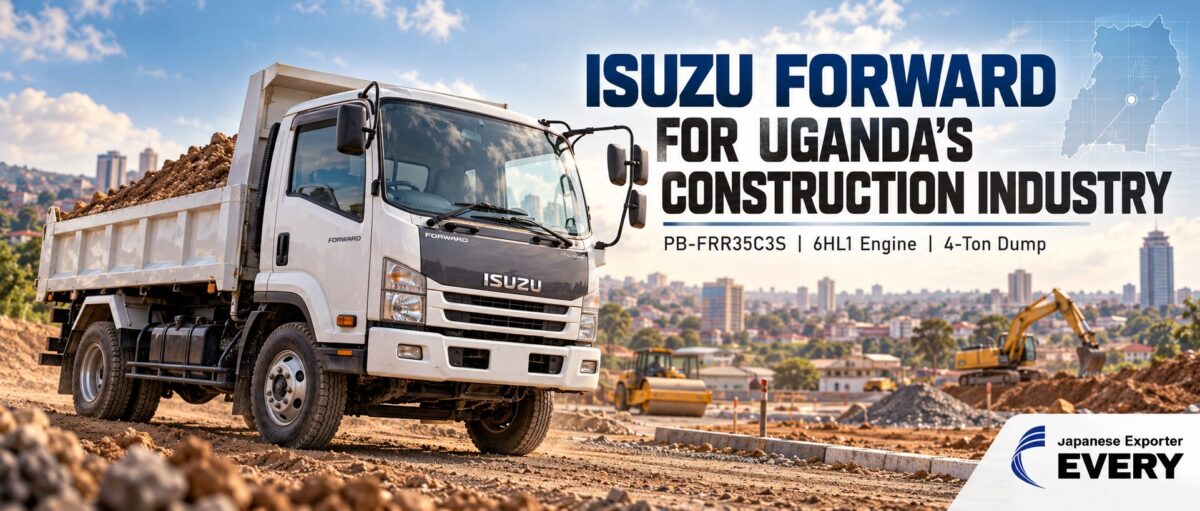

The Isuzu Forward PB-FRR35C3S featured in this EVERYCAR.jp export case is a 2004 Japanese medium-duty dump truck supplied for a business customer in Uganda. The transaction record identifies a 7,160cc-class diesel engine, model code PB-FRR35C3S, approximately 237,000 km at the time of sale and a clutchless manual / semi-automatic transmission. For construction businesses, this type of Forward can provide a useful balance between the smaller Isuzu Elf and the heavier Isuzu Giga.
However, buyers should not select a truck only because it is a Forward or because it has the 6HL1 engine family. The better purchase depends on registered payload, dump-body condition, PTO and hydraulics, chassis condition, tyres, brakes, transmission, local parts support and current Uganda import requirements. This updated guide explains those points through a practical Country × Vehicle × Use approach.
Isuzu Forward PB-FRR35C3S: Quick Facts
| Item | Vehicle / Buying Information |
|---|---|
| Manufacturer | Isuzu |
| Model | Forward |
| Model Code | PB-FRR35C3S |
| Registration | September 2004 in the documented EVERYCAR.jp delivery case |
| Engine Family | 6HL1 |
| Engine Capacity | 7,160cc-class in the vehicle transaction record |
| Engine Layout | Inline 6-cylinder diesel |
| Body Type | Dump truck |
| Mileage | Approximately 237,000 km in the documented transaction |
| Transmission | Clutchless-MT / Semi-AT in the documented transaction |
| Destination Market | Uganda |
| Shipping Destination in Transaction Record | Mombasa, Kenya |
Important: Payload, gross vehicle weight, axle specification, dump-body dimensions and other details can differ between PB-FRR35C3S trucks. Confirm the official Japanese vehicle documents for the actual unit before purchase.
What Is the Isuzu Forward?
The Isuzu Forward is a medium-duty commercial truck positioned between the light-duty Isuzu Elf and the heavy-duty Isuzu Giga.
Depending on year and chassis specification, Forward trucks can be found with bodies such as:
- Dump trucks
- Flatbeds
- Crane trucks
- Box bodies
- Refrigerated trucks
- Garbage trucks
- Tankers
- Special-purpose commercial bodies
That range makes the Forward useful for buyers who need more capacity than a light-duty truck but do not require the size or operating cost of a heavy-duty model.
View the current Isuzu Forward stock from Japan to compare available dump trucks, flatbeds, cranes and other specifications.
What Is the Isuzu 6HL1 Engine?
The 6HL1 belongs to Isuzu's inline six-cylinder commercial diesel engine family and has been used in older Forward applications.
Published technical references identify the engine at approximately 7.166 liters, while the EVERYCAR.jp transaction record for this PB-FRR35C3S lists the vehicle at approximately 7,160cc.
For overseas buyers, the engine code is useful when checking:
- Oil filters
- Fuel filters
- Air filters
- Cooling-system parts
- Fuel-system components
- Engine gaskets and seals
- Clutch and transmission-related parts
- Replacement-engine compatibility
Do not assume one horsepower or torque figure applies to every 6HL1. Engine output can vary by specification and production period.
Why the PB-FRR35C3S Model Code Matters
The name “Isuzu Forward” covers several generations and chassis families.
Model codes such as PB-FRR35C3S help buyers identify a much more specific vehicle than the model name alone.
Before buying a similar truck, confirm:
- Full chassis number
- First registration date
- Engine model
- Transmission
- Maximum loading capacity
- Vehicle weight
- Gross vehicle weight
- Wheelbase
- Overall dimensions
- Dump-body dimensions
- Brake specification
- Axle configuration
These details influence parts ordering, import classification, shipping cost and suitability for construction work.
Country × Vehicle × Use: Why the Forward Fits Uganda Construction Work
For Uganda, the Isuzu Forward can be useful when construction work requires more commercial capacity than a light truck but does not justify a full heavy-duty truck.
The PB-FRR35C3S dump configuration is particularly relevant for projects involving loose materials and repeated loading and unloading.
Building Construction
A medium-duty dump truck can support projects carrying materials such as:
- Sand
- Soil
- Gravel
- Aggregate within the truck's legal payload
- Construction debris where legally permitted
The dump body can reduce unloading time compared with a flatbed when the cargo is suitable for hydraulic tipping.
Road and Civil Engineering
A Forward dump can also support:
- Road maintenance
- Drainage work
- Site preparation
- Small civil-engineering projects
- Access-road development
For this type of work, the hydraulic system, body subframe, tyres and suspension deserve the same attention as the engine.
Urban Construction Around Kampala
For contractors operating around Kampala, truck size can directly affect productivity.
A Forward can provide more payload and body capacity than an Elf while remaining easier to operate in constrained areas than a larger Giga.
Before purchasing, compare:
- Project access width
- Turning space
- Dump-body size
- Legal payload
- Daily number of trips
Regional Construction Projects
For projects outside Kampala, buyers should also consider:
- Road quality
- Distance from workshop support
- Availability of commercial tyres
- Fuel availability
- Cooling-system condition
- Brake condition
For regional work, avoiding downtime can be more valuable than buying the lowest-priced truck.
Isuzu Elf vs Forward vs Giga for Construction
| Buying Point | Isuzu Elf | Isuzu Forward | Isuzu Giga |
|---|---|---|---|
| General Class | Light-duty | Medium-duty | Heavy-duty |
| Urban Maneuverability | Best | Balanced | Requires more space |
| Typical Project Scale | Small commercial work | Medium construction work | Heavy construction and bulk transport |
| Tyre and Maintenance Cost | Generally lower | Moderate | Generally higher |
| Best Use | Light loads and narrow sites | Versatile medium-duty work | Large-volume and heavy-duty operations |
The most economical choice is not automatically the largest truck. Match truck class to the normal cargo and work cycle.
Dump Truck or Flatbed Forward?
| Construction Use | Dump Truck | Flatbed |
|---|---|---|
| Sand and Soil | Very practical | Manual unloading required |
| Gravel / Aggregate | Well suited within legal payload | Less efficient to unload |
| Timber | Not ideal | Better suited |
| Pipes and Long Materials | Not ideal | Usually better |
| Bagged Materials | Possible | Often more flexible |
| Hydraulic Maintenance | Required | Usually unnecessary |
If most cargo is loose material, a dump truck can save unloading time. If the business carries timber, steel, pipes or equipment, a flatbed may be more versatile.
The Dump System Must Be Inspected Separately
A used dump truck has two major systems to evaluate: the truck itself and the hydraulic body.
PTO
Check that the power take-off engages correctly.
Watch for:
- Delayed engagement
- Abnormal noise
- Oil leakage
- Control problems
Hydraulic Pump
The hydraulic pump should raise the body smoothly without excessive noise or delay.
Check for:
- Slow lifting
- Jerky operation
- Hydraulic leakage
- Abnormal pump noise
Hydraulic Cylinder
Inspect:
- Oil leakage
- Cylinder rod damage
- Corrosion
- Uneven lifting
Dump Body
Check:
- Floor wear
- Side panels
- Tailgate
- Rear hinges
- Pivot points
- Hydraulic-cylinder mounts
- Subframe
- Previous structural welding
For a deeper explanation of these systems, see How PTO Systems Work in Trucks.
Do Not Assume Every PB-FRR35C3S Carries 4 Tons
The original article described the truck as a 4-ton dump, and the model is commonly found in that commercial category. However, a generic “4-ton” label should not replace the official maximum loading capacity of the individual vehicle.
The legal payload can change according to:
- Dump-body weight
- Hydraulic equipment
- Wheelbase
- Axle specification
- Registration configuration
Use the maximum loading capacity written on the Japanese vehicle documents when calculating project productivity.
What to Check on a Used 6HL1 Engine
Cold Start
Request a genuine cold-start video whenever possible.
Look for:
- Long cranking
- Unstable idle
- Abnormal knocking
- Persistent white smoke
- Persistent blue smoke
Oil Leakage
Inspect:
- Rocker-cover area
- Engine block
- Oil pan
- Front and rear engine areas
- Fuel-system area
Cooling System
A construction truck may spend long periods working under load and at lower road speeds.
Check:
- Radiator
- Coolant condition
- Hoses
- Fan operation
- Water-pump area
- Evidence of previous overheating
A cooling-system problem can quickly become expensive when a truck works heavily in warm conditions.
Exhaust Smoke
Observe the engine:
- At idle
- During acceleration
- Under load where practical
Persistent abnormal smoke deserves investigation before purchase.
Transmission: Why the Clutchless-MT Matters
The documented Uganda transaction identifies the truck's transmission as Clutchless-MT / Semi-AT.
This means buyers should not evaluate it exactly like a conventional manual gearbox.
Before purchase, check:
- Gear engagement
- Shift smoothness
- Warning indicators
- Cold-operation behavior
- Warm-operation behavior
- Local workshop familiarity with the system
If local mechanics mainly work with conventional manual transmissions, confirm technical support before choosing a clutchless transmission truck.
Brake System and Construction Safety
A loaded dump truck requires dependable brakes, especially on sloped roads and construction access routes.
Before buying, confirm the individual brake specification and inspect:
- Brake response
- Warning indicators
- Brake hoses and lines
- Air-system operation where applicable
- Parking brake
- Evidence of uneven braking
Brake condition should be part of the purchase budget, not an afterthought after arrival.
Chassis and Subframe Inspection
The chassis deserves close inspection on any used construction truck.
Check:
- Main frame rails
- Crossmembers
- Leaf-spring mounts
- Cab mounts
- Dump-body subframe
- Hydraulic-cylinder mounts
- Previous welding
- Cracks
- Heavy corrosion
- Accident-repair evidence
Dump trucks experience repeated stress during loading and tipping, so the body subframe and hinge areas are particularly important.
Tyres and Suspension
Commercial tyres and suspension repairs can materially change the real purchase cost.
Check:
- Tyre size
- Tread depth
- Sidewall condition
- Load rating
- Uneven wear
- Leaf springs
- Spring hangers
- Bushings
- Steering play
Also confirm that replacement commercial tyres in the correct size are available in Uganda.
6HL1 vs Older 6HE1 Forward
| Buying Point | 6HE1 Forward | 6HL1 Forward |
|---|---|---|
| General Generation | Older | Later than many 6HE1 applications |
| Engine Layout | Inline 6-cylinder | Inline 6-cylinder |
| Displacement Class | Approximately 7.1L | Approximately 7.2L |
| Main Used-Truck Focus | Mechanical condition, chassis and parts support | Mechanical condition, chassis and parts support |
An older 6HE1 truck can still be useful when it is in strong condition. A 6HL1 truck may provide a newer platform, but body condition and maintenance history still matter more than engine generation alone.
6HL1 vs Later 4HK1 Forward
| Buying Point | 6HL1 Generation | Later 4HK1 Generation |
|---|---|---|
| Engine Layout | Inline 6-cylinder | Inline 4-cylinder |
| General Vehicle Age | Older | Generally newer |
| Electronic Complexity | Earlier generation | More electronic control |
| Emissions Equipment | Earlier systems | More advanced depending on year |
| Main Buying Decision | Condition and local familiarity | Newer age and diagnostic capability |
A newer Forward can reduce vehicle-age concerns, while an older 6HL1 may remain attractive where mechanics and parts suppliers know the platform well.
Fuel Economy: Construction Work Needs Its Own Calculation
There is no meaningful single km/L figure for every Forward dump truck.
Fuel consumption changes with:
- Payload
- Road gradient
- Traffic
- Idling time
- PTO and hydraulic use
- Number of loading cycles
- Tyre pressure
- Engine condition
A truck working on a construction site can consume fuel while stationary because the engine also supports PTO and hydraulic operation.
For business planning, calculate fuel cost per completed work cycle rather than relying only on highway km/L.
Country × Vehicle × Use: When a Forward Is the Better Choice
A Forward dump can be a good fit when:
- A Canter is too small for normal project loads
- A Giga would add unnecessary size and operating cost
- The site can accommodate a medium-duty truck
- The business needs hydraulic unloading
- Isuzu parts and maintenance are available locally
A Forward may not be the right choice when:
- The normal cargo is very light
- Access roads are too narrow
- True heavy-duty capacity is required
- The destination cannot support the transmission or engine specification
Uganda Import and Shipping Planning
Uganda is landlocked, so a used truck shipped from Japan normally arrives through a regional seaport before inland transport.
Common route planning includes Mombasa in Kenya or Dar es Salaam in Tanzania.
A complete import budget can include:
- Vehicle purchase price
- Japan-side inland transport
- Export handling
- Pre-export inspection where required
- Ocean freight
- Port charges
- Customs clearance
- Applicable taxes and levies
- Inland transport to Uganda
- Registration
- Initial maintenance
For more detail, see How to Ship a Truck from Japan to Uganda via Kenya or Tanzania.
Confirm Current Uganda Import Requirements Before Purchase
Do not assume that a previous successful Uganda shipment automatically proves that another truck with the same age and specification can be imported today.
Before payment, confirm the latest requirements concerning:
- Vehicle-age eligibility
- Goods-vehicle classification
- Gross vehicle weight
- Pre-export inspection
- Roadworthiness certification
- Applicable taxes and levies
- Customs documentation
- Registration
Rules, inspection procedures and service providers can change. Use the latest official Uganda guidance for the individual vehicle.
Shipping Cost Depends on the Actual Truck
Two Forward dump trucks can have different freight costs even when they share the same model family.
Shipping quotations depend on:
- Overall length
- Overall width
- Overall height
- Running condition
- Shipping method
- Port of discharge
A longer or taller dump body can increase shipping cost.
Parts Availability: Check Before the Truck Leaves Japan
For a used construction truck, parts planning is part of the buying process.
Check local availability for:
- Oil filters
- Fuel filters
- Air filters
- Cooling-system parts
- Fuel-system components
- Brake parts
- Suspension parts
- Transmission-related parts
- Hydraulic hoses
- Hydraulic seals
Some dump-body and hydraulic parts may come from the body manufacturer rather than Isuzu.
An Actual Uganda Customer Delivery Case
A later EVERYCAR.jp customer-delivery record documents this same type of vehicle as an actual business transaction for Uganda.
The record identifies:
- September 2004 Isuzu Forward
- Model code PB-FRR35C3S
- Dump body
- 7,160cc diesel
- Approximately 237,000 km
- Clutchless-MT / Semi-AT
- Mombasa as the shipping destination shown in the transaction documents
No written customer review was provided for that transaction, so no claims should be added about the customer's satisfaction or the truck's condition after arrival.
See the Isuzu Forward Dump Truck Customer Delivery Case for Uganda.
How to Compare Two Used Forward Dump Trucks
| Check | Truck A | Truck B |
|---|---|---|
| Model Code | Confirm | Confirm |
| Engine Model | Confirm | Confirm |
| Registration Year | Compare | Compare |
| Official Payload | Compare | Compare |
| GVW | Compare | Compare |
| Dump Body Size | Compare | Compare |
| Transmission | Compare | Compare |
| PTO | Test | Test |
| Hydraulic Pump | Test | Test |
| Cylinder / Hoses | Inspect | Inspect |
| Engine Condition | Inspect | Inspect |
| Cooling System | Inspect | Inspect |
| Chassis / Subframe | Inspect | Inspect |
| Tyres / Brakes | Inspect | Inspect |
| Local Parts Support | Confirm | Confirm |
| Uganda Import Eligibility | Confirm | Confirm |
| Shipping + Inland Cost | Calculate | Calculate |
| Total Landed Cost | Calculate | Calculate |
This method gives a more useful commercial comparison than selecting the truck with the lowest FOB price or the largest engine.
FAQ: Isuzu Forward for Uganda Construction
What engine is used in the PB-FRR35C3S Forward?
The Uganda export case is associated with the Isuzu 6HL1 diesel engine family. The vehicle transaction records its engine capacity at approximately 7,160cc.
Is the Isuzu Forward a 4-ton dump truck?
PB-FRR35C3S Forward trucks are commonly found in the 4-ton dump category, but the official maximum loading capacity must be confirmed from the individual truck's Japanese documents.
Is the Isuzu Forward good for construction in Uganda?
It can be a practical choice for medium-duty construction work when the project needs hydraulic unloading, suitable payload and a truck smaller than a heavy-duty Giga. Chassis, hydraulics, tyres, brakes and local maintenance support should all be checked.
Should I choose an Isuzu Elf, Forward or Giga for construction?
Choose an Elf for lighter loads and tighter sites, a Forward for medium-duty projects and a Giga when genuine heavy-duty capacity is required. The best truck depends on the normal load and project environment.
What is the most important thing to check on a used Forward dump?
There is no single inspection point. Confirm the official payload, engine and cooling system, transmission, chassis, PTO, hydraulic pump, cylinder, dump-body subframe, tyres and brakes before calculating the total landed cost.
Choose the Forward by Country × Vehicle × Use
The Isuzu Forward PB-FRR35C3S can be a practical construction truck for Uganda when its medium-duty size, dump body and mechanical condition match the project's actual needs.
Before purchasing, answer three questions:
- Country: Does the exact truck meet current Uganda import and inspection requirements, and can local workshops support it?
- Vehicle: What are its official payload, engine, transmission, chassis and hydraulic condition?
- Use: Will it move sand, soil, aggregate or another material that benefits from a dump body?
Then compare the complete cost of putting the truck into productive service rather than the Japan purchase price alone.
EVERY TRADING has exported Japanese vehicles since 2006 and supports overseas buyers sourcing commercial vehicles according to destination, body type, payload and business use.
Looking for an Isuzu Forward? View the current used Isuzu Forward stock from Japan and compare dump trucks, flatbeds, cranes, refrigerated trucks and other available configurations.
If a Forward is not the correct size for your project, browse the wider Japanese used truck stock and compare light-, medium- and heavy-duty alternatives.
Related Guides
- Used Isuzu Forward Trucks for Sale
- Isuzu Forward Dump Truck Customer Delivery Case for Uganda
- Japanese Used Trucks, Buses and Tractors for Uganda
- How to Ship a Truck from Japan to Uganda
- How PTO Systems Work in Trucks
- Japanese Used Trucks for Sale


Browse Reliable Used Trucks & Buses from Japan
Carefully selected vehicles ready for export worldwide
Search 100,000+ Dealer Stock Vehicles from Japan
Access a wide selection of vehicles from Japanese dealers nationwide. Updated daily.
