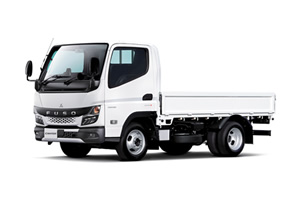
MITSUBISHI CANTER
The MITSUBISHI FUSO CANTER has a long history as a light-duty commercial truck, with the first model introduced in Japan in 1963. Over successive generations, the Canter has been offered in a wide range of configurations, which is especially useful for overseas buyers searching the Japanese used truck market. Learn more about the Mitsubishi Fuso Canter evolution over 20 years.
Body type is one of the most important points to compare. Japanese used Canter listings may include flatbeds for general cargo, dump trucks for construction work, freezer or refrigerated bodies for temperature-controlled transport, and other purpose-built configurations. Current and past EVERYCAR.jp listings also show that specifications vary considerably between individual vehicles.
Engine and chassis combinations differ depending on generation and specification. Examples found in the Japanese used market include older 4D-series engines such as the 4D33 and later 4M-series engines including the 4M40 and 4M50, such as this MITSUBISHI CANTER PA-FE73DH with 4M50 engine. Newer-generation Canter trucks can also use the 4P10 diesel engine series. Model codes vary accordingly, so buyers should always confirm the exact engine model, displacement, transmission, and chassis code shown for each vehicle.
Both 2WD and 4WD Canter configurations have been produced. For example, certain FG-series models are 4WD, such as this MITSUBISHI CANTER PA-FG72DB 4WD, making drivetrain an important consideration for buyers operating on unpaved roads, construction sites, farms, or other demanding routes.
When choosing a Used MITSUBISHI CANTER from Japan, compare the body dimensions, payload rating, drivetrain, transmission, mileage, engine specification, and intended application rather than selecting by model name alone. These details can differ substantially between trucks of different years and configurations.
EVERYCAR.jp lists used Canter trucks available for export from Japan. Review the individual vehicle pages above to compare specifications and identify a truck that matches your cargo, operating environment, and business requirements.