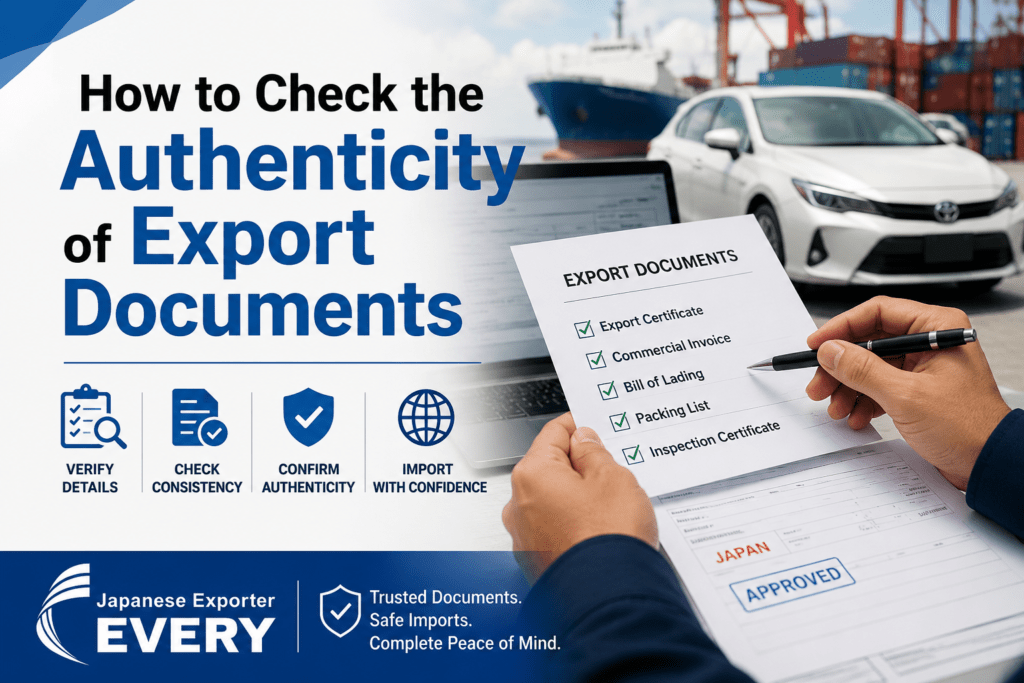

How to Check the Authenticity of Export Documents: A Complete Guide for Safe Vehicle Imports from Japan
Buying a used vehicle from Japan offers excellent value. Japanese vehicles are known for their quality, reliability, and long service life. However, every international buyer should pay close attention to one important area—export documents.
Authentic export documents protect your investment. They also help customs clearance proceed smoothly and reduce the risk of fraud.
Unfortunately, fake or altered documents sometimes appear in international trade. Therefore, every buyer should know how to verify important paperwork before making a payment or accepting delivery.
At EVERY, we believe transparency builds trust. We provide genuine export documents and guide our customers through every step of the export process.
In this article, you will learn how to check the authenticity of export documents and protect your vehicle import from unnecessary risks.
Why Export Documents Matter
Export documents prove that a vehicle has been legally prepared for international shipment.
They help confirm:
- Vehicle ownership
- Vehicle identity
- Export approval
- Shipping information
- Customs requirements
- Buyer information
Without accurate documents, customs clearance may become delayed or even rejected.
Therefore, checking every document carefully is an important part of importing a vehicle from Japan.
Common Export Documents for Japanese Vehicles
Before checking authenticity, it helps to understand the most common documents.
These usually include:
- Export Certificate
- Commercial Invoice
- Bill of Lading (B/L)
- Packing List (when applicable)
- Inspection Certificate (if required)
- Insurance documents (when applicable)
- Shipping schedule information
Each document serves a different purpose during the export process.
Step 1: Verify the Export Certificate
The Export Certificate is one of the most important documents.
It confirms that the vehicle has been officially registered for export from Japan.
Check the following information carefully:
- Chassis number
- Vehicle model
- Registration history
- Engine information
- First registration date
- Vehicle classification
Every detail should match the vehicle you purchased.
If any information looks different, contact your exporter immediately.
Step 2: Compare the Chassis Number
The chassis number is the vehicle's unique identification number.
This number should appear consistently on:
- Export Certificate
- Commercial Invoice
- Bill of Lading
- Inspection reports
- Purchase agreement
Even one incorrect character may cause customs problems.
Therefore, compare every document carefully before shipment.
Step 3: Review the Commercial Invoice
The Commercial Invoice contains important financial information.
Confirm that it includes:
- Buyer name
- Seller information
- Vehicle description
- Vehicle quantity
- Purchase price
- Shipping terms
- Invoice date
The invoice should match your purchase agreement.
Any unexpected changes deserve immediate clarification.
Step 4: Check the Bill of Lading
The Bill of Lading (B/L) is issued by the shipping company.
This document confirms that the vehicle has been loaded for international transport.
Review:
- Consignee name
- Shipper name
- Vessel name
- Voyage number
- Port of loading
- Port of destination
- Vehicle description
- Container number or RoRo information
All information should match your booking details.
Step 5: Confirm Shipping Information
Reliable exporters provide clear shipping updates.
Check that the following information is consistent:
- Vessel name
- Departure date
- Estimated arrival date
- Shipping route
- Port information
You can also compare this information with the shipping schedule provided by the shipping company.
This extra step improves confidence before delivery.
Step 6: Examine Document Quality
Authentic documents usually have a professional appearance.
Look for:
- Clear printing
- Correct spelling
- Consistent formatting
- Complete company information
- Official document numbers
Poor formatting or missing information may indicate a problem.
However, minor design differences do not always mean a document is fake.
Therefore, ask your exporter whenever you have questions.
Step 7: Verify the Exporter's Company Information
A trustworthy exporter should provide complete business details.
Check for:
- Company name
- Business address
- Telephone number
- Email address
- Company website
Professional exporters are transparent about their business information.
EVERY proudly provides clear communication throughout the export process.
Step 8: Compare All Vehicle Details
Every document should describe the same vehicle.
Compare:
- Manufacturer
- Model
- Model code
- Production year
- Color
- Mileage
- Chassis number
Consistency across all documents greatly reduces the chance of errors.
Step 9: Review Inspection Reports
Many buyers also receive inspection reports.
These reports often include:
- Vehicle condition
- Exterior damage
- Interior condition
- Mechanical observations
- Auction grade
- Additional comments
Inspection reports should support the information shown in the export documents.
Together, they provide a complete picture of the vehicle.
Step 10: Confirm Payment Information
Payment instructions should remain consistent throughout the transaction.
Always confirm:
- Bank account name
- Bank name
- Account number
- SWIFT code
If payment details suddenly change, contact your exporter through previously verified communication channels.
Never rely only on a single email.
Warning Signs of Fraud
Although most Japanese exporters operate honestly, buyers should remain cautious.
Warning signs include:
- Unusually low prices
- Pressure to pay immediately
- Missing company information
- Inconsistent documents
- Different bank account names
- Poor communication
- Refusal to answer questions
If something feels unusual, investigate before sending payment.
Careful verification protects your investment.
Why Working with a Trusted Exporter Matters
Document verification becomes much easier when you work with a reliable exporter.
Professional exporters provide:
- Genuine export documents
- Clear communication
- Fast responses
- Accurate paperwork
- Professional inspections
- Secure payment procedures
Therefore, choosing the right exporter reduces both risk and stress.
How EVERY Supports Safe International Buyers
At EVERY, we understand that overseas buyers depend on accurate documentation.
Our team carefully prepares every export document before shipment.
We also help customers understand:
- Export Certificate details
- Shipping documents
- Commercial invoices
- Vehicle information
- Customs paperwork
Furthermore, we answer questions quickly whenever buyers need assistance.
Our goal is complete transparency from purchase to delivery.
Benefits of Authentic Export Documents
Accurate documentation provides many advantages.
Buyers enjoy:
- Faster customs clearance
- Lower risk of delays
- Better legal protection
- Easier vehicle registration
- Greater purchasing confidence
- Secure international transactions
As a result, the entire import process becomes smoother.
Frequently Asked Questions
Which export document is the most important?
The Export Certificate and the Bill of Lading are among the most important documents because they confirm the vehicle's identity and shipment.
How can I verify the chassis number?
Compare the chassis number on every export document with the vehicle information provided by your exporter and inspection reports.
Can incorrect documents delay customs clearance?
Yes. Even small errors may delay customs procedures or require additional verification.
Should I check every document before making payment?
Yes. Reviewing all available documents helps reduce risk and improves confidence before completing your purchase.
How does EVERY help verify export documents?
EVERY prepares accurate documentation, explains every document clearly, and provides professional support throughout the export process.
Import with Confidence Through EVERY
Authentic export documents are the foundation of a safe international vehicle purchase.
They confirm ownership, protect your investment, and help your vehicle reach its destination without unnecessary delays.
By carefully reviewing every document and working with a trusted Japanese exporter, you can avoid many common import problems.
At EVERY, we believe trust begins with honesty. That is why we provide accurate export documents, transparent communication, and professional support for every customer around the world.
If you are planning to import a Japanese used vehicle, EVERY is ready to help you complete the process safely, smoothly, and with complete confidence.


Browse Reliable Used Trucks & Buses from Japan
Carefully selected vehicles ready for export worldwide
Search 100,000+ Dealer Stock Vehicles from Japan
Access a wide selection of vehicles from Japanese dealers nationwide. Updated daily.
