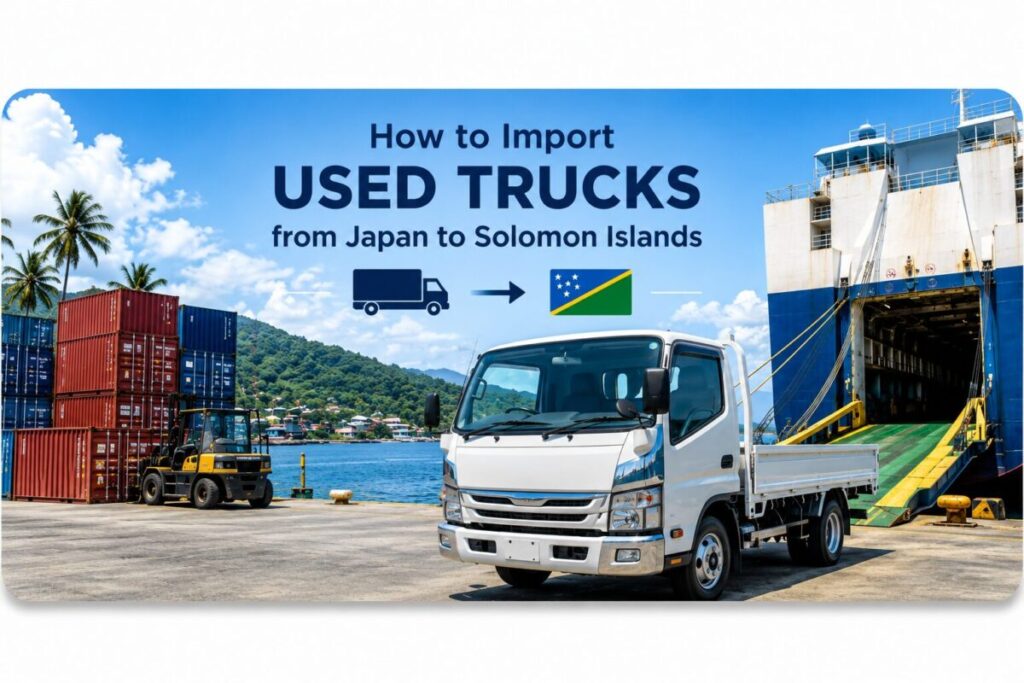

How to Import Used Trucks from Japan to Solomon Islands
Importing a used truck from Japan can help Solomon Islands businesses reduce costs and improve daily transport.
Japanese used trucks offer strong engines, practical body designs, and reliable performance. Therefore, they suit many local industries.
Businesses use trucks for construction, agriculture, retail delivery, timber transport, fishing support, tourism, and public services.
However, importing a truck involves more than choosing a low price online.
You must select the right vehicle, calculate the total cost, prepare documents, arrange shipping, and complete customs clearance.
Moreover, the truck must suit the real road and operating conditions in Solomon Islands.
This guide explains the complete process in simple steps. It also covers truck selection, shipping, customs, maintenance, and common mistakes.
Why Solomon Islands Businesses Import Used Trucks from Japan
Solomon Islands has a small domestic vehicle market. As a result, local buyers often depend on imported vehicles.
New commercial trucks can cost too much for many small and medium businesses.
In contrast, Japanese used trucks provide a practical balance between price, condition, durability, and availability.
Japan also has a wide selection of light-duty, medium-duty, and heavy-duty trucks.
Therefore, buyers can choose a truck that matches their cargo, roads, budget, and business type.
Japanese trucks also use right-hand drive layouts. This is suitable because vehicles drive on the left side in Solomon Islands.
In addition, many Japanese trucks have diesel engines. Diesel power suits commercial use, heavy loads, and long working hours.
Understanding the Solomon Islands Truck Market
Solomon Islands consists of many islands spread across a wide area.
Therefore, transport conditions differ greatly between Honiara, provincial towns, rural communities, ports, plantations, and logging areas.
Road transport plays a major role on larger islands. However, shipping and small boats remain essential between islands.
Most imported trucks arrive through the main international port in Honiara.
After customs clearance, trucks may remain on Guadalcanal or move to another island by domestic vessel.
This extra movement can increase the final cost. Therefore, buyers should plan the full route before purchasing.
Commercial Vehicle Demand in Honiara
Honiara has the country’s largest concentration of businesses, government offices, shops, warehouses, and construction activity.
Light-duty trucks support delivery work across the city.
Meanwhile, medium-duty trucks serve construction suppliers, wholesalers, hardware stores, food distributors, and building contractors.
Traffic congestion can occur around central Honiara, markets, port areas, and busy commercial roads.
Therefore, very large trucks may not suit every delivery route.
A compact truck often gives better turning ability, easier parking, and lower fuel use.
Truck Demand Outside Honiara
Outside the capital, roads can become narrower, rougher, steeper, or less developed.
Heavy rain can also create mud, potholes, drainage problems, and damaged road surfaces.
As a result, ground clearance, strong suspension, durable tires, and simple mechanical systems become important.
Provincial businesses may also face limited access to spare parts and repair equipment.
Therefore, popular models with common components often provide better long-term value.
Industries That Need Used Trucks in Solomon Islands
Construction and Infrastructure
Construction remains one of the main sources of truck demand.
Contractors need vehicles to carry sand, gravel, cement, timber, steel, tools, and workers.
Tipper trucks can move loose materials. Flatbed trucks can carry long or heavy cargo.
Meanwhile, crane trucks help load equipment where forklifts are not available.
For urban building projects, a compact truck may provide enough capacity.
However, larger road and infrastructure projects may require medium-duty trucks.
Agriculture and Rural Production
Agricultural businesses need trucks to move crops, fertilizer, tools, water tanks, and farm supplies.
Common products include coconuts, copra, cocoa, vegetables, root crops, and fresh fruit.
Farm roads may become difficult during the rainy season.
Therefore, farmers should avoid choosing a truck only by payload.
They should also consider tire size, ground clearance, chassis strength, and road access.
A small flatbed truck can serve village farms well.
However, larger agricultural operators may need a medium-duty cargo truck.
Fishing and Seafood Distribution
The fishing sector also creates demand for commercial vehicles.
Businesses need trucks to move ice, fishing gear, fuel containers, packaging, and seafood.
Refrigerated trucks can protect fresh and frozen products during transport.
However, refrigeration equipment needs careful inspection before shipment.
Buyers must confirm the cooling unit, insulation, compressor, and power system.
They should also check whether local technicians can maintain that equipment.
Logging and Timber Transport
Forestry has played a major role in the Solomon Islands economy.
Logging operations often use rough private roads and remote loading areas.
Therefore, timber transport requires careful vehicle selection.
A light-duty delivery truck cannot replace a purpose-built heavy truck.
Buyers should calculate legal payload, axle capacity, frame strength, tire condition, and braking performance.
Moreover, rough logging roads can place heavy stress on suspension and drivetrain parts.
Retail, Wholesale, and General Delivery
Shops and wholesalers need practical trucks for daily distribution.
They may carry beverages, food, furniture, appliances, building materials, and general goods.
A box truck protects cargo from sun, rain, and road dust.
On the other hand, a flatbed offers more flexibility for large items.
Therefore, the best body type depends on the cargo.
Tourism and Hotel Supply
Tourism operators, resorts, and hotels also require commercial vehicles.
They need trucks for food deliveries, linen, water, fuel, maintenance tools, and guest supplies.
Smaller trucks often work better on narrow island roads.
In addition, a clean body and quiet engine can create a better image near tourism facilities.
Best Japanese Used Trucks for Solomon Islands
No single truck suits every buyer.
Therefore, choose the size and body according to the real job.
Light-Duty Trucks
Light-duty trucks offer good fuel economy and easy operation.
They suit Honiara deliveries, small construction work, agriculture, retail, and hotel supply.
Popular options include the Mitsubishi Canter, Toyota Dyna, Isuzu Elf, and Hino Dutro.
These trucks come with many body types.
- Flatbed trucks
- Dump trucks
- Box trucks
- Refrigerated trucks
- Crane trucks
- Garbage trucks
- Water tanker trucks
Before buying, confirm the exact payload and body dimensions.
A longer body can carry more cargo. However, it may become harder to turn on narrow roads.
Medium-Duty Trucks
Medium-duty trucks suit larger loads and more demanding business use.
Construction suppliers, contractors, fuel companies, and wholesalers often need this class.
Common choices include the Hino Ranger and Isuzu Forward.
These models can support flatbeds, dump bodies, cranes, tankers, and cargo boxes.
However, buyers should check whether local roads can support the vehicle’s total weight.
They should also confirm access to loading areas, bridges, workshops, and fuel stations.
Heavy-Duty Trucks
Heavy-duty trucks can support major construction, mining, fuel transport, and large-scale logistics.
However, they need more fuel, wider roads, stronger bridges, and skilled maintenance.
Therefore, buyers should not choose a heavy truck only because it looks powerful.
A medium-duty truck may produce better profit when loads remain moderate.
Step 1: Decide What Truck You Need
First, define the truck’s main job.
Do not begin with a brand name alone.
Instead, answer the following questions.
- What cargo will the truck carry?
- What is the average cargo weight?
- What is the maximum cargo weight?
- Will the truck operate in Honiara or rural areas?
- Will it use sealed roads, gravel roads, or logging roads?
- Does the business need a flatbed, dump, box, crane, or refrigerator?
- How many kilometres will the truck travel each week?
- Can local workshops repair the selected model?
- What is the total budget, including shipping and customs?
These answers will narrow the selection.
For example, a shop may need a compact box truck.
Meanwhile, a construction business may need a dump truck with stronger suspension.
Step 2: Set a Realistic Total Budget
The vehicle price is only one part of the import cost.
Therefore, calculate the complete landed cost before making payment.
The total may include:
- Vehicle purchase price
- Exporter service charges
- Transport within Japan
- Export documentation
- Inspection or repair costs
- Ocean freight
- Marine insurance
- Customs duty
- Domestic taxes
- Port charges
- Shipping agent fees
- Customs broker fees
- Storage charges
- Registration and licensing
- Domestic transport after clearance
In international trade, CIF usually means cost, insurance, and freight.
Customs may use the CIF value when assessing import charges.
However, tax rates and valuation methods can change.
Therefore, confirm the current tariff with Solomon Islands Customs or a licensed local broker.
Step 3: Find a Reliable Japanese Truck Exporter
A reliable exporter should provide clear information before requesting payment.
The company should explain the truck price, condition, freight, documents, and shipping process.
Ask for detailed photos of the vehicle.
In addition, request photos of the following areas:
- Front and rear body
- Both sides of the truck
- Cab interior
- Dashboard and odometer
- Engine room
- Chassis and frame
- Tires
- Cargo body
- Hydraulic equipment
- Rust or repaired areas
For a dump truck, request a video of the dump operation.
For a crane truck, ask for operation photos and capacity details.
For a refrigerated truck, request evidence that the cooling system works.
Moreover, confirm the exporter’s company name and bank account.
Never send money to an unrelated personal account.
Step 4: Check the Truck’s Condition
A low purchase price does not always create a low total cost.
A damaged truck may require expensive repairs after arrival.
Therefore, inspect the mechanical and structural condition carefully.
Engine Condition
Check for excessive smoke, oil leaks, unusual sounds, and weak starting.
Also, confirm the engine model and fuel type.
A common diesel engine may offer easier maintenance and parts sourcing.
Transmission and Clutch
Manual transmissions remain common in Japanese commercial trucks.
They often provide simple operation and strong control on hills.
However, the driver must have the correct skills.
Check clutch condition, gear engagement, and transmission noise.
Chassis and Rust
The chassis supports the entire vehicle and cargo.
Therefore, serious corrosion can create a safety risk.
Check the frame, crossmembers, spring mounts, and body mounting points.
Surface rust may be manageable. In contrast, deep structural rust needs careful review.
Tires and Suspension
Rough roads can quickly damage weak tires and worn suspension parts.
Check tire tread, sidewall cracks, spring condition, shock absorbers, and wheel alignment.
Also, confirm whether replacement tire sizes are available locally.
Brakes and Steering
Strong brakes are essential on wet roads and steep sections.
Check brake operation, warning lights, air pressure systems, and steering play.
Medium and heavy trucks may use air brakes.
Therefore, local technicians should understand the system.
Step 5: Receive and Confirm the Proforma Invoice
After selecting the truck, the exporter should issue a proforma invoice.
Check every detail before payment.
- Exporter’s legal company name
- Bank account name
- Vehicle make and model
- Chassis number
- Model code
- Year of manufacture or registration
- Engine number, when available
- FOB or CIF price
- Destination port
- Payment terms
- Included services
Also, confirm whether the quotation includes marine insurance.
Do not assume insurance comes with every shipping quote.
Step 6: Make a Safe Payment
Bank transfer remains a common payment method for vehicle exports.
Before sending funds, compare the invoice with the exporter’s official company information.
In addition, ask your bank to verify the beneficiary details.
Keep the bank receipt and transaction record.
These documents may help with accounting and customs procedures.
Be careful when someone suddenly requests a new bank account by email.
Fraudsters sometimes copy business emails and change payment instructions.
Therefore, verify any account change through a trusted communication channel.
Step 7: Prepare the Truck for Export
After payment, the exporter moves the truck toward the port and prepares export documents.
The preparation process may include cleaning, inspection, repairs, and removal of loose personal items.
Biosecurity checks can become important for used vehicles.
Mud, seeds, plant material, insects, and soil can cause delays.
Therefore, the truck should arrive in clean condition.
Farm and construction vehicles need special attention underneath the chassis and around tires.
Step 8: Choose the Best Shipping Method
RoRo Shipping
RoRo means roll-on, roll-off shipping.
The truck drives onto the vessel in Japan and drives off at the destination port.
This method often suits complete and operational trucks.
RoRo shipping may provide simple handling and competitive freight.
However, sailing schedules and space can vary.
Large trucks may also face higher freight because shipping lines calculate volume.
Container Shipping
Container shipping can offer more protection during sea transport.
However, many trucks do not fit inside a standard container.
Small trucks may fit after careful measurement or partial disassembly.
Still, loading and unloading can add labour and handling costs.
Therefore, ask the exporter to confirm container dimensions before booking.
Breakbulk Shipping
Very large vehicles or special trucks may use breakbulk shipping.
This method can handle oversized cargo.
However, costs and schedules may differ from standard RoRo services.
Step 9: Confirm the Destination Port
Honiara is the main entry point for international vehicle shipments.
However, the final buyer may operate on another island.
Therefore, confirm the next transport stage before the truck leaves Japan.
Ask the following questions:
- Can a domestic vessel carry the truck?
- What is the domestic freight cost?
- Does the destination wharf have unloading equipment?
- Can the truck drive safely from the wharf?
- Are there bridge or road weight limits?
- Will the buyer need temporary storage in Honiara?
These issues can strongly affect the final landed cost.
Step 10: Receive the Shipping Documents
The exporter should send shipping and export documents after departure.
Required documents can vary, but common documents include:
- Commercial invoice
- Bill of Lading
- Japanese export certificate
- English translation of the export certificate
- Freight information
- Insurance certificate, when purchased
- Vehicle inspection documents, when required
- Packing or equipment details, when applicable
Check the consignee name carefully.
It should match the importer’s correct legal or personal details.
A spelling error can delay cargo release.
Also, send document copies to the customs broker before the vessel arrives.
Step 11: Complete Customs Clearance in Solomon Islands
The Solomon Islands Trade Portal lists several stages for importing vehicles by sea.
These stages involve the shipping agent, Customs and Excise Division, port authority, and biosecurity authorities.
The general process includes document submission, customs assessment, payment, release approval, port procedures, and vehicle collection.
First, the importer or broker submits the required import documents.
Next, Customs reviews the declared value and vehicle details.
Then, the importer pays the assessed duties, taxes, and fees.
After payment, the shipping agent can issue the required release order.
The importer must also complete port and biosecurity procedures.
Finally, the truck can leave the port after all approvals.
Solomon Islands uses several import duty bands for imported goods.
However, the exact rate depends on tariff classification and current government rules.
Therefore, do not rely on an old online tax estimate.
Ask Customs or a licensed broker for a written calculation before shipment.
How to Reduce Customs and Port Delays
Port delays can increase storage costs.
Therefore, preparation should begin before the vessel arrives.
- Send all documents to the broker early.
- Confirm the vessel’s estimated arrival date.
- Check the consignee name and address.
- Prepare enough funds for duties and port charges.
- Confirm the tariff code with the broker.
- Respond quickly to customs questions.
- Arrange collection transport in advance.
- Keep the truck clean for biosecurity review.
Moreover, maintain regular contact with the shipping agent.
Vessel schedules can change because of weather, port congestion, or operational reasons.
Step 12: Register and License the Truck
Customs release does not automatically mean the truck can operate on public roads.
The owner may need to complete local registration, roadworthiness, licensing, and insurance procedures.
Requirements can depend on vehicle type and use.
For example, a commercial cargo truck may face different rules from a private pickup.
Therefore, contact the relevant Solomon Islands transport authority before collection.
Prepare the customs release documents, export certificate, invoice, and identification records.
Choosing the Right Truck Size for Local Roads
The Solomon Islands road network contains many unsealed sections.
Official and development reports also note the country’s limited paved road coverage.
Therefore, road condition should influence truck size and specifications.
Small Trucks for Urban and Village Delivery
Small trucks suit short routes, lighter cargo, narrow streets, and local shop deliveries.
They also use less fuel than larger trucks.
However, overloading can quickly damage the chassis, springs, tires, and brakes.
Medium Trucks for Construction and Distribution
Medium trucks offer more payload and stronger frames.
They suit contractors, large farms, wholesalers, and building material suppliers.
However, buyers should confirm road width and bridge capacity.
Four-Wheel-Drive Vehicles
Four-wheel drive can help on mud, steep roads, plantation tracks, and remote routes.
Still, four-wheel drive does not remove all risk.
Tires, driver skill, ground clearance, and vehicle weight remain important.
Moreover, four-wheel-drive systems can cost more to maintain.
Recommended Truck Body Types
Flatbed Truck
A flatbed offers flexible loading and easy side access.
It suits timber, pipes, machinery, agricultural products, and building supplies.
However, rain can damage uncovered cargo.
Dump Truck
A dump truck suits sand, gravel, soil, and construction waste.
Check the hydraulic cylinder, power take-off system, body floor, and tipping operation.
Box Truck
A box truck protects goods from tropical rain and strong sunlight.
It suits retail products, furniture, food, and general cargo.
Check the roof, door seals, floor, and signs of water leakage.
Refrigerated Truck
A refrigerated truck supports seafood, meat, frozen food, and fresh produce.
However, it needs reliable power, correct refrigerant, and specialist maintenance.
Crane Truck
A crane truck can load blocks, machinery, generators, and construction materials.
Confirm the crane capacity, boom length, safety system, and inspection status.
Water Tanker
A water tanker can support construction sites, communities, hotels, and farms.
Check tank corrosion, pump operation, hoses, and mounting points.
Fuel Economy and Operating Costs
Fuel can become a major business expense in Solomon Islands.
Therefore, choose the engine size carefully.
A larger engine provides more power. However, it may consume more fuel.
Likewise, an empty heavy truck wastes money when the business carries small loads.
Calculate expected weekly distance and average load.
Then, compare that figure with the truck’s engine size and gross vehicle weight.
Regular maintenance also improves fuel economy.
Dirty filters, low tire pressure, weak injectors, and overloaded bodies can increase consumption.
Spare Parts and Maintenance Planning
A truck produces income only when it can work.
Therefore, spare parts availability matters as much as the purchase price.
Before buying, ask local workshops which Japanese models they repair most often.
Also, check access to filters, brake parts, clutch parts, belts, bearings, and suspension components.
Buyers in remote provinces may consider ordering basic service parts with the truck.
- Engine oil filters
- Fuel filters
- Air filters
- Fan belts
- Brake parts
- Wheel bearings
- Common seals and gaskets
- Fuses and bulbs
However, confirm the exact part numbers before ordering.
Preparing a Truck for Tropical Conditions
Solomon Islands has high temperatures, heavy rainfall, humidity, and coastal air.
These conditions can affect electrical parts, cooling systems, paint, and metal surfaces.
Therefore, inspect the radiator, coolant hoses, battery, alternator, and air conditioning.
Apply rust protection where practical.
Also, repair water leaks around the cab and cargo body.
Coastal businesses should wash salt and mud from the chassis regularly.
Common Import Mistakes to Avoid
Choosing the Cheapest Truck
A cheap truck may have rust, engine problems, weak tires, or body damage.
Therefore, compare condition and total cost, not price alone.
Ignoring the Final Delivery Island
Some buyers calculate only the cost to Honiara.
However, domestic shipping can add a large expense.
Buying the Wrong Body Type
A cargo box cannot perform the same job as a dump body.
Define the truck’s daily task before purchase.
Overlooking Truck Dimensions
A truck may be too long, high, or wide for the intended route.
Therefore, confirm dimensions before shipping.
Failing to Check Payload
Overloading reduces safety and increases maintenance costs.
Always confirm legal and practical payload limits.
Using Old Tax Information
Import tariffs and tax systems can change.
Therefore, get a current calculation from Customs or a local broker.
Waiting Until Arrival to Find a Broker
Late preparation can create storage fees and document problems.
Choose a broker before the vessel arrives.
Example Import Cost Planning
Every shipment has different costs.
However, buyers can use a simple planning method.
- Start with the truck purchase price.
- Add inland transport and export charges in Japan.
- Add ocean freight and insurance.
- Calculate the estimated CIF value.
- Ask a broker to estimate customs duty and taxes.
- Add port, agent, broker, and registration fees.
- Add domestic shipping outside Honiara.
- Keep an emergency repair budget.
Do not spend the full budget on the vehicle price.
Instead, keep enough money for clearance, transport, registration, and initial maintenance.
Questions to Ask Before Buying
- Is the truck currently running?
- Does the engine start from cold?
- Are there warning lights?
- Is there serious chassis rust?
- What is the exact payload?
- What are the body dimensions?
- What is the engine model?
- Is the transmission manual or automatic?
- Does the hydraulic equipment work?
- Are all tires usable?
- Is the truck suitable for RoRo shipping?
- What documents will the exporter provide?
- Does the price include freight?
- Does the price include insurance?
- What is the estimated sailing schedule?
How EVERY TRADING Supports Solomon Islands Buyers
EVERY TRADING Co Ltd has exported Japanese used vehicles and machinery to international customers since 2006.
We support buyers who need trucks for construction, agriculture, delivery, tourism, and other commercial work.
Our team can help buyers search for suitable vehicles from Japanese stock and dealer networks.
We can also explain the vehicle condition, quotation, shipping options, and export documents.
However, buyers should always confirm local import rules with Solomon Islands authorities.
Clear communication remains essential throughout the process.
Therefore, provide the following information when requesting a truck:
- Your destination country
- Your destination port
- Your final island or town
- Your preferred truck type
- Your required payload
- Your preferred body type
- Your road conditions
- Your budget
This information helps us recommend a more practical truck.
Frequently Asked Questions
Can I import a right-hand-drive truck to Solomon Islands?
Right-hand-drive vehicles suit the local left-side driving system.
However, confirm the current legal requirements before purchase.
What is the main port for used trucks?
Honiara is the main international entry point for vehicle imports.
Buyers on other islands may need additional domestic shipping.
What documents do I need?
Common documents include the commercial invoice, Bill of Lading, and Japanese export certificate.
Customs or biosecurity authorities may request additional documents.
How much import duty will I pay?
The amount depends on the current tariff classification, customs value, and government tax rules.
Therefore, request a current estimate from Solomon Islands Customs or a licensed broker.
Is RoRo or container shipping better?
RoRo often suits complete running trucks.
Container shipping may suit smaller vehicles or shipments needing extra protection.
The best choice depends on size, schedule, freight, and destination.
Which truck size is best?
A light-duty truck suits local delivery and smaller loads.
A medium-duty truck suits construction, wholesale, and larger cargo.
Choose based on road access and real payload.
Should I buy a four-wheel-drive truck?
Four-wheel drive can help on rough, steep, or muddy roads.
However, it may increase purchase and maintenance costs.
Can I ship a truck to an island outside Guadalcanal?
International shipment may first arrive in Honiara.
Then, the buyer may arrange domestic sea transport.
Confirm vessel availability and unloading conditions before buying.
Final Checklist for Solomon Islands Importers
- Define the truck’s main job.
- Confirm cargo weight and body type.
- Check local road conditions.
- Choose a common and serviceable model.
- Review detailed photos and condition reports.
- Calculate the total landed cost.
- Verify the exporter and bank account.
- Confirm shipping method and destination port.
- Prepare documents before arrival.
- Use a local customs broker.
- Confirm current duty and tax rates.
- Plan domestic transport from Honiara.
- Prepare funds for registration and maintenance.
Conclusion
Importing a used truck from Japan can create strong value for Solomon Islands businesses.
However, successful importing requires careful planning.
The right truck must match the cargo, road, island, budget, and available maintenance support.
In addition, buyers must calculate shipping, customs, port fees, and domestic transport.
A reliable Japanese used truck can support business growth for many years.
Therefore, focus on condition, suitability, and total operating cost.
With the right preparation, Solomon Islands buyers can import practical trucks for construction, agriculture, fishing, retail, tourism, and logistics.


Browse Reliable Used Trucks & Buses from Japan
Carefully selected vehicles ready for export worldwide
Search 100,000+ Dealer Stock Vehicles from Japan
Access a wide selection of vehicles from Japanese dealers nationwide. Updated daily.
