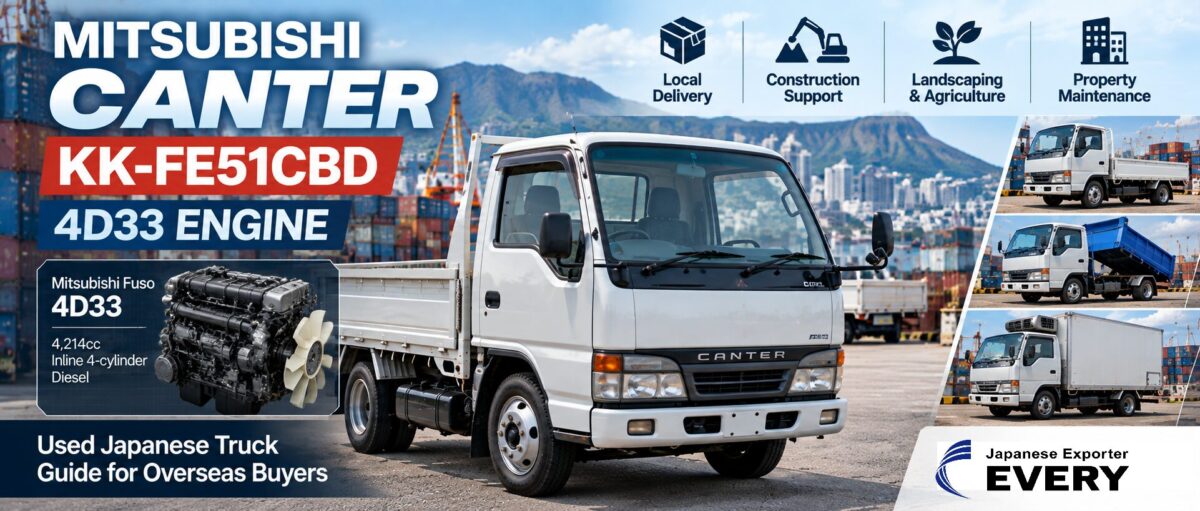

The Mitsubishi Canter KK-FE51CBD is an older Japanese light-duty commercial truck equipped with Mitsubishi Fuso's 4D33 diesel engine. For buyers looking for a straightforward work truck, its value comes from the combination of a compact cab-over layout, a 4.2-liter-class diesel engine and the wide range of commercial bodies available on Canter chassis.
For Hawaii and other overseas markets, however, the engine name alone should not decide the purchase. Buyers should compare the exact model code, payload, body type, transmission, chassis condition, engine condition, tyre specification, local parts support and total landed cost. This guide explains the KK-FE51CBD and 4D33 combination, suitable business uses, buying checks and how it compares with other Canter generations.
Mitsubishi Canter KK-FE51CBD Quick Facts
| Item | Buying Information |
|---|---|
| Manufacturer | Mitsubishi Fuso |
| Model | Canter |
| Model Code | KK-FE51CBD |
| Engine Model | 4D33 |
| Engine Displacement | Approximately 4,214cc |
| Engine Layout | Inline 4-cylinder diesel |
| Fuel | Diesel |
| Vehicle Class | Light-duty commercial truck |
| Common Canter Applications | Flatbed, dump, van, refrigerated body and other commercial configurations |
Specifications such as payload, transmission, wheelbase and body dimensions can vary by individual vehicle. Confirm the Japanese Export Certificate, chassis plate and current stock information before purchase.
What Is the Mitsubishi Fuso 4D33 Engine?
The 4D33 belongs to Mitsubishi Fuso's long-running 4D3 diesel-engine family. The same engine family includes 4D30, 4D31, 4D32, 4D33, 4D34, 4D35 and 4D36 versions used across several generations of Japanese commercial vehicles.
The 4D33 has approximately 4,214cc of displacement and appears in many older Mitsubishi Fuso Canter chassis codes, including FE51-series models.
For overseas buyers, its main practical characteristic is that it belongs to an older diesel generation compared with later electronically controlled Canter engines.
This can be useful in markets where workshops already have experience with older commercial diesel systems. However, an older engine should never be judged by reputation alone.
What to Check on a Used 4D33
- Cold-start performance
- Exhaust smoke
- Engine oil leakage
- Coolant leakage
- Abnormal mechanical noise
- Cooling-system condition
- Injection-system condition
- Engine identification and serial information
For a broader technical overview, see the Mitsubishi Fuso 4D3 Series engine guide.
Why the Model Code KK-FE51CBD Matters
“Mitsubishi Canter” covers many generations, chassis sizes, engines and commercial specifications.
The model code helps narrow the vehicle to the correct chassis family. For parts sourcing and import checks, the complete chassis number is even more useful.
Before buying a KK-FE51CBD, verify:
- Full chassis number
- Engine model
- First registration date
- Transmission
- Maximum payload
- Vehicle weight
- Gross vehicle weight
- Wheelbase
- Overall dimensions
- Commercial body type
The 4D33 was used across numerous Canter model codes, so engine code alone is not enough when ordering drivetrain or chassis parts.
Country × Vehicle × Use: Is the KK-FE51CBD Suitable for Hawaii?
For Hawaii, a compact Canter can be relevant to businesses that need a commercial truck for local delivery, construction support, landscaping, property maintenance or agricultural transport without moving into a much larger truck class.
The cab-over layout gives the Canter a relatively compact overall footprint compared with many conventional-cab commercial trucks.
Urban and Local Delivery
For Honolulu and other developed areas, a Canter can support:
- Food and beverage distribution
- Retail deliveries
- Building-supply transport
- Maintenance businesses
- Small logistics operations
For city use, the important specifications are not only engine size. Check overall truck length, body width, turning requirements and parking space.
Construction and Contractor Support
A flatbed or suitable commercial body can transport:
- Tools
- Building supplies
- Pipes
- Timber
- Site equipment
If the truck has a dump, crane or other working body, the PTO and hydraulic equipment should be inspected separately from the engine and chassis.
Landscaping and Property Maintenance
A compact commercial truck can also serve:
- Landscaping companies
- Resort and hotel maintenance
- Groundskeeping operations
- Agricultural properties
Body type should match the actual work. A flatbed may suit equipment and plants, while a dump body may be more useful for soil or landscape material.
The Canter Is Also Relevant Beyond Hawaii
The same basic characteristics can make older 4D33 Canters useful in other markets, provided local regulations and parts support allow them.
East Africa
In markets such as Tanzania, Zambia and Mozambique, Canters are often considered for:
- General cargo
- Agricultural products
- Construction materials
- Local distribution
Caribbean Markets
For island economies, compact commercial trucks can be useful for:
- Retail supply
- Hotel maintenance
- Construction support
- Food distribution
Local import age, inspection, emissions and registration requirements must be checked before purchase.
Choose the Body Type Before Choosing the Truck
The same Canter chassis can perform very different work depending on its body.
| Body Type | Typical Use | Extra Buying Checks |
|---|---|---|
| Flatbed | General cargo, construction, agriculture | Deck floor, sideboards, subframe, rust |
| Dump | Soil, aggregate and construction work | PTO, hydraulic pump, cylinder, hinges |
| Box Van | Retail and protected cargo | Doors, roof leakage, floor, body condition |
| Freezer / Refrigerated | Food and temperature-controlled cargo | Cooling unit, insulation, compressor, body seals |
| Crane Truck | Construction and equipment handling | PTO, hydraulics, boom, winch, outriggers |
EVERYCAR.jp currently lists Mitsubishi Canter trucks in several body configurations. View the current Mitsubishi Canter stock to compare available body types, years, engines and model codes.
KK-FE51CBD 4D33 vs Other Canter Engines
The 4D33 is only one of many engines used in the Canter.
| Engine | Approx. Displacement | General Buyer Consideration |
|---|---|---|
| 4D32 | 3.56L class | Older Canter generation; compare condition and chassis specification |
| 4D33 | 4.21L class | Older commercial diesel used across many Canter chassis |
| 4D35 | 4.56L class | Larger-displacement member of the 4D3 family |
| 4M50 | 4.9L class | Later generation; exact electronic specification matters |
| 4P10 | 3.0L class | Modern Canter generation with newer engine technology |
The Japanese Truck Engine Model Codes List provides a broader reference for Canter and other Japanese truck engines.
Older 4D33 Canter or Newer Canter: Which Should You Choose?
An Older 4D33 Canter May Suit You When:
- Your local workshop understands older diesel systems.
- 4D33 parts are available locally.
- You want a simpler commercial truck platform.
- The chassis and body remain structurally sound.
- The lower purchase cost leaves room for preventive maintenance.
A Newer Canter May Be Better When:
- Your business cannot tolerate much downtime.
- You want a newer cab and chassis.
- Your workshop can support electronic diesel systems.
- Your destination has stricter age or emissions requirements.
- You need a specific later body or payload configuration.
Do not compare only the purchase price. Calculate likely repairs, tyres, freight and local maintenance as well.
Mitsubishi Canter vs Isuzu Elf
The Isuzu Elf is one of the main alternatives buyers compare with the Canter.
| Buying Point | Mitsubishi Canter | Isuzu Elf |
|---|---|---|
| Vehicle Class | Light-duty commercial truck | Light-duty commercial truck |
| Body Choice | Wide range depending on chassis | Wide range depending on chassis |
| Older Diesel Options | 4D3-series and other engines | 4HF1, 4HG1 and other engines |
| Main Buying Decision | Condition, payload, body and local support | Condition, payload, body and local support |
Neither truck should be chosen by brand name alone. See Isuzu Elf vs Mitsubishi Fuso Canter for a wider comparison.
Buying Checklist for a KK-FE51CBD
1. Engine Condition
Request a cold-start video where possible.
Check for:
- Difficult starting
- Persistent blue smoke
- Persistent white smoke
- Excessive black smoke
- Oil leakage
- Coolant leakage
- Abnormal engine noise
2. Cooling System
Older commercial diesel trucks deserve a careful cooling-system check.
Inspect:
- Radiator
- Coolant hoses
- Water-pump area
- Coolant condition
- Signs of previous overheating
3. Transmission and Clutch
If the vehicle uses a manual transmission, test:
- Clutch engagement
- Clutch slip
- All forward gears
- Reverse
- Gearbox noise
- Oil leakage
The transmission fitted to the actual truck should be confirmed rather than assumed from the model name.
4. Chassis and Frame
Because 4D33 Canters are older trucks, inspect the chassis carefully.
Look at:
- Main frame rails
- Crossmembers
- Suspension mounts
- Body mounts
- Previous welding
- Heavy corrosion
For Hawaii and other coastal markets, existing corrosion deserves particular attention because future exposure to salt air can accelerate deterioration.
5. Brakes and Steering
Check brake operation, steering play, front suspension and visible component wear.
A truck intended to carry commercial loads should not be purchased based on engine condition alone.
6. Tyres
Check:
- Tread depth
- Sidewall cracking
- Uneven wear
- Correct tyre size
- Local replacement availability
A complete commercial-truck tyre replacement can significantly change the initial operating budget.
If It Has a Working Body, Test the Working Body
A dump, crane, freezer or other special-purpose Canter needs two inspections:
- The truck chassis and drivetrain
- The commercial equipment mounted on the truck
For a dump truck, test the PTO, hydraulic pump and cylinder.
For a crane, test the boom, rotation, winch and outriggers.
For a refrigerated truck, confirm that the refrigeration unit operates and that replacement parts are available where the truck will work.
Parts Availability: Use the Full Vehicle Information
Before importing an older Canter, confirm access to regular maintenance parts in the destination market.
Useful parts to investigate include:
- Oil filters
- Fuel filters
- Air filters
- Fan belts
- Cooling-system parts
- Clutch components
- Injection-system components
- Brake parts
- Engine gaskets and seals
When ordering major components, use the full chassis number and engine model rather than asking only for “Canter 4D33 parts.”
Should You Buy a Replacement 4D33 Engine Instead?
If you already own a Canter with a damaged 4D33, compare the cost of repairing your current engine with buying a replacement used engine.
Before installing another 4D33, confirm:
- Exact engine code
- Donor vehicle model code
- Injection-system specification
- Engine mounts
- Flywheel and clutch compatibility
- Included accessories
Even engines with the same basic 4D33 designation can come from different chassis specifications.
Import and Registration Checks for Hawaii and Other Markets
A Japanese truck being physically suitable for the work does not automatically mean it can be legally registered in every destination.
Before buying, confirm the current rules regarding:
- Vehicle age
- Safety compliance
- Emissions requirements
- Right-hand-drive registration
- Commercial vehicle licensing
- Vehicle weight
- Inspection requirements
This is especially important for older Japanese domestic-market trucks.
Import, registration, tax and inspection requirements can change. Confirm the latest rules with the relevant authorities before purchase and shipment.
Shipping a Canter from Japan
Freight depends on the exact truck rather than the Canter name.
Confirm:
- Overall length
- Overall width
- Overall height
- Body type
- Running condition
- Destination port
A long-body van or crane can cost more to ship than a short flatbed even when both share the same engine.
For the overall buying and shipping process, see How Vehicle Export Works from Japan.
How to Compare Two Used Canters
| Check | Truck A | Truck B |
|---|---|---|
| Model Code | Confirm | Confirm |
| Engine Model | Confirm | Confirm |
| Payload | Compare | Compare |
| Body Type | Compare | Compare |
| Mileage | Check | Check |
| Engine Condition | Inspect | Inspect |
| Chassis Rust | Inspect | Inspect |
| Transmission / Clutch | Test | Test |
| Tyres | Inspect | Inspect |
| Body Equipment | Test | Test |
| Parts Availability | Confirm | Confirm |
| Freight | Calculate | Calculate |
| Total Landed Cost | Calculate | Calculate |
This method gives a better business decision than choosing the truck with the lowest FOB price.
Who Should Consider a KK-FE51CBD 4D33 Canter?
This generation can be relevant for buyers who:
- Need a compact commercial cargo truck
- Already have local support for older Mitsubishi Fuso engines
- Prefer a relatively straightforward diesel platform
- Need a flatbed or another practical commercial body
- Have verified the condition of the chassis and drivetrain
- Have confirmed current import and registration eligibility
A newer Canter may make more sense if the business depends heavily on daily uptime or if older trucks face regulatory restrictions at the destination.
FAQ: Mitsubishi Canter KK-FE51CBD and 4D33
What engine does the Mitsubishi Canter KK-FE51CBD use?
The KK-FE51CBD is associated with Mitsubishi Fuso's 4D33 diesel engine, which has approximately 4,214cc of displacement.
Is the Mitsubishi 4D33 a 3.3-liter engine?
No. Despite the “33” in the engine designation, the 4D33 has approximately 4.2 liters of displacement. Engine names should not be interpreted as displacement figures.
Is the 4D33 turbocharged?
4D33 specifications can vary by application. Buyers should confirm the exact engine fitted to the individual vehicle rather than assuming turbo or non-turbo specification from the engine family alone.
Is an older 4D33 Canter suitable for Hawaii?
It can suit local delivery, construction support, landscaping, agriculture and property-maintenance work when the body and payload match the job. The truck's condition and current import, emissions and registration eligibility must also be confirmed.
Should I choose a 4D33 Canter or a newer Canter?
Choose according to condition, body type, payload, maintenance support and total landed cost. An older 4D33 can offer a simpler diesel platform, while a newer Canter provides a newer chassis and later engine technology.
Choose the Canter for the Work, Not Just the Engine Name
The Mitsubishi Canter KK-FE51CBD with the 4D33 engine can still be a useful commercial truck when its condition and body configuration match the buyer's real business requirements.
For Hawaii or another overseas destination, compare:
- Payload
- Body type
- Engine condition
- Transmission condition
- Chassis corrosion
- Tyres
- Local parts support
- Import eligibility
- Shipping cost
EVERY TRADING has exported Japanese vehicles since 2006 and can help buyers source Canter trucks from Japan according to body type, payload, model, budget and destination.
Looking for a Mitsubishi Canter? View the current Mitsubishi Canter stock from Japan and compare available years, engines, model codes and commercial body types.
If the exact KK-FE51CBD is not available, compare Japanese used trucks for sale or ask for a similar Canter that matches your required payload and work.
Related Guides
- Used Mitsubishi Canter Trucks for Sale
- Mitsubishi Fuso 4D3 Series Engine Guide
- Japanese Truck Engine Model Codes List
- Isuzu Elf vs Mitsubishi Fuso Canter
- How Vehicle Export Works from Japan


Browse Reliable Used Trucks & Buses from Japan
Carefully selected vehicles ready for export worldwide
Search 100,000+ Dealer Stock Vehicles from Japan
Access a wide selection of vehicles from Japanese dealers nationwide. Updated daily.
