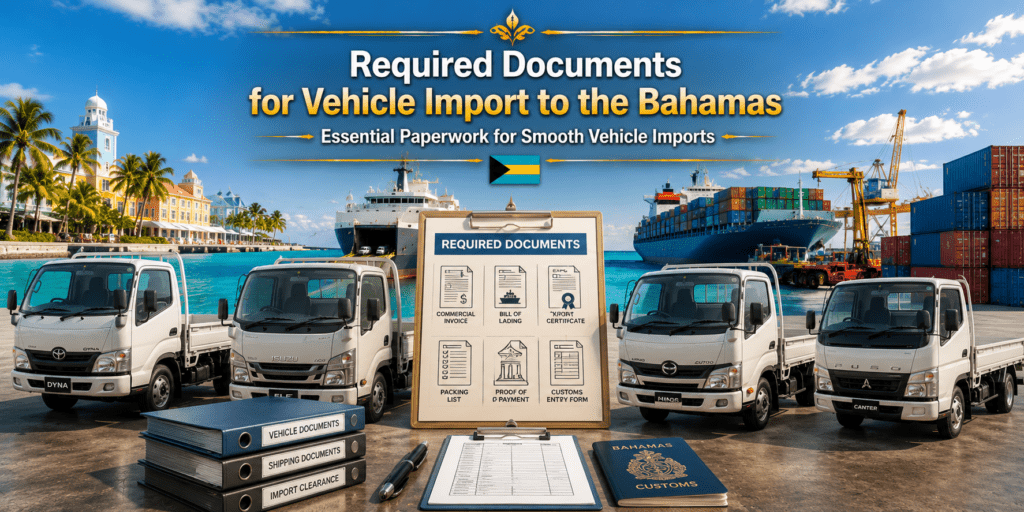

Required Documents for Vehicle Import to the Bahamas: Complete Guide for Buyers
Importing a used vehicle from Japan to the Bahamas can be an excellent investment. Japanese vehicles are well known for their reliability, fuel efficiency, durability, and value for money. As a result, many Bahamian businesses and private buyers choose Japanese trucks, vans, SUVs, buses, and passenger cars every year.
However, importing a vehicle successfully requires more than simply purchasing the vehicle. Proper documentation is equally important. Missing paperwork can lead to customs delays, additional expenses, storage charges, and unnecessary stress.
Therefore, understanding the required import documents before shipping your vehicle is essential.
At EVERY Japan, we have exported Japanese vehicles to more than 100 countries since 2006. In this guide, we explain the key documents required for vehicle imports to the Bahamas and show how proper preparation can make the process smooth and efficient.
🇧🇸 Why Documentation Matters in the Bahamas
The Bahamas relies heavily on imported vehicles.
Commercial trucks support:
- Construction projects
- Tourism operations
- Retail distribution
- Marine services
- Infrastructure development
Meanwhile, passenger vehicles serve individuals, families, and businesses throughout Nassau, Freeport, and the Family Islands.
Because imported vehicles play such an important role, customs authorities require documentation to verify ownership, value, and vehicle details.
Consequently, accurate paperwork helps ensure successful importation.
🚢 The Vehicle Import Process
Before reviewing individual documents, it helps to understand the basic import process.
Step 1
Select and purchase a vehicle in Japan.
Step 2
Prepare export documents.
Step 3
Arrange shipping.
Step 4
Receive shipping documents.
Step 5
Complete customs clearance in the Bahamas.
Step 6
Register and operate the vehicle.
At every stage, documentation plays a critical role.
📄 Commercial Invoice
The Commercial Invoice is one of the most important import documents.
This document includes:
- Buyer information
- Seller information
- Vehicle details
- Purchase price
- Invoice number
- Transaction date
Customs officials use the invoice to determine vehicle value.
Therefore, accuracy is essential.
Furthermore, the invoice helps establish proof of ownership.
🚛 Export Certificate
Japan issues an Export Certificate when a vehicle is exported.
This document provides important information such as:
- Chassis number
- Engine number
- Registration history
- Vehicle specifications
- Previous registration details
The Export Certificate verifies the vehicle's identity.
Consequently, customs authorities frequently review this document during clearance procedures.
For most imports from Japan, this document is indispensable.
⚓ Bill of Lading (B/L)
The Bill of Lading serves as the official shipping document.
Shipping companies issue it after the vehicle has been loaded onto the vessel.
The Bill of Lading typically includes:
- Consignee information
- Shipping route
- Vessel details
- Vehicle information
- Port of loading
- Port of discharge
In addition, this document proves that the vehicle has been shipped.
Without it, collecting the vehicle at the destination port may become difficult.
📋 Packing List
Some shipments include a Packing List.
This document provides:
- Cargo description
- Number of units
- Shipping details
- Additional items included in the shipment
Although not always required for every shipment, it often helps customs officers review imported cargo more efficiently.
🔍 Vehicle Inspection Documents
Many buyers request inspection reports before purchasing a vehicle.
These reports may include:
- Exterior condition
- Interior condition
- Mileage verification
- Mechanical assessment
- Auction information
Inspection reports help buyers understand vehicle condition before shipment.
Consequently, they reduce purchasing risk.
🚗 Vehicle Purchase Agreement
The purchase agreement records the terms of sale between buyer and seller.
The document may include:
- Vehicle description
- Agreed purchase price
- Payment terms
- Delivery arrangements
This agreement provides additional evidence supporting ownership and transaction details.
💳 Proof of Payment
Customs authorities may request evidence that payment has been completed.
Acceptable proof may include:
- Bank transfer records
- Payment confirmations
- Financial transaction receipts
Maintaining organized payment records can simplify customs procedures significantly.
Therefore, buyers should keep copies of all payment documents.
🏛 Customs Entry Documents
Upon arrival in the Bahamas, customs entry documentation must be completed.
These forms generally provide:
- Importer information
- Vehicle details
- Value declarations
- Tax calculations
Accurate declarations help avoid unnecessary delays.
Furthermore, proper completion improves processing efficiency.
💰 Why Vehicle Value Documentation Is Important
Import duties and taxes often depend on vehicle value.
Consequently, customs authorities carefully review:
- Commercial invoices
- Purchase records
- Payment documentation
Providing clear and accurate information helps establish the correct customs value.
This reduces the risk of disputes and delays.
🚛 Documents Required for Commercial Trucks
Commercial vehicle imports often require additional attention because businesses use them for revenue-generating activities.
Popular imported truck models include:
These trucks support construction, logistics, tourism, and retail operations throughout the Bahamas.
Therefore, accurate commercial vehicle documentation becomes particularly important.
🌴 Vehicle Imports Support the Bahamian Economy
The Bahamas depends heavily on transportation.
Hotels require delivery vehicles.
Construction companies need trucks.
Retailers rely on distribution fleets.
Marine businesses require support vehicles.
As a result, imported Japanese vehicles contribute significantly to economic activity across the islands.
Efficient documentation helps these vehicles enter service quickly.
⚠ Common Documentation Mistakes
Many import delays result from avoidable errors.
Common mistakes include:
Incorrect Chassis Numbers
Even minor errors can create problems.
Missing Signatures
Unsigned documents may require correction.
Incomplete Buyer Information
Accurate importer details are essential.
Payment Record Issues
Missing payment evidence can delay processing.
Lost Original Documents
Original paperwork should be stored carefully.
Avoiding these mistakes saves time and money.
🚢 Why Work with an Experienced Exporter?
Experienced exporters understand international documentation requirements.
They can help buyers by:
- Preparing paperwork correctly
- Reviewing documentation before shipment
- Providing export guidance
- Coordinating shipping procedures
Consequently, buyers reduce risk and improve efficiency.
🤝 Why Bahamas Buyers Trust EVERY Japan
Since 2006, EVERY Japan has exported quality vehicles to customers around the world.
We assist buyers with:
- Vehicle sourcing
- Export documentation
- Inspection reports
- Shipping arrangements
- Customs preparation support
As a result, our customers enjoy a smoother importing experience.
🌎 Prepare the Right Documents and Import with Confidence
Importing a vehicle from Japan to the Bahamas can be straightforward when the correct paperwork is prepared from the beginning.
Documents such as the Commercial Invoice, Export Certificate, Bill of Lading, payment records, and customs paperwork all play essential roles in the import process.
By understanding these requirements and working with an experienced exporter, buyers can avoid delays, reduce costs, and complete customs clearance successfully.
Whether you are importing a truck for business, a van for tourism operations, or a passenger vehicle for personal use, proper documentation is the key to a successful import.
Contact EVERY Japan today and let our experienced team help you import your next Japanese vehicle to the Bahamas with confidence.


Browse Reliable Used Trucks & Buses from Japan
Carefully selected vehicles ready for export worldwide
Search 100,000+ Dealer Stock Vehicles from Japan
Access a wide selection of vehicles from Japanese dealers nationwide. Updated daily.
