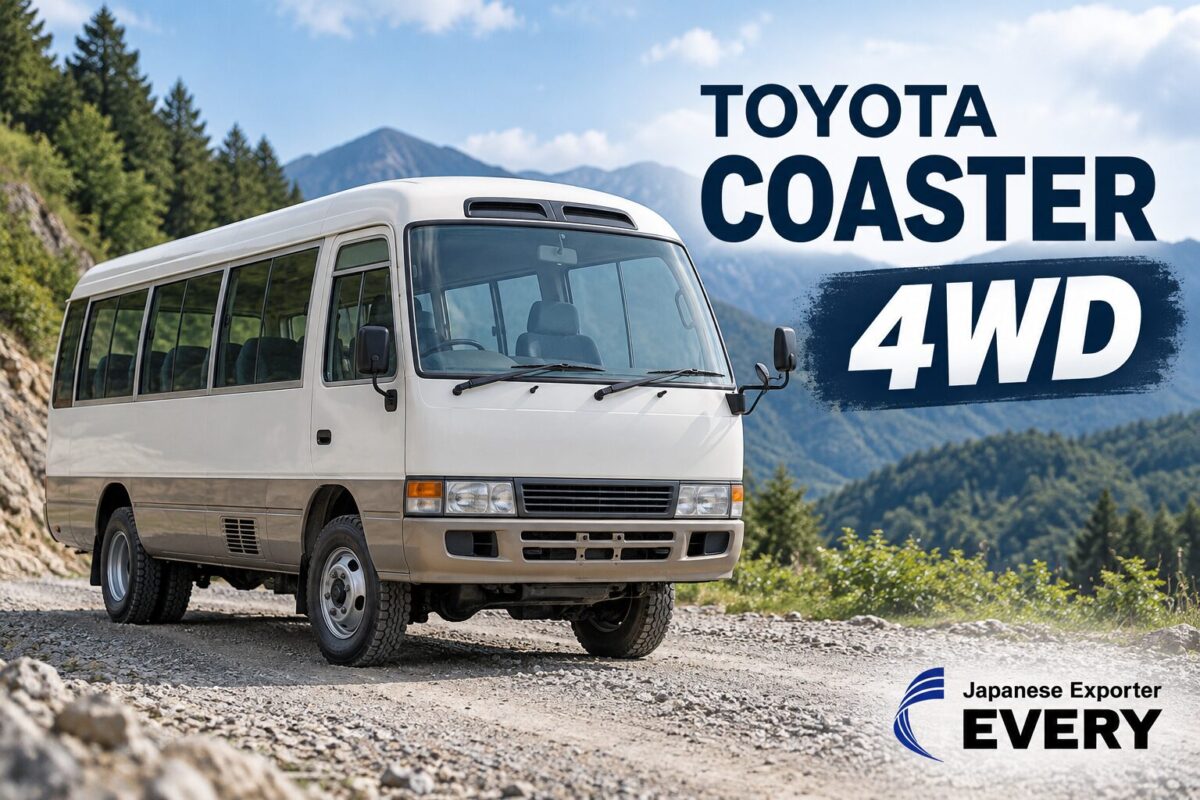

A used Toyota Coaster 4WD can be a strong choice for operators who need passenger transport on gravel roads, steep routes, snow or other low-traction surfaces. However, buyers should not treat “Coaster 4WD” as one universal specification. Four-wheel-drive versions are mainly found among older Coaster generations, and model code, engine, body configuration, seating capacity and transmission can differ between individual vehicles.
For overseas buyers, identifying the exact model is the first step. Codes such as HZB56V and XZB56V can help distinguish 4WD-related Coaster specifications from the many 2WD Coasters in the Japanese market. This guide explains the models to look for, the 1HZ diesel found in HZB56V examples, where 4WD is genuinely useful, what it cannot do, and what to inspect before buying one from Japan.
Toyota Coaster 4WD Quick Facts
| Item | Buyer Information |
|---|---|
| Vehicle Type | Japanese minibus / passenger bus |
| 4WD Availability | Mainly found among older used Coaster generations |
| Important Model Codes | HZB56V and XZB56V are examples buyers may encounter when searching for 4WD-related Coaster specifications |
| Confirmed Engine Example | 1HZ diesel in U-HZB56V |
| 1HZ Displacement | 4,164cc |
| Best Use | Passenger transport where additional traction is required |
| Key Buying Priority | Confirm actual drivetrain, model code, engine, seating capacity and condition for the individual bus |
Buyer takeaway: If you specifically need four-wheel drive, do not buy a Coaster based on the vehicle name or appearance alone. Confirm the complete model code and actual drivetrain before purchase.
View Available Toyota Coaster Stock from Japan
Which Toyota Coaster Models Have 4WD?
This is one of the most important questions for an overseas buyer.
Most Toyota Coasters available in Japan are not 4WD. Four-wheel-drive versions are associated with specific older model codes, so the drivetrain needs to be identified at chassis level.
Model codes that buyers may encounter when researching older 4WD Coasters include:
- HZB56V
- XZB56V
These codes should be treated as starting points for identification rather than a substitute for checking the actual vehicle.
EVERYCAR.jp has previously handled a U-HZB56V fitted with Toyota's 1HZ diesel engine, while the current Coaster stock search also recognizes HZB56V and XZB56V among Coaster model-code options.
Why Model Code Matters
The Toyota Coaster name covers many generations and configurations.
Used Coasters in Japan include model codes such as:
- HZB40
- HZB50
- HZB56V
- XZB40
- XZB50
- XZB51
- XZB56V
- XZB70
- later GDB-series models
They should not be treated as mechanically identical.
Before buying, request:
- Complete model code
- Chassis number
- Drive type
- Engine model
- Transmission
- Registration year and month
- Seating capacity
- Overall dimensions
HZB56V and the Toyota 1HZ Diesel Engine
One of the better-known older Coaster 4WD-related specifications is HZB56V.
A U-HZB56V previously documented by EVERYCAR.jp uses Toyota's 1HZ diesel engine with a displacement of 4,164cc.
| Item | U-HZB56V Example |
|---|---|
| Model | Toyota Coaster |
| Model Code | U-HZB56V |
| Engine Model | 1HZ |
| Displacement | 4,164cc |
| Fuel | Diesel |
The 1HZ is also found in other Toyota vehicles and other Coaster specifications, so engine code alone does not identify a 4WD Coaster. Both the model code and drivetrain must be checked.
Why Overseas Buyers Search for the 1HZ
Many overseas buyers specifically search for older Toyota diesel engines because local workshops already know how to service them and replacement parts may be available in their market.
That local support is more important than general statements about an engine being “reliable.”
Before purchasing a 1HZ Coaster, ask your local workshop or parts supplier whether they can source:
- Oil and fuel filters
- Air filters
- Belts
- Cooling-system components
- Fuel-system parts
- Engine gaskets and seals
- Clutch components where applicable
Use the chassis number and engine model when confirming parts compatibility.
Older 4WD Coaster vs Later 2WD Coaster
A buyer who wants a Coaster should first decide whether four-wheel drive is genuinely necessary.
| Buying Factor | Older Coaster 4WD | Later Coaster 2WD |
|---|---|---|
| Traction | Additional driven axle can help on loose or slippery surfaces | Suitable for normal paved-road passenger operation |
| Availability in Japan | More specialized and harder to find | Much broader used-market selection |
| Vehicle Age | Often older | Newer model years are available |
| Engine | Older engines such as 1HZ may be encountered | Later generations include N04C and newer diesel specifications |
| Maintenance | 4WD drivetrain components add inspection points | Simpler drivetrain, but newer vehicles can have more electronic and emissions-control systems |
| Best For | Routes where extra traction is actually required | Paved-road transport, hotels, schools, tours and general passenger service |
If your bus will spend almost all of its working life on paved roads, paying more for a rare older 4WD model may not be necessary.
If your regular route includes gravel, snow, mud, steep unsealed access roads or other low-traction conditions, a properly maintained 4WD Coaster may justify the additional search and maintenance requirements.
What 4WD Actually Helps With
Four-wheel drive primarily improves traction. That distinction matters when selecting a passenger bus.
A 4WD Coaster can provide an advantage when driving on:
- Loose gravel
- Snow-covered roads
- Muddy access roads
- Steep surfaces with limited traction
- Unpaved rural routes
- Work sites with maintained but rough access roads
However, 4WD does not automatically turn a Coaster into an extreme off-road vehicle.
A Coaster 4WD Is Still a Minibus
Ground clearance, approach and departure angles, tyres, vehicle weight and long body dimensions still limit where the vehicle can safely travel.
A 4WD Coaster should therefore be selected for rough-road passenger transport, not because the buyer expects it to perform like a dedicated off-road truck or SUV.
Claims that every Coaster 4WD can safely cross deep rivers, severe rock terrain or other extreme obstacles should be avoided. Route conditions and the individual vehicle specification need to be evaluated separately.
What Is Different in a 4WD Drivetrain?
A four-wheel-drive bus has additional drivetrain components that a comparable 2WD vehicle does not require.
Depending on the exact specification, inspection may need to include:
- Front differential
- Front drive components
- Propeller shafts
- Transfer-related components
- Universal joints
- Oil seals
- Drivetrain mounts
This additional hardware is one reason why buying a 4WD Coaster purely because “4WD is better” is not always the right decision.
Buy it when the route requires the extra traction.
How Many Passengers Can a Toyota Coaster 4WD Carry?
Do not assume that every 4WD Coaster has the same seating capacity.
Coaster seating varies significantly according to body, registration category, market specification and interior configuration. The Japanese used market contains Coasters configured as regular passenger buses, kindergarten buses, campers and other special-purpose vehicles.
Before purchase, verify:
- Registered seating capacity
- Actual installed seats
- Seat condition
- Seat belts where fitted or required
- Emergency exits
- Local passenger-vehicle registration requirements
Do not use a generic “26–29 passengers” figure to calculate whether an individual used bus meets your business requirements.
What About Newer Toyota Coaster Engines?
Later Coaster generations should be separated from the older 1HZ-powered 4WD discussion.
Toyota's official specifications for the later Coaster include the 4.009-liter N04C direct-injection turbo-diesel engine. Depending on specification, official Toyota documents list versions including N04C-VJ, N04C-VK, N04C-WA and N04C-WB.
For example, Toyota's 2017 specifications list:
| Engine | Displacement | Output | Torque |
|---|---|---|---|
| N04C-VJ | 4.009L | 110kW (150PS) at 2,500rpm | 420Nm at 1,400rpm |
| N04C-VK | 4.009L | 132kW (180PS) at 2,800rpm | 461Nm at 1,600rpm |
These figures describe the corresponding later Toyota specifications. They should not be applied to an HZB56V or other older 4WD Coaster.
1HZ 4WD Coaster vs N04C 2WD Coaster
| Buyer Question | Older 1HZ 4WD Coaster | Later N04C 2WD Coaster |
|---|---|---|
| Do I need extra traction? | Better candidate where 4WD is required | Best considered where 2WD is sufficient |
| Do I want a newer bus? | Usually older used vehicles | Later model years available |
| Does my workshop know older Toyota diesels? | Important when choosing 1HZ | Check N04C and electronic diesel support |
| Are emissions-system diagnostics available? | Older specification may be simpler depending on vehicle | More relevant on later diesel generations |
| Which should I choose? | When the route genuinely requires 4WD and the individual bus is in good condition | When road conditions do not require 4WD and newer specifications are more useful |
Best Uses for a Toyota Coaster 4WD
A 4WD Coaster makes the most sense when its additional traction solves a real operational problem.
Rural Passenger Transport
Routes that combine paved roads with gravel or seasonal unsealed sections can justify four-wheel drive, particularly where traction deteriorates during rain or winter.
Hotel and Lodge Shuttle
A property reached by a steep or unpaved access road may benefit from a 4WD minibus while still requiring comfortable passenger capacity.
School or Community Transport
Where permitted by local regulations, a Coaster can serve communities outside major paved-road networks. Seating and passenger-safety requirements must be checked for the destination country.
Mining, Construction and Remote-Site Staff Transport
A Coaster can carry more passengers than a typical 4WD van. However, the route should still be suitable for a minibus in terms of ground clearance, dimensions and vehicle weight.
Snow-Country Transport
Four-wheel drive can be useful where winter traction is a regular concern. Tyre specification remains critical; 4WD does not replace appropriate winter tyres or chains where required.
Used Toyota Coaster 4WD Inspection Checklist
1. Verify That It Is Actually 4WD
This should be the first step.
Confirm the complete model code, chassis information and drivetrain rather than relying on an advertisement title or visual appearance.
2. Inspect the 4WD Drivetrain
Check for:
- Differential oil leakage
- Propeller-shaft play
- Universal-joint wear
- Abnormal drivetrain noise
- Damaged boots or seals where applicable
- Evidence of impacts underneath the vehicle
3. Inspect the Chassis and Underbody
A 4WD bus may have spent more time on snow, gravel or rough roads than a conventional urban bus.
Inspect frame rails, crossmembers, suspension mounting areas and the underbody for corrosion, impact damage, repairs or deformation.
4. Check the Engine from Cold
For an older 1HZ vehicle, request cold-start information where available.
Look for difficult starting, unusual exhaust smoke, abnormal noise, oil leakage, coolant leakage and signs of overheating.
5. Check the Cooling System
Passenger buses can operate for long periods under load, so cooling-system condition deserves attention. Inspect the radiator, hoses, coolant and visible leakage.
6. Inspect the Transmission and Clutch
Where a manual transmission is fitted, check clutch engagement, slipping and gear selection. Do not assume that every Coaster 4WD uses the same transmission.
7. Inspect Suspension and Tyres
Check springs, dampers, bushes and tyre wear. On a 4WD vehicle, also confirm that tyre sizes and specifications are appropriate across the axles.
8. Inspect the Passenger Compartment
For a working bus, mechanical condition is only half of the inspection.
Also check:
- Seats
- Floor
- Doors
- Air conditioning
- Interior lights
- Windows
- Emergency equipment
Why Low Mileage Does Not Automatically Mean a Better Bus
A bus can accumulate substantial operating hours without covering large distances.
School buses, hotel shuttles and site buses may make repeated short trips and spend long periods idling with the air conditioning running.
Compare mileage with:
- Driver's seat and steering-wheel wear
- Pedal wear
- Passenger-seat condition
- Door mechanism wear
- Engine condition
- Chassis condition
- Service history where available
Condition and maintenance history are more useful than odometer mileage alone.
Parts Availability for an Older Coaster 4WD
Toyota parts availability is often one reason overseas buyers consider the Coaster, but parts support should not be described as universal.
An older HZB56V has components that differ from a normal HZB40 or HZB50, particularly in its drivetrain.
Before buying, ask local suppliers about availability for:
- 1HZ service parts
- Clutch and transmission components
- Front drivetrain components
- Differential parts
- Propeller shafts and universal joints
- Brake components
- Suspension components
Provide the complete chassis number when checking compatibility.
Shipping a Toyota Coaster 4WD from Japan
For overseas shipment, the exact overall dimensions of the individual bus should be confirmed before calculating logistics.
Do not use generic Coaster dimensions because standard-body, long-body and special-purpose vehicles can differ.
Before purchase, confirm:
- Overall length
- Overall width
- Overall height
- Vehicle weight
- Seating capacity
- Destination port
Shipping options and costs depend on destination, vessel availability and vehicle dimensions.
Check Import Rules Before Buying
This article is intended for international buyers rather than one specific destination country. Import requirements therefore need to be checked individually.
Before purchasing a Coaster 4WD, verify the current rules for your destination regarding:
- Vehicle age limits
- Bus and commercial passenger-vehicle classification
- Right-hand-drive restrictions
- Emission requirements
- Pre-export inspections
- Seat and passenger-safety requirements
- Import duties and taxes
- Registration requirements
Bus regulations can differ from passenger-car regulations. Confirm current requirements with the relevant customs and transport authorities before committing to a vehicle.
Buying a Used Toyota Coaster 4WD from Japan
EVERY TRADING has exported Japanese used vehicles, trucks and buses since 2006, serving customers in more than 100 countries.
Because genuine 4WD Coasters are more specialized than standard 2WD models, the exact specification you need may not always be available in stock. Buyers should search by model code and drivetrain as well as by the Toyota Coaster name.
View Available Toyota Coaster Stock
If you specifically need a 4WD model, tell us your destination country, preferred model code, required seating capacity, transmission preference and intended road conditions. This makes it easier to search Japanese stock and auction vehicles for a suitable bus.
FAQ About Toyota Coaster 4WD
Is every Toyota Coaster available with 4WD?
No. Most used Coasters are not 4WD. Four-wheel-drive versions are associated with specific model codes and generations. Always verify the drivetrain of the individual vehicle before purchase.
Which model codes should I search for when looking for a Coaster 4WD?
HZB56V and XZB56V are model codes that buyers may encounter when researching older Coaster 4WD specifications. The complete chassis information and actual drivetrain should still be verified for each vehicle.
What engine is used in the HZB56V?
A U-HZB56V documented by EVERYCAR.jp uses Toyota's 1HZ diesel engine with 4,164cc displacement. Do not assume that this specification applies to every other Coaster model code.
Should I buy a 4WD Coaster or a newer 2WD Coaster?
Choose according to the route. If your operation regularly involves low-traction gravel, snow, mud or steep unsealed roads, a 4WD model may be worth searching for. If the bus will operate mainly on paved roads, the larger selection of newer 2WD Coasters may give you more choices in year, seating, engine and condition.
What should I inspect before buying an older Coaster 4WD?
Verify the drivetrain first, then inspect the chassis, front differential and other 4WD components, propeller shafts, engine, cooling system, transmission, suspension, tyres and passenger compartment. Also confirm that parts for the specific chassis and drivetrain are available in your country.
Is a Toyota Coaster 4WD Right for Your Operation?
A Toyota Coaster 4WD makes sense when your passenger route genuinely needs additional traction. It can be useful for rural roads, mountain access, snow, unpaved hotel routes and remote-site staff transport, while retaining the passenger capacity of a minibus.
However, 4WD should not be the only reason to buy an older bus. Verify the model code and drivetrain first, then compare chassis condition, engine, transmission, seating capacity, local parts support and import eligibility.
If your roads do not require four-wheel drive, compare later 2WD Coasters as well. If 4WD is essential, prioritize a genuine, well-maintained 4WD vehicle over age, mileage or cosmetic appearance alone.


Browse Reliable Used Trucks & Buses from Japan
Carefully selected vehicles ready for export worldwide
Search 100,000+ Dealer Stock Vehicles from Japan
Access a wide selection of vehicles from Japanese dealers nationwide. Updated daily.
