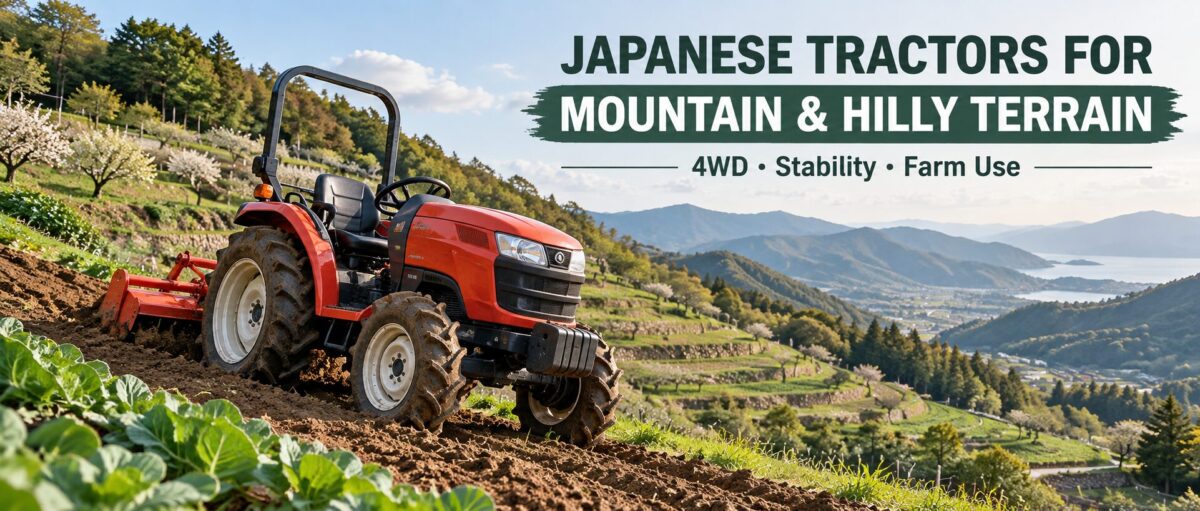

For mountain and hilly farms, the best tractor is not simply the smallest tractor or the model with the highest horsepower. Buyers should prioritize traction, rollover protection, tyre condition, wheelbase, weight distribution, braking, transmission control and compatibility with the actual implement. A compact 4WD Japanese tractor can be useful on narrow terraces, orchards and hillside vegetable farms, but no tractor should be described as “safe on steep slopes” without checking the exact machine, operator's manual and working conditions.
Used Japanese tractors from Kubota, Yanmar, Iseki and Mitsubishi offer many compact 4WD choices, but specifications differ by model and year. For overseas buyers, the practical approach is Country × Vehicle × Use: identify the terrain and crop, select the right tractor size and drivetrain, then inspect the individual machine before export. This guide explains what matters most.
Japanese Tractor for Hilly Terrain: Quick Buying Guide
| Feature | Why It Matters on Hills | Buyer Check |
|---|---|---|
| 4WD | Can improve traction on loose, wet or uneven ground | Confirm front axle engagement and operation |
| ROPS | Provides a protective zone in a rollover when correctly used with a seat belt | Confirm a proper ROPS is fitted and undamaged |
| Seat Belt | Keeps the operator within the ROPS protective zone | Check belt and anchorage condition |
| Tyres | Affect traction, braking and stability | Inspect tread, cracks, matching sizes and inflation specification |
| Wheel Track | Influences tractor stance and stability | Use only manufacturer-approved settings |
| Brakes | Critical when working or transporting on gradients | Test both sides and parking brake |
| Transmission | Helps control speed during precise farm work | Check gears, clutch, shuttle or HST operation |
| Implement Weight | Changes weight distribution and stability | Confirm implement compatibility and ballast requirements |
| Steering | Precise control matters on narrow paths | Check play, linkage and power steering |
| Ground Condition | Wet grass, loose soil and rocks change traction | Match tyres and operation to actual field conditions |
There is no universal “safe slope angle” that applies to every tractor. Tractor geometry, attachments, ballast, ground condition and direction of travel all affect rollover risk. Always follow the operator's manual and local safety requirements.
What Was Weak in the Previous Article?
The earlier version correctly focused on compact size, traction and 4WD. However, several statements were too broad for a practical buying guide.
For example, it described specific models as automatically suitable for mountain farming and assigned broad horsepower ranges without explaining:
- Whether the individual tractor has ROPS
- Exact tyre and wheel configuration
- Implement weight
- Transmission type
- Brake condition
- Ground condition
- Operator safety requirements
The updated approach is more useful:
Choose the tractor specification first. Choose the individual model second.
Why Compact Japanese Tractors Can Suit Hilly Farms
Many Japanese farms historically developed around relatively small fields, narrow access roads and highly specialized crop production. As a result, Japan's used tractor market contains many compact machines.
A compact tractor can be useful where a farmer needs to work around:
- Narrow farm tracks
- Terraced fields
- Orchards
- Tea fields
- Vineyards
- Vegetable plots
- Small mixed farms
However, compact does not automatically mean stable.
A narrow tractor with a high-mounted load can become less stable than a wider machine with appropriate weight distribution.
Therefore, evaluate the whole tractor configuration.
Why 4WD Matters on Uneven Terrain
Four-wheel drive sends driving force to both front and rear axles when engaged.
This can help when working on:
- Loose soil
- Wet ground
- Uneven farm tracks
- Soft field edges
- Moderate gradients where the manufacturer permits operation
4WD can improve traction, but it does not prevent rollovers.
It also does not change:
- The tractor's approved operating limits
- Legal towing capacity
- Implement weight limits
- Need for ROPS
- Need for safe operator technique
4WD vs 2WD for Hilly Farms
| Buying Point | 4WD Tractor | 2WD Tractor |
|---|---|---|
| Loose or Uneven Ground | Usually offers better traction | Can lose traction earlier |
| Wet Farm Paths | Often more useful | More limited |
| Mechanical Complexity | More front-drive components | Simpler drivetrain |
| Front Axle Maintenance | Requires inspection of 4WD axle and seals | Simpler front axle on many models |
| Flat, Dry Fields | Useful but not always necessary | Can be adequate |
| Hilly Terrain | Often preferable for traction | Must be evaluated carefully for the intended work |
For flat, dry farmland, see the 2WD Japanese Tractors for Dry and Flat Farmland guide.
ROPS Is One of the Most Important Features
A Roll-Over Protective Structure, or ROPS, is one of the most important safety features to check on a tractor that may operate on uneven or sloped ground.
ROPS can include:
- Two-post structures
- Four-post structures
- Approved protective cab structures
The purpose of ROPS is to help maintain a protected area around the operator if the tractor overturns.
ROPS does not prevent every rollover.
It must also be used correctly with the seat belt.
Why the Seat Belt Matters with ROPS
When a tractor has a certified ROPS, the seat belt helps keep the operator inside the protected zone.
Before purchasing a used tractor, inspect:
- Seat belt webbing
- Buckle
- Anchor points
- Seat mounting
- ROPS mounting points
A damaged, modified or heavily corroded ROPS deserves further inspection.
Do not assume a sun canopy or simple frame is a certified ROPS.
There Is No Universal Safe Slope Angle
Online tractor discussions sometimes recommend one maximum slope angle for all machines.
That approach is unsafe and too simplistic.
Rollover risk changes with:
- Tractor model
- Wheel track
- Tyres
- Ground condition
- Implement position
- Loader height
- Ballast
- Speed
- Direction of travel
- Holes, ditches and field edges
Always follow the operating limits and instructions for the exact tractor.
If terrain is too steep for safe operation, use another work method rather than relying on 4WD or additional horsepower.
Tyres: One of the Most Important Buying Checks
Tyres directly affect traction and control.
Inspect:
- Tread depth
- Sidewall cracking
- Dry rot
- Cuts
- Uneven wear
- Correct front and rear sizes
- Tyre compatibility with 4WD gearing
Using incorrect tyre sizes on a 4WD tractor can affect drivetrain operation.
When replacing tyres, use specifications approved for the tractor.
Agricultural Tyres vs Other Tyre Types
Tyre choice should follow the work.
| Tyre Type | Typical Strength | Main Consideration |
|---|---|---|
| Agricultural Lug Tyre | Strong soil traction | Can disturb soft ground |
| Turf-Type Tyre | Lower surface disturbance | Less aggressive traction in some soil conditions |
| Industrial-Type Tyre | Durability for mixed surfaces | Match to farm and implement use |
For a hillside orchard, vineyard or tea field, the correct tyre can be as important as engine horsepower.
Wheel Track and Stability
Some tractors allow wheel-track adjustment.
A different wheel setting can change:
- Overall width
- Row clearance
- Turning space
- Stability characteristics
However, adjustment should only be made within the manufacturer's approved configuration.
Do not modify wheels, spacers or axles simply to make a tractor appear “slope ready.”
Why Weight Distribution Matters
Tractor stability changes when weight is added or moved.
Examples include:
- Front loader
- Rear rotary tiller
- Heavy mower
- Trailer
- Front weights
- Wheel ballast
An implement changes the tractor's center of gravity and axle loading.
Before using a heavy implement, confirm:
- Manufacturer compatibility
- Three-point hitch capacity
- Front and rear axle limits
- Required ballast
- Tyre-pressure requirements
Front Loaders Require Extra Care on Slopes
A front loader can change tractor stability significantly, especially when the bucket or load is raised.
For hilly farming, a buyer considering a loader-equipped tractor should inspect:
- Loader mounting points
- Hydraulic cylinders
- Hoses
- Front axle
- Steering joints
- Recommended ballast
The loader and tractor must be treated as one complete machine when evaluating stability and operating limits.
Transmission Choice for Hilly Farm Work
Used Japanese tractors may use:
- Conventional manual transmission
- Shuttle transmission
- Hydrostatic transmission
- Other manufacturer-specific transmissions
The best choice depends on the job.
Manual Transmission
Can suit:
- Steady field work
- Operators familiar with geared tractors
- Markets where mechanical transmission repair is common
Shuttle Transmission
Can be useful where the tractor repeatedly changes direction, such as:
- Loader work
- Orchard work
- Confined field operation
Hydrostatic Transmission
Can offer easy speed and direction control during:
- Mowing
- Orchard maintenance
- Landscaping
- Precision low-speed work
However, used HST units should be tested carefully for smooth operation, response and abnormal noise.
Brakes Are Critical on Hilly Terrain
A tractor intended for elevated or uneven fields should have a healthy braking system.
Check:
- Left and right brake operation
- Brake balance
- Pedal travel
- Pedal linkage
- Parking brake
- Fluid or mechanical system according to tractor design
If separate left and right brake pedals are fitted, confirm that the pedal-locking mechanism works correctly for transport operation.
Steering and Front Axle Inspection
On 4WD tractors, the front axle works under both steering and driving loads.
Inspect:
- Front axle oil leakage
- Kingpins and steering joints
- Tie rods
- Wheel bearings
- Drive joints
- Power steering
Excessive steering play can make precise control more difficult on narrow farm paths.
PTO and Three-Point Hitch: Match the Implement
Most buyers do not purchase a tractor only to drive it.
The tractor must operate an implement.
Typical hillside-farm implements can include:
- Rotary tiller
- Mower
- Sprayer
- Small plow
- Transport box
- Orchard equipment
Confirm:
- PTO speed
- PTO shaft condition
- Three-point linkage category and dimensions
- Hydraulic lifting condition
- Implement weight
Japanese domestic-market tractors can have implement arrangements that differ from equipment commonly sold in another country.
Country × Vehicle × Use: Kenya × Compact 4WD Tractor × Tea or Coffee Farm
Kenyan highland farming can include sloped tea, coffee and mixed-crop areas.
A compact 4WD Japanese tractor can be worth considering where the farm has:
- Narrow field access
- Smaller plots
- Uneven ground
- Light cultivation work
- Spraying or mowing requirements
Prioritize:
- ROPS
- 4WD operation
- Brakes
- Suitable tyres
- Narrow-path maneuverability
- Parts availability
Do not choose a tractor purely because its horsepower falls within a certain range.
Country × Vehicle × Use: Uganda × 4WD Tractor × Highland Mixed Farming
In Uganda, farms in elevated and uneven regions may combine:
- Coffee
- Bananas
- Vegetables
- Livestock support work
- General transport
A compact 4WD tractor can support multiple jobs when fitted with suitable implements.
For a used tractor, inspect:
- Front-drive axle
- Hydraulics
- PTO
- Tyres
- ROPS
- Cooling system
Availability of local filters, seals and common service parts should be confirmed before purchase.
Country × Vehicle × Use: Fiji × Compact Tractor × Hilly Small Farm
Small and irregular agricultural plots in Fiji can require maneuverable equipment.
For hilly vegetable, fruit or mixed farms, a buyer may prioritize:
- Compact dimensions
- 4WD traction
- ROPS
- Good brakes
- Strong tyre condition
- Simple implement compatibility
Shipping cost also matters because tractor dimensions, implements and additional tyres can change the total freight requirement.
Country × Vehicle × Use: Mountain Orchard × Compact Tractor
Orchards create a different requirement from open farmland.
A tractor may need to move between:
- Trees
- Narrow rows
- Branches
- Irrigation equipment
Important buying factors include:
- Overall width
- Overall height
- Turning space
- ROPS configuration
- Mower or sprayer compatibility
Any folding ROPS should be used according to manufacturer instructions and returned to its protective operating position when required.
Country × Vehicle × Use: Vineyard × Narrow Tractor
Vineyards can require a narrow machine, but narrow width also means stability must be evaluated carefully.
Before selecting a tractor, compare:
- Row spacing
- Wheel-track specification
- ROPS
- Tyre type
- Sprayer weight
- Terrain
A tractor that fits between vines is not automatically appropriate for every slope within the vineyard.
Country × Vehicle × Use: Terraced Vegetable Farm
Terraced farms can combine tight turning space with elevation changes.
A smaller tractor can reduce maneuvering difficulty, but buyers should inspect:
- Braking
- Steering
- Tyres
- 4WD
- ROPS
- Implement overhang
Field-edge and embankment risk must also be considered during operation.
How Much Horsepower Do You Need?
There is no single horsepower range for “mountain farming.”
Choose horsepower according to:
- Implement requirement
- Soil type
- Farm size
- PTO demand
- Transport requirement
- Tractor weight
A 30 HP tractor is not automatically more suitable for hills than a 20 HP tractor.
More horsepower does not correct poor tyres, excessive implement weight or an unsafe configuration.
Small Tractor vs Larger Tractor on Hills
| Buying Point | Compact Tractor | Larger Tractor |
|---|---|---|
| Narrow Access | Often easier | Can be restricted |
| Turning Space | Usually smaller | Usually larger |
| Heavy Implement Capacity | More limited | Potentially greater |
| Transport Weight | Lower | Higher |
| Stability | Depends on complete configuration | Depends on complete configuration |
| Best Choice | Small plots and suitable implements | Larger implements and workloads where terrain permits |
Size alone does not determine slope safety.
Used Kubota Tractors for Hilly Terrain
Japanese used Kubota stock can include compact B-, L-, GL- and other series tractors.
Many individual units may be available with 4WD, but specification varies.
Before choosing one for a hilly farm, confirm:
- Exact model
- Drive type
- ROPS
- Transmission
- Tyre specification
- Implement compatibility
Do not assume every Kubota GL or L-series tractor has the same width, horsepower or safety equipment.
Used Yanmar Tractors for Hilly Terrain
Japanese used Yanmar stock can include YM-, F-, AF-, EF- and other series tractors depending on availability.
A 4WD Yanmar can be worth considering for compact mixed farming, but inspect:
- Front axle
- Transmission
- PTO
- Hydraulic lift
- ROPS
- Tyre condition
Series name alone should not be used to determine slope capability.
Used Iseki Tractors for Hilly Terrain
Used Iseki tractors can include TU-, TF-, TG- and other series.
Compact Iseki units can suit small fields when their specifications match the work.
Confirm:
- 4WD
- Gearbox condition
- Hydraulic operation
- ROPS
- Wheel and tyre specification
- Local parts support
Used Mitsubishi Tractors for Hilly Terrain
Japanese used Mitsubishi agricultural tractors can include MT- and other model families.
As with other brands, evaluate:
- Model code
- Horsepower
- 4WD system
- Brakes
- ROPS
- PTO
- Hydraulics
The correct individual tractor matters more than the brand name alone.
Do Not Buy by Brand Ranking Alone
Kubota, Yanmar, Iseki and Mitsubishi have all produced many different tractor specifications.
A buyer should not assume:
- Kubota is always more stable
- Yanmar always has more torque
- Iseki is always better for narrow farms
- Mitsubishi is always lighter
These characteristics must be checked model by model.
Wet Hills Require Different Planning
A slope that is manageable when dry can become much more difficult after rain.
Wet conditions can reduce tyre grip and create:
- Mud
- Sliding
- Soft shoulders
- Hidden holes
- Erosion
4WD can improve traction, but it cannot eliminate the underlying hazard.
For muddy-field applications, see 4WD Japanese Tractors for Wet and Muddy Fields.
Rocky Ground Requires a Different Tractor Check
Mountain farms can also contain exposed stones and rocky soil.
Check:
- Tyre damage
- Front axle
- Steering linkage
- Underside damage
- Three-point linkage
- Implement condition
A stronger or heavier tractor may be needed for some implements, but excessive size can create problems on narrow terraces.
See the Heavy-Duty Japanese Tractors for Rocky Soil Farming guide for additional buying considerations.
What to Inspect Before Buying a Used Japanese Tractor
| Inspection Point | What to Check |
|---|---|
| ROPS | Presence, damage, corrosion and correct mounting |
| Seat Belt | Buckle, webbing and anchorage |
| Engine | Cold start, smoke, leaks and abnormal noise |
| Cooling System | Radiator, hoses and coolant leakage |
| 4WD | Engagement and front axle operation |
| Transmission | All gears, shuttle or HST function |
| Brakes | Left, right and parking-brake operation |
| Steering | Play, power assist and joints |
| Tyres | Tread, cracks and correct sizes |
| PTO | Engagement and abnormal vibration |
| Hydraulics | Lift operation and oil leakage |
| Three-Point Hitch | Wear, bent components and linkage condition |
| Frame | Cracks, corrosion and previous repairs |
For a broader inspection checklist, see How to Inspect a Used Japanese Tractor Before Buying.
Front Axle Leakage: Pay Extra Attention on 4WD Tractors
The driven front axle is one of the main items to inspect on an older 4WD tractor.
Look around:
- Front hubs
- Axle seals
- Steering knuckles
- Differential housing
Oil leakage does not automatically mean the tractor is unusable, but repair cost should be included in the purchase decision.
Test the Hydraulic Lift with an Implement if Possible
A hydraulic lift that moves with no load may still be weak.
Where practical, check whether the system:
- Lifts smoothly
- Holds position
- Responds correctly to controls
- Leaks oil
- Makes abnormal pump noise
This is especially important for buyers planning to use rotary tillers, mowers or sprayers.
Check PTO Compatibility Before Export
A Japanese domestic tractor may arrive without the implement a buyer plans to use locally.
Before purchase, confirm:
- PTO shaft specification
- PTO speed
- Rotation requirements
- Three-point hitch dimensions
- Hydraulic requirements
Do this before the tractor leaves Japan rather than discovering an attachment mismatch after arrival.
Maintenance Priorities for Hilly-Farm Tractors
Tractors working on uneven terrain deserve regular inspection.
Priority areas include:
- Brakes
- Steering
- Tyres
- Wheel fasteners
- ROPS mounting
- Seat belt
- Front axle
- Hydraulic hoses
- Implement mounting points
Do not use one generic maintenance interval for every tractor.
Follow the manual for the exact model and increase inspections when operating conditions are severe.
Parts Availability Before Export
Before choosing an older Japanese tractor, ask local suppliers about:
- Engine filters
- Fuel filters
- Hydraulic filters
- Clutch parts
- Brake parts
- Front axle seals
- Steering joints
- Hydraulic seals
- PTO parts
Use the exact tractor model when requesting parts.
“Kubota 25 HP” or “Yanmar tractor” is not enough information for reliable parts identification.
Shipping a Japanese Tractor to a Hilly-Farm Market
Shipping cost depends on:
- Tractor dimensions
- ROPS height
- Tyre size
- Attached rotary tiller
- Front loader
- Additional implements
- Shipping method
If the tractor includes a rotary tiller or other implement, confirm whether it will remain attached or be prepared separately for shipping.
Do not modify or remove safety structures only to reduce shipping volume unless any temporary handling is specifically authorized and the tractor can be correctly restored to its approved configuration before use.
Calculate the Total Cost, Not Only the Tractor Price
Compare:
- Tractor purchase price
- Japan inland transport
- Export handling
- Implement cost
- Shipping
- Import duties and taxes
- Port and clearing costs
- Inland delivery
- Initial maintenance
- Required tyres or parts
A cheaper tractor with poor tyres, leaking front hubs and weak hydraulics may have a higher real cost than a better-condition machine.
How to Compare Two Used Tractors for Hilly Terrain
| Check | Tractor A | Tractor B |
|---|---|---|
| 4WD | Confirm | Confirm |
| ROPS | Confirm | Confirm |
| Seat Belt | Inspect | Inspect |
| Tyre Condition | Inspect | Inspect |
| Wheel Configuration | Confirm | Confirm |
| Brakes | Test | Test |
| Steering | Test | Test |
| Front Axle | Inspect | Inspect |
| Transmission | Test | Test |
| Hydraulics | Test | Test |
| PTO | Test | Test |
| Implement Match | Confirm | Confirm |
| Local Parts | Confirm | Confirm |
| Total Landed Cost | Calculate | Calculate |
Common Mistakes When Buying a Tractor for Hills
1. Choosing by Horsepower Alone
Horsepower does not tell you tyre condition, stability, braking or implement compatibility.
2. Assuming 4WD Makes Any Slope Safe
4WD improves traction. It does not eliminate rollover risk.
3. Ignoring ROPS
A used tractor without appropriate rollover protection deserves careful reconsideration before slope-related work.
4. Ignoring the Seat Belt
A ROPS and seat belt are designed to work together to protect the operator in a rollover.
5. Buying a Narrow Tractor Without Considering Stability
Narrow width can help access, but it does not automatically improve stability.
6. Ignoring Implement Weight
A mower, loader, sprayer or tiller changes tractor balance and axle loading.
7. Fitting Incorrect Tyres
Tyre size and matching are especially important on 4WD machines.
8. Buying Before Checking Parts
Confirm local parts availability for the exact model, not only the brand.
FAQ: Japanese Tractors for Mountain and Hilly Terrain
Is a 4WD tractor better for hilly terrain?
4WD can improve traction on loose, wet and uneven ground, so it is often worth considering for hilly farms. However, 4WD does not prevent rollover. ROPS, tyres, brakes, weight distribution, implements and safe operating limits are also critical.
What horsepower tractor is best for a mountain farm?
There is no universal horsepower figure. Choose power according to the implement, soil, farm size and workload. Stability and tractor configuration should be evaluated separately from horsepower.
What is the safest slope angle for a compact tractor?
There is no single safe angle for every tractor. Safe operation depends on the exact machine, wheel configuration, attachments, surface, direction of travel and manufacturer instructions. Follow the operator's manual and avoid terrain that is too steep for safe operation.
Should a tractor for hills have ROPS?
Rollover protection is a major safety consideration for tractors used on uneven terrain. When a tractor is equipped with an approved ROPS, the seat belt should be used correctly so the operator remains within the protected zone.
Which Japanese tractor brand is best for hilly terrain?
Kubota, Yanmar, Iseki and Mitsubishi all produced compact 4WD tractors suitable for different farm applications. There is no single best brand for every hill farm. Compare the exact model, ROPS, tyres, brakes, transmission, parts support and implement compatibility.
Choose by Country × Vehicle × Use
The best Japanese tractor for mountain farming is the machine that matches the farm, the implement and the local maintenance environment—not simply the tractor with the most horsepower or the smallest body.
Use three questions:
- Country: What terrain, road access, parts supply, import rules and local workshop capability exist?
- Vehicle: Does the exact tractor have suitable 4WD, ROPS, tyres, brakes, steering, PTO and hydraulic condition?
- Use: Will it work in a tea field, vineyard, orchard, terraced vegetable plot, mixed farm or livestock operation?
Then check the actual machine before shipping.
EVERY TRADING has exported Japanese vehicles and agricultural machinery since 2006 and supports overseas buyers with vehicle sourcing, export preparation and international shipping arrangements.
Looking for a Japanese tractor? Browse the current used Japanese farm tractors for sale and compare drive type, horsepower, tyres, safety equipment, implements and condition before requesting a quotation.
Related Japanese Tractor Guides
- Used Japanese Farm Tractors for Sale
- How to Inspect a Used Japanese Tractor Before Buying
- 4WD Japanese Tractors for Wet and Muddy Fields
- 2WD Japanese Tractors for Dry and Flat Farmland
- Heavy-Duty Japanese Tractors for Rocky Soil Farming
- Used Tractor Applications & Export Guide


Browse Reliable Used Trucks & Buses from Japan
Carefully selected vehicles ready for export worldwide
Search 100,000+ Dealer Stock Vehicles from Japan
Access a wide selection of vehicles from Japanese dealers nationwide. Updated daily.
