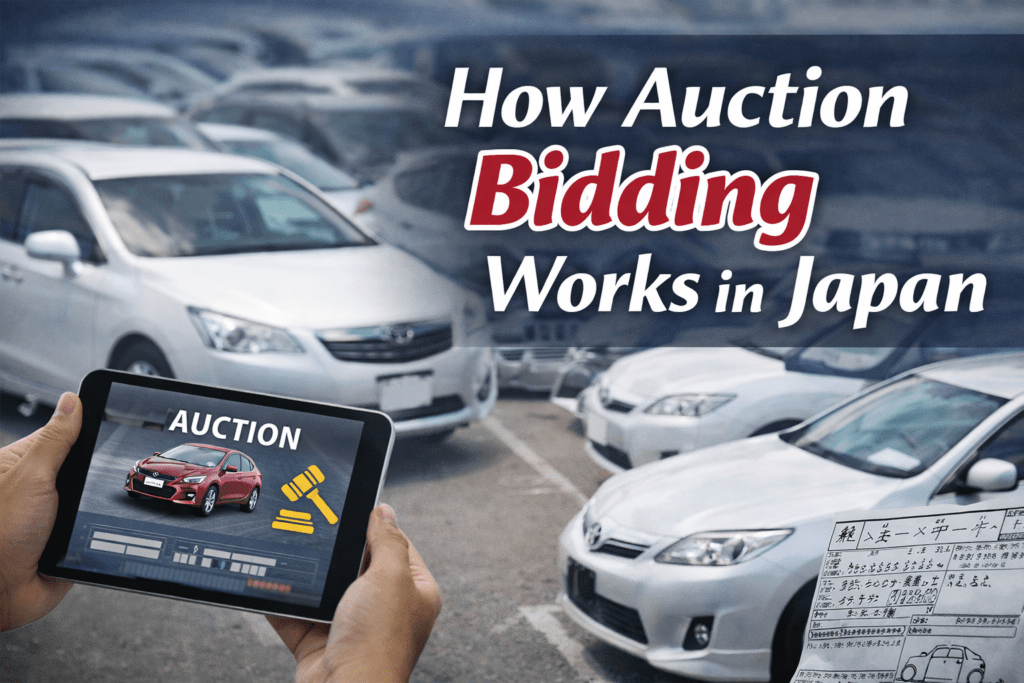

How Auction Bidding Works in Japan
Japanese car auctions are one of the fastest and most competitive vehicle markets in the world. Every week, thousands of vehicles are sold through live bidding systems. For overseas buyers, understanding how bidding works is essential if you want to secure good vehicles at the right price.
At first, auction bidding in Japan may seem complex. The process moves quickly, prices change in seconds, and different auction houses may have slightly different systems. However, once you understand the basics, it becomes a powerful tool for sourcing vehicles for export.
This guide explains how auction bidding works in Japan, how overseas buyers participate, what advantages the system offers, and how to avoid common mistakes when placing bids.
Search available auction vehicles here:
Browse Auction Vehicles
Understanding the Japanese Car Auction System
Before learning about bidding, it is important to understand how the Japanese car auction system works. These auctions are wholesale marketplaces where licensed dealers and exporters buy and sell vehicles.
Most overseas buyers cannot access auctions directly. Instead, they work with export companies that have auction membership. These companies act as agents and place bids on behalf of international customers.
Vehicles come from many sources, including dealer trade-ins, lease returns, rental fleets, and company vehicles. Each vehicle is inspected and listed with detailed information before auction day.
Main elements of the auction system
- Auction house: Organizes the sale and manages bidding systems
- Seller: Provides the vehicle to the auction
- Buyer: Dealer or exporter placing bids
- Auction sheet: Inspection report with condition details
- Reserve price: Minimum price the seller will accept
This system allows buyers to access a large number of vehicles quickly and compare many options in one place.
How Auction Bidding Works in Japan
Auction bidding in Japan is usually conducted through live digital systems. Vehicles are presented one by one, and buyers place bids in real time. Each auction lane moves very quickly, often completing a sale within one or two minutes.
Because of this speed, preparation is very important. Buyers must decide their maximum bid before the auction starts.
Types of bidding systems
1. Live bidding
Live bidding happens during the auction. Buyers place bids while watching the auction screen or using an online system. Prices increase step by step as bidders compete.
2. Pre-bid (advance bidding)
Buyers can place a bid before the auction starts. This is useful when you cannot attend the live auction. The system will automatically bid up to your maximum limit.
3. Negotiation (post-auction)
If a vehicle does not reach the reserve price, the buyer may enter negotiation. In this stage, the buyer can offer a price, and the seller decides whether to accept.
How prices move during bidding
- The auction starts at a base price
- Buyers place bids quickly
- The price increases in steps
- If the reserve price is reached, the vehicle is sold
- If not, negotiation may follow
Understanding this flow helps buyers stay calm and avoid overbidding during fast auctions.
Benefits of Japanese Auction Bidding for Overseas Buyers
Japanese auctions offer several advantages for international buyers. These benefits make the system one of the best sourcing methods for export businesses.
1. Access to real market pricing
Auction prices reflect actual demand. This helps buyers understand the true value of vehicles instead of relying on retail prices.
2. Large inventory
Thousands of vehicles are listed every week. Buyers can choose from many models, conditions, and price ranges.
3. Faster sourcing
Instead of waiting for stock, buyers can find suitable vehicles quickly through auctions.
4. Transparency
Auction sheets and inspection reports provide useful information before bidding.
5. Flexibility
Buyers can control their budget by setting maximum bids and choosing when to participate.
Step-by-Step Flow of Auction Bidding for Overseas Buyers
Since most overseas buyers use exporters, the bidding process involves cooperation between the buyer and the export company.
Step 1: Select target vehicles
The exporter searches auction listings and sends suitable options to the buyer.
Step 2: Review vehicle details
The buyer checks auction sheets, photos, and specifications carefully.
Step 3: Set maximum bid
The buyer decides the highest price based on total cost and resale value.
Step 4: Place the bid
The exporter places the bid during the auction or as a pre-bid.
Step 5: Win or lose
If the bid is successful, the vehicle is secured. If not, the buyer can try other vehicles.
Step 6: Payment and export
After winning, the buyer completes payment and the exporter arranges shipment.
Important Points and Cautions When Bidding
Auction bidding can be profitable, but it also requires discipline. Buyers should avoid common mistakes that reduce profit.
Do not chase the lowest price
The cheapest vehicle is not always the best choice. Condition and resale value are more important.
Always check the auction sheet
Do not rely only on photos. The auction sheet contains important condition details.
Control your maximum bid
Emotional bidding can lead to overpaying. Always stick to your planned budget.
Consider total cost
Include shipping, taxes, and fees when calculating your bid price.
Understand your market
Choose vehicles that match demand in your country.
Why You Should Use a Professional Export Company
Working with a professional exporter makes auction bidding much easier and safer. They provide knowledge, access, and support throughout the process.
They understand auction systems
Exporters know how auctions work and how to place bids effectively.
They reduce risk
They check vehicle details and help avoid poor-quality units.
They manage logistics
They handle shipping, documents, and export procedures.
They support long-term business
They help buyers build stable sourcing strategies over time.
- Access to dealer-only auctions
- Accurate vehicle evaluation
- Efficient bidding support
- Complete export service
Tips to Win More Auctions Successfully
- Research market prices before bidding
- Focus on high-demand models
- Set realistic budgets
- Work with experienced exporters
- Stay patient and consistent
Successful buyers focus on long-term strategy, not just single purchases.
Conclusion
Japanese auction bidding is a powerful way to source used vehicles for export. It offers access to a large inventory, competitive prices, and real market data.
However, it also requires knowledge, preparation, and discipline. Buyers who understand the system and work with reliable partners can achieve better results.
EVERY TRADING is a Japanese used vehicle export company that supports customers worldwide. We help overseas buyers search auction vehicles, place bids, and complete exports smoothly.
Learn more about Japanese auctions:
Japanese Car Auction Guide
Start searching your vehicle from Japan today:
Search Auction Vehicles Now
If you are looking for any Japanese vehicles, cars and truck and bus for sale, please check our list.
The list of Japanese Used Truck, Bus, cars, and tractor exporter EVERYCAR.jp (*Click to open).We do our best work for all customer's partnership.
It's for SDGs goal number 17 "PARTNERSHIP FOR THE GOALS".
Let's work together!


