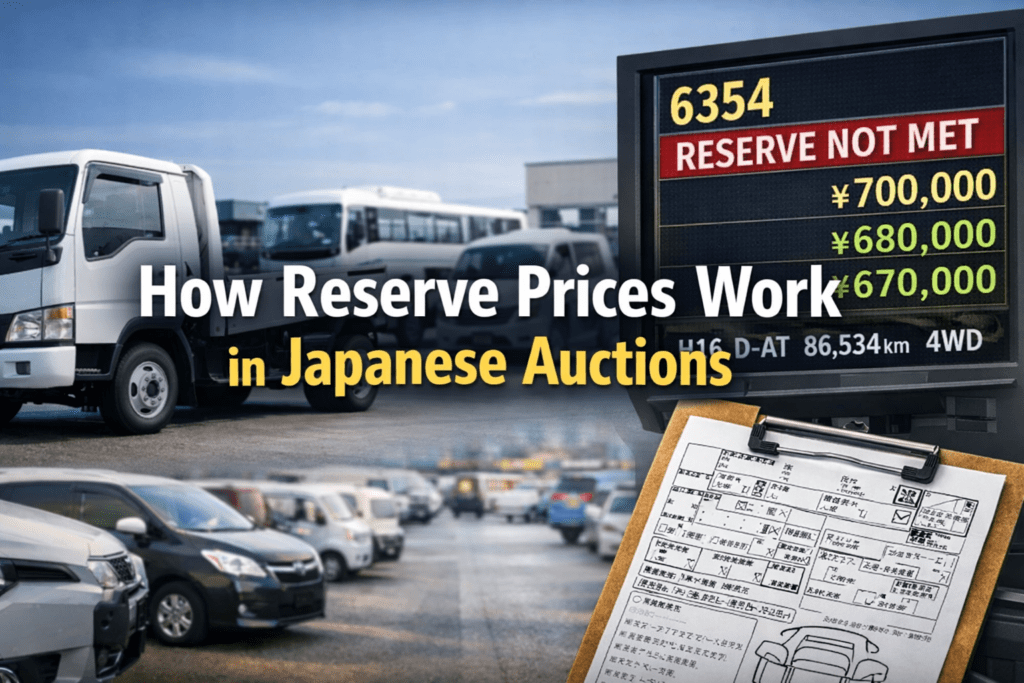

How Reserve Prices Work in Japanese Auctions
Japanese used car auctions are one of the most important sourcing channels for overseas buyers. Every week, a huge number of cars, SUVs, vans, trucks, buses, and other vehicles move through auction houses across Japan. Because of this scale, many importers use Japanese auctions to secure better stock for export.
However, many first-time buyers do not fully understand how reserve prices work. They may see active bidding and assume the highest bid will always win the vehicle. In reality, that is not always true. If the final bid does not reach the seller’s reserve price, the vehicle may not be sold.
This part of the auction system is very important for overseas buyers. When you understand reserve prices, you can interpret auction results more accurately, plan bids more carefully, and reduce confusion during the buying process.
This guide explains how reserve prices work in Japanese auctions, how they affect bidding, why they matter in export business, and why working with a professional export company helps buyers make better decisions.
Search available auction vehicles here:
Browse Auction Vehicles
Understanding the Japanese Car Auction System
Before looking at reserve prices, it is useful to understand the basic structure of Japanese car auctions. These auctions are wholesale marketplaces where licensed dealers and exporters buy and sell used vehicles through fast live bidding systems.
Most overseas buyers cannot join these auctions directly. Instead, they usually work with a Japanese exporter or auction agent. That company searches auction listings, explains vehicle condition, places bids, and arranges export after purchase.
Vehicles come into the system from trade-ins, lease returns, rental fleets, dealer stock, company vehicles, and finance companies. Once a vehicle reaches the auction house, staff inspect it, prepare an auction sheet, and list it for sale.
Main parts of the auction system
- Auction house: The company that organizes inspections, listings, and bidding
- Seller: The dealer or company offering the vehicle for sale
- Buyer: The dealer or exporter placing the bid
- Auction sheet: The inspection report with vehicle details and condition notes
- Starting price: The opening point of bidding
- Reserve price: The minimum amount the seller wants before agreeing to sell
This system gives buyers access to a very large number of vehicles in a short time. It also creates a competitive market where prices are shaped by condition, demand, season, and export interest.
What Is a Reserve Price in a Japanese Auction?
A reserve price is the minimum selling level set by the seller. In simple terms, it is the lowest price the seller is willing to accept for the vehicle.
If bidding rises but does not reach that reserve level, the car may not be sold. This means the highest bid does not always win automatically. The reserve price protects the seller from selling the vehicle below an amount they consider acceptable.
For overseas buyers, this is one of the most important things to understand. You may bid actively and still lose the vehicle, even if no other buyer goes higher, because the bid did not reach the seller’s expected level.
Why reserve prices exist
- To protect the seller’s minimum expected value
- To prevent very low sales in weak bidding situations
- To give sellers more control over final results
- To balance auction speed with seller interests
Reserve prices are common in vehicle auctions around the world. In Japan, they are an important part of how professional buyers read auction results and plan bidding strategy.
How Reserve Prices Affect Bidding
Reserve prices affect both buyer behavior and auction outcomes. A vehicle may receive many bids and still remain unsold if the reserve price is not reached. On the other hand, a vehicle with strong market demand may rise above reserve quickly and sell without delay.
This is why reserve prices matter so much. They influence whether the vehicle is sold, whether negotiation starts after the auction, and whether buyers should continue bidding or stop.
Common outcomes during bidding
- Bid reaches reserve: The vehicle is usually sold to the highest bidder
- Bid stays below reserve: The vehicle may remain unsold
- Bid comes close to reserve: Negotiation may be possible after the auction
- Strong demand: Bidding may pass reserve very quickly
Because auction lanes move fast, buyers often do not know the exact reserve price during live bidding. Instead, experienced exporters read auction behavior and market trends to judge how likely the reserve is to be reached.
How Reserve Prices Are Decided
The reserve price is usually set by the seller. It is based on factors such as vehicle condition, expected market value, recent auction results, and the seller’s own business goals.
Still, reserve prices are not always fixed in the same way. Different sellers may use different strategies. Some want a quick sale and set a realistic reserve. Others aim high and only sell if the final bid reaches a strong level.
Factors that influence reserve prices
- Vehicle condition: Clean units often carry stronger reserve expectations
- Mileage: Lower mileage may support a higher reserve
- Market demand: Popular export models often have stronger seller expectations
- Seasonal demand: Some vehicle types sell better at certain times of year
- Seller strategy: Some sellers prefer a fast sale, while others wait for a stronger price
As a result, the reserve price is not always easy to predict just by looking at the starting price. That is why buyers should never rely on one number alone.
Benefits of Understanding Reserve Prices for Overseas Buyers
Overseas buyers gain several clear benefits when they understand how reserve prices work. This knowledge helps improve bidding discipline and reduces confusion after an auction ends.
1. Better price expectations
Buyers who understand reserve prices know that the final result depends on more than active bidding. This makes budgeting more realistic.
2. Less confusion about unsold vehicles
Sometimes buyers think they lost because another bidder offered more. In fact, the car may simply have failed to meet reserve. Understanding this helps buyers interpret auction results correctly.
3. Stronger bidding discipline
Reserve price awareness keeps buyers focused on business value rather than emotional bidding. That supports better long-term buying decisions.
4. Better negotiation strategy
If a vehicle does not sell, there may be a chance to negotiate. Buyers who understand reserve logic can respond faster and more effectively.
5. Improved export planning
When buyers understand likely sale behavior, they can plan sourcing schedules more accurately and avoid delays caused by unrealistic targets.
Step-by-Step Buying Flow for Overseas Buyers
Most overseas buyers use exporters to access Japanese auctions. The exporter acts as a local partner and handles both bidding and export procedures.
Step 1: Choose a trusted export company
Your exporter should understand auction systems, vehicle inspection reports, pricing behavior, and international shipping. This partnership is the base of smooth buying.
Step 2: Search auction vehicles
You share your target model, year range, mileage limit, and budget. The exporter then searches auction listings that match your needs.
Step 3: Review auction details
Before bidding, you should review the auction sheet, photos, equipment, repair history, and estimated total cost. This matters more than the starting price alone.
Step 4: Set your maximum bid
Your maximum bid should be based on total landed cost and resale potential in your market. The exporter may also advise whether the reserve is likely to be high or realistic.
Step 5: Bid at auction
The exporter places the bid during the live auction or through an advance bidding system. If bidding reaches reserve and your bid is highest, the vehicle is secured.
Step 6: Handle unsold or negotiation situations
If the bid does not reach reserve, the vehicle may remain unsold. In some cases, the exporter can try negotiation with the seller after the auction.
Step 7: Complete payment and export
If the purchase is successful, the exporter handles payment control, inland transport, export documentation, and shipment to your destination country.
Important Cautions About Reserve Prices
Reserve prices are useful to understand, but buyers should also be careful not to build the wrong assumptions around them.
Do not assume every highest bid wins
This is one of the most common misunderstandings. If reserve is not reached, the vehicle may remain unsold even when no one bids higher.
Do not guess value from reserve behavior alone
A high reserve does not always mean the vehicle is worth the price. Sometimes the seller’s expectations are simply too strong for the current market.
Do not ignore total landed cost
Even if a bid reaches reserve, the full business result still depends on shipping, taxes, repairs, and destination charges. The reserve price is only one part of the buying equation.
Watch for emotional bidding
Some buyers keep increasing their bids because they assume the reserve must be close. This can lead to overpaying and weak profit.
Know that reserve may differ by seller
Not all sellers think the same way. Some are realistic, while others are more aggressive. That is why auction experience matters.
Why a Professional Export Company Helps So Much
For overseas buyers, understanding reserve prices is easier when a professional exporter is involved. Auction access is only one part of the service. The real value comes from reading the market correctly and acting with discipline.
They understand auction behavior
Experienced exporters know how sellers behave, how auction houses work, and how likely reserve levels affect final results. This helps buyers avoid poor assumptions.
They read the full vehicle picture
Good exporters do not focus only on live bidding. They also review the auction sheet, demand level, recent sales, and export suitability.
They improve negotiation chances
If a vehicle does not sell, a professional exporter may still help through post-auction negotiation. This can save time and create extra opportunities.
They manage the full export process
After purchase, the exporter arranges payment, vehicle pickup, documents, and shipping. This reduces mistakes and helps the buyer stay focused on business planning.
- Access to dealer-only Japanese auction systems
- Clear explanation of pricing behavior and reserve risk
- Support with realistic maximum bid planning
- Help with negotiation when vehicles remain unsold
- Complete export and shipping support from Japan
Simple Tips for Overseas Buyers
If you want better results in Japanese auctions, focus on value and discipline rather than trying to guess reserve numbers too aggressively.
- Study the full auction sheet before approving a bid
- Set a firm maximum bid based on landed cost
- Do not assume the highest bid always wins
- Use reserve behavior as a signal, not a guarantee
- Work with a reliable exporter who understands both Japan and your market
These simple habits can improve buying accuracy, reduce disappointment, and support better long-term import business results.
Conclusion
Reserve prices are a key part of Japanese car auctions. They protect the seller’s minimum expected value and affect whether a vehicle is sold, left unsold, or moved into negotiation. For overseas buyers, understanding this system is very important.
When buyers understand how reserve prices work, they can read auction results more accurately, avoid unrealistic assumptions, and bid with better control. This leads to safer purchases and stronger business planning.
EVERY TRADING is a Japanese used vehicle export company serving customers around the world. We help overseas buyers search Japanese auction stock, understand auction behavior, and move from bidding to shipment with confidence.
Whether you want passenger cars, SUVs, vans, or commercial vehicles, our team can help you search auction vehicles and buy from Japan with clearer strategy and lower risk.
Learn more about Japanese auctions:
Japanese Car Auction Guide
Start searching your vehicle from Japan today:
Search Auction Vehicles Now
If you are looking for any Japanese vehicles, cars and truck and bus for sale, please check our list.
The list of Japanese Used Truck, Bus, cars, and tractor exporter EVERYCAR.jp (*Click to open).We do our best work for all customer's partnership.
It's for SDGs goal number 17 "PARTNERSHIP FOR THE GOALS".
Let's work together!


