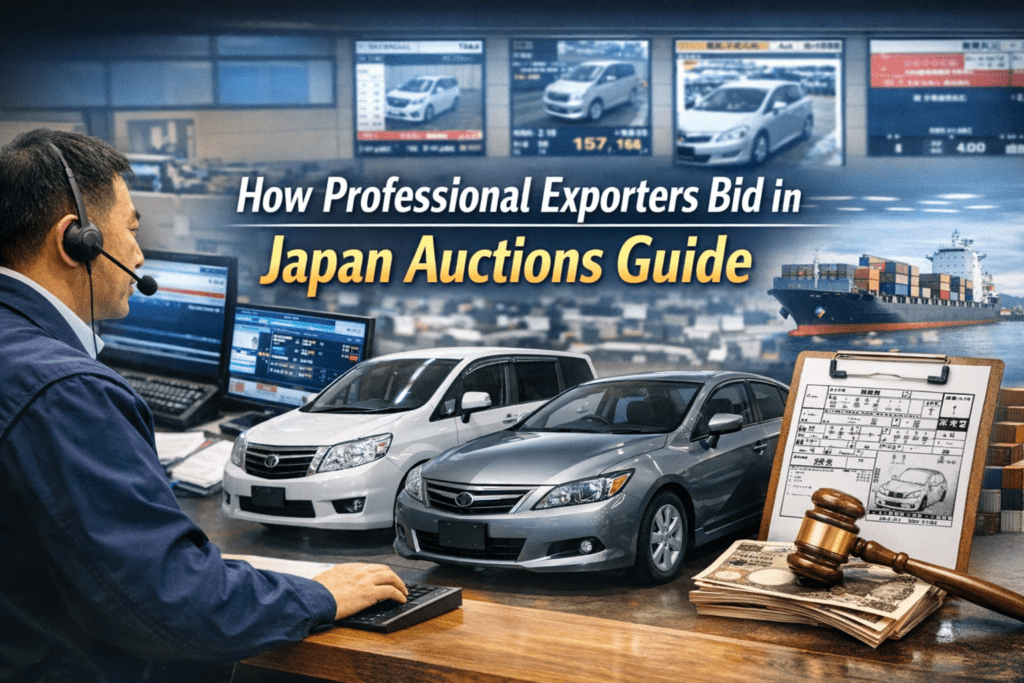

How Professional Exporters Bid in Japan Auctions
Japanese car auctions are one of the most important vehicle sourcing channels for global buyers. The EVERYCAR guide index lists How Professional Exporters Bid in Japan Auctions under its Auction Bidding Strategy section for overseas buyers who want to understand how the system works in practice.
For many first-time buyers, bidding at a Japanese auction may look simple. A vehicle appears on the screen, the price rises, and the highest bid wins. However, professional exporters do much more than press a button. They prepare before the auction starts, study the auction sheet carefully, calculate the total landed cost, and bid with a clear strategy.
This matters a lot for overseas buyers. Most international customers do not bid directly in Japanese dealer auctions. Instead, they rely on export companies that already understand the market, the speed of the auction system, and the risks that can affect the final result.
In this guide, you will learn how the Japanese car auction system works, how professional exporters approach bidding, why this helps overseas buyers, what cautions to watch, and why working with an experienced exporter can improve your buying success from Japan.
Search available auction vehicles here:
Browse Auction Vehicles
Understanding the Japanese Car Auction System
Japanese used car auctions are wholesale marketplaces where licensed dealers and exporters buy and sell vehicles through live bidding systems. The EVERYCAR guide collection explains that these articles are designed to help overseas buyers understand auction systems, inspection reports, bidding procedures, and the export process. That shows clearly that Japanese auctions are structured trade platforms, not ordinary public retail websites. :contentReference[oaicite:3]{index=3}
Every week, large auction houses across Japan list huge numbers of passenger cars, vans, SUVs, trucks, buses, tractors, and commercial vehicles. These vehicles come from trade-ins, lease returns, rental fleets, dealer stock, finance companies, and business fleets. Auction houses inspect each vehicle, prepare an auction sheet, upload photos, and place the unit into a live sale lane or online bidding system. :contentReference[oaicite:4]{index=4}
Main parts of the auction system
- Auction house: The company that manages inspection, listing, and bidding
- Seller: The dealer, lease company, or business offering the vehicle
- Buyer: A licensed dealer or exporter placing the bid
- Auction sheet: The inspection report showing condition, notes, and grade
- Starting price: The opening point where bidding begins
- Reserve price: The minimum level the seller hopes to accept
Because Japanese auctions move very quickly, buyers need a strategy before the vehicle enters the sale lane. This is where professional exporters stand out. They do not rely on guesswork. They build the bid plan before the live sale begins.
What Professional Exporters Actually Do Before Bidding
Many overseas buyers think exporters only place bids on vehicles they are told to buy. In reality, professional exporters do much more. They act as market readers, risk filters, and sourcing partners.
Before a single bid is placed, the exporter usually searches suitable vehicles, reviews auction sheets, checks vehicle demand in the destination market, estimates full export cost, and advises the buyer on a realistic maximum bid. This preparation is one reason professional exporters often produce better results than unplanned bidding.
Typical exporter preparation before auction day
- Search target vehicles that match the buyer’s request
- Read the auction sheet and inspector comments carefully
- Check repair history, condition marks, and grade details
- Estimate landed cost including shipping and export fees
- Study current demand for that vehicle in the buyer’s market
- Set a realistic maximum bid before the sale starts
This process reduces mistakes and gives the buyer a stronger business basis for each auction decision.
How Professional Exporters Bid During Live Auctions
When the auction starts, professional exporters do not simply chase the vehicle emotionally. They follow the bidding plan they created in advance. This is one of the biggest differences between professional and inexperienced buyers.
During the live auction, the exporter watches the bidding flow, monitors the sale lane, and places bids within the approved limit. If the competition rises beyond business value, they stop. This discipline protects the buyer from overpaying.
How professional exporters approach the live bid
- They stay inside the maximum bid: They do not keep chasing the price without a plan
- They watch market behavior: They understand when a vehicle is becoming overpriced
- They stay calm under speed: Fast auction movement does not change the business logic
- They move to backup options: If one vehicle is lost, they can quickly shift to another target
For overseas buyers, this kind of discipline is very important. In a fast-moving auction, emotional bidding is one of the easiest ways to lose profit.
Why Overseas Buyers Benefit from Exporter Bidding Strategy
Most overseas buyers do not have direct Japanese auction access. Even when they can view stock through a platform, they still need a professional exporter to bid and complete the transaction. This is not a weakness. In many cases, it is a real advantage.
Professional exporters know how to read the vehicle, how to judge the auction flow, and how to connect the bid result to shipping and import reality. That knowledge helps international buyers avoid common mistakes.
Main benefits for overseas buyers
- Better stock selection: Exporters screen vehicles before bidding
- Better cost control: They build the bid around landed cost, not auction emotion
- Better risk management: They explain grade, repairs, and market fit before approval
- Faster buying: They can react quickly inside Japan’s fast auction system
- Smoother export flow: They handle payment, inland transport, paperwork, and shipping
This is why experienced importers often treat exporters as sourcing partners, not only as agents who click the bid button.
Step-by-Step Flow of How Exporters Bid for Buyers
The exporter bidding process follows a practical sequence. While each company has its own style, the basic flow is very similar across the industry.
Step 1: Understand the buyer’s request
The exporter starts by understanding what the customer needs. This usually includes the make, model, year range, mileage limit, budget, transmission, fuel type, and destination market.
Step 2: Search auction listings
Next, the exporter searches dealer-only auction stock for suitable vehicles. This is one of the biggest strengths of working with a professional company. They can review many vehicles quickly across multiple auction houses.
Step 3: Review condition and business value
The exporter checks auction sheets, photos, grade, damage marks, repair history, and market demand. They also think about resale potential in the buyer’s country.
Step 4: Set the maximum bid
Before the auction begins, the buyer and exporter agree on a practical bid limit. This amount should reflect the full business picture, not only the auction price.
Step 5: Bid during the live sale
When the vehicle enters the lane, the exporter places the bid through the auction system. If the price rises too high, they stop and move on.
Step 6: Confirm result and proceed
If the vehicle is won, the exporter arranges payment, domestic transport in Japan, export documents, and shipment. If it is lost, they may shift to another unit.
What Professional Exporters Check Before Approving a Bid
Professional exporters rarely rely on one number or one photo. They build the bid decision on several key factors at the same time.
Main points exporters check
- Auction grade: Useful as a quick guide, but never enough alone
- Repair history: Structural repair can affect demand and resale value
- Mileage: High mileage can still work if the market accepts it and the price is right
- Equipment: Transmission, AC, fuel type, and trim level matter in export markets
- Country rules: Import restrictions and inspection requirements affect real value
- Total landed cost: Auction price alone is never the full picture
Because exporters understand how these factors connect, they can help buyers avoid units that look cheap but become weak business after arrival.
Important Cautions for Overseas Buyers
Even with a strong exporter, buyers still need to understand some basic cautions. A professional exporter improves the process, but disciplined expectations still matter.
Do not assume every win is a good deal
Winning matters only if the vehicle still makes sense after shipping, taxes, repairs, and local resale costs.
Do not chase popular vehicles emotionally
Strong export models often attract heavy bidding. Professional exporters know when to stop. Buyers should respect that discipline.
Do not focus only on auction grade
Grade is helpful, but comments, repair notes, and market fit matter just as much.
Do not ignore the destination market
A vehicle that looks attractive in Japan may be a poor match in another country if demand, taxes, or regulations are weak.
Do not choose an exporter based only on access
Real value comes from advice, honesty, and risk management, not only from auction membership.
Why Professional Export Companies Matter
The biggest lesson for overseas buyers is simple. In Japanese auctions, access matters, but strategy matters more. This is why professional export companies are so important.
A good exporter provides more than auction access. They help you search the right stock, filter risky vehicles, calculate realistic bid limits, and keep your buying disciplined during live auctions. After the win, they also handle the export side, including inland transport, payment, document preparation, and shipment.
Why experienced exporters add real value
- They understand how Japanese auctions really behave
- They can read condition reports accurately
- They protect buyers from emotional overbidding
- They help build repeatable sourcing strategies
- They support the full process from bid to export
For global buyers, this means safer purchases, stronger cost control, and smoother operations over the long term.
Simple Tips for Overseas Buyers
If you want to benefit from professional exporter bidding strategy, keep your buying approach clear and practical.
- Choose an exporter with real auction experience
- Ask for clear explanations of auction sheet risks
- Set your maximum bid before the live sale starts
- Focus on landed cost, not only hammer price
- Accept backup options when one target becomes too expensive
These simple habits can improve your results and help you build a more stable import business.
Conclusion
Professional exporters bid in Japan auctions with preparation, discipline, and market knowledge. They search suitable stock, study the auction sheet, calculate the full cost, and place bids based on business value rather than emotion.
For overseas buyers, this approach creates real advantages. It reduces risk, improves stock selection, and makes the fast Japanese auction system much easier to use effectively.
EVERY TRADING is a Japanese used vehicle export company serving customers around the world. We help overseas buyers search Japanese auction vehicles, understand auction systems, and move from bidding to shipment with more confidence and better control. The EVERYCAR guide collection and auction search platform are designed to help global buyers understand Japan’s vehicle auction market and access available stock from Japan. :contentReference[oaicite:5]{index=5}
Learn more about Japanese auctions:
Japanese Car Auction Guide
Start searching your vehicle from Japan today:
Search Auction Vehicles Now
If you are looking for any Japanese vehicles, cars and truck and bus for sale, please check our list.
The list of Japanese Used Truck, Bus, cars, and tractor exporter EVERYCAR.jp (*Click to open).We do our best work for all customer's partnership.
It's for SDGs goal number 17 "PARTNERSHIP FOR THE GOALS".
Let's work together!


