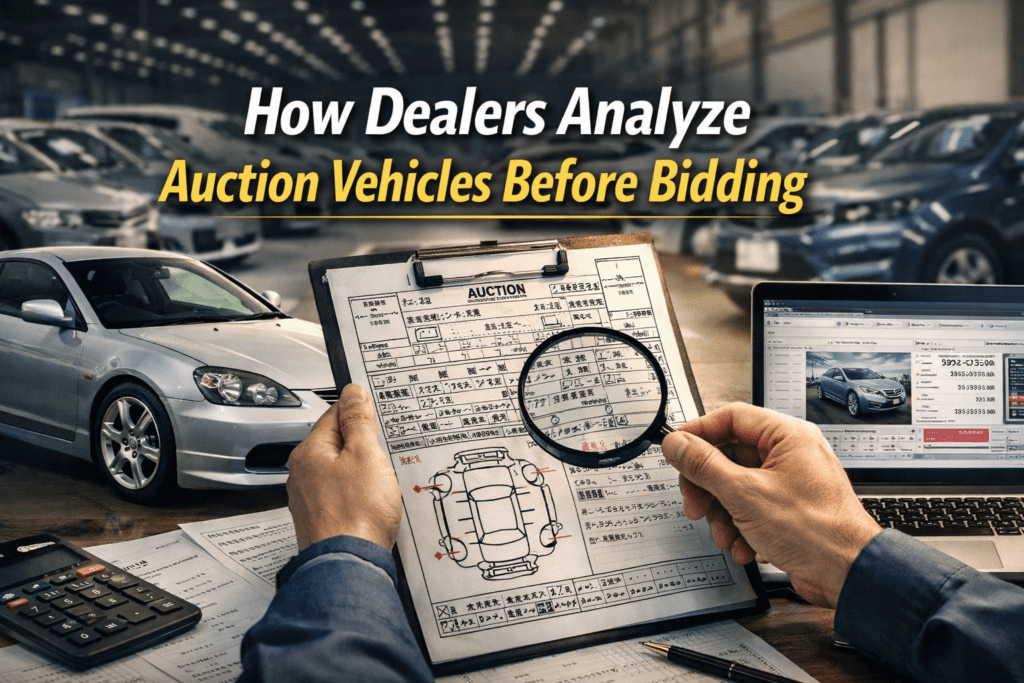

How Dealers Analyze Auction Vehicles
Japanese car auctions offer one of the largest and most reliable sources of used vehicles in the world. Every week, thousands of vehicles are listed across multiple auction houses. Because of this scale, dealers and exporters depend on auctions to source inventory quickly and efficiently.
However, successful buying in auctions is not based on luck. Professional dealers do not simply look at photos and bid. They follow a structured analysis process before every purchase. This process helps them avoid risk, control costs, and select vehicles that match their target market.
For overseas buyers, understanding how dealers analyze auction vehicles is extremely important. It allows you to make better decisions, avoid costly mistakes, and build a more stable import business.
In this guide, you will learn how the Japanese auction system works, how professional dealers evaluate vehicles, what overseas buyers should focus on, and how to apply these methods when sourcing vehicles from Japan.
Search available auction vehicles here:
Browse Auction Vehicles
Understanding the Japanese Car Auction System
Japanese used car auctions are wholesale platforms where licensed dealers and exporters buy and sell vehicles through live bidding systems. These auctions are not public marketplaces. Only registered members can participate directly, which is why overseas buyers usually work with exporters.
Vehicles come from many sources, including dealer trade-ins, lease returns, rental companies, and corporate fleets. Once a vehicle arrives at the auction, it is inspected and given an auction sheet. This sheet includes a grade, condition notes, and a diagram showing damage locations.
During the auction, vehicles are sold in a fast-moving bidding environment. Buyers place bids in real time, and the highest bidder wins if the seller’s conditions are met.
Main elements dealers analyze in auctions
- Auction sheet: The most important inspection document
- Vehicle grade: Overall condition rating
- Photos: Exterior and interior condition
- Start price and bidding history: Market behavior indicators
- Seller type: Dealer, lease, or corporate source
Professional dealers rely heavily on these elements to make quick and accurate decisions.
How Dealers Analyze Auction Vehicles Step by Step
Experienced dealers follow a consistent evaluation process. They do not rely on guesswork. Instead, they check multiple factors before placing a bid.
1. Reading the auction sheet carefully
The auction sheet is the foundation of all analysis. Dealers review comments, repair history, damage marks, and condition notes. They pay attention to small details such as scratches, dents, rust, and interior condition.
2. Checking the auction grade
The grade provides a quick overview of condition. However, professional buyers never rely on the grade alone. They combine it with detailed notes and photos to understand the real condition.
3. Evaluating mileage and usage
Mileage affects value and resale potential. Dealers compare mileage with the vehicle’s age and type to judge whether it is reasonable or risky.
4. Reviewing photos carefully
Photos confirm the condition described in the auction sheet. Dealers look for inconsistencies between photos and inspection notes. If something does not match, they treat it as a risk.
5. Checking market demand
A good vehicle is not always a good purchase. Dealers consider whether the vehicle is popular in their target market. They check demand for model, fuel type, transmission, and specifications.
6. Estimating total cost
Dealers calculate the total cost before bidding. This includes auction price, fees, transport, shipping, and local costs. They only bid if the vehicle fits their profit margin.
Benefits for Overseas Buyers
Learning how dealers analyze vehicles gives overseas buyers a strong advantage. Instead of relying only on exporter advice, you can understand the reasoning behind each decision.
Key benefits
- Better decision-making: You understand which vehicles are worth bidding on
- Reduced risk: You avoid hidden problems
- Improved profit margins: You control total cost more effectively
- Stronger market fit: You select vehicles suited to your country
- Long-term business growth: You build consistent sourcing strategies
These advantages help you compete more effectively in the global used car market.
Step-by-Step Buying Flow for Overseas Buyers
Most overseas buyers work with Japanese exporters to access auctions. The process is structured and designed to reduce risk.
Step 1: Vehicle search
The exporter searches auction listings based on your requirements, including model, year, mileage, and budget.
Step 2: Vehicle analysis
The exporter analyzes the auction sheet, photos, and condition. They share this information with you before bidding.
Step 3: Cost estimation
The total cost is calculated, including shipping and destination expenses. This step is critical for avoiding overpayment.
Step 4: Set maximum bid
You approve a maximum bid before the auction. This ensures disciplined bidding.
Step 5: Live bidding
The exporter places bids in real time. If the price exceeds your limit, they stop bidding.
Step 6: Export process
After winning, the exporter handles payment, documentation, and shipping.
Common Mistakes When Analyzing Auction Vehicles
Even experienced buyers can make mistakes. Understanding these errors helps improve your analysis.
1. Ignoring detailed comments
Some buyers focus only on the grade and miss important notes about repairs or damage.
2. Trusting photos too much
Photos may not show all issues. Always combine them with inspection reports.
3. Not considering market demand
A good vehicle in Japan may not sell well in your country.
4. Underestimating total cost
Ignoring shipping, taxes, and repairs can reduce profit significantly.
5. Bidding without a strategy
Without a clear plan, buyers may overpay or select unsuitable vehicles.
Why Professional Export Companies Matter
For overseas buyers, working with a professional export company is essential. Exporters have direct access to auctions and deep experience in vehicle analysis.
They understand how to read auction sheets, evaluate condition, and predict market value. They also help buyers avoid risks and make better decisions during live bidding.
Key advantages of using an exporter
- Accurate interpretation of auction sheets
- Real-time bidding support
- Cost calculation and risk assessment
- Export documentation and shipping management
- Market knowledge for different countries
This support is especially important for first-time buyers and growing import businesses.
Practical Tips for Better Vehicle Analysis
If you want to improve your auction results, follow these simple tips:
- Always read the full auction sheet carefully
- Compare grade with detailed notes
- Check photos for confirmation
- Understand your local market demand
- Calculate total landed cost before bidding
- Work closely with a trusted exporter
These habits will help you make smarter and more consistent decisions.
Conclusion
Professional dealers succeed in Japanese auctions because they follow a structured analysis process. They do not rely on guesswork. They evaluate condition, demand, cost, and risk before placing any bid.
For overseas buyers, learning this approach is key to long-term success. By understanding how dealers analyze auction vehicles, you can reduce mistakes, improve profitability, and build a stronger import business.
EVERY TRADING is a Japanese used vehicle export company serving customers around the world. We support overseas buyers by providing access to auction vehicles, professional analysis, and reliable export services. Our platform allows you to search Japanese auction vehicles easily and make informed purchasing decisions.
Learn more about Japanese auctions:
Japanese Car Auction Guide
Start searching your vehicle from Japan today:
Search Auction Vehicles Now
If you are looking for any Japanese vehicles, cars and truck and bus for sale, please check our list.
The list of Japanese Used Truck, Bus, cars, and tractor exporter EVERYCAR.jp (*Click to open).We do our best work for all customer's partnership.
It's for SDGs goal number 17 "PARTNERSHIP FOR THE GOALS".
Let's work together!


