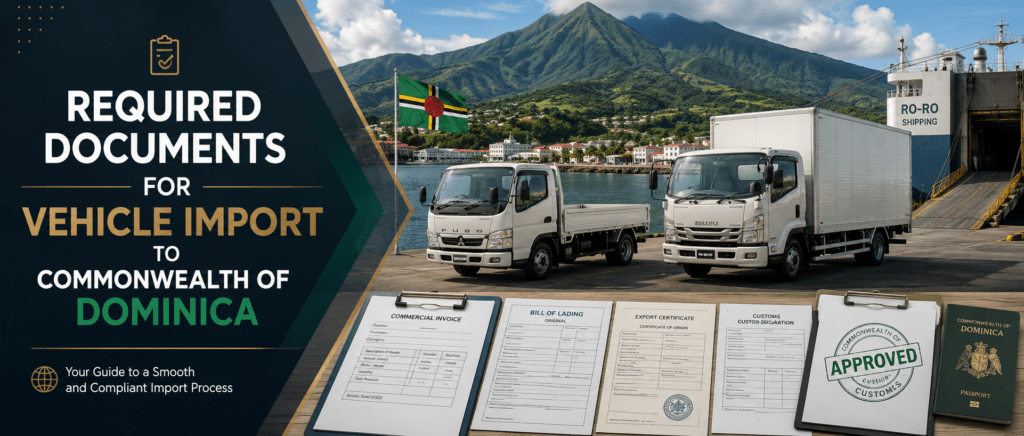

Required Documents for Vehicle Import to Commonwealth of Dominica
A Complete Guide for Importing Used Trucks from Japan with Confidence
Importing a used truck from Japan to the Commonwealth of Dominica can be a smart business decision. However, smooth import does not depend only on the vehicle itself.
It also depends on correct documents.
For many Dominica buyers, paperwork may feel confusing at first. Yet, once you understand each document, the process becomes much easier. Moreover, good preparation helps you avoid customs delays, port storage charges, and unexpected costs.
Dominica is a small but highly active island economy. Agriculture, construction, tourism, retail supply, and public works all depend on reliable commercial vehicles. Therefore, many businesses need strong used trucks that can handle steep roads, narrow village routes, and daily cargo work.
Japanese used trucks are a strong match for this market. They are right-hand drive, fuel-efficient, durable, and easy to operate on Dominica’s roads. In addition, popular models like Isuzu Elf, Toyota Dyna, Mitsubishi Fuso Canter, Hino Dutro, and Hino Ranger are trusted by many Caribbean buyers.
Still, even the best truck cannot leave the port without the correct import documents.
This guide explains the required documents for vehicle import to Dominica. It also shows how each document supports customs clearance, registration, and business use.
Why Documents Matter When Importing Vehicles to Dominica
Dominica imports many goods by sea. Vehicles, trucks, spare parts, construction supplies, and retail goods often arrive through the island’s port system.
Because of this, customs must check every shipment carefully.
For vehicle imports, documents confirm:
- Who owns the vehicle
- What vehicle arrived
- How much the vehicle cost
- Where the vehicle came from
- Which ship carried the vehicle
- Which taxes and duties apply
Therefore, documents protect both the buyer and the authorities.
If one document has a wrong chassis number, the clearance process may stop. If the invoice value is unclear, customs may request more proof. If the Bill of Lading is missing, the buyer may not claim the truck.
As a result, preparation is very important.
Dominica’s Real Transport Environment
Before looking at the documents, it helps to understand the local market.
Dominica is not a flat island. It has mountains, rainforest areas, coastal roads, and many steep routes. Therefore, commercial vehicles must work harder than vehicles in many other markets.
A truck in Dominica may need to carry goods from Roseau to rural communities. It may climb hilly roads with agricultural produce. Also, it may support construction work in areas with narrow access.
Because of these conditions, buyers often choose Japanese used trucks.
They offer:
- Strong diesel engines
- Good fuel economy
- Compact body sizes
- Reliable braking systems
- High durability
- Easy daily operation
However, the import process must go smoothly. Otherwise, the truck may sit at the port while the business waits.
That is why correct documents are essential.
Main Required Documents for Vehicle Import to Dominica
The required documents may vary by shipment, vehicle type, and importer status. However, most used vehicle imports from Japan need several key documents.
Below are the main documents Dominica buyers should prepare.
1. Commercial Invoice
The Commercial Invoice is one of the most important documents.
It shows the transaction between the seller and the buyer. It also helps customs calculate duties and taxes.
A good invoice should include:
- Exporter name
- Importer name
- Vehicle make and model
- Year of manufacture
- Chassis number
- Engine number, if available
- Vehicle price
- Freight cost, if included
- Insurance cost, if included
- Total CIF or FOB value
- Payment details
For Dominica buyers, the invoice must be clear and accurate.
For example, if you import an Isuzu Elf from Japan, the invoice should show the correct chassis number. It should also match the export documents and Bill of Lading.
If the invoice has errors, customs may delay clearance. Therefore, always check the invoice before shipment.
2. Original Bill of Lading
The Bill of Lading is the main shipping document.
It proves that the shipping company accepted the vehicle for transport. It also gives the importer the right to claim the vehicle after arrival.
The Bill of Lading usually shows:
- Shipper name
- Consignee name
- Notify party
- Vessel name
- Port of loading
- Port of discharge
- Vehicle details
- Chassis number
- Freight terms
For Dominica imports, this document is especially important.
Without the correct Bill of Lading, the importer may face serious delays at the port. In many cases, the original document must match the shipping agent’s records.
Therefore, buyers should confirm all details early.
3. ASYCUDA Bill of Lading
Dominica uses customs systems that support electronic processing.
The ASYCUDA Bill of Lading helps customs match shipment data with the import declaration. It connects the shipping record to the customs clearance process.
This document may come from the shipping agent or broker.
It helps confirm:
- Cargo arrival
- Shipment details
- Vessel information
- Import declaration data
For first-time importers, this part may feel technical. However, a customs broker can usually assist.
Therefore, working with an experienced local agent is useful.
4. Japanese Export Certificate
The Japanese Export Certificate is another key document.
When a vehicle leaves Japan, it must be deregistered for export. Japan then issues an export certificate. This document proves that the vehicle can legally leave Japan.
It may include:
- Chassis number
- Make and model
- Engine displacement
- Vehicle weight
- First registration date
- Previous registration details
For Dominica buyers, this document helps confirm the vehicle identity.
It is also useful during registration after customs clearance.
In many cases, exporters provide the original Japanese document with an English translation. This makes the process easier for buyers and authorities.
5. English Translation of Export Certificate
Japanese export documents are often written in Japanese.
Therefore, an English translation helps local authorities understand the vehicle details clearly.
The translation may show:
- Vehicle name
- Model code
- Chassis number
- Engine size
- Fuel type
- Weight
- Date of first registration
This document is not just helpful. It can also prevent misunderstanding.
For example, customs may need to check engine size for duty calculation. Registration officers may also need clear vehicle data.
Therefore, always ask the exporter for an English translation.
6. Freight Invoice
If freight does not appear clearly on the Commercial Invoice, a separate Freight Invoice may be needed.
This document shows the shipping cost from Japan to Dominica.
It may include:
- Shipping company
- Route
- Vessel name
- Freight amount
- Payment terms
Dominica customs may use freight cost when calculating customs value.
Therefore, the amount must be accurate.
This is especially important when the vehicle is purchased under FOB terms. Under FOB, the buyer arranges freight separately. As a result, customs may ask for proof of shipping cost.
7. Marine Insurance Certificate
Marine insurance protects the vehicle during transport.
If you purchase the truck under CIF terms, insurance may already be included. If you buy under FOB or C&F terms, you may need to arrange insurance separately.
The Insurance Certificate may show:
- Insured value
- Vehicle details
- Voyage information
- Coverage period
- Insurance company
For Dominica buyers, insurance is highly recommended.
Shipping routes are long. Also, vehicles may pass through multiple ports before arrival. Therefore, insurance gives peace of mind.
Even if the vehicle arrives safely, the certificate can help support customs value.
8. Packing List
For a single RORO vehicle, the Packing List may be simple.
However, it can still help customs understand the shipment.
It may include:
- Vehicle description
- Chassis number
- Quantity
- Weight
- Any spare parts or items included
If the vehicle ships by container, the Packing List becomes more important.
For example, a buyer may ship a truck with spare tires, filters, or small parts. In that case, customs needs clear details.
Therefore, list all items honestly.
9. Proof of Payment
Customs may ask for proof of payment in some cases.
This document helps confirm the true transaction value.
Proof of payment may include:
- Bank transfer receipt
- Telegraphic transfer copy
- Payment confirmation
- Seller receipt
For business importers, this document is especially useful.
It can help show that the invoice value reflects the actual payment.
Therefore, keep all payment records safely.
10. Import Declaration
The Import Declaration is part of the customs process in Dominica.
A customs broker usually prepares this document. It includes vehicle details, value, tariff information, and duty calculation.
The declaration may require:
- Invoice details
- Bill of Lading details
- Customs value
- Duty rate
- Taxes and charges
- Importer information
This document must match all supporting papers.
If the chassis number or value does not match, customs may request corrections. As a result, the process may take longer.
Therefore, accuracy is key.
11. Tax and Duty Payment Receipt
After customs assesses the vehicle, the importer must pay the required duties and taxes.
After payment, you should receive proof of payment.
This receipt is important because it shows that the vehicle can move forward in the release process.
Keep this document carefully.
You may need it for:
- Port release
- Vehicle registration
- Company records
- Future resale
12. Port Release Documents
After customs clearance, the vehicle must be released from the port.
Port release documents may include:
- Delivery order
- Customs release
- Payment receipt
- Shipping agent release
- Identification documents
The exact process may depend on the shipping agent and port procedures.
However, the main point is simple. You need proof that customs and the shipping company have approved release.
Therefore, coordinate early with your broker and agent.
13. Importer Identification Documents
The importer must prove identity.
For an individual buyer, this may include:
- National ID
- Passport
- Driver’s license
- Taxpayer information, if required
For a company, this may include:
- Business registration
- Company tax information
- Authorization letter
- Director or representative ID
This is important because customs must confirm who imports the vehicle.
If a company imports trucks for construction or distribution, company documents should be ready before the vehicle arrives.
14. Authorization Letter
If someone clears the truck on behalf of the importer, an authorization letter may be needed.
This letter allows a broker, agent, or representative to handle the process.
It should include:
- Importer name
- Representative name
- Vehicle details
- Chassis number
- Permission statement
- Signature and date
This helps avoid confusion at customs and port offices.
For busy business owners, this document is very useful.
15. Vehicle Condition Report
A Vehicle Condition Report may not always be mandatory. However, it is very helpful.
It can include:
- Exterior photos
- Interior photos
- Engine photos
- Mileage
- Rust condition
- Tire condition
- Truck bed condition
For Dominica, condition matters a lot.
The island’s roads can be steep and demanding. Also, coastal air can affect metal parts over time. Therefore, buyers should choose vehicles with strong underbody condition.
A good condition report helps buyers avoid poor-quality trucks.
16. Inspection Report from Japan
Some exporters provide a pre-export inspection report.
This report may check:
- Engine condition
- Transmission
- Brakes
- Lights
- Tires
- Rust
- Oil leaks
- Truck body condition
For Dominica buyers, this gives extra confidence before shipment.
It also helps businesses choose trucks that can start work quickly after arrival.
How These Documents Support Dominica Businesses
Correct documents do more than complete customs clearance.
They support real business needs.
For Agriculture
Farmers and produce dealers need trucks quickly.
A delay can affect transport of bananas, root crops, vegetables, and market goods. Therefore, fast clearance helps protect income.
For Construction
Construction companies need trucks for cement, blocks, sand, tools, and equipment.
If a dump truck or flatbed truck waits too long at the port, work may slow down.
For Tourism Supply
Hotels and restaurants depend on steady deliveries.
A refrigerated truck or box truck can support food, drinks, linen, and maintenance supplies.
For Retail Distribution
Shops and wholesalers need reliable transport between Roseau, Portsmouth, and other communities.
Therefore, clean paperwork helps keep supply chains moving.
Common Document Mistakes to Avoid
Many import delays happen because of small mistakes.
Avoid these common problems:
- Wrong chassis number
- Missing original Bill of Lading
- Unclear invoice value
- No English translation
- Missing freight cost
- Incorrect consignee name
- Late broker communication
- Unpaid port charges
Fortunately, most of these problems are easy to avoid.
Check every document before the vessel arrives.
Why Chassis Number Accuracy Is So Important
The chassis number connects all documents.
It appears on:
- Invoice
- Bill of Lading
- Export Certificate
- Import Declaration
- Registration documents
Therefore, one wrong letter or number can create a serious issue.
Before shipment, compare the chassis number across every document.
This simple step can save days of delay.
CIF, FOB, and Document Differences
Shipping terms also affect your documents.
CIF
CIF means Cost, Insurance, and Freight.
This is easier for many Dominica buyers because the exporter arranges the shipping and insurance.
You usually receive:
- Invoice with CIF value
- Bill of Lading
- Insurance document
- Export documents
FOB
FOB means Free on Board.
The buyer arranges freight and insurance separately.
In this case, customs may need extra proof of freight and insurance costs.
C&F
C&F means Cost and Freight.
Shipping is included, but insurance is not.
Therefore, buyers should arrange insurance and keep the certificate.
For first-time buyers in Dominica, CIF is often the easiest option.
RORO vs Container Documents
The shipping method can also affect paperwork.
RORO Shipping
RORO is common for trucks.
The vehicle is driven onto the vessel and driven off at arrival.
Documents are usually simpler.
Container Shipping
Container shipping may need a more detailed Packing List.
It may also include container number, seal number, and stuffing details.
If you ship spare parts with the truck, list them clearly.
Best Practice Before the Vehicle Arrives
Do not wait until the vessel reaches Dominica.
Instead, prepare early.
Before arrival, confirm:
- Original Bill of Lading status
- Invoice accuracy
- Export Certificate details
- Broker readiness
- Freight and insurance records
- Importer ID documents
- Funds for duties and taxes
As a result, you can move faster after arrival.
Why Work with a Trusted Japanese Exporter
A trusted exporter makes the import process much easier.
A professional exporter can:
- Prepare accurate documents
- Confirm chassis numbers
- Provide clear photos
- Explain shipping terms
- Arrange RORO or container shipping
- Support communication before arrival
For Dominica buyers, this support is valuable.
The distance between Japan and Dominica is long. Therefore, clear communication builds trust.
Best Truck Types for Dominica Importers
Dominica buyers should choose trucks based on road conditions and business use.
Light-Duty Trucks
Best for:
- Retail delivery
- Small farms
- Local shops
- Service businesses
Recommended models:
Medium-Duty Trucks
Best for:
- Construction
- Building material transport
- Larger farms
- Wholesale distribution
Recommended models:
Special-Purpose Trucks
Best for:
- Refrigerated delivery
- Water service
- Utility work
- Municipal work
These trucks may need extra checks before import.
Therefore, confirm specifications carefully.
Final Checklist for Dominica Vehicle Import Documents
Before shipping, prepare this checklist:
- Commercial Invoice
- Original Bill of Lading
- ASYCUDA Bill of Lading
- Japanese Export Certificate
- English Translation
- Freight Invoice
- Marine Insurance Certificate
- Packing List
- Proof of Payment
- Import Declaration
- Tax and Duty Payment Receipt
- Port Release Documents
- Importer ID
- Business Registration, if applicable
- Authorization Letter, if needed
- Vehicle Condition Report
- Inspection Report, if available
This checklist helps you stay organized.
Moreover, it reduces the risk of delay.
Final Thoughts
Importing a used vehicle from Japan to the Commonwealth of Dominica is a strong opportunity for business growth.
Japanese used trucks are reliable, practical, and well-suited to Dominica’s mountain roads, coastal climate, and active commercial sectors. However, success depends on proper preparation.
Documents are the foundation of smooth import.
With the correct invoice, Bill of Lading, export certificate, customs declaration, and supporting records, buyers can clear vehicles faster and avoid unnecessary problems.
Therefore, always check your documents early. Work with a trusted exporter. Communicate with your broker. Also, plan your full cost before the vehicle arrives.
When you prepare well, importing a Japanese used truck to Dominica becomes simple, clear, and profitable.


Browse Reliable Used Trucks & Buses from Japan
Carefully selected vehicles ready for export worldwide
Search 100,000+ Dealer Stock Vehicles from Japan
Access a wide selection of vehicles from Japanese dealers nationwide. Updated daily.
