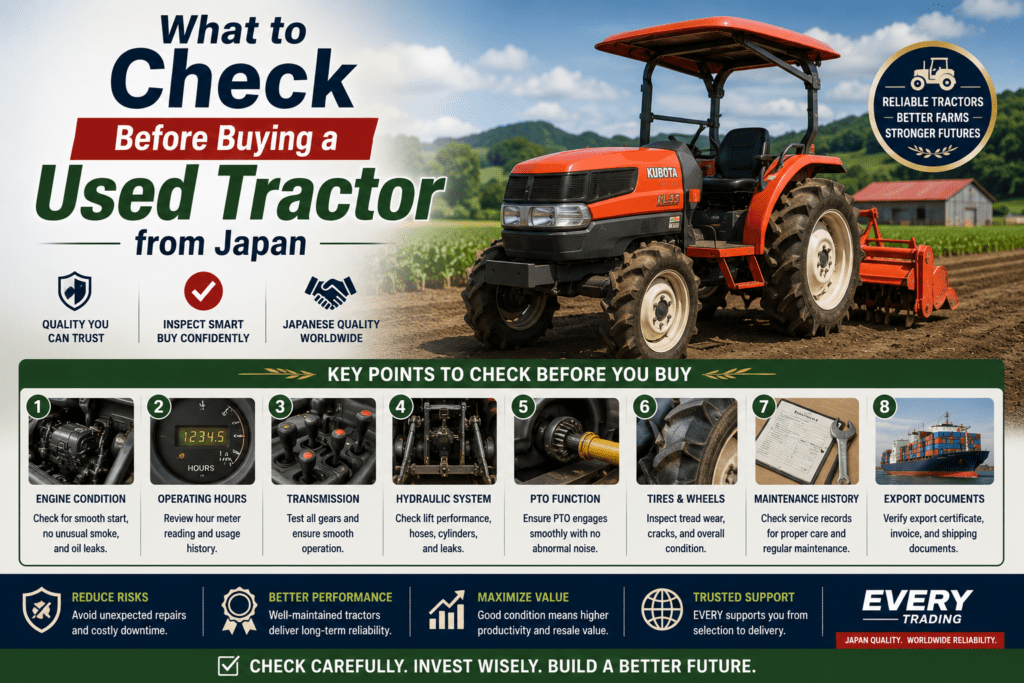

What to Check Before Buying a Used Tractor from Japan
Quality, Trust & Inspection
Japanese used tractors have become increasingly popular among farmers, agricultural businesses, dealers, and equipment buyers around the world. Their reputation for reliability, fuel efficiency, durability, and long service life makes them a smart investment for many agricultural operations.
However, buying a used tractor requires more than simply choosing a well-known brand. Buyers should carefully evaluate the tractor's condition, history, specifications, and documentation before making a purchase.
A thorough inspection can help reduce risks and improve long-term satisfaction.
At EVERY, we have helped customers source quality tractors from Japan since 2006. Therefore, we understand the factors that matter most when purchasing agricultural equipment.
In this guide, we explain the most important points buyers should check before purchasing a used tractor from Japan.
Why Proper Inspection Matters
A tractor is a long-term investment.
Farmers rely on tractors for daily operations such as:
- Land preparation
- Cultivation
- Planting
- Harvesting
- Transport work
- Property maintenance
Therefore, reliability and performance are critical.
Moreover, identifying potential issues before purchase can save significant repair costs later.
As a result, inspection should always be a priority.
Start with the Right Tractor Size
Before evaluating condition, buyers should determine the correct tractor size.
Different farming operations require different horsepower ranges.
Small Farms
Typical range:
- 15HP to 30HP
Suitable for:
- Vegetable farming
- Small orchards
- Property maintenance
Medium Farms
Typical range:
- 30HP to 60HP
Suitable for:
- Mixed farming
- Field cultivation
- General agricultural work
Large Farms
Typical range:
- 60HP and above
Suitable for:
- Commercial agriculture
- Large-scale cultivation
- Heavy-duty applications
Therefore, selecting the correct size should be the first step.
Check Engine Condition
The engine is one of the most important tractor components.
A healthy engine provides dependable performance and reduces future repair costs.
Buyers should evaluate:
- Starting performance
- Engine noise
- Exhaust smoke
- Oil leaks
- Fluid condition
Furthermore, smooth engine operation often indicates proper maintenance.
Consequently, engine condition deserves careful attention.
Verify Operating Hours
Unlike trucks and passenger vehicles, tractors often use hour meters instead of mileage.
Operating hours provide valuable information regarding usage levels.
Generally:
- Lower hours indicate less use
- Moderate hours may still offer excellent value
- Extremely high hours require additional evaluation
However, hours alone do not determine quality.
Therefore, buyers should combine hour readings with overall condition assessments.
Inspect the Transmission System
The transmission directly affects tractor performance.
Whether the tractor uses manual, shuttle shift, powershift, or hydrostatic transmission, proper operation is essential.
Buyers should check:
- Smooth gear engagement
- Transmission response
- Abnormal noises
- Fluid condition
Consequently, transmission inspection helps identify potential concerns early.
Examine the PTO (Power Take-Off)
Many agricultural implements rely on the PTO system.
Therefore, PTO functionality is extremely important.
Inspect:
- PTO engagement
- PTO operation
- Shaft condition
- Abnormal vibrations
Moreover, PTO repairs can be expensive.
As a result, verification before purchase is highly recommended.
Check the Hydraulic System
Hydraulics power many agricultural attachments.
A weak hydraulic system can significantly reduce productivity.
Buyers should inspect:
- Hydraulic lift performance
- Hose condition
- Cylinder operation
- Hydraulic leaks
Furthermore, smooth lifting performance often indicates good system health.
Evaluate Tires Carefully
Tires represent a significant operating expense.
Therefore, buyers should examine:
- Tread depth
- Sidewall condition
- Cracks
- Uneven wear
- Matching tire sets
As a result, buyers can better estimate future replacement costs.
Inspect the Exterior Condition
Exterior condition often provides clues regarding overall care.
Look for:
- Rust
- Damage
- Weld repairs
- Frame condition
- Paint quality
Although cosmetic issues may not affect performance, they can reveal maintenance habits.
Therefore, exterior inspection remains valuable.
Review Maintenance History
Maintenance records provide important insight into tractor ownership.
Well-maintained tractors often deliver:
- Better reliability
- Longer lifespan
- Lower repair costs
- Improved resale value
When available, review records such as:
- Oil changes
- Filter replacements
- Hydraulic servicing
- Major repairs
Consequently, maintenance history helps buyers make informed decisions.
Confirm Brand and Parts Availability
Popular Japanese tractor brands often provide better long-term ownership experiences.
Well-known manufacturers include:
- Kubota
- Yanmar
- Iseki
- Mitsubishi
- Shibaura
- Hinomoto
Furthermore, popular brands generally offer better spare parts availability.
Therefore, buyers should consider future maintenance support before purchasing.
Verify Four-Wheel Drive Operation
Many buyers prefer 4WD tractors.
Four-wheel drive improves:
- Traction
- Stability
- Hill performance
- Wet-condition operation
Consequently, buyers should verify proper 4WD engagement and operation.
This step is especially important for hilly or tropical farming environments.
Check Attachments and Implements
Some tractors include valuable attachments.
Examples include:
- Rotary tillers
- Front loaders
- Mowers
- Plows
- Harrows
Therefore, buyers should inspect attachment condition carefully.
Moreover, attachment value can significantly affect overall purchase value.
Review Export Documents
Documentation remains an important part of any international purchase.
Buyers should verify:
- Export Certificate
- Commercial Invoice
- Bill of Lading
- Inspection Reports
Furthermore, accurate documentation helps ensure smoother customs clearance and registration procedures.
Why Auction Sheets Matter
Many Japanese tractors are sold through auction systems.
Auction sheets often provide valuable information regarding:
- Tractor condition
- Damage history
- Operating hours
- Inspector comments
Therefore, buyers should review auction information whenever available.
Consequently, they gain additional transparency before purchase.
Work with a Trusted Exporter
Even the best tractor requires professional export support.
A reliable exporter can help with:
- Tractor sourcing
- Condition verification
- Auction interpretation
- Shipping arrangements
- Documentation preparation
As a result, buyers can purchase with greater confidence.
How EVERY Supports Tractor Buyers
At EVERY, we specialize in helping customers source quality Japanese agricultural equipment.
Our support includes:
- Professional inspections
- Auction sheet reviews
- Vehicle and machinery sourcing
- Transparent communication
- Export documentation assistance
- Reliable shipping support
Moreover, we have served customers in more than 100 countries since 2006.
Therefore, buyers can rely on our experience throughout the purchasing process.
Common Mistakes Buyers Should Avoid
Avoid these common mistakes:
- Focusing only on price
- Ignoring maintenance history
- Overlooking operating hours
- Skipping document verification
- Choosing the wrong horsepower range
- Ignoring parts availability
Consequently, careful planning helps improve purchasing outcomes.
Final Thoughts
Buying a used tractor from Japan can be an excellent investment when approached correctly.
Japanese tractors offer outstanding reliability, fuel efficiency, durability, and long-term value. However, successful purchasing requires careful evaluation.
By checking engine condition, operating hours, transmission performance, hydraulics, maintenance history, documentation, and overall condition, buyers can make smarter decisions and reduce risks.
Since 2006, EVERY has proudly supported customers worldwide with quality Japanese tractors, trucks, buses, and machinery. Through professional inspections, transparent communication, and trusted export services, we help buyers source agricultural equipment from Japan with confidence.
When buying a used tractor, careful inspection today can lead to years of dependable performance tomorrow.


Browse Reliable Used Trucks & Buses from Japan
Carefully selected vehicles ready for export worldwide
Search 100,000+ Dealer Stock Vehicles from Japan
Access a wide selection of vehicles from Japanese dealers nationwide. Updated daily.
