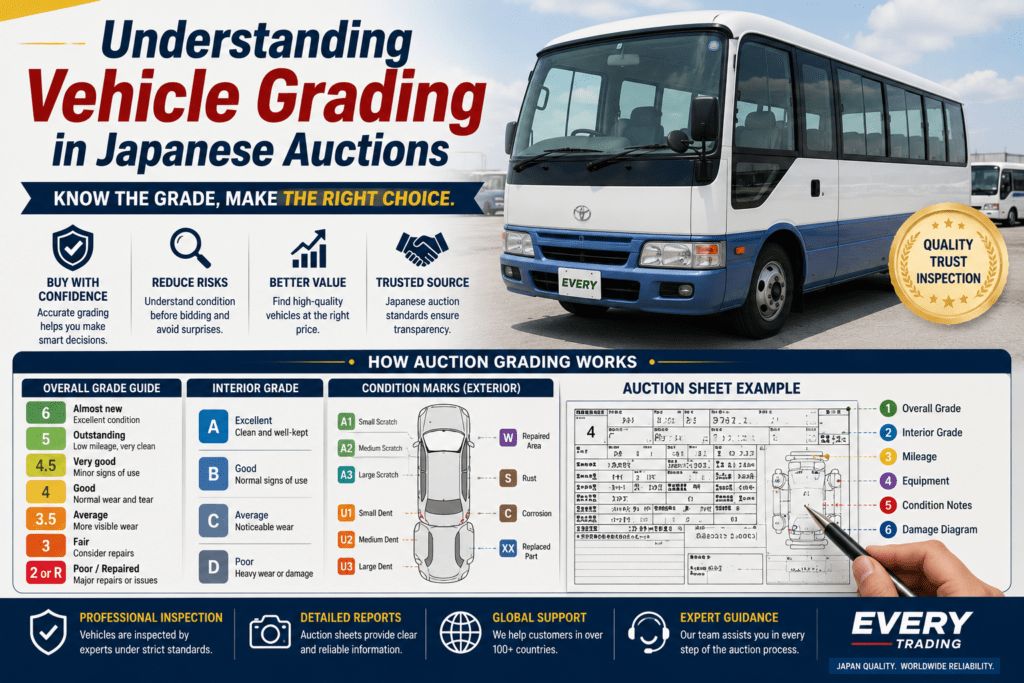

Understanding Vehicle Grading in Japanese Auctions
Quality, Trust & Inspection
Japanese vehicle auctions are among the largest and most trusted used vehicle marketplaces in the world. Every week, thousands of trucks, buses, tractors, commercial vehicles, and passenger cars become available through auction networks across Japan.
However, buying from Japanese auctions requires more than simply looking at photos and prices.
Successful buyers understand one important system that helps evaluate vehicle quality before bidding.
That system is vehicle grading.
Japanese auction grades provide valuable information about a vehicle's overall condition. Moreover, they help buyers compare vehicles more accurately and make smarter purchasing decisions.
At EVERY, we help customers understand auction grades and inspection reports every day. Therefore, we know how important this information is when sourcing quality vehicles from Japan.
In this guide, we explain how Japanese vehicle grading works and how buyers can use grading information to purchase with confidence.
What Is Vehicle Grading?
Vehicle grading is a condition evaluation system used by Japanese auction houses.
Professional inspectors evaluate each vehicle and assign a grade based on its condition.
The grading process helps buyers understand:
- Overall vehicle quality
- Exterior condition
- Interior condition
- Repair history
- General wear and tear
As a result, buyers can compare vehicles more efficiently before bidding.
Why Auction Grades Matter
Many international buyers cannot inspect vehicles personally.
Therefore, auction grades provide an important source of information.
Auction grades help buyers:
- Reduce purchasing risks
- Compare vehicles quickly
- Understand condition levels
- Identify higher-quality units
- Make informed bidding decisions
Consequently, grading systems play a critical role in the Japanese auction market.
Who Assigns Auction Grades?
Professional auction inspectors assign grades.
These inspectors evaluate vehicles according to established auction standards.
They review:
- Exterior condition
- Interior condition
- Mechanical observations
- Repair history
- Overall appearance
Therefore, auction grades provide an independent assessment rather than a seller's opinion.
Understanding Common Overall Grades
Although grading systems vary slightly between auction companies, most follow similar standards.
Let's review the most common grades.
Grade 6
Grade 6 vehicles are almost new.
These vehicles often have:
- Extremely low mileage
- Excellent condition
- Minimal wear
Consequently, they are rare and highly desirable.
Grade 5
Grade 5 vehicles are in outstanding condition.
Typically, they feature:
- Low mileage
- Very clean interiors
- Excellent exterior condition
Therefore, many buyers consider Grade 5 vehicles premium-quality used units.
Grade 4.5
Grade 4.5 vehicles are also highly desirable.
They usually show:
- Minor wear
- Excellent maintenance
- Strong overall condition
As a result, they often provide excellent value.
Grade 4
Grade 4 is one of the most common grades in Japanese auctions.
These vehicles generally offer:
- Good condition
- Normal wear
- Well-maintained appearance
Consequently, Grade 4 vehicles remain popular among international buyers.
Grade 3.5
Grade 3.5 vehicles typically show more visible wear.
Examples may include:
- Minor scratches
- Small dents
- Interior wear
However, many Grade 3.5 vehicles still offer strong reliability and value.
Therefore, buyers should review inspection details carefully.
Grade 3
Grade 3 vehicles often require additional evaluation.
They may show:
- Higher mileage
- More cosmetic wear
- Additional repairs
Consequently, buyers should carefully review auction comments and photos before bidding.
Grade 2 and Below
Lower grades generally indicate significant wear or repair history.
These vehicles may require:
- Mechanical repairs
- Cosmetic restoration
- Additional maintenance
Therefore, experienced buyers often perform more detailed evaluations before purchasing.
Understanding "R" and "RA" Grades
Many buyers encounter R and RA grades.
These grades indicate repair history.
R Grade
An R grade usually means the vehicle has undergone repair work.
RA Grade
An RA grade often indicates lighter repair history.
However, repair history does not automatically mean poor quality.
Therefore, buyers should review inspection details carefully.
Many repaired vehicles continue to perform very well.
Interior Grades Explained
Auction houses often assign separate interior grades.
Common interior grades include:
A Grade
Excellent condition.
B Grade
Normal wear for age and mileage.
C Grade
Visible wear or damage.
D Grade
Significant wear requiring attention.
Therefore, interior grades provide additional insight beyond the overall vehicle grade.
Exterior Condition Markings
Japanese auction reports include diagrams showing vehicle condition.
Inspectors use symbols to identify imperfections.
Common examples include:
A1
Small scratch.
A2
Moderate scratch.
A3
Large scratch.
U1
Small dent.
U2
Moderate dent.
U3
Large dent.
W
Repaired area.
S
Rust.
C
Corrosion.
Consequently, buyers can identify specific exterior issues before bidding.
Why Auction Sheets Are Important
Auction grades provide a summary.
However, auction sheets provide more detailed information.
Auction sheets often include:
- Overall grade
- Interior grade
- Exterior notes
- Mileage
- Repair history
- Inspector comments
Therefore, buyers should always review the complete auction sheet whenever possible.
Mileage and Vehicle Grade
Many buyers assume higher grades always mean lower mileage.
However, this is not always true.
A well-maintained vehicle with moderate mileage may receive a better grade than a poorly maintained vehicle with lower mileage.
Therefore, buyers should evaluate:
- Grade
- Mileage
- Maintenance history
- Inspection comments
Together rather than individually.
Why Professional Interpretation Matters
Japanese auction sheets contain specialized terminology.
Additionally, many comments appear in Japanese.
Therefore, understanding auction information can be challenging for overseas buyers.
At EVERY, we help customers interpret:
- Auction grades
- Inspector comments
- Condition diagrams
- Repair history notes
As a result, buyers gain a clearer understanding of each vehicle.
Common Mistakes Buyers Make
Some buyers focus only on overall grades.
However, this approach can lead to missed opportunities.
Avoid these mistakes:
- Ignoring auction comments
- Overlooking repair notes
- Focusing only on mileage
- Ignoring condition diagrams
- Assuming all auctions use identical grading standards
Therefore, comprehensive evaluation is always recommended.
Why Auction Grades Improve Transparency
One reason Japanese auctions are respected worldwide is transparency.
The grading system provides:
- Independent inspections
- Standardized evaluations
- Detailed condition reporting
- Consistent information
Consequently, buyers can make more informed decisions.
Furthermore, grading systems help reduce uncertainty when purchasing internationally.
How EVERY Helps Buyers Source Quality Vehicles
At EVERY, we help customers navigate Japanese auctions with confidence.
Our support includes:
- Auction sheet translation
- Grade interpretation
- Vehicle sourcing
- Inspection support
- Export documentation assistance
- Shipping coordination
Moreover, we explain auction information clearly so buyers understand exactly what they are purchasing.
Why Understanding Grades Saves Money
Smart bidding starts with understanding vehicle condition.
When buyers understand auction grades, they can:
- Avoid unnecessary risks
- Identify better-value vehicles
- Improve purchasing decisions
- Control costs
- Increase profitability
Therefore, grading knowledge becomes a valuable business tool.
Final Thoughts
Japanese auction grading systems help buyers evaluate vehicle quality before purchase. Understanding grades, inspection reports, repair history, and condition diagrams allows buyers to make informed decisions and reduce purchasing risks.
While grades provide valuable information, they should always be reviewed together with auction sheets, photographs, inspection reports, and exporter guidance.
At EVERY, we help customers understand every aspect of Japanese auction vehicles. Since 2006, we have supported buyers in more than 100 countries by providing professional advice, transparent information, and reliable export services.
When you understand auction grades, you gain a powerful advantage in sourcing quality vehicles from Japan with confidence.


Browse Reliable Used Trucks & Buses from Japan
Carefully selected vehicles ready for export worldwide
Search 100,000+ Dealer Stock Vehicles from Japan
Access a wide selection of vehicles from Japanese dealers nationwide. Updated daily.
