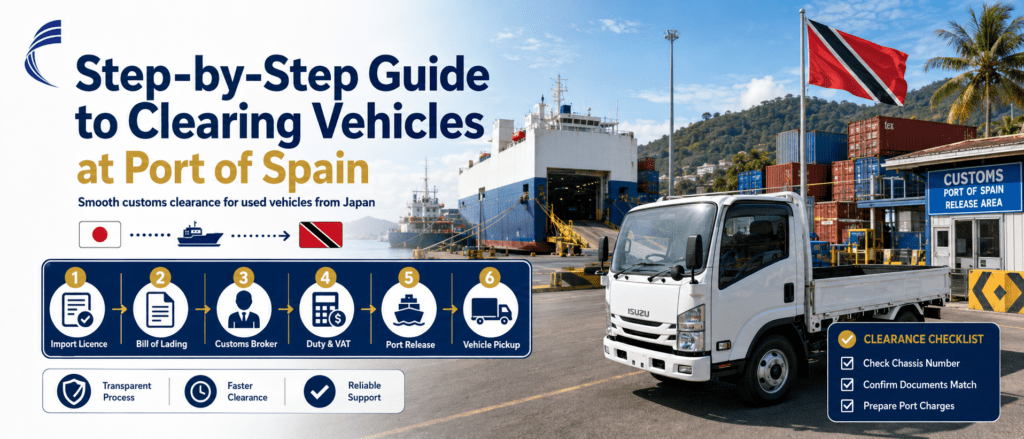

Clear Vehicles at Port of Spain Step by Step: A Smart Guide for Trinidad and Tobago Buyers
Importing a used vehicle from Japan is exciting.
However, the real work starts when the vehicle arrives in Trinidad and Tobago.
For many buyers, Port of Spain is a key arrival point. It connects overseas shipping with local business, customs, transport, and registration. Therefore, understanding the port clearance process can save time, money, and stress.
This guide explains how to clear vehicles at Port of Spain step by step.
It focuses on Trinidad and Tobago buyers. It also covers Japanese used trucks, vans, buses, pickups, and commercial vehicles. In addition, it explains the practical needs of local businesses.
If you import a truck for delivery, construction, farming, tourism, or logistics, this article will help you prepare.
Why Port Clearance Matters in Trinidad and Tobago
A used vehicle from Japan can offer strong value.
Japanese used trucks often have clean interiors, reliable diesel engines, right-hand drive layout, and strong body condition. Also, Japanese commercial vehicles work well for many Trinidad and Tobago businesses.
However, a vehicle cannot start working until it clears the port.
A truck sitting at the port cannot deliver goods. A van waiting for documents cannot serve customers. A bus without clearance cannot move passengers. So, clearance speed matters.
This is especially true for business buyers.
In Trinidad, many companies need vehicles for port delivery, hardware supply, construction jobs, food distribution, agricultural transport, and industrial service. In Tobago, buyers need vehicles for hotels, tourism, local shops, farms, and island logistics.
Therefore, a smooth port process protects your business plan.
What Happens When a Vehicle Arrives at Port of Spain?
When the vessel arrives, the vehicle enters the local import process.
The vehicle may arrive by RoRo vessel, container vessel, or another cargo method. RoRo is common for vehicles because the vehicle rolls on and rolls off the ship.
After arrival, several steps happen.
First, shipping documents must match the vehicle. Next, customs paperwork must be prepared. Then, duties and taxes must be assessed. After that, the buyer or clearing agent must complete the release process. Finally, the vehicle can leave the port.
This may sound complex.
However, the process becomes easier when you prepare early.
Step 1: Confirm the Vehicle Before It Leaves Japan
Good clearance starts before shipment.
Do not wait until the vehicle arrives in Trinidad and Tobago. Instead, confirm the details in Japan first.
You should check:
- Make and model
- Chassis number
- Engine number if needed
- Year of manufacture
- Vehicle category
- Maximum Gross Weight, also called MGW
- Body type
- Fuel type
- Right-hand drive status
- Export certificate details
- Invoice details
- Shipping terms
For commercial vehicles, this is very important.
Pickup trucks and panel vans can have different age rules from heavier trucks. Also, larger trucks may need extra approval. Therefore, check the vehicle type and MGW before shipping.
For example, a Mitsubishi Canter may suit delivery work. A Hino Ranger may suit construction supply. An Isuzu Forward may suit logistics. However, each truck must match import rules.
So, start with correct information.
Step 2: Secure the Import Licence Before Shipment
The Import Licence is a key step.
Used right-hand drive vehicles need approval before import. For commercial vehicles, the application should match the real business purpose.
This is where many buyers make mistakes.
They find a good truck in Japan. Then, they rush to ship it. After that, they realize the import licence is not ready.
That can create serious delays.
Therefore, get approval before shipment.
Commercial buyers should prepare:
- Business registration documents
- Cover letter
- Vehicle details
- Purpose of import
- Proof of commercial activity
- Existing fleet details if needed
- Chassis number evidence
- MGW information
- Agricultural documents if the vehicle is for farming
- Transport Board approval if required for heavy trucks
Also, explain the business use clearly.
A delivery company may import a box truck. A contractor may import a dump truck. A farm may import a flatbed. A hotel supplier may import a clean light-duty truck.
Clear purpose helps the application.
Step 3: Choose a Good Customs Broker
A customs broker is very important in Trinidad and Tobago.
The broker helps prepare customs forms, calculate charges, and guide the release process. Also, the broker can help prevent document mistakes.
For vehicle clearance at Port of Spain, a broker can handle many practical steps.
These may include:
- Customs declaration
- C82 or related customs forms
- Duty and tax calculation
- Document submission
- Port release coordination
- Advice on inspections
- Communication with customs
- Guidance on payment steps
Choose a broker before the vessel arrives.
Do not wait until the vehicle lands. If you wait too long, the vehicle may collect storage charges.
Ask your broker what documents they need. Then, send copies early.
Step 4: Collect All Required Documents
Documents control the clearance process.
If one document is missing, the vehicle may not move. If the chassis number is wrong, the broker may need corrections. If the consignee name does not match, release may become difficult.
Prepare these documents early:
- Import Licence
- Commercial Invoice
- CARICOM Area Invoice if needed
- Bill of Lading
- Export Certificate from Japan
- Certificate of Origin if needed
- Freight invoice
- Insurance document if CIF
- Payment proof
- Importer ID
- Business registration documents
- Customs declaration documents
- Broker authorization if needed
Also, keep digital and printed copies.
Many delays start with small errors.
Therefore, compare every document.
The chassis number must match. The buyer name must match. The vehicle description must match. The port name must match.
This simple check can save days.
Step 5: Track the Vessel Arrival
Once the vehicle leaves Japan, track the vessel.
Ask your exporter or shipping agent for:
- Vessel name
- Voyage number
- Estimated arrival date
- Port of discharge
- Bill of Lading copy
- Shipping line contact
- Any transshipment details
Arrival dates can change.
Weather, port schedules, and shipping routes may affect timing. Therefore, keep checking updates.
For Port of Spain, timing matters because your broker needs documents before arrival. Also, you may need to arrange funds for duties, taxes, and local charges.
So, do not wait for the vessel to arrive before planning.
Step 6: Check the Bill of Lading Carefully
The Bill of Lading is one of the most important shipping documents.
It proves that the vehicle shipped. It also shows who can receive it.
Check these details:
- Consignee name
- Notify party
- Vehicle description
- Chassis number
- Vessel name
- Port of loading
- Port of discharge
- Freight terms
- Shipping line information
If the consignee name is wrong, release may slow down.
If the chassis number is wrong, customs may ask for correction. If the port is wrong, the cargo process can become confusing.
Therefore, check the draft before the final document.
Ask for correction early if needed.
Step 7: Prepare for Customs Valuation
Customs will assess the vehicle value.
This step affects duties and taxes. Therefore, the invoice, freight cost, and insurance details must be clear.
Your broker may ask for:
- Vehicle invoice
- Freight amount
- Insurance amount
- Payment receipt
- Exporter invoice
- Auction invoice if needed
- Any other proof of value
The customs value may depend on the vehicle cost, freight, insurance, and other related costs.
So, prepare full information.
For business buyers, this helps with cash planning.
A low FOB price is not the full cost. You must also consider shipping, customs charges, port charges, broker fees, inspection costs, and registration costs.
Therefore, calculate the landed cost before buying.
Step 8: Pay Duties, Taxes, and Local Charges
After customs assessment, the buyer must pay the required charges.
These may include:
- Customs duty
- VAT
- Motor vehicle tax or related tax
- Port charges
- Handling charges
- Storage charges if delayed
- Broker fees
- Shipping line release fees
- Inspection fees if required
- Registration-related fees
Costs can vary by vehicle type.
A light delivery truck may not cost the same as a heavy dump truck. A pickup may not follow the same category as a large commercial truck. Also, fuel type, engine size, vehicle age, and value can affect the final amount.
Therefore, ask for an estimate early.
This is especially important for small businesses.
A truck import can be a major investment. So, buyers should prepare funds before arrival.
Step 9: Complete Port Release Procedures
Once customs and port requirements are ready, the vehicle can move toward release.
Your broker or agent may coordinate with customs, the port, and the shipping line.
At this stage, you may need:
- Customs release
- Port release
- Shipping line release
- Payment receipts
- Bill of Lading
- Identification
- Broker documents
- Vehicle documents
The port may also check cargo status before release.
If the vehicle arrived by RoRo, it may be parked in a vehicle yard. If it arrived in a container, it may need container handling and devanning.
Therefore, the release process depends on the shipping method.
RoRo can be simple when documents are ready. However, missing papers can still cause delays.
Step 10: Arrange Vehicle Pickup from the Port
After release, arrange pickup quickly.
For a truck, you need to decide how it will leave the port.
Options may include:
- Driving it out after approval
- Towing it
- Transporting it on a carrier
- Moving it to a workshop
- Moving it to a storage yard
- Moving it to the business location
Do not assume the vehicle can drive immediately.
After a long sea journey, the battery may be weak. Tires may need air. Fluids may need checking. Also, some vehicles may need service before road use.
Therefore, plan safe movement.
For commercial trucks, this is even more important.
A dump truck, crane truck, or large cargo truck should receive a careful check before it starts work.
Step 11: Inspect the Vehicle After Release
Once the vehicle leaves the port, inspect it properly.
Do not put it into business use on the same day without checking it.
Start with basic items:
- Engine oil
- Coolant
- Brake fluid
- Battery
- Tires
- Lights
- Wipers
- Belts
- Hoses
- Brake performance
- Steering
- Suspension
- Air conditioning
- Undercarriage
- Any visible leaks
Also, compare the vehicle with the export documents.
Check the chassis number. Check the model. Check the odometer. Check the body type. Then, take photos for your records.
For Trinidad and Tobago roads, cooling and brakes are very important.
Traffic, hills, heat, and rain can test a vehicle quickly. Therefore, do not skip the first service.
Step 12: Prepare for Local Inspection and Registration
After customs clearance, the vehicle must meet local road use requirements.
The process may include roadworthiness checks and registration steps. The exact process can depend on vehicle type, age, and use.
Commercial vehicles may need extra attention.
For example, a bus may need seating and safety checks. A truck may need weight and body confirmation. A pickup or van may need standard inspection and registration.
So, ask your broker or local authority about the next step.
Prepare:
- Customs documents
- Import Licence
- Export Certificate
- Bill of Lading
- Payment receipts
- ID or business documents
- Insurance if needed
- Inspection documents
- Any roadworthiness certificate
Once registration finishes, the vehicle can start serving your business.
Practical Tips for Port of Spain Buyers
Port clearance is easier when you plan like a business.
Here are useful tips.
First, choose the right vehicle before buying. Do not buy a truck that cannot meet import rules.
Next, work with an exporter who provides clear documents. A good exporter should confirm chassis number, year, model code, and export certificate details.
Then, hire a customs broker early. The broker should see your documents before the vessel arrives.
Also, prepare money before arrival. Port charges and storage can grow if payment delays happen.
Finally, inspect the vehicle after release. A clean Japanese used truck still needs local service after shipment.
Common Delays at Port of Spain
Many delays come from simple problems.
These include:
- Import Licence not ready
- Wrong chassis number
- Missing Bill of Lading
- Wrong consignee name
- Unclear vehicle age
- Missing export certificate
- Late broker appointment
- Payment delay
- Port storage charges
- Vehicle category issue
- MGW not confirmed
- Heavy truck approval not checked
- Document mismatch
Most of these problems can be avoided.
The key is preparation.
Why Japanese Used Trucks Are Popular in Trinidad and Tobago
Japanese used trucks fit many local needs.
They offer right-hand drive layout, strong diesel engines, and practical size. Also, many models are well known across the Caribbean.
Popular choices include:
- Toyota Dyna
- Toyota Toyoace
- Isuzu Elf
- Mitsubishi Canter
- Hino Dutro
- Isuzu Forward
- Hino Ranger
- Mitsubishi Fighter
- Nissan Condor
Light trucks work well for delivery and small business. Medium trucks suit contractors, farmers, and hardware suppliers. Box trucks protect cargo from tropical rain. Dump trucks support construction. Flatbeds help with materials and equipment.
Therefore, Japan offers many options for local buyers.
Port Clearance for Different Vehicle Uses
Different industries need different planning.
Construction Vehicles
Construction buyers often import dump trucks, flatbeds, and crane trucks.
They should check hydraulic systems, chassis strength, MGW, and import approval before shipment. Also, they should plan workshop inspection after release.
Delivery and Retail Vehicles
Retail and delivery buyers often need box trucks and light-duty trucks.
They should focus on cargo space, fuel economy, easy driving, and air conditioning. Also, they should prepare fast clearance to start business quickly.
Agriculture Vehicles
Farm buyers may import pickups, light trucks, flatbeds, and sometimes tractors.
They should prepare agricultural documents if required. Also, they should check road access, tires, and underbody condition.
Tourism and Tobago Business Vehicles
Tourism and Tobago buyers may need vans, buses, pickups, or small trucks.
They should think about passenger comfort, cargo flexibility, and corrosion protection. Coastal air can affect vehicles over time.
Industrial and Energy Service Vehicles
Industrial buyers may need larger trucks, service trucks, or special vehicles.
They should confirm MGW, work equipment, and local approval rules before shipment.
How to Reduce Storage Charges
Storage charges can hurt your budget.
To reduce them, prepare early.
Send documents to your broker before arrival. Confirm the Bill of Lading. Pay charges quickly. Respond to customs questions fast. Also, keep all contacts ready.
Your exporter, shipping agent, broker, and buyer should communicate clearly.
One missing answer can delay the whole process.
Therefore, create a simple import folder.
Keep all documents in one place. Name each file clearly. Share it with your broker.
This small habit can make clearance smoother.
Why a Trusted Exporter Helps Clearance
A trusted Japanese exporter does more than sell a vehicle.
The exporter supports the import process by preparing accurate documents. This helps your broker in Trinidad and Tobago.
A reliable exporter should help with:
- Correct invoice
- Export certificate
- Chassis number confirmation
- Vehicle year confirmation
- FOB, C&F, or CIF details
- Shipping schedule
- Bill of Lading instructions
- Photos and condition details
- Communication before shipment
Also, the exporter should explain if a vehicle may not fit your import rules.
Honest advice is important.
A cheap truck is not a good deal if it cannot clear smoothly.
How EVERY Supports Trinidad and Tobago Buyers
EVERY helps overseas customers buy used vehicles from Japan with confidence.
For Trinidad and Tobago buyers, we support practical vehicle selection and export preparation.
We can help you:
- Search Japanese used trucks
- Check auction stock
- Review vehicle condition
- Confirm chassis number
- Check basic vehicle details
- Prepare export documents
- Arrange shipping from Japan
- Support FOB, C&F, or CIF quotations
- Communicate before vessel departure
- Support business buyers, dealers, and fleet operators
Also, we understand the local market.
A buyer in Port of Spain may need fast delivery vehicles. A contractor in San Fernando may need a strong dump truck. A farmer may need a flatbed or pickup. A Tobago hotel supplier may need a clean van or light truck.
Therefore, we help buyers choose vehicles based on real use.
Final Port of Spain Clearance Checklist
Before the vessel arrives, check this list:
- Import Licence approved
- Customs broker selected
- Vehicle age confirmed
- MGW confirmed for trucks
- Chassis number checked
- Invoice received
- Bill of Lading checked
- Export certificate received
- Certificate of Origin arranged if needed
- Freight and insurance details ready
- Business documents prepared
- Customs documents prepared
- Duties and taxes estimated
- Port charges expected
- Pickup plan arranged
- Workshop inspection booked
- Registration documents planned
This checklist helps reduce risk.
It also helps your vehicle start work faster.
Final Advice for Trinidad and Tobago Buyers
Clearing a vehicle at Port of Spain is easier when you prepare before shipment.
First, choose the right Japanese used vehicle. Next, confirm import eligibility. Then, secure the Import Licence. After that, send all documents to your customs broker.
Once the vehicle arrives, move quickly.
Pay charges, complete customs steps, arrange release, and inspect the vehicle. Then, continue with local registration and service.
For Trinidad and Tobago businesses, a Japanese used truck can be a powerful investment.
It can support delivery, construction, farming, tourism, logistics, and industrial work. However, that value begins only after smooth clearance.
So, plan early. Check every document. Work with trusted partners. Then, bring your vehicle from Japan into business with confidence.


Browse Reliable Used Trucks & Buses from Japan
Carefully selected vehicles ready for export worldwide
Search 100,000+ Dealer Stock Vehicles from Japan
Access a wide selection of vehicles from Japanese dealers nationwide. Updated daily.
