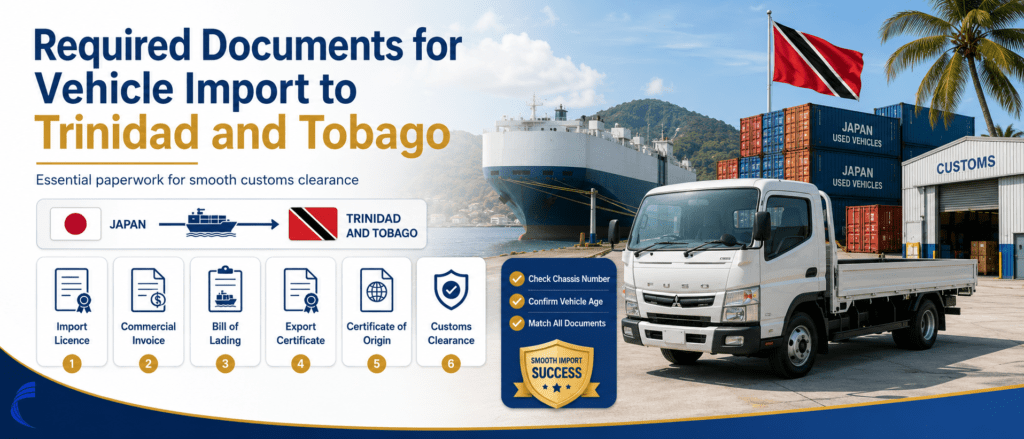

Vehicle Import Documents for Trinidad & Tobago: A Clear Guide for Japan Used Vehicle Buyers
Importing a used vehicle from Japan to Trinidad and Tobago can be a smart business choice.
Many buyers in Trinidad and Tobago choose Japanese used trucks, vans, buses, pickups, and commercial vehicles. They want strong engines, right-hand drive layout, fair prices, and long-term value.
However, a successful import does not depend only on the vehicle.
Documents matter just as much.
If one document is missing, customs clearance may slow down. If one detail is wrong, the port process may become stressful. Also, if the import licence is not ready before shipment, the buyer may face serious problems.
Therefore, this guide explains the required documents for vehicle import to Trinidad and Tobago.
It focuses on real buyers in Trinidad and Tobago. It also explains why each document matters for used Japanese vehicles, trucks, and business fleets.
Why Documents Matter for Trinidad and Tobago Buyers
Trinidad and Tobago has strong demand for reliable commercial vehicles.
In Trinidad, businesses use trucks for construction, hardware delivery, port logistics, energy services, food supply, agriculture, and retail transport. In Tobago, many buyers need vehicles for tourism, hotels, farms, small shops, and island delivery work.
Because vehicles support daily business, delays can be costly.
A truck stuck at the port cannot earn money. A van waiting for customs cannot deliver goods. A bus without proper papers cannot join service. Therefore, correct documents help protect your investment.
Also, Trinidad and Tobago has rules for used right-hand drive vehicles.
Since Japan exports right-hand drive vehicles, buyers must confirm import requirements before the vehicle leaves Japan. This step is very important.
In short, documents help you:
- Prove vehicle ownership
- Confirm vehicle age
- Confirm vehicle origin
- Support customs valuation
- Apply for an import licence
- Clear the vehicle at the port
- Register the vehicle for road use
- Avoid extra storage charges
- Reduce business delays
So, before you think only about the truck price, check the paperwork first.
Main Documents Needed for Vehicle Import
The exact document list can depend on the vehicle type, importer type, and local rules.
However, most vehicle imports from Japan to Trinidad and Tobago need several core documents.
These usually include:
- Import Licence
- Commercial Invoice or Supplier’s Invoice
- CARICOM Area Invoice
- Bill of Lading
- Export Certificate or Deregistration Certificate
- Certificate of Origin
- Age Verification Document
- Customs Declaration Form
- Importer identification
- Business documents for commercial use
- Transport Board approval for certain heavy trucks
- Insurance and freight details when needed
Next, let’s explain each document in simple terms.
1. Import Licence
The Import Licence is one of the most important documents.
Used right-hand drive vehicles need approval before shipment to Trinidad and Tobago. Therefore, buyers should not ship the vehicle first and apply later.
This is a common mistake.
The Import Licence confirms that the government allows the vehicle to enter the country. For used Japanese vehicles, this step is very important because Japan mainly exports right-hand drive vehicles.
For commercial vehicles, the application should include correct vehicle details. These may include:
- Vehicle make
- Vehicle model
- Year of manufacture
- Chassis number
- Engine number if needed
- Right-hand drive or left-hand drive
- Maximum Gross Weight, also called MGW
- Vehicle use
- Business purpose
- Importer details
For example, a buyer importing a Mitsubishi Canter for delivery work should state the vehicle type clearly. A buyer importing a Hino Ranger dump truck should also confirm the MGW.
Moreover, some heavy trucks may need extra approval.
Therefore, always check the rules before purchase.
2. Commercial Invoice or Supplier’s Invoice
The Commercial Invoice shows the sale details.
It proves the vehicle price and seller information. Customs uses this document to check the value of the vehicle.
A proper invoice should show:
- Seller name
- Buyer name
- Vehicle make
- Vehicle model
- Chassis number
- Year of manufacture
- Price
- Currency
- Payment terms
- Shipping terms, such as FOB, C&F, or CIF
This document must match other papers.
For example, the chassis number on the invoice should match the Bill of Lading and export certificate. If it does not match, the clearing process may slow down.
Also, the buyer name should be correct.
If a company imports the vehicle, the company name should match the business documents. If an individual imports it, the name should match the ID or passport.
Small mistakes can create big delays.
Therefore, check the invoice before shipment.
3. CARICOM Area Invoice
The CARICOM Area Invoice is important for goods entering the CARICOM region.
Trinidad and Tobago customs may require this document during import clearance. It supports the customs process and gives structured information about the imported goods.
For vehicle imports, it should match the main invoice details.
It may include:
- Exporter information
- Importer information
- Description of goods
- Country of origin
- Value
- Freight details
- Insurance details if applicable
- Shipping method
Since Trinidad and Tobago is part of CARICOM, this document can help customs handle the import correctly.
Therefore, buyers should ask the exporter or shipping support team about it early.
4. Bill of Lading
The Bill of Lading is a key shipping document.
It confirms that the vehicle has been loaded for sea transport. It also shows the shipping route and port details.
For used vehicles from Japan, the Bill of Lading usually includes:
- Shipper name
- Consignee name
- Notify party
- Vessel name
- Port of loading
- Port of discharge
- Vehicle description
- Chassis number
- Freight terms
- Shipping line details
This document is very important at the port.
In many cases, the consignee or authorized clearing agent uses it to receive and clear the vehicle.
So, buyers should check the consignee name carefully.
If the name is wrong, releasing the vehicle may become difficult. Also, if the original document is needed, losing it can cause serious problems.
Therefore, keep the Bill of Lading safe.
5. Export Certificate or Deregistration Certificate from Japan
A Japanese Export Certificate proves that the vehicle left the Japanese registration system.
This document is very important for used vehicle imports. It can show the vehicle’s official details from Japan.
It may include:
- Vehicle make
- Model code
- Chassis number
- Engine details
- First registration date
- Dimensions
- Weight
- Owner information
- Deregistration details
For Trinidad and Tobago buyers, this document helps confirm the vehicle’s identity.
It also helps prove the vehicle age. This matters because import rules can depend on the year of manufacture.
If the vehicle is a truck, the buyer should check the weight information too. For commercial vehicles, MGW can affect import requirements.
Therefore, do not rely only on photos.
Ask for document copies before shipment.
6. Certificate of Origin
The Certificate of Origin shows where the vehicle comes from.
For a used Japanese vehicle, it helps prove that the vehicle comes from Japan. Customs may use this document during import processing.
This document should match the invoice and shipping documents.
A Certificate of Origin is especially useful when importers need clear proof of source. It also supports transparent international trade.
For business buyers in Trinidad and Tobago, this can be useful for company records as well.
7. Age Verification Document
Vehicle age is very important.
Trinidad and Tobago has age rules for used vehicles. These rules can differ by vehicle type. Therefore, buyers need proof of the vehicle’s age before import.
For Japanese used vehicles, age may come from:
- Export Certificate
- Deregistration Certificate
- Manufacture year data
- Auction sheet information
- Official vehicle record
- Exporter confirmation
However, do not depend only on the auction listing.
Always confirm the age through proper documents.
For example, a commercial pickup, panel van, or truck may need to fit a specific age limit. A heavier truck may also need extra attention due to MGW rules.
Therefore, verify the year before buying.
This step can save a lot of money.
8. Customs Declaration Form
The Customs Declaration Form supports the clearance process.
In Trinidad and Tobago, importers must submit customs information and pay duties and taxes before the goods can clear.
For commercial goods, a customs broker normally helps with the process.
This is important for business buyers.
A broker can help prepare the declaration, calculate duties, submit documents, and guide the buyer through port procedures.
For vehicle imports, the declaration should match the invoice, Bill of Lading, and vehicle documents.
Again, consistency matters.
If the vehicle description changes between documents, customs may ask questions.
9. Importer Identification
The importer must prove identity.
For an individual buyer, this may include a passport, driver’s permit, or national ID.
For a company, documents may include business registration details and company information.
Commercial vehicle buyers should prepare business records early.
This can help show why the vehicle is needed. For example, a construction company may import a dump truck. A logistics company may import a box truck. A farm may import a flatbed truck or pickup.
Clear business purpose can support the application.
Therefore, prepare your identity and business documents before applying.
10. Business Purpose Documents for Commercial Vehicles
Commercial vehicle imports are different from personal vehicle imports.
A business may need to explain how the vehicle will be used.
This is important in Trinidad and Tobago because commercial vehicles support many industries.
These include:
- Construction
- Hardware supply
- Agriculture
- Food distribution
- Retail delivery
- Energy services
- Industrial maintenance
- Tourism support
- Port logistics
- Inter-island business
For example, a contractor in San Fernando may need a dump truck for road and drainage work. A shop in Chaguanas may need a box truck for goods delivery. A hotel supplier in Tobago may need a clean light-duty truck for regular deliveries.
Therefore, the buyer should prepare a simple and clear explanation.
Good documents make the application stronger.
11. Transport Board Approval for Some Heavy Trucks
Some heavy vehicles may need extra approval.
This can depend on the Maximum Gross Weight of the truck. Therefore, buyers importing larger commercial trucks should check this before purchase.
This is very important for:
- Heavy-duty trucks
- Large dump trucks
- Large cargo trucks
- Special purpose trucks
- Garbage compactors
- Industrial service trucks
A buyer should check the MGW on the Japanese vehicle documents. Then, the buyer should confirm local requirements with the relevant authority or clearing agent.
Do this before shipment.
A heavy truck can be expensive to ship. So, eligibility must be clear before the vehicle leaves Japan.
12. Freight and Insurance Documents
Freight and insurance documents may also support customs valuation.
If the vehicle price is C&F, the freight cost is included. If the price is CIF, insurance is also included.
Customs may need to see how the total value was calculated.
Therefore, buyers should keep:
- Freight invoice
- Insurance certificate if applicable
- C&F or CIF quotation
- Payment receipt
- Exporter statement if needed
This helps the clearing agent calculate the landed cost.
It also helps the buyer understand total expenses.
Why Trinidad and Tobago Buyers Should Prepare Early
Timing matters in vehicle import.
Documents should not be prepared after the vessel arrives. That can lead to storage charges and delays.
Instead, buyers should start before shipment.
A smart timeline looks like this:
- Choose the vehicle type.
- Confirm age and import eligibility.
- Get vehicle details from the exporter.
- Apply for the Import Licence.
- Confirm invoice and payment details.
- Arrange shipping.
- Check the Bill of Lading draft.
- Send documents to the clearing agent.
- Prepare customs clearance.
- Inspect and register after arrival.
This process is simple when each step happens in order.
However, problems start when buyers rush.
Common Document Mistakes to Avoid
Many import delays come from small mistakes.
Here are common issues:
- Import Licence not obtained before shipment
- Wrong chassis number on invoice
- Wrong consignee name on Bill of Lading
- Missing CARICOM Area Invoice
- No clear age verification
- Missing Certificate of Origin
- Business name does not match company documents
- MGW not confirmed for a truck
- Clearing agent receives documents too late
- Buyer does not understand local duties and taxes
These problems can cost money.
Therefore, always check documents twice.
Why Japanese Used Vehicle Documents Are Important
Japan has a strong vehicle registration system.
For buyers in Trinidad and Tobago, Japanese documents can provide useful details. They help confirm that the vehicle is real, traceable, and properly exported.
This is especially important for commercial vehicles.
Trucks often work hard. So, buyers need confidence before they pay.
Japanese documents can help confirm:
- Correct model
- Chassis number
- Vehicle size
- Vehicle weight
- Registration history
- Export status
- Vehicle identity
Also, auction sheets can add extra information.
An auction sheet is not always a customs document. However, it can help the buyer understand condition, mileage, repairs, rust, and equipment.
Therefore, buyers should collect both official documents and condition reports.
Documents for Trucks, Vans, Buses, and Pickups
Different vehicles may need different checks.
Light-Duty Trucks
Light-duty trucks are common for delivery, small shops, food supply, and construction support.
Examples include Toyota Dyna, Toyota Toyoace, Isuzu Elf, Mitsubishi Canter, Nissan Atlas, and Hino Dutro.
For these trucks, check the invoice, export certificate, chassis number, and age.
Medium-Duty Trucks
Medium trucks support hardware companies, farms, construction contractors, and logistics firms.
Examples include Isuzu Forward, Hino Ranger, Mitsubishi Fighter, and Nissan Condor.
For these vehicles, check MGW, payload, body type, and truck category.
Heavy-Duty Trucks
Heavy trucks need extra care.
Examples include Hino Profia, Mitsubishi Super Great, Isuzu Giga, and Nissan UD Quon.
For these trucks, check MGW, axle details, purpose, and local approval needs.
Pickups and Panel Vans
Pickups and panel vans are useful for contractors, farmers, repair companies, and delivery teams.
Because rules can differ from larger trucks, buyers should confirm the exact import category before purchase.
Buses
Used buses can support schools, staff transport, tourism, and community use.
For buses, buyers should check seating capacity, age, inspection needs, and registration requirements.
How Documents Help Customs Clearance
Customs clearance works best when documents match.
The customs officer and broker need clear information. They need to know what the vehicle is, where it came from, how much it cost, and who owns it.
If everything matches, the process can move faster.
The key matching points are:
- Chassis number
- Importer name
- Vehicle make
- Vehicle model
- Year
- Value
- Port of discharge
- Country of origin
So, before shipment, compare every document.
Check the spelling of names. Check the chassis number. Check the vehicle description. Check the port.
This simple habit can prevent stress later.
Trinidad and Tobago Business Buyers Need Reliable Paperwork
Trinidad and Tobago has a practical commercial vehicle market.
Many buyers do not import vehicles for luxury. They import vehicles for work.
A truck may carry cement, steel, food, tools, farm goods, furniture, or shop stock. A van may support daily delivery. A bus may carry staff or tourists.
Because the vehicle supports income, paperwork must support speed and safety.
A company cannot afford long port delays.
Therefore, good paperwork is part of good business.
How EVERY Supports Vehicle Import Documents
EVERY supports overseas buyers who want to import used vehicles from Japan.
For Trinidad and Tobago customers, we help buyers understand the vehicle details before shipment.
We can support buyers with:
- Vehicle search from Japan
- Truck and van selection
- Auction sheet checks
- Condition photo checks
- Chassis number confirmation
- Invoice preparation
- Export document support
- Shipping document coordination
- FOB, C&F, or CIF quotation
- Communication with the buyer before shipment
Also, we understand that buyers need clear information.
A first-time importer may need simple guidance. A dealer may need fast document flow. A business buyer may need accurate details for finance and clearance.
Therefore, clear communication is very important.
Final Checklist Before Shipping from Japan
Before the vehicle leaves Japan, check this list.
- Import Licence is approved.
- Vehicle age is confirmed.
- Chassis number is correct.
- Invoice details are correct.
- Buyer name is correct.
- Business name is correct if applicable.
- Export certificate is available.
- Certificate of Origin is arranged if needed.
- Shipping terms are clear.
- Bill of Lading draft is checked.
- Clearing agent has document copies.
- Local duties and charges are estimated.
- Vehicle category is confirmed.
- MGW is checked for trucks.
- Special approval is checked for heavy vehicles.
If all items are ready, the import process becomes much safer.
Final Advice for Trinidad and Tobago Importers
Documents are the foundation of a smooth vehicle import.
A good Japanese used truck can bring strong value to your business. However, correct documents help bring that truck into service faster.
So, do not leave paperwork until the last minute.
First, confirm import rules. Next, prepare the Import Licence. Then, check all vehicle details before shipment. Also, work with a trusted exporter and a reliable clearing agent.
This approach helps reduce delays, extra costs, and stress.
For buyers in Trinidad, the right vehicle can support construction, delivery, industrial work, farming, and logistics. For buyers in Tobago, it can support tourism, local delivery, farms, and small business transport.
Japan offers many reliable used vehicles.
With the right documents, Trinidad and Tobago buyers can import with more confidence.


Browse Reliable Used Trucks & Buses from Japan
Carefully selected vehicles ready for export worldwide
Search 100,000+ Dealer Stock Vehicles from Japan
Access a wide selection of vehicles from Japanese dealers nationwide. Updated daily.
