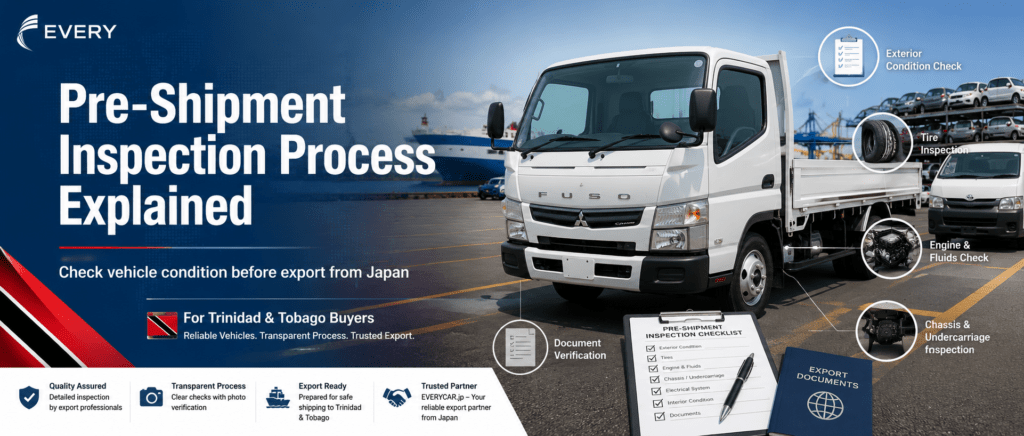

Pre-Shipment Inspection Guide for T&T Buyers: Import Japanese Used Vehicles with Confidence
Buying a used vehicle from Japan is a big decision.
For Trinidad and Tobago buyers, it is often a business decision too. A truck may support daily delivery. A van may help a shop serve more customers. A dump truck may work on a construction site. A bus may support staff transport, school service, tourism, or community use.
Therefore, vehicle condition matters.
A good vehicle can help your business move faster. However, a poor vehicle can create repairs, delays, and extra costs.
This is why pre-shipment inspection is important.
A pre-shipment inspection helps buyers check the vehicle before it leaves Japan. It also helps reduce surprises after arrival in Trinidad and Tobago.
This guide explains the pre-shipment inspection process in simple English. It focuses on Japanese used trucks, vans, buses, pickups, and commercial vehicles for Trinidad and Tobago buyers.
What Is Pre-Shipment Inspection?
Pre-shipment inspection means checking a vehicle before export.
In simple terms, the vehicle is checked before it leaves Japan. The purpose is to confirm its identity, condition, documents, and readiness for shipment.
This inspection may include photos, videos, document checks, auction sheet review, and key condition checks.
For used vehicles, this step is very helpful.
A buyer in Trinidad and Tobago cannot easily visit the vehicle in Japan. Therefore, pre-shipment checks help the buyer see important details before final shipment.
The process can help confirm:
- Chassis number
- Vehicle model
- Year
- Mileage
- Engine condition
- Interior condition
- Exterior condition
- Tyres
- Brakes
- Lights
- Undercarriage
- Rust
- Cargo body condition
- Special equipment
- Export documents
- Shipping readiness
So, pre-shipment inspection is part of smart buying.
Why Trinidad and Tobago Buyers Need Pre-Shipment Checks
Trinidad and Tobago has a practical commercial vehicle market.
Many buyers import vehicles to support real work. The vehicle must handle local roads, heat, rain, traffic, hills, and business loads.
In Trinidad, trucks often work around Port of Spain, Chaguanas, San Fernando, Couva, Arima, and Point Lisas. They may deliver goods, move tools, carry building materials, or support industrial services.
In Tobago, vehicles may work near coastal roads, hotels, guesthouses, farms, and tourism areas. Smaller roads and hills can make reliable condition even more important.
Therefore, buyers should check the vehicle before it ships.
A weak battery, poor tyres, oil leak, heavy rust, or wrong document can create problems later.
Pre-shipment inspection helps reduce that risk.
Inspection Starts With the Buyer’s Purpose
A good inspection starts with the intended use.
A delivery truck needs different checks from a dump truck. A bus needs different checks from a pickup. A freezer truck needs different checks from a flatbed.
Therefore, buyers should explain how they plan to use the vehicle.
For example:
- Delivery in Port of Spain
- Retail supply in Chaguanas
- Construction work in San Fernando
- Industrial service near Point Lisas
- Farm transport in rural areas
- Hotel supply in Tobago
- Tourism transport
- Staff transport
- Fleet business
Once the purpose is clear, the inspection can focus on the right points.
A farm truck needs load strength and ground clearance. A delivery truck needs fuel efficiency and good brakes. A tourism van needs clean interior and working air conditioning.
So, first define the job.
Step 1: Confirm Vehicle Identity
The first step is identity confirmation.
The vehicle must match the documents and sales information.
The most important item is the chassis number.
Check the chassis number on:
- Vehicle body
- Invoice
- Export Certificate
- Auction sheet if available
- Bill of Lading later
- Import Licence application
- Customs documents later
If the chassis number is wrong, customs clearance and registration can become difficult.
Therefore, buyers should request a clear chassis number photo before shipment.
Also, check the make, model, year, body type, and odometer.
For Japanese trucks, model codes can look unfamiliar. Examples include NKR, NPR, XZU, FEB, FE, FD, FK, and other codes. These details help identify the truck.
So, do not ignore them.
Step 2: Review the Auction Sheet or Condition Report
Many Japanese used vehicles come from auctions.
Auction sheets can give useful condition information. They may show grade, mileage, rust notes, dents, repair history, accident history, and equipment notes.
However, auction sheets often use short comments and codes.
Therefore, buyers should ask the exporter to explain important notes.
Check for:
- Auction grade
- Mileage
- Interior grade
- Exterior condition
- Rust comments
- Accident history
- Repair history
- Engine notes
- Transmission notes
- Equipment notes
- Warning lights
- Body condition
A small comment may be important.
For example, “rust on frame,” “oil leak,” “engine noise,” or “AC not working” can affect the final buying decision.
Therefore, review the report before shipment.
Step 3: Check Exterior Condition
Exterior condition is easy to see, but it needs careful review.
Ask for clear photos from many angles.
Check:
- Front
- Rear
- Left side
- Right side
- Roof if possible
- Bumpers
- Lights
- Mirrors
- Windshield
- Doors
- Cargo body
- Lower panels
- Paint condition
- Dents
- Scratches
- Rust
For commercial vehicles, exterior condition also affects business image.
A clean truck can make a company look more professional. This matters for delivery companies, hotels, retail suppliers, and service teams.
However, do not focus only on looks.
A truck can look clean outside but still have chassis rust or mechanical issues.
So, exterior photos are only one part of the inspection.
Step 4: Check Interior and Cabin Condition
The driver uses the cabin every day.
Therefore, interior condition matters.
Ask for photos of:
- Driver seat
- Passenger seat
- Dashboard
- Steering wheel
- Floor
- Door panels
- Gear lever
- Air conditioning controls
- Odometer
- Warning lights
- Seat belts
- Roof lining
- Cargo area for vans
- Passenger area for buses
For Trinidad and Tobago, air conditioning matters a lot.
Hot weather, humidity, and traffic can make driving uncomfortable. A working AC can improve driver comfort and daily productivity.
For buses and vans, passengers also notice interior condition.
So, inspect cabin quality before shipment.
Step 5: Check Engine Condition
The engine is one of the most important inspection points.
A used Japanese truck may have a strong diesel engine. However, buyers should still check basic condition.
Ask for:
- Engine bay photos
- Engine start video
- Exhaust smoke video
- Idle sound if video is available
- Dashboard warning light photo
- Odometer photo
- Any visible leak photos
- Auction sheet engine comments
Check for heavy smoke, strange noise, leaks, or warning lights.
For Trinidad and Tobago, engine cooling is also important.
A truck may work in traffic and heat. It may carry heavy loads. It may drive in hilly areas. Therefore, a healthy engine and cooling system are very important.
Step 6: Check Transmission and Driving Condition
The truck must move smoothly.
Transmission problems can be costly. Therefore, the inspection should include basic driving or movement information when possible.
Check:
- Manual or automatic transmission
- Gear shifting
- Clutch feel if manual
- Acceleration
- Unusual noise
- Dashboard warning lights
- Movement video if available
- Auction comments
For city delivery, automatic transmission can reduce driver fatigue.
However, many commercial buyers prefer manual transmission for simple maintenance and strong control. The best choice depends on the job.
Therefore, confirm the transmission type before shipment.
Step 7: Check Brakes and Steering
Brakes and steering are safety items.
They matter a lot in Trinidad and Tobago.
A truck may face traffic in Port of Spain. It may climb hills in Tobago. It may drive in rain. It may carry heavy cargo. Therefore, brakes and steering must be strong.
Before shipment, check available comments about:
- Brake warning lights
- Brake feel
- Parking brake
- Steering condition
- Steering noise
- Alignment issues
- Uneven tyre wear
- Suspension comments
After arrival, complete a local brake and steering check before daily use.
Pre-shipment inspection reduces risk. Local inspection completes the safety check.
Step 8: Check Tyres and Wheels
Tyres are very important for commercial vehicles.
A truck with poor tyres can create safety risk and extra cost.
Before shipment, ask for tyre photos.
Check:
- Tread depth
- Sidewall cracks
- Uneven wear
- Tyre size
- Load rating if visible
- Matching tyres
- Spare tyre
- Wheel condition
- Rust around rims
For Trinidad and Tobago, tyres must handle rain, heat, heavy cargo, and mixed road conditions.
If the tyres are weak, include replacement cost in your budget.
A truck can still be a good purchase if tyres need replacement. However, the buyer should know this before shipment.
Step 9: Check Undercarriage and Rust
Undercarriage photos are very important.
Island markets need stronger rust awareness because of coastal air and humidity.
Trinidad and Tobago buyers should check rust carefully before import.
Ask for underbody photos when possible.
Check:
- Chassis frame
- Cross members
- Suspension areas
- Axles
- Brake lines
- Fuel tank area
- Cabin floor
- Cargo body floor
- Wheel arches
- Lower door sections
- Rear body structure
Surface rust can be normal on used commercial vehicles.
However, deep rust, frame corrosion, cracks, or heavy underbody damage can become serious.
This is especially important for trucks that carry heavy loads.
Step 10: Check Cargo Body and Special Equipment
Commercial trucks often have special bodies.
The inspection should match the body type.
Box Trucks
Check the box body, roof, floor, side panels, rear door, locks, and water leak signs.
Flatbed Trucks
Check bed floor, side panels, tie-down points, rust, and rear gate.
Dump Trucks
Check dump body floor, rear gate, hydraulic cylinder, PTO, lift operation, and frame area.
Crane Trucks
Check crane boom, outriggers, wire, hook, hydraulic leaks, control levers, and base frame.
Freezer Trucks
Check cooling unit, temperature display, cargo box, rear door, and operation video if possible.
Buses
Check seats, doors, air conditioning, passenger area, lights, emergency exits, and floor rust.
A truck’s body can affect its value.
Therefore, inspect the working equipment before shipment.
Step 11: Check Export Documents
Documents are part of inspection too.
A good vehicle still needs correct paperwork.
Before shipment, confirm:
- Commercial Invoice
- Export Certificate
- Chassis number
- Vehicle year
- Make and model
- Buyer name
- Consignee details
- Shipping terms
- Destination port
- Import Licence details if applicable
- Bill of Lading instructions
For Trinidad and Tobago, document accuracy is very important.
Wrong details can delay customs clearance, TTBS-related steps, inspection, or registration.
Therefore, compare every document before the vessel departs.
Step 12: Confirm Shipping Readiness
Before the vehicle goes to the port in Japan, check shipping readiness.
For RORO shipping, the vehicle should normally move under its own power.
Check:
- Engine starts
- Battery is usable
- Brakes work
- Steering works
- Tyres hold air
- No serious fluid leaks
- Fuel level follows shipping rule
- No loose cargo inside
- Chassis number is visible
- Vehicle dimensions are known
For container shipping, check dimensions and loading method.
Most trucks ship better by RORO. However, parts, engines, and compact cargo may use container shipping.
So, choose the method based on the vehicle.
Why Pre-Shipment Inspection Helps Port Clearance
Pre-shipment inspection does not replace customs clearance.
However, it supports smoother clearance.
When vehicle details are correct, documents are easier to prepare. When the chassis number matches, the broker can work faster. When the vehicle can move, port pickup becomes easier.
This can help reduce delays.
For Trinidad and Tobago buyers, delays can create storage charges and lost business time. Therefore, early checking is valuable.
A truck that arrives with correct documents and known condition gives the buyer more confidence.
Why Pre-Shipment Inspection Helps Registration
After customs clearance, the vehicle usually needs inspection and registration steps.
Pre-shipment checks can prepare the buyer for these steps.
For example, if tyres look weak, the buyer can budget for tyres. If lights are damaged, the buyer can plan repairs. If the chassis number is confirmed, registration becomes easier.
So, inspection before shipment helps with planning after arrival.
It gives the buyer fewer surprises.
Common Issues Found Before Shipment
Pre-shipment checks may find problems such as:
- Weak tyres
- Battery issue
- Oil leak
- Coolant leak
- Rust
- Body dents
- Broken lights
- AC issue
- Heavy smoke
- Transmission issue
- Chassis number confusion
- Missing document
- Wrong model information
- Damaged cargo body
- Non-working dump or crane equipment
Finding these issues before shipment is better than finding them after arrival.
Then, the buyer can decide.
They may continue, negotiate, choose another vehicle, or budget for repair.
Pre-Shipment Inspection for Trinidad Business Uses
Different business uses need different inspection focus.
Delivery Trucks
Focus on fuel economy, tyres, brakes, AC, box body, cargo door, and clean cabin.
Construction Trucks
Focus on chassis, suspension, brakes, dump body, hydraulics, tyres, and frame rust.
Farm Vehicles
Focus on underbody, ground clearance, cargo bed, tyres, and engine strength.
Industrial Service Trucks
Focus on payload, engine power, cooling, cargo space, and safety.
Tobago Business Vehicles
Focus on rust, compact size, AC, tyres, and clean interior.
Buses and Vans
Focus on seats, doors, AC, brakes, tyres, lights, and passenger safety.
This approach helps buyers inspect based on real use.
How EVERY Supports Pre-Shipment Checks
EVERY helps buyers understand vehicle condition before export.
We support Trinidad and Tobago buyers with clear communication and practical vehicle checks.
We can help with:
- Vehicle search from Japan
- Auction sheet review
- Condition photo checks
- Video requests
- Chassis number confirmation
- Odometer photo confirmation
- Engine bay photo checks
- Undercarriage photo requests
- Cargo body photo checks
- Export document support
- FOB, C&F, or CIF quotation
- RORO shipping guidance
- Basic shipping readiness checks
Also, we help buyers choose vehicles based on purpose.
A Port of Spain buyer may need a delivery truck. A San Fernando contractor may need a dump truck. A Tobago hotel supplier may need a clean van. A farmer may need a flatbed.
Therefore, we match the inspection focus to the customer’s business.
Buyer Checklist Before Payment
Before payment, check:
- Vehicle fits your business purpose.
- Import eligibility is confirmed.
- Chassis number is clear.
- Year and model are confirmed.
- Auction sheet is reviewed.
- Exterior photos are checked.
- Interior photos are checked.
- Engine information is checked.
- Tyres are checked.
- Undercarriage photos are reviewed.
- Cargo body is checked.
- Documents are clear.
- Shipping method is confirmed.
- Landed cost is estimated.
This checklist helps protect your money.
Buyer Checklist Before Shipment
Before shipment, check:
- Invoice details are correct.
- Export Certificate details are correct.
- Chassis number matches.
- Consignee name is correct.
- Destination port is correct.
- Import Licence is ready if required.
- Shipping term is clear.
- Vehicle can move for RORO.
- Photos and videos are saved.
- Broker has document copies.
- Arrival plan is ready.
This helps reduce delays.
Buyer Checklist After Arrival
After arrival, check:
- Vehicle leaves port safely.
- Chassis number matches documents.
- Engine oil is checked.
- Coolant is checked.
- Brakes are checked.
- Tyres are checked.
- Lights and wipers work.
- Battery is tested.
- Undercarriage is inspected.
- Insurance is arranged.
- Local inspection is completed.
- Registration process starts.
This final step turns the imported vehicle into a road-ready business tool.
Final Advice for Trinidad and Tobago Buyers
Pre-shipment inspection is one of the smartest steps in used vehicle import.
It helps buyers see condition before the vehicle leaves Japan. It also helps reduce risk, plan costs, and prepare for customs, inspection, and registration.
For Trinidad and Tobago buyers, this matters because vehicles often support business income.
A reliable truck, van, pickup, or bus can help with delivery, construction, agriculture, tourism, logistics, and industrial work. However, a poorly checked vehicle can create stress and delay.
Therefore, inspect before shipment.
Check the chassis number. Review photos. Ask for videos. Confirm documents. Check tyres, brakes, rust, engine condition, and body type. Then, plan the shipping and local process.
A good inspection helps you import with confidence.
It helps your vehicle arrive ready for the next step.
Most of all, it helps your business move forward in Trinidad and Tobago.


Browse Reliable Used Trucks & Buses from Japan
Carefully selected vehicles ready for export worldwide
Search 100,000+ Dealer Stock Vehicles from Japan
Access a wide selection of vehicles from Japanese dealers nationwide. Updated daily.
