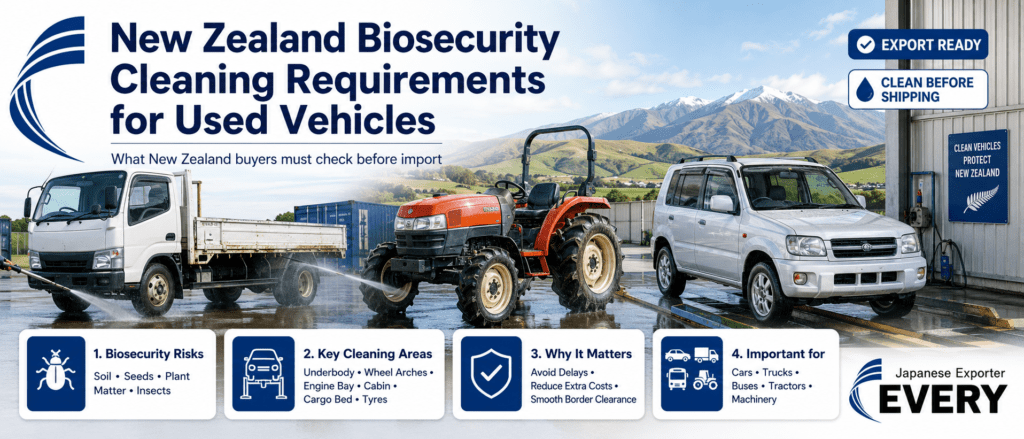

NZ Biosecurity Cleaning Guide for Used Vehicles
New Zealand protects its land very carefully.
This is important for farmers.
It is important for growers.
It is also important for transport businesses, importers, and vehicle buyers.
Because of this, used vehicles entering New Zealand must be clean.
This rule applies to many imported items. It can include used cars, trucks, buses, vans, tractors, machinery, tyres, and vehicle parts.
For buyers importing from Japan, this is one of the most important points to understand.
A vehicle can look good in photos.
It can have low mileage.
It can also have a clean interior.
However, it may still fail biosecurity inspection if soil, plant matter, seeds, insects, or other contaminants remain in hidden areas.
New Zealand’s Ministry for Primary Industries, often called MPI, explains that vehicles, machinery, and parts, including tyres, often carry soil, plant matter, and animals. MPI’s role is to help importers meet biosecurity requirements and keep New Zealand free from pests and diseases.
Therefore, cleaning is not a small detail.
It is part of the import process.
This guide explains New Zealand biosecurity cleaning requirements for used vehicles. It also shows what buyers should check before shipping a used vehicle from Japan.
Why Biosecurity Cleaning Matters in New Zealand
New Zealand has a strong farming and food economy.
Dairy, meat, horticulture, forestry, wine, and rural industries all depend on a healthy natural environment. If a pest or disease enters the country, it can damage farms, crops, forests, and native ecosystems.
So, New Zealand takes border protection seriously.
Used vehicles can carry risk because they travel on roads, farms, yards, construction sites, and storage areas. They may collect mud, dust, grass, seeds, leaves, insects, and animal material.
This is especially important for:
- Used trucks
- Farm tractors
- Construction machinery
- Buses
- Mini trucks
- 4WD vehicles
- Vans
- Tyres
- Used vehicle parts
- Machinery attachments
For example, a used tractor may hold soil under the chassis.
A used truck may have seeds inside the tyre area.
A used bus may have insects around the luggage bay.
A mini truck may carry mud in the cargo bed or wheel arches.
A construction machine may hold dirt in tracks, buckets, or underbody areas.
As a result, cleaning must be thorough.
Biosecurity Is Different from Road Compliance
Many buyers think only about road registration.
That is important. However, biosecurity is a different step.
New Zealand Transport Agency, Waka Kotahi, explains that imported vehicles must meet safety and emissions standards, receive border inspection, receive entry certification, and be registered and licensed if used on New Zealand roads.
However, MPI handles biosecurity risk.
So, buyers should think about two separate areas.
First, the vehicle must be clean for biosecurity.
Second, the vehicle must meet road-use requirements.
A vehicle can pass one area but still face trouble in the other.
For example, a truck may have correct export documents but still need extra cleaning. Likewise, a tractor may be mechanically good but still arrive with soil contamination.
Therefore, importers should prepare both sides early.
What Must Be Clean?
MPI says importers need to make sure vehicles, machinery, and parts are clean and meet other requirements. It also explains that importers need to provide a declaration through the Trade Single Window before arrival.
In simple terms, used vehicles must arrive free from biosecurity contamination.
This can include:
- Soil
- Mud
- Sand
- Seeds
- Leaves
- Grass
- Plant material
- Animal material
- Insects
- Nests
- Egg masses
- Webbing
- Snails
- Other pests
Buyers should not only clean visible areas.
Many contamination points are hidden.
That is why inspection photos and careful preparation matter.
Key Cleaning Areas for Used Vehicles
1. Underbody
The underbody is one of the most important areas.
Mud and soil often stick under the vehicle. This is common for trucks, 4WD vehicles, farm machinery, and vehicles used on rural roads.
Check these areas:
- Chassis rails
- Cross members
- Axles
- Suspension arms
- Leaf springs
- Brake areas
- Fuel tank area
- Underbody covers
- Spare tyre area
- Wheel arches
Even a small amount of soil can create inspection concerns.
So, buyers should request clear underbody photos before shipping.
2. Wheel Arches and Tyres
Tyres often collect mud, seeds, and plant material.
Wheel arches can also hold dirt in corners and seams.
Check:
- Tyre tread
- Sidewalls
- Inside wheel arches
- Mud flaps
- Suspension mounts
- Spare tyre
- Rim gaps
- Behind plastic liners
This area is especially important for farm vehicles, 4WD trucks, and construction vehicles.
If a vehicle has off-road tyres, cleaning needs more care.
Deep tread can hide soil.
3. Engine Bay
The engine bay can hold leaves, insects, nests, and dust.
It may look clean from above. However, small materials can stay near the radiator, battery tray, firewall, and air intake area.
Check:
- Radiator area
- Battery tray
- Air filter box
- Firewall
- Bonnet edges
- Engine mounts
- Wiring areas
- Under engine covers
- Drain channels
Do not use unsafe cleaning methods.
However, make sure the area is free from organic material and pests.
4. Interior and Cabin
The cabin can also carry biosecurity risk.
Shoes, floor mats, seat tracks, storage pockets, and cargo areas can hold soil or plant material.
Check:
- Floor mats
- Seat rails
- Under seats
- Boot or luggage area
- Glove box
- Door pockets
- Cargo floor
- Air vents
- Cabin corners
For buses, check passenger areas carefully.
For vans, check rear cargo space.
For trucks, check the sleeper cab if fitted.
For mini trucks, check under the seat and floor areas.
A clean cabin also gives buyers a better customer experience.
5. Cargo Beds and Loading Areas
Commercial vehicles often carry goods, tools, farm items, or construction materials.
So, cargo areas need careful checks.
For trucks, check:
- Flat deck surface
- Dump bed
- Box body floor
- Side panels
- Tailgate
- Hinges
- Drain holes
- Tie-down points
- Under bed frame
For vans, check:
- Rear floor
- Side panels
- Roof lining
- Step area
- Door seals
For refrigerated trucks, check drain areas and door seals.
Organic material can hide in small gaps.
6. Buses and Passenger Vehicles
Used buses need both exterior and interior checks.
Tourism and community transport buyers should check:
- Underbody
- Wheel arches
- Engine bay
- Luggage bays
- Passenger floor
- Seat rails
- Steps
- Door mechanisms
- Air conditioning vents
- Storage compartments
Tour buses can carry dust and small material from many passenger trips.
Community buses may also collect mud from shoes.
Therefore, interior cleaning is important.
7. Tractors and Farm Machinery
Tractors need extra care.
They often work directly with soil, grass, crops, and animal areas. As a result, they can hold contamination in many hidden places.
Check:
- Tyres
- Rims
- Axles
- Mudguards
- Undercarriage
- Engine bay
- Radiator screen
- PTO area
- Three-point linkage
- Loader arms
- Bucket
- Cabin floor
- Seat base
- Drawbar
- Implements
Rotary tillers need special attention.
They can hold soil between blades and inside the frame. Loader buckets can also hold dirt in corners.
For New Zealand farm buyers, cleaning tractors before shipment is essential.
8. Construction Machinery
Construction machinery can carry high biosecurity risk.
Machines used on building sites, farms, forests, or earthwork areas may hold soil in tracks, buckets, and underbody sections.
Check:
- Tracks
- Tyres
- Buckets
- Blades
- Hydraulic arms
- Pivot points
- Belly plates
- Undercarriage
- Radiator area
- Cabin floor
- Tool boxes
If the machine has tracks, cleaning can take much longer.
So, plan early.
Why Japan-to-New Zealand Buyers Should Plan Cleaning Early
Many New Zealand buyers import used vehicles from Japan.
Japan is a major supply source because both countries use right-hand-drive vehicles. Also, Japanese auctions offer a wide choice of cars, trucks, buses, tractors, and machinery.
However, Japan has many climates and use environments.
A used truck may come from an urban delivery route.
A tractor may come from a rural farm.
A bus may come from a mountain route.
A 4WD vehicle may have off-road use.
A machinery unit may have soil from work sites.
Therefore, each vehicle needs a different cleaning approach.
Do not assume all Japanese used vehicles are ready for New Zealand.
Instead, ask for condition details and photos before purchase.
This helps reduce risk.
What Happens If a Vehicle Arrives Dirty?
If a vehicle arrives with biosecurity contamination, delays can happen.
It may need further inspection. It may also need cleaning or treatment before clearance.
This can create extra cost and time.
Possible problems include:
- Port delays
- Additional cleaning fees
- Storage costs
- Inspection delay
- Delivery delay
- Customer complaints
- Missed business use
- Extra communication work
For businesses, time matters.
A truck waiting at the border cannot deliver goods.
A tractor waiting for clearance cannot support farm work.
A bus waiting for release cannot start service.
Therefore, cleaning before shipment is a smart investment.
Approved Systems and Cleaning Providers
MPI provides information about approved systems and cleaning providers for used vehicles and machinery. These systems help importers meet biosecurity requirements when importing to New Zealand.
This is useful for importers because approved systems can reduce uncertainty.
For buyers importing from Japan, it is wise to ask whether the vehicle can be cleaned through an appropriate process before shipping.
This can be especially important for:
- Used tractors
- Farm machinery
- 4WD vehicles
- Mini trucks
- Construction machinery
- Vehicles with heavy underbody dirt
- Vehicles stored outdoors
- Vehicles with attachments
Cleaning support should match the vehicle type.
A normal car and a used tractor need different attention.
Cleaning Checklist by Vehicle Type
Used Cars and Vans
For cars and vans, check:
- Underbody
- Wheel arches
- Engine bay
- Boot area
- Spare tyre area
- Floor mats
- Seat rails
- Air vents
- Door seals
- Exterior gaps
These vehicles may look clean. However, small materials can hide easily.
A van used for cargo may need extra rear-area cleaning.
Used Trucks
For trucks, check:
- Chassis
- Cross members
- Axles
- Wheel arches
- Mud flaps
- Engine bay
- Cab floor
- Flat deck
- Box body floor
- Dump bed
- Crane base
- Tailgate
- Spare tyre area
Dump trucks and flat decks often collect soil or plant material.
Crane trucks may also hold dirt around the crane base and outriggers.
Used Buses
For buses, check:
- Underbody
- Wheel arches
- Engine bay
- Passenger floor
- Seat rails
- Steps
- Luggage bays
- Door tracks
- AC vents
- Storage compartments
For tourism buses, luggage bays need special care.
For school or community buses, foot areas may carry mud or grass.
Used Tractors
For tractors, check:
- Tyres
- Rims
- Axles
- Mudguards
- PTO
- Linkage
- Loader
- Bucket
- Rotary tiller
- Cabin floor
- Engine bay
- Radiator screen
- Drawbar
- Implements
Tractors have the highest cleaning risk among many vehicle types.
So, always inspect them carefully.
Mini Trucks and 4WD Vehicles
For mini trucks and 4WD vehicles, check:
- Tyres
- Wheel arches
- Underbody
- Cargo bed
- Mud flaps
- Suspension
- Engine bay
- Seat base
- Cabin floor
- Spare tyre
- 4WD components
These vehicles often work on private property or rough roads.
So, cleaning should focus on hidden mud.
Best Practices Before Shipping from Japan
1. Request Detailed Photos
Photos help buyers understand the risk.
Ask for:
- Underbody photos
- Tyre tread photos
- Wheel arch photos
- Engine bay photos
- Cargo bed photos
- Interior floor photos
- Luggage area photos
- Implement photos, if fitted
For tractors and machinery, ask for close-up photos of soil contact areas.
This includes tyres, PTO, tillers, buckets, and undercarriage.
2. Request Videos When Needed
Videos can show more than photos.
Ask for videos of:
- Engine start
- Underbody walkaround
- Wheel area
- Dump operation
- Crane operation
- Tractor linkage
- Loader movement
- Machinery tracks
- Interior walkaround
These videos can also support condition checks.
3. Plan Cleaning Before Shipment
Do not leave cleaning until arrival.
Pre-shipment cleaning can reduce risk, delays, and extra cost.
This is especially important for:
- Farm vehicles
- Tractors
- Construction machinery
- 4WD trucks
- Mini trucks
- Vehicles with muddy tyres
- Vehicles with outdoor storage history
4. Keep Documents Clear
Biosecurity is not only about cleaning.
Documentation also matters.
MPI explains that importers need to provide a declaration through the Trade Single Window at least several days before arrival.
Also, road-use vehicles need separate evidence for NZTA requirements.
Therefore, buyers should prepare both biosecurity and road compliance documents.
5. Work with a Trusted Exporter
A trusted exporter can help reduce risk.
They can check the vehicle before shipping. They can also help with photos, cleaning advice, export documents, and shipping preparation.
For New Zealand, this support is very important.
Biosecurity Cleaning for Different New Zealand Buyers
For Farmers
Farmers often import tractors, 4WD trucks, mini trucks, and farm machinery.
These vehicles may carry soil risk.
Farm buyers should focus on tyres, underbody, PTO, implements, loader buckets, and mudguards.
A clean tractor can reduce delay after arrival.
For Construction Companies
Construction buyers may import dump trucks, crane trucks, machinery, and site vehicles.
These units often hold mud and sand.
Check tracks, dump beds, underbody, buckets, and hydraulic arms.
Cleaning before shipping can help protect the project schedule.
For Tourism Operators
Tourism operators may import buses and vans.
They should check passenger areas, luggage bays, underbody, tyres, and air vents.
A clean bus also gives better first impressions for customers.
For Small Businesses
Small companies may import vans, box trucks, mini trucks, and delivery vehicles.
They need vehicles ready for work.
Clean cargo areas, underbody, and tyres can help reduce delays.
For Lifestyle Block Owners
Lifestyle block buyers may import mini trucks and compact tractors.
These vehicles often work on soil and grass.
So, biosecurity cleaning matters even for private property use.
Why Buy New Zealand-Bound Used Vehicles from EVERY
EVERY helps overseas buyers find reliable Japanese used vehicles, trucks, buses, tractors, and machinery.
For New Zealand buyers, we understand that condition and cleaning awareness matter.
You need more than a good price.
You need clear vehicle details.
You need photos.
You need export documents.
You also need careful preparation before shipping.
EVERY can help with:
- Japanese used vehicle sourcing
- Truck, bus, tractor, and machinery search
- Auction stock support
- Detailed photos and videos
- Vehicle condition checking
- Export document preparation
- Shipping support from Japan
- Cleaning awareness before shipment
- Communication before purchase
- Advice for New Zealand-bound buyers
A smooth import starts before the vehicle leaves Japan.
Therefore, careful checking matters.
Final Thoughts
New Zealand biosecurity cleaning requirements are very important for used vehicle buyers.
They protect farms, forests, crops, animals, and the natural environment. They also help keep New Zealand’s transport and import process safe.
For buyers importing from Japan, cleaning should be part of the purchase plan.
Used cars, trucks, buses, vans, mini trucks, tractors, machinery, tyres, and parts can all carry contamination. Soil, seeds, plant material, insects, nests, and mud can cause delays and extra costs.
So, check the vehicle carefully. Request photos. Ask for videos. Plan cleaning before shipping. Also, prepare the right import and compliance documents.
With the right preparation and a trusted Japanese exporter, New Zealand buyers can reduce risk and receive their vehicles with more confidence.


Browse Reliable Used Trucks & Buses from Japan
Carefully selected vehicles ready for export worldwide
Search 100,000+ Dealer Stock Vehicles from Japan
Access a wide selection of vehicles from Japanese dealers nationwide. Updated daily.
