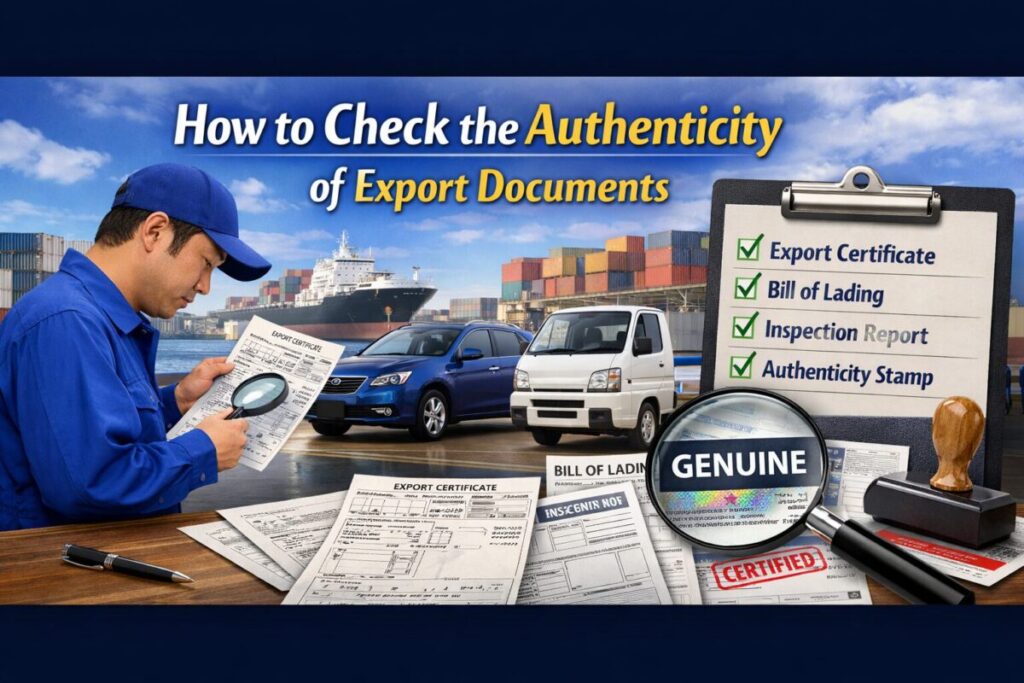

How to Verify Export Documents Before Buying a Japanese Used Vehicle: The Complete Buyer’s Guide
Importing a used vehicle from Japan can be a smart investment. Japanese cars, trucks, buses, tractors, and machinery are known for their quality, reliability, and long service life. However, every successful import depends on one critical factor—authentic export documents.
Incorrect or fraudulent paperwork can delay customs clearance, increase costs, or even prevent your vehicle from entering your country. Therefore, every buyer should understand how to verify export documents before completing a purchase.
At EVERY TRADING, transparency and trust are at the heart of our business. We prepare accurate export documents and help our customers understand every step of the process.
This guide explains how to check the authenticity of export documents and avoid unnecessary risks when importing vehicles from Japan.
Why Export Documents Matter
Every international shipment requires official paperwork.
These documents prove ownership, identify the vehicle, and support customs clearance.
Without accurate documents, buyers may face:
- Customs delays
- Additional inspection fees
- Registration problems
- Shipping complications
- Financial losses
Therefore, document verification should always be part of your buying process.
What Are Export Documents?
Export documents are official papers prepared during the export process.
The required documents may vary by destination country.
However, most vehicle exports include:
- Export Certificate
- Commercial Invoice
- Bill of Lading (B/L)
- Packing List when required
- Inspection Certificate when required
- Insurance documents when applicable
Each document serves a different purpose during shipping and import.
The Export Certificate Is One of the Most Important Documents
Japan issues an Export Certificate after a vehicle completes the export process.
This document contains important information such as:
- Chassis number
- Vehicle model
- Engine number
- Registration history
- Previous registration details
Before purchasing, compare this information with the vehicle itself.
All details should match exactly.
Verify the Chassis Number
The chassis number is the vehicle's unique identification number.
It appears on several documents and on the vehicle.
Always compare the chassis number on:
- Export Certificate
- Commercial Invoice
- Bill of Lading
- Auction Sheet
- Vehicle identification plate
Even one incorrect character can create customs problems.
Review the Commercial Invoice Carefully
The commercial invoice contains important transaction details.
Check that it includes:
- Seller's company name
- Buyer's information
- Vehicle description
- Chassis number
- Purchase price
- Shipping terms
- Invoice date
All information should remain consistent across every document.
Understand the Bill of Lading
The Bill of Lading confirms that the shipping company has received the vehicle.
It also provides shipment information.
Verify:
- Vessel name
- Voyage number
- Port of loading
- Destination port
- Chassis number
- Consignee information
Accurate shipping information helps avoid unnecessary delays.
Confirm the Exporter's Company Information
Always verify the exporter's business details before sending payment.
A professional exporter should provide:
- Company name
- Business address
- Telephone number
- Official website
- Business registration information
Trustworthy companies welcome verification requests.
Transparency builds confidence.
Compare Every Document Together
Never review documents separately.
Instead, compare them side by side.
Check that these details remain identical:
- Chassis number
- Vehicle model
- Engine information
- Buyer name
- Seller name
- Export date
Consistency strongly supports document authenticity.
Review the Auction Sheet
If the vehicle comes from a Japanese auction, request the official auction sheet.
The auction sheet includes:
- Auction grade
- Mileage
- Vehicle condition
- Damage map
- Inspector comments
- Chassis number
Matching auction information provides another layer of confidence.
Check Vehicle Photos Against the Documents
Photos help confirm document accuracy.
Compare visible details such as:
- Chassis plate
- Odometer
- Exterior color
- Interior features
- Vehicle model
Everything should match the written information.
If something seems different, ask questions before making payment.
Be Careful of Edited Documents
Modern editing software can change digital documents.
Therefore, examine files carefully.
Watch for:
- Different fonts
- Misaligned text
- Blurry numbers
- Missing stamps
- Unusual formatting
Professional exporters provide clean and consistent documentation.
Ask Questions Before You Pay
Good exporters welcome questions.
Do not hesitate to ask:
- Can I review the export documents?
- Can you explain this information?
- Does the chassis number match?
- Can I receive additional photos?
- Can you provide the auction sheet?
Clear communication protects both buyers and sellers.
Watch for Warning Signs
Several warning signs deserve attention.
These include:
- Inconsistent chassis numbers
- Missing documents
- Different vehicle descriptions
- Pressure to pay immediately
- Refusal to answer questions
- Poor communication
If multiple warning signs appear, investigate further before proceeding.
Work with an Experienced Japanese Exporter
Professional exporters understand international documentation requirements.
They prepare documents carefully and answer customer questions quickly.
An experienced exporter also understands destination country regulations.
This knowledge helps reduce customs issues after shipment.
How EVERY Protects Buyers
At EVERY, document accuracy is a top priority.
Before shipment, our team carefully prepares and reviews every document.
We verify:
- Vehicle information
- Chassis numbers
- Export records
- Customer details
- Shipping information
We also answer customer questions promptly and provide clear explanations whenever needed.
Our goal is to make the export process simple and transparent.
Why Accurate Documents Save Time and Money
Correct paperwork helps buyers avoid unnecessary expenses.
Verified documents support:
- Faster customs clearance
- Easier vehicle registration
- Lower administrative delays
- Better shipment tracking
- Greater buyer confidence
Good documentation protects your investment from the beginning.
Digital Communication Makes Verification Easier
Today, buyers can review documents before shipment.
EVERY shares document copies so customers can confirm important details in advance.
This process allows buyers to identify questions early and avoid last-minute surprises.
Better communication leads to smoother transactions.
Why Buyers Around the World Trust EVERY
EVERY has supplied Japanese vehicles to customers in more than 100 countries.
Buyers choose us because we provide:
- Honest communication
- Accurate documentation
- Professional inspections
- Fast customer support
- Transparent export procedures
- Worldwide shipping experience
We believe trust begins with accurate information.
That commitment continues throughout every shipment.
Final Thoughts
Authentic export documents are just as important as the vehicle itself. They confirm ownership, support customs clearance, and help ensure a smooth import process.
Before buying a Japanese used vehicle, always compare every document carefully, verify the chassis number, review the auction sheet, and work with a trusted exporter.
At EVERY, we prepare accurate export documents, provide transparent communication, and guide our customers through every stage of the export process.
When you choose EVERY, you choose reliability, professionalism, and a trusted partner for importing Japanese cars, trucks, buses, tractors, and machinery.


Browse Reliable Used Trucks & Buses from Japan
Carefully selected vehicles ready for export worldwide
Search 100,000+ Dealer Stock Vehicles from Japan
Access a wide selection of vehicles from Japanese dealers nationwide. Updated daily.
