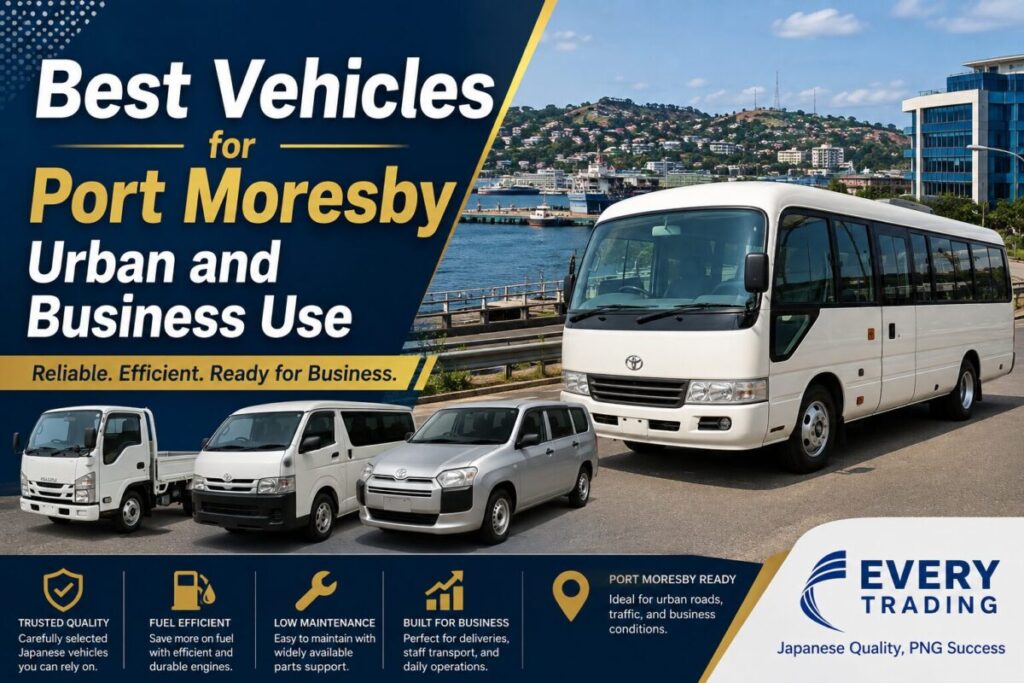

Smart Japanese Commercial Vehicles for Everyday Business Success
Port Moresby is the largest commercial center in Papua New Guinea. Every day, businesses move food, construction materials, retail products, fuel, office supplies, and industrial equipment across the city. Therefore, choosing the right commercial vehicle can improve productivity, reduce operating costs, and increase business efficiency.
Unlike many rural regions of Papua New Guinea, Port Moresby mainly operates on paved urban roads. However, traffic conditions, construction activity, industrial zones, and frequent delivery schedules require vehicles that combine reliability, fuel efficiency, and easy maintenance.
Japanese used commercial vehicles continue to attract buyers because they offer excellent value, proven durability, and a wide range of specifications. As a result, companies involved in logistics, retail, construction, maintenance services, and government projects often select Japanese trucks for daily operations.
Why Port Moresby Businesses Prefer Japanese Used Vehicles
Port Moresby businesses operate in many different industries. Consequently, no single truck suits every company. Delivery businesses require compact vehicles, while construction companies often need larger trucks with greater payload capacity.
Japanese manufacturers offer vehicles for almost every business size. Furthermore, replacement parts are widely available through international suppliers, making long-term ownership more practical.
- Excellent fuel efficiency
- Reliable diesel engines
- Comfortable driving position
- Good resale value
- Easy maintenance
- Strong reputation worldwide
- Many body configurations available
Best Vehicle Categories for Port Moresby
Light Delivery Trucks
Small delivery companies frequently operate within Port Moresby's commercial districts. Therefore, compact trucks are often the most practical option.
The ISUZU ELF remains one of the most popular choices because it combines easy maneuverability with useful carrying capacity. It performs well on urban streets while remaining economical for daily deliveries.
Likewise, the TOYOTA DYNA is suitable for wholesalers, supermarkets, hardware suppliers, and maintenance contractors. Its compact dimensions help drivers access busy commercial areas more easily.
Medium-Duty Trucks
Businesses transporting heavier goods usually require additional payload capacity. Fortunately, Japanese medium-duty trucks offer an excellent balance between size and operating costs.
The HINO RANGER is widely used for construction materials, industrial equipment, and inter-company deliveries throughout urban areas.
Similarly, the ISUZU FORWARD provides dependable performance for logistics companies serving warehouses, factories, and commercial developments.
Construction Support Vehicles
Port Moresby continues to experience commercial development, housing projects, and infrastructure improvements. Consequently, contractors require dependable trucks that can operate every day.
The MITSUBISHI CANTER remains one of the most versatile options for contractors. It supports numerous body types, including flatbeds, cranes, tippers, and service vehicles.
For larger construction projects, businesses may also consider medium-duty or heavy-duty models depending on required payload and operating conditions.
Choosing the Right Vehicle for Your Business
Every business has different transportation needs. Therefore, buyers should first identify how the vehicle will be used before selecting a specific model.
- Retail product delivery
- Construction materials
- Maintenance services
- Government contracts
- Warehouse distribution
- Industrial equipment transport
- Food and beverage delivery
Additionally, buyers should consider daily driving distance, average cargo weight, loading frequency, parking space, and maintenance planning before making a purchase.
Consider Local Operating Conditions
Port Moresby offers different driving conditions from many Highlands or remote regions. Urban roads are generally more suitable for standard commercial trucks. However, some industrial areas and construction sites may require vehicles with higher ground clearance or specialized bodies.
Businesses operating outside Port Moresby should also evaluate road conditions near their final destination. Vehicle selection should match the actual operating environment instead of relying only on city driving conditions.
Best Vehicles for Different Port Moresby Business Needs
The right vehicle depends on how the business earns money each day.
For example, a shop making ten small deliveries needs a different vehicle from a contractor carrying cement and steel.
Therefore, Port Moresby buyers should match vehicle size and body type to the real workload.
Retail and Wholesale Distribution
Retailers and wholesalers often need reliable vehicles for several deliveries each day.
A compact light truck usually works well for this purpose.
It can move cartons, drinks, packaged food, household products, office supplies, and other retail stock.
Moreover, a shorter wheelbase can make parking and reversing easier around busy customer locations.
A box body can protect goods from rain, dust, and direct sunlight.
However, businesses that carry mixed cargo may prefer a dropside flatbed.
Hardware and Building Suppliers
Hardware businesses often carry longer and heavier products.
Common loads may include timber, pipes, roofing sheets, tools, cement, and plumbing materials.
Therefore, deck length and payload become more important than a very compact body.
Flatbed trucks often provide the greatest flexibility.
Nevertheless, cargo must remain within the vehicle's safe weight and dimensional limits.
Strong tie-down points also help secure long materials during urban transport.
Construction and Maintenance Contractors
Contractors often need one vehicle to perform several jobs.
A truck may carry workers, tools, generators, building materials, or waste from a project site.
Therefore, a flatbed, dump truck, crane truck, or double cab may provide better value than a standard cargo body.
Ground clearance also deserves attention.
Most Port Moresby urban work does not require serious off-road ability.
However, construction entrances can become rough, uneven, or muddy after rain.
Food and Hospitality Businesses
Hotels, restaurants, supermarkets, and food distributors need clean and dependable transport.
For dry products, a closed box body can provide useful protection.
Meanwhile, chilled or frozen products may require a refrigerated truck.
In that case, buyers should inspect the refrigeration system separately from the vehicle.
Check the compressor, insulation, door seals, temperature performance, and power source.
Workshop and Mobile Service Businesses
Electrical, plumbing, mechanical, and maintenance companies often carry tools instead of very heavy cargo.
Therefore, a compact truck with secure storage may offer excellent value.
Toolboxes can keep equipment organised and reduce loading time.
In addition, operators should consider cabin storage, lighting, and access to frequently used parts.
Why Urban Driving Changes Maintenance Priorities
Port Moresby urban driving creates a different maintenance pattern from long-distance Highlands transport.
Vehicles may complete many short journeys with frequent starts, stops, and periods of idling.
As a result, several components deserve regular attention.
- Engine cooling system
- Brake pads, shoes, and fluid
- Battery and charging system
- Engine oil and filters
- Air-conditioning system
- Tyres and wheel alignment
- Clutch or automatic transmission
- Steering and suspension
Short journeys can also make businesses delay maintenance because the truck never travels far from the workshop.
However, this can create expensive downtime later.
A planned maintenance schedule usually costs less than emergency repairs during a busy working week.
Cooling System Care in Port Moresby
Port Moresby's warm climate makes cooling-system condition especially important.
Slow traffic can also reduce airflow through the radiator.
Therefore, buyers should inspect the radiator, coolant, hoses, fan, belts, and water-pump area.
Look for signs of previous overheating.
These may include coolant stains, damaged hoses, poor repairs, or unusual temperature behaviour.
After arrival, use the correct coolant and maintain the system on schedule.
Plain water alone may not provide suitable long-term protection against corrosion and overheating.
Air Conditioning Is a Business Feature, Not Only a Comfort Feature
A commercial vehicle may operate for many hours each day.
Therefore, driver comfort can influence concentration and productivity.
Working air conditioning can offer practical value during delivery work around Port Moresby.
Before purchase, test the complete system.
Do not confirm it only because the fan blows air.
Check whether the cabin becomes properly cool.
Also inspect the compressor operation and listen for unusual noise.
Tyres and Suspension for Daily Urban Work
Port Moresby roads vary between established commercial routes, residential streets, industrial areas, and construction access roads.
Therefore, tyre quality matters even when most driving occurs on paved roads.
Check:
- Tyre manufacturing age
- Tread depth
- Sidewall damage
- Load rating
- Matching tyre sizes
- Spare-wheel condition
Replacement availability also matters.
A common tyre size can reduce downtime when a business needs a quick replacement.
Suspension wear can affect steering, braking, tyre wear, and cargo stability.
Therefore, inspect springs, bushes, shock absorbers, ball joints, and steering components.
Prevent Coastal Corrosion Before It Becomes Expensive
Port Moresby has a coastal environment.
Heat, humidity, moisture, and salt exposure can contribute to corrosion over time.
Therefore, buyers should inspect more than the painted body.
Important areas include:
- Chassis rails
- Crossmembers
- Cargo-body mounts
- Battery tray
- Brake pipes
- Wheel rims
- Electrical connections
- Door and body seams
After arrival, regular cleaning can help remove dirt and salt deposits.
Suitable rust protection may also extend working life.
However, existing structural corrosion should be evaluated before purchase.
Do Port Moresby Businesses Need 4WD?
Most businesses operating mainly on established Port Moresby roads do not need 4WD every day.
A 2WD commercial truck often costs less to buy and maintain.
It may also offer lower drivetrain complexity.
However, 4WD can make sense for certain businesses.
Examples include contractors entering undeveloped sites or companies regularly travelling beyond established urban roads.
Even then, 4WD should not replace correct tyres and careful loading.
Businesses should pay for 4WD when the regular operating route genuinely requires it.
For rural and difficult-road selection, see the Japanese 4WD Trucks for Rural Roads and Remote Areas guide.
Daily Inspection Can Reduce Business Downtime
A five-minute inspection before work can identify small problems early.
Drivers should check:
- Engine oil level
- Coolant level
- Visible fluid leaks
- Tyre condition
- Lights and indicators
- Brake feel
- Dashboard warning lights
- Mirrors and windscreen
- Cargo-body condition
Any change in engine sound, braking, steering, or temperature should be reported quickly.
Businesses should also record maintenance work.
This creates a useful service history and helps managers plan future repairs.
Keep Common Service Parts Ready
Commercial vehicles lose money when they cannot work.
Therefore, businesses should keep frequently used parts available when practical.
- Oil filters
- Fuel filters
- Air filters
- Drive belts
- Common hoses
- Fuses and bulbs
- Brake service parts
However, every part should match the exact engine and chassis specification.
Do not order parts from the model name alone.
For example, the same truck family can use different engines across production years.
Plan Motukea Arrival Before Buying the Vehicle
For many Port Moresby-area buyers, Motukea provides an important arrival point for international cargo.
However, buyers should confirm the actual vessel service and terminal arrangement before purchasing.
Not every vehicle or shipping method follows the same route.
Vehicle dimensions can also influence the available shipping option.
Therefore, confirm:
- Vehicle length
- Vehicle width
- Vehicle height
- Running condition
- Shipping method
- Expected arrival terminal
- Collection arrangements
A running vehicle may suit RORO when a suitable service is available.
Container shipment may suit selected smaller vehicles, subject to dimensions and loading conditions.
The lowest ocean freight is not always the lowest final delivery cost.
Prepare Customs Documents Before Vessel Arrival
Import preparation should begin before the vehicle reaches Papua New Guinea.
PNG Customs requires importers to provide accurate information for the customs declaration.
Current requirements can involve importer registration and a Tax Identification Number.
A licensed customs broker handles the import declaration on the importer's behalf.
Depending on the importer and shipment, documents can include:
- Importer registration documents
- Tax Identification Number information
- Commercial invoice
- Bill of Lading
- Vehicle description
- Chassis number
- Country of origin
- Declared vehicle value
Businesses should confirm the current checklist before shipment.
PNG Customs currently warns importers to understand the full cost before purchasing a used vehicle.
Therefore, do not base the budget only on the Japanese purchase price.
Do Not Copy Another Vehicle's Tax Calculation
The final customs assessment depends on the vehicle's classification and current rules.
Engine specification, vehicle type, declared value, freight, and other factors may affect the calculation.
Therefore, an old calculation for another buyer may not match your vehicle.
Ask the licensed customs broker to confirm the current classification before finalising the budget.
This approach reduces the risk of unexpected costs after arrival.
RTA Inspection and Road-Use Preparation
Customs clearance is only one stage of putting an imported vehicle into service.
The Road Traffic Authority has an onshore inspection process for imported vehicles.
Therefore, businesses should plan inspection before assuming the vehicle can begin commercial work immediately.
The process may depend on the vehicle category and intended use.
A truck, bus, and private passenger vehicle should not automatically follow identical procedures.
Confirm the current requirements directly with the relevant authority before arrival.
Registration and CTP Insurance
Registration and compulsory insurance should also form part of the pre-purchase budget.
Motor Vehicles Insurance Limited is involved in PNG's compulsory third-party insurance system.
However, procedures and charges can change.
Vehicle category can also affect the process.
Therefore, buyers should confirm current registration and insurance requirements before the vehicle enters daily business service.
Calculate the Full Business Cost
The cheapest vehicle in Japan is not automatically the cheapest vehicle to operate in Port Moresby.
A realistic budget should consider:
- Vehicle purchase price
- Japan-side transport
- Export handling
- Ocean freight
- Marine insurance when applicable
- Customs duties and applicable taxes
- Licensed customs broker costs
- Port and terminal charges
- Local inspection
- Registration
- CTP insurance
- Initial servicing
- Tyres or battery if replacement is required
Next, consider monthly operating costs.
- Fuel
- Routine maintenance
- Tyres
- Driver costs
- Insurance
- Repair reserve
This calculation gives a better picture of long-term value.
Why the Cheapest Truck May Cost More Over Time
Two similar trucks can have very different long-term costs.
One may cost less initially but need tyres, brakes, cooling repairs, and suspension work immediately.
Another may cost slightly more but arrive ready for regular service.
Therefore, buyers should compare condition instead of price alone.
For daily commercial use, downtime has a financial cost.
A truck that cannot make deliveries cannot generate normal transport income.
How to Prepare a Vehicle for Daily Port Moresby Work
After arrival and legal clearance, complete a preventive service before heavy commercial use.
Depending on condition, this may include:
- Engine oil and filter replacement
- Fuel-filter replacement
- Air-filter inspection
- Cooling-system check
- Brake inspection
- Tyre-pressure adjustment
- Battery test
- Air-conditioning test
- Transmission or clutch inspection
- Greasing where applicable
This creates a known maintenance starting point.
It also helps the business set the next service date accurately.
Match the Vehicle to Port Moresby, Not the Whole of PNG
A major mistake is choosing one specification for every Papua New Guinea operating environment.
Port Moresby urban transport differs from Lae-based logistics and Highlands freight.
A compact 2WD delivery truck may work extremely well in the city.
However, the same truck may not suit regular remote-road cargo work.
Likewise, an expensive 4WD work truck may provide little extra value for daily supermarket deliveries.
Therefore, the route should guide the specification.
For model comparisons focused on the capital, read Best Japanese Trucks for Port Moresby Business Use.
Long-Term Support Starts Before the Purchase
A good buying decision should include the next several years of operation.
Before selecting a vehicle, ask:
- Can local workshops service this engine?
- Are common filters available?
- Can replacement tyres be sourced easily?
- Is the transmission familiar to local mechanics?
- Will the normal payload stay within the vehicle's limits?
- Can the business afford preventive maintenance?
These questions often matter more than cosmetic appearance.
A practical vehicle with good parts support can remain productive for longer.
Final Port Moresby Business Vehicle Checklist
- Define the daily business task.
- Calculate the normal cargo weight.
- Choose the correct vehicle size.
- Select the correct cargo body.
- Confirm customer and warehouse access.
- Decide whether 2WD or 4WD is actually necessary.
- Inspect the chassis and suspension.
- Check cooling-system condition.
- Check tyres and local replacement availability.
- Test the transmission.
- Confirm air-conditioning operation.
- Request recent vehicle photos and operating videos.
- Confirm the shipping route to Port Moresby.
- Prepare importer and Customs documents.
- Appoint a licensed customs broker.
- Confirm RTA inspection requirements.
- Plan registration and CTP insurance.
- Complete an initial service after arrival.
- Set a preventive maintenance schedule.
Search for Japanese Used Vehicles for Port Moresby
Buyers can compare available Japanese commercial vehicles through the EVERYCAR.jp vehicle stock list.
Compare the model, chassis, year, mileage, body type, payload, dimensions, tyres, and drivetrain.
Most importantly, compare each vehicle with the work it must perform in Port Moresby.
For vehicle-selection support or a quotation, use the EVERY TRADING inquiry page.
Related Papua New Guinea Articles
- Japanese Used Trucks, Buses and Tractors for Papua New Guinea
- Best Japanese Trucks for Port Moresby Business Use
- Mini Trucks and Light Trucks for Small Business Use in Papua New Guinea
Final Advice for Port Moresby Vehicle Buyers
The best vehicle for Port Moresby is not simply the strongest or largest model available.
Instead, the vehicle should match the business route, payload, customer access, and long-term maintenance budget.
Compact trucks can provide strong value for frequent urban delivery.
Meanwhile, medium-duty trucks may suit construction suppliers, industrial businesses, and heavier commercial loads.
Above all, choose a vehicle that the business can maintain consistently.
That approach can reduce downtime, control operating costs, and support dependable business service in Port Moresby.
Information Notice
Information checked: August 2026.
PNG Customs currently requires importers to follow applicable importer registration and vehicle import procedures. Imported vehicles are also subject to other agency requirements before road use.
Vehicle inspection, registration, CTP insurance, duties, taxes, fees, and commercial requirements may differ by vehicle class and intended use.
Import regulations, taxes, fees and procedures may change. Please confirm the latest requirements with the relevant authorities or a licensed customs agent in Papua New Guinea before purchasing or shipping a vehicle.


Browse Reliable Used Trucks & Buses from Japan
Carefully selected vehicles ready for export worldwide
Search 100,000+ Dealer Stock Vehicles from Japan
Access a wide selection of vehicles from Japanese dealers nationwide. Updated daily.
