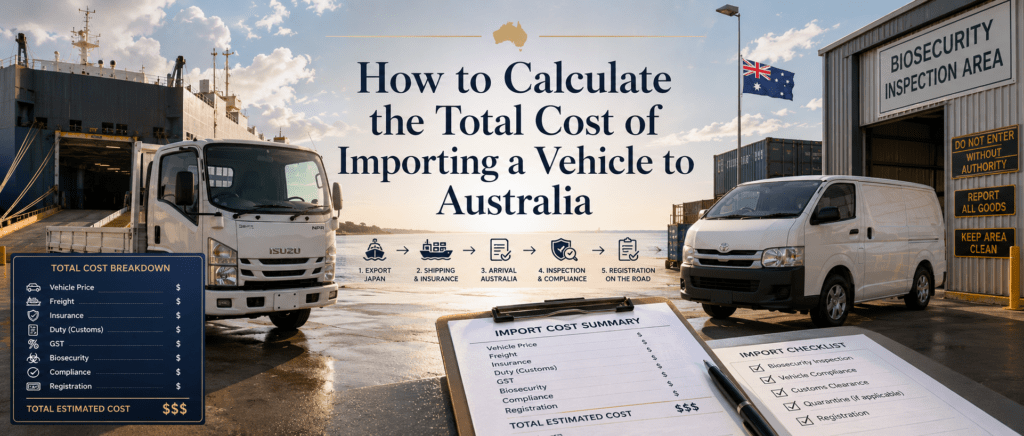

How to Calculate the Total Cost of Importing a Vehicle to Australia
A Complete Landed-Cost Guide for Japanese Used Cars and Commercial Vehicles
Importing a vehicle from Japan to Australia can offer excellent value.
However, the Japanese purchase price is only the beginning.
Australian buyers must also consider import approval, freight, insurance, customs charges, GST, biosecurity, compliance work, port fees, transport, and registration.
Therefore, the cheapest vehicle in Japan may not produce the lowest final cost in Australia.
A careful buyer calculates the full landed cost before making payment.
This is especially important for commercial vehicles.
Australian businesses use imported vehicles across many industries. These include construction, farming, mining support, trades, tourism, transport, and regional delivery.
A Japanese used truck, van, bus, or special-purpose vehicle may suit these operations very well.
Still, Australia has strict vehicle and biosecurity rules.
For that reason, cost planning must start before shipment.
This guide explains every major cost. It also provides a practical calculation method for Australian importers.
What Does “Total Import Cost” Mean?
The total import cost is the full amount needed to bring the vehicle into Australia and prepare it for legal use.
It may include:
- Vehicle purchase price
- Japanese auction or dealer fees
- Inland transport in Japan
- Export documentation
- Vehicle import approval
- Pre-shipment inspection
- Biosecurity cleaning
- Ocean freight
- Marine insurance
- Customs duty
- Australian GST
- Luxury Car Tax, if applicable
- Import processing charges
- Port and terminal fees
- Customs broker fees
- Biosecurity inspection
- Additional cleaning or treatment
- Wharf storage
- Local towing or transport
- Compliance and modification work
- Engineering inspection
- State or territory registration
- Stamp duty
- Compulsory insurance
- Initial servicing and repairs
Therefore, buyers should never compare vehicles by FOB price alone.
Instead, compare the estimated cost after registration.
Why Japanese Used Vehicles Attract Australian Buyers
Japan offers a wide range of well-maintained used vehicles.
Many models also use right-hand drive. Therefore, they match Australian driving conditions naturally.
Japanese vehicles can offer:
- Strong maintenance history
- Low or moderate mileage
- High build quality
- Useful commercial body types
- Fuel-efficient diesel engines
- Compact dimensions
- Good reliability
- Specialist models unavailable locally
Australian buyers often look for:
- Toyota Hiace vans
- Toyota Coaster buses
- Isuzu Elf trucks
- Hino Dutro trucks
- Mitsubishi Fuso Canter trucks
- Nissan Caravan vans
- Refrigerated vehicles
- Camper vehicles
- Special-purpose trucks
- Older enthusiast vehicles
- Four-wheel-drive vehicles
However, not every vehicle can enter Australia.
First, you must confirm import eligibility.
Step 1: Confirm That the Vehicle Can Be Imported
The first cost question is not “How much is the freight?”
The first question is:
“Can this vehicle legally enter Australia?”
Australia requires an import approval for road vehicles.
Different approval pathways apply to different vehicles and import purposes.
For example, a vehicle may qualify through:
- A vehicle type approval
- A concessional RAV entry pathway
- A registered automotive workshop pathway
- The older vehicle pathway
- A personal effects pathway
- A special-purpose vehicle pathway
- A non-RAV approval for limited uses
Eligibility must be checked before purchase.
Otherwise, you may buy a vehicle that cannot enter the Australian market.
Even worse, the vehicle may arrive without approval.
That situation can create storage, re-export, or disposal costs.
Therefore, confirm eligibility first.
Add the Import Approval Cost
Your budget should include the government application fee.
The amount depends on the approval pathway and application type.
You may also need professional support.
Possible extra costs include:
- Import consultant fee
- Vehicle eligibility research
- Model report access
- Workshop assessment
- Evidence preparation
- Translation of Japanese documents
Some applications are simple.
However, specialist vehicles may require more work.
Therefore, obtain a written estimate before purchase.
Step 2: Calculate the Vehicle Purchase Cost
The purchase cost may include more than the winning bid or advertised price.
For an auction vehicle, calculate:
- Winning bid
- Auction fee
- Agent fee
- Recycling fee
- Document fee
- Japanese consumption tax treatment
- Bank transfer fee
- Currency conversion cost
For dealer stock, calculate:
- Vehicle price
- Dealer fee
- Export document fee
- Inspection fee
- Optional repair cost
Always confirm whether the quotation is FOB, C&F, or CIF.
These terms change the amount included.
Consider Exchange Rate Risk
Most Japanese vehicles are priced in Japanese yen.
However, Australian buyers often budget in Australian dollars.
Exchange rates can move between:
- Quotation
- Payment
- Freight booking
- Customs valuation
- Final clearance
Therefore, include a currency buffer.
For example, a 3% to 5% buffer can reduce budget pressure.
Also, check international transfer fees.
Your bank and the receiving bank may both charge fees.
Step 3: Add Transport and Export Costs in Japan
The vehicle must move from the auction or dealer yard to the export port.
Japan has several common vehicle export ports.
These may include:
- Yokohama
- Kawasaki
- Nagoya
- Kobe
- Osaka
- Hakata
Inland transport cost depends on distance.
A vehicle located far from the port will cost more to move.
A large truck will also cost more than a small car.
Other Japanese-side costs may include:
- Yard storage
- Export deregistration
- Export certificate
- English translation
- Customs export clearance
- Port handling
- Loading preparation
- Vehicle cleaning
- Asbestos checks
- Refrigerant documentation
Therefore, request a full Japanese-side cost breakdown.
Step 4: Estimate Biosecurity Preparation Costs
Australia has strict biosecurity rules.
Used vehicles can carry:
- Soil
- Seeds
- Leaves
- Insects
- Animal material
- Plant material
- Mud
- Dust
- Organic waste
These materials often hide in difficult areas.
Common risk points include:
- Wheel arches
- Mudguards
- Chassis rails
- Engine bay
- Radiator fins
- Underbody
- Fuel tank area
- Spare wheel well
- Under seats
- Floor mats
- Storage compartments
- Door seals
- Air vents
Therefore, a quick exterior wash may not be enough.
Professional biosecurity cleaning can add cost.
However, poor cleaning can cost much more after arrival.
Include Offshore Cleaning in the Budget
Your pre-shipment budget may include:
- Steam cleaning
- Undercarriage cleaning
- Cabin vacuuming
- Engine bay cleaning
- Radiator cleaning
- Removal of leaves and seeds
- Cleaning inside chassis rails
- Spare-wheel-area cleaning
- Inspection photographs
- Cleaning certificate or provider report
Recognised offshore cleaning may reduce the level of onshore inspection.
However, the vehicle must still meet Australian cleanliness standards.
Therefore, use a provider with Australian import experience.
Step 5: Calculate Ocean Freight
Freight depends on the shipping method.
The main options are:
- RORO shipping
- Container shipping
- Break-bulk shipping
For standard running vehicles, RORO may offer lower costs.
For smaller or higher-value vehicles, container shipping may offer more protection.
Large commercial vehicles may require RORO or break-bulk service.
RORO Freight
RORO means Roll-on/Roll-off.
The vehicle drives onto the vessel.
Freight may depend on vehicle dimensions.
Shipping companies often use cubic metres.
A simple volume calculation is:
Length × Width × Height = Vehicle Volume
For example:
- Length: 6.0 metres
- Width: 2.0 metres
- Height: 2.5 metres
Vehicle volume:
6.0 × 2.0 × 2.5 = 30 cubic metres
The shipping line may multiply that volume by its freight rate.
Therefore, a tall box truck may cost much more than a flatbed.
Container Freight
Container shipping can include:
- Ocean freight
- Container loading
- Securing
- Packing materials
- Container transport
- Terminal handling
- Unpacking in Australia
- Container detention risk
A standard vehicle may fit inside a 20-foot container.
However, many trucks need a 40-foot container, high-cube container, or special equipment.
Always check dimensions before purchase.
Do not assume the vehicle will fit.
Break-Bulk Freight
Large trucks, buses, machinery, and special vehicles may ship as break-bulk cargo.
This method can involve:
- Crane handling
- Wharf labour
- Special lifting
- Extra terminal charges
- Higher insurance
- More detailed logistics planning
Therefore, request a complete quote.
A basic ocean freight figure may exclude major handling charges.
Step 6: Add Marine Insurance
Marine insurance protects the vehicle during transport.
It may cover:
- Total loss
- Serious shipping damage
- Certain handling damage
- Vessel incidents
- Some transit risks
Insurance cost often depends on the insured value.
The insured value may include:
- Vehicle price
- Freight
- Additional percentage for related costs
Do not assume C&F includes insurance.
C&F includes cost and freight only.
CIF includes cost, insurance, and freight.
Still, check the actual coverage.
Low-cost insurance may have exclusions.
Step 7: Estimate the Customs Value
Australian customs calculations start with the customs value.
The customs value is not always the same as the Japanese invoice total.
The Australian Border Force applies valuation rules.
In many normal transactions, the price paid can form the starting point.
However, adjustments may apply.
Possible adjustments include:
- Assists
- Commissions
- Royalties
- Related-party pricing
- Certain overseas costs
A customs broker can help confirm the correct value.
Use Australian dollars for the final entry.
The official customs exchange rate may differ from your bank rate.
Therefore, allow a small exchange-rate buffer.
Step 8: Calculate Customs Duty
Customs duty depends on:
- Tariff classification
- Country of origin
- Trade agreement eligibility
- Vehicle type
- Available concessions
- Supporting origin documents
Do not assume every imported vehicle attracts the same rate.
Some vehicles may attract the general tariff rate.
Others may qualify for reduced or zero duty.
A Japanese vehicle does not automatically receive a lower rate only because it ships from Japan.
Origin rules and evidence still matter.
Therefore, ask a customs broker to confirm:
- Tariff code
- Duty rate
- Origin requirements
- Required certificate or declaration
- Available concession
Customs Duty Formula
A basic calculation is:
Customs Value × Duty Rate = Customs Duty
For example:
- Customs value: AUD 25,000
- Assumed duty rate: 5%
Estimated duty:
AUD 25,000 × 5% = AUD 1,250
This is only an example.
Your actual duty rate may differ.
Step 9: Calculate Australian GST
Australian GST on a taxable importation is generally 10%.
However, GST does not apply only to the vehicle purchase price.
The GST base can include:
- Customs value
- Customs duty
- International freight
- Marine insurance
- Other included transport costs
A basic formula is:
GST = 10% × Value of the Taxable Importation
A simplified vehicle formula is:
GST = 10% × (Customs Value + Duty + Freight + Insurance)
GST Calculation Example
Assume:
- Customs value: AUD 25,000
- Customs duty: AUD 1,250
- Freight: AUD 4,000
- Insurance: AUD 250
GST base:
25,000 + 1,250 + 4,000 + 250 = AUD 30,500
GST:
AUD 30,500 × 10% = AUD 3,050
Therefore, the estimated duty and GST total is:
AUD 1,250 + AUD 3,050 = AUD 4,300
Again, this is an illustrative example.
Actual figures depend on the customs entry.
Can a Business Claim the GST?
A GST-registered business may qualify for an input tax credit.
However, eligibility depends on how the vehicle supports the business.
The importer must also hold the required records.
Therefore, ask an Australian tax adviser or accountant.
Do not treat GST recovery as guaranteed.
In addition, GST still affects cash flow at import.
Eligible businesses may also consider the Deferred GST Scheme.
However, conditions apply.
Step 10: Check Whether Luxury Car Tax Applies
Luxury Car Tax may apply to some passenger vehicles.
It does not usually apply to every commercial vehicle.
For example, some goods-carrying vehicles may fall outside the definition of a luxury car.
However, a passenger vehicle above the threshold may attract LCT.
For the 2025–26 financial year:
- General LCT threshold: AUD 80,567
- Fuel-efficient vehicle threshold: AUD 91,387
- LCT rate: 33% above the relevant threshold
The fuel-efficient definition also became stricter from 1 July 2025.
Therefore, do not assume an efficient hybrid automatically receives the higher threshold.
Basic LCT Formula
The general formula is:
(LCT Value − LCT Threshold) × 10 ÷ 11 × 33%
Only the value above the threshold attracts LCT.
Before purchasing an expensive passenger vehicle, ask a customs broker to calculate it.
For trucks and commercial vans, confirm whether the vehicle meets the relevant car definition.
Step 11: Add Customs Entry and Broker Charges
Most vehicle importers use a licensed customs broker.
Broker costs may include:
- Import declaration preparation
- Tariff classification
- Customs valuation
- GST calculation
- Document review
- Biosecurity coordination
- Port release work
- Communication with government agencies
There may also be government import processing charges.
The amount can depend on the type and value of the entry.
Therefore, request a written broker quotation.
Ask whether the quotation includes:
- ABF entry fees
- DAFF processing
- Document fees
- Disbursement fees
- Port communication
- After-hours work
- Amendments
Step 12: Calculate Biosecurity Inspection Charges
Used vehicles may undergo internal and external inspection.
The importer normally pays the related charges.
Possible costs include:
- Inspection booking
- Biosecurity officer time
- Approved arrangement facility fees
- Movement to inspection site
- Unpacking
- Cleaning
- Fumigation
- Re-inspection
- Storage during treatment
If contamination is serious, the government may direct:
- Additional treatment
- Re-export
- Destruction
These outcomes can be expensive.
Therefore, offshore cleaning is one of the best ways to control risk.
Step 13: Add Port and Terminal Costs
Australian port costs can surprise first-time buyers.
Possible charges include:
- Terminal handling
- Wharf handling
- Vehicle release
- Delivery order
- Port service fee
- Security fee
- Infrastructure fee
- Container lift
- Unpacking
- Depot fee
- Storage
- Demurrage
- Container detention
The amount varies by:
- Port
- Shipping line
- Terminal
- Shipping method
- Vehicle size
- Time at the terminal
Common arrival ports may include:
- Brisbane
- Sydney
- Melbourne
- Adelaide
- Fremantle
Choose the port based on total cost.
The closest port is not always the cheapest.
For example, one port may offer cheaper freight but higher local handling.
Therefore, compare the complete arrival cost.
Step 14: Include Local Transport
After clearance, the vehicle must move from the port.
You may need:
- Tow truck
- Tilt-tray transport
- Car carrier
- Heavy haulage
- Temporary storage
- Transport to a compliance workshop
- Transport to your home or business
An unregistered imported vehicle may not be driven freely on public roads.
Therefore, include transport in the budget.
The cost will depend on:
- Vehicle size
- Distance
- Weight
- Running condition
- State
- Special permit requirements
Large trucks may require specialist transport.
Step 15: Calculate Compliance and Modification Costs
Import approval does not automatically make the vehicle road-ready.
The vehicle may need work to meet Australian requirements.
Possible compliance costs include:
- Registered automotive workshop work
- Model report access
- ADR compliance
- Seat-belt changes
- Child restraint points
- Lighting changes
- Tyre replacement
- Speedometer changes
- Emissions work
- Side intrusion work
- Exhaust changes
- Identification checks
- Engineering certification
- RAV entry
- Roadworthiness inspection
The cost can range widely.
A common Japanese model with established support may cost less.
A rare specialist vehicle may cost much more.
Therefore, obtain a compliance estimate before buying.
Commercial Vehicle Compliance
Commercial vehicles may need special attention.
This can include:
- Gross vehicle mass
- Axle ratings
- Brake standards
- Lighting placement
- Load body condition
- Seat and seat-belt compliance
- Tyres and wheels
- Speed limiting
- Dimensions
- Rear underrun protection
- Side guards
- Refrigeration equipment
- Crane or lifting equipment
A Japanese truck built for the domestic market may not match Australian specifications.
Therefore, model selection is critical.
Step 16: Consider Refrigerant and Asbestos Risks
Vehicles with air-conditioning or refrigeration systems may require extra checks.
This is especially important for:
- Refrigerated trucks
- Refrigerated vans
- Buses
- Motorhomes
- Vehicles with non-standard cooling systems
The gas type and quantity may affect licensing or reporting requirements.
In addition, asbestos imports are heavily restricted.
Older vehicles may contain asbestos in:
- Brake parts
- Clutch parts
- Gaskets
- Heat shields
- Exhaust components
Testing and component replacement can add significant cost.
Therefore, ask the exporter for evidence before shipment.
Step 17: Add State or Territory Registration Costs
Australia does not use one national registration system.
Each state and territory has different requirements.
Your final cost may include:
- Identity inspection
- Roadworthy certificate
- Engineering certificate
- Registration fee
- Number plates
- Compulsory third-party insurance
- Stamp duty
- Vehicle tax
- Heavy vehicle charges
The cost depends on where you register the vehicle.
For example, requirements may differ in:
- New South Wales
- Victoria
- Queensland
- Western Australia
- South Australia
- Tasmania
- Australian Capital Territory
- Northern Territory
Therefore, check your local road authority before purchase.
Heavy Vehicle Registration
Heavy trucks may also fall under national heavy vehicle rules.
However, registration still involves the relevant jurisdiction.
Costs can depend on:
- Number of axles
- Vehicle mass
- Trailer configuration
- Intended use
- Inspection category
A truck that looks affordable in Japan may carry high compliance and registration costs.
Therefore, confirm the Australian operating category early.
Step 18: Add Initial Service and Repair Costs
Even a clean Japanese used vehicle may need local preparation.
Budget for:
- Engine oil
- Filters
- Coolant
- Transmission fluid
- Brake inspection
- Tyres
- Battery
- Wipers
- Air-conditioning service
- Wheel alignment
- Rust protection
- Spare keys
- English labels
- Local navigation or communication equipment
Commercial buyers should also consider downtime.
A truck that needs repairs cannot generate income.
Therefore, include both repair cost and lost operating time.
A Practical Total-Cost Formula
Use this formula:
Total Import Cost =
Vehicle Purchase Price
- Japanese Fees
- Japan Inland Transport
- Export Documentation
- Import Approval
- Pre-Shipment Cleaning
- Freight
- Marine Insurance
- Customs Duty
- GST
- LCT, if applicable
- Customs Broker Fees
- Government Processing Charges
- Biosecurity Inspection
- Port and Terminal Charges
- Storage or Treatment
- Local Transport
- Compliance Work
- Engineering and Inspection
- Registration and Stamp Duty
- Initial Repairs and Service
- Contingency
This total gives a much better picture than FOB price alone.
Detailed Example: Japanese Used Commercial Van
The following example is illustrative only.
Assume an Australian business imports a Japanese commercial van.
Japanese-Side Costs
- Vehicle purchase: AUD 22,000
- Auction and exporter fees: AUD 1,200
- Inland transport in Japan: AUD 700
- Export documents: AUD 300
- Cleaning and inspection: AUD 800
Japanese-side subtotal:
AUD 25,000
Shipping Costs
- Ocean freight: AUD 3,800
- Marine insurance: AUD 250
Shipping subtotal:
AUD 4,050
Approval and Customs
- Import approval and related support: AUD 900
- Assumed customs duty: AUD 1,250
- Estimated GST: AUD 3,030
- Broker and entry costs: AUD 750
Approval and customs subtotal:
AUD 5,930
Australian Arrival Costs
- Biosecurity inspection: AUD 450
- Port and terminal fees: AUD 1,200
- Local transport: AUD 600
Arrival subtotal:
AUD 2,250
Compliance and Registration
- Compliance work: AUD 4,000
- Engineering and inspection: AUD 800
- Registration, duty, and insurance: AUD 2,100
- Initial service: AUD 900
Compliance subtotal:
AUD 7,800
Estimated Total
- Japanese-side subtotal: AUD 25,000
- Shipping subtotal: AUD 4,050
- Approval and customs: AUD 5,930
- Arrival subtotal: AUD 2,250
- Compliance subtotal: AUD 7,800
Estimated total:
AUD 45,030
Therefore, a vehicle costing AUD 22,000 in Japan may cost about AUD 45,000 after preparation and registration.
Actual costs can be lower or higher.
Add a Contingency Buffer
Import costs can change.
Common reasons include:
- Exchange-rate movement
- Vessel delay
- Port congestion
- Cleaning failure
- Re-inspection
- Storage
- Compliance surprises
- Tyre replacement
- Document correction
- Freight adjustment
Therefore, add a contingency.
A practical buffer may be:
- 10% for a straightforward import
- 15% for a specialist vehicle
- 20% or more for a rare or modified vehicle
This protects your cash flow.
Australia-Specific Market Considerations
Australia has long distances and varied road conditions.
Vehicle choice should match the intended area.
Urban Delivery
Sydney, Melbourne, Brisbane, and Perth have busy roads and tight loading areas.
Compact Japanese vans and light trucks can offer:
- Easy manoeuvring
- Lower fuel use
- Good cargo space
- Practical turning circles
However, compliance and parts support remain important.
Regional Transport
Regional businesses often need:
- Strong cooling systems
- Reliable diesel engines
- Good fuel range
- Durable suspension
- Available parts
A rare model may cause problems far from a major city.
Therefore, choose a model with practical support.
Farming and Agriculture
Farm vehicles may operate on:
- Gravel roads
- Muddy access tracks
- Long rural routes
- Hot conditions
- Dusty environments
Biosecurity cleaning is especially important for imported farm or machinery vehicles.
In addition, the vehicle must suit local payload and towing rules.
Construction and Trades
Builders and tradespeople may value:
- Tipper bodies
- Crane trucks
- Dual-cab trucks
- Service bodies
- Refrigerated bodies
- Compact cab-over designs
However, specialist equipment can increase compliance cost.
Check the whole vehicle, not only the chassis.
Mining and Remote Support
Remote work requires high reliability.
A cheaper vehicle with limited parts support may create expensive downtime.
Therefore, long-term operating cost matters more than the purchase price.
How to Reduce the Total Import Cost
You cannot remove every cost.
However, you can reduce risk.
Confirm Eligibility Before Purchase
Never buy first and investigate later.
This is the most important rule.
Choose a Vehicle with an Established Compliance Path
Common models may offer lower workshop and parts costs.
Request Exact Dimensions
Correct dimensions help prevent freight surprises.
Use Professional Biosecurity Cleaning
Good offshore cleaning reduces the risk of treatment and storage.
Compare Arrival Ports
Compare freight, terminal charges, transport, and local compliance access.
Prepare Documents Early
Late paperwork can create storage costs.
Avoid Unnecessary Modifications
Modified vehicles may need more evidence and engineering.
Confirm Duty Treatment
Correct origin evidence may affect customs duty.
Obtain Written Quotes
Ask for written estimates from:
- Exporter
- Shipping company
- Customs broker
- Compliance workshop
- Transport company
- Registration authority
Keep a Contingency Fund
A buffer prevents the import from stopping after arrival.
Common Cost Mistakes
Avoid these common mistakes.
Buying Before Import Approval
This can leave you with a vehicle that cannot enter Australia.
Calculating GST on the Purchase Price Only
GST may also include duty, freight, and insurance.
Ignoring Biosecurity Cleaning
Poor cleaning can cause treatment, storage, or re-export costs.
Assuming the Vehicle Qualifies for Zero Duty
Country of shipment and country of origin are not always the same.
Ignoring LCT
High-value passenger vehicles may attract significant LCT.
Forgetting Compliance Costs
Import approval does not guarantee registration.
Using an Incomplete Freight Quote
Some quotes exclude terminal, loading, or destination fees.
Ignoring State Registration Rules
Each jurisdiction has different charges and standards.
Choosing a Rare Model Without Parts Support
Low purchase price may lead to high operating cost.
Questions to Ask Before Importing
Ask the exporter:
- Is the vehicle eligible for Australia?
- What is the exact chassis number?
- What is the build date?
- What are the full dimensions?
- Does the vehicle contain asbestos?
- What refrigerant does it use?
- Has it received biosecurity cleaning?
- What documents will you provide?
- Is the quote FOB, C&F, or CIF?
- Which Australian port will receive it?
Ask the customs broker:
- What tariff classification applies?
- What duty rate applies?
- Can a trade agreement apply?
- What is the estimated GST?
- Could LCT apply?
- What import processing charges apply?
- What documents are required?
Ask the compliance workshop:
- Can this exact model be complied?
- What approval pathway applies?
- What modifications are required?
- What is the estimated cost?
- How long will the work take?
- What registration documents will be issued?
Final Cost Checklist
Before making payment, complete this checklist:
- Import eligibility confirmed
- Import approval pathway confirmed
- Purchase price confirmed
- Japan fees confirmed
- Inland transport confirmed
- Vehicle dimensions confirmed
- Export document cost confirmed
- Cleaning cost confirmed
- Freight quote confirmed
- Marine insurance confirmed
- Duty estimate confirmed
- GST estimate confirmed
- LCT checked
- Broker fees confirmed
- Biosecurity fees estimated
- Port charges estimated
- Local transport quoted
- Compliance quote received
- Registration costs checked
- Initial repair budget prepared
- Contingency added
Only then should you compare the imported vehicle with an Australian-market alternative.
Final Thoughts
Importing a vehicle from Japan to Australia can deliver strong value.
However, success depends on accurate cost planning.
The Japanese vehicle price may represent only half of the final investment. Freight, taxes, biosecurity, compliance, port fees, and registration can add a large amount.
Therefore, calculate the complete landed and registered cost before purchase.
First, confirm import eligibility.
Next, obtain clear quotes for shipping, customs, cleaning, compliance, and registration.
Then, add GST, possible duty, possible LCT, and a contingency buffer.
This approach helps private buyers avoid surprises. It also helps Australian businesses protect cash flow and profit margins.
A well-selected Japanese used vehicle can support urban delivery, regional transport, agriculture, construction, tourism, and many other industries.
Yet, the best import is not always the cheapest vehicle.
The best import is the vehicle that arrives legally, clears smoothly, meets Australian standards, and delivers reliable long-term value.


Browse Reliable Used Trucks & Buses from Japan
Carefully selected vehicles ready for export worldwide
Search 100,000+ Dealer Stock Vehicles from Japan
Access a wide selection of vehicles from Japanese dealers nationwide. Updated daily.
