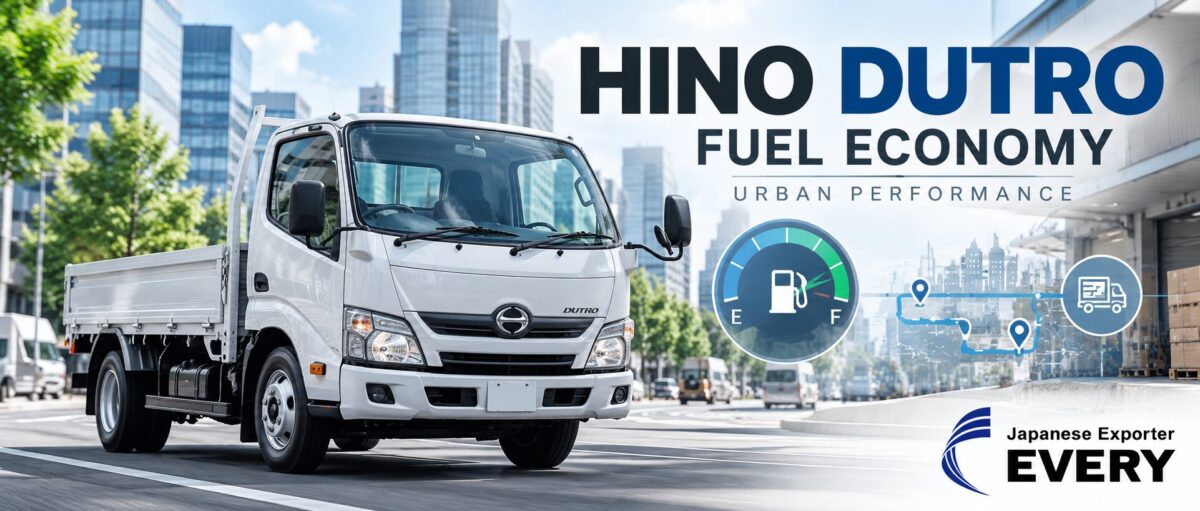

The Hino Dutro is best evaluated as an efficient light-duty commercial truck rather than by one advertised fuel-economy number. Actual fuel consumption depends on the engine, model code, payload, body type, transmission, road gradient, traffic, tyre condition and driving pattern. A lightly loaded flatbed working on suburban routes can produce a very different result from a refrigerated Dutro making repeated city deliveries.
For overseas buyers, the Dutro is especially relevant when a business needs a compact truck for urban distribution, last-mile delivery, construction support, agriculture or refrigerated transport. This guide explains its main engine families, urban advantages, fuel-cost factors, Country × Vehicle × Use examples and the checks that matter before purchasing a used Hino Dutro from Japan.
Hino Dutro: Quick Facts for Used-Truck Buyers
| Item | Buying Information |
|---|---|
| Manufacturer | Hino |
| Model | Dutro |
| Vehicle Class | Light-duty commercial truck |
| Common Used Model Family | XZU-series and related chassis codes |
| Common Older Engine | S05D, 4,899cc on documented examples |
| Common Later Engine | N04C, 4,009cc on documented examples |
| Drivetrain | 2WD and 4WD available depending on specification |
| Body Types | Flatbed, dump, box van, refrigerated, insulated and other commercial bodies |
| Typical Uses | Urban delivery, agriculture, construction, service work and local distribution |
Payload, engine output, transmission, wheelbase and body dimensions vary between individual trucks. Always check the exact model code and Japanese vehicle documents before purchase.
What Makes the Hino Dutro Suitable for Urban Work?
The Dutro belongs to a truck class designed to combine commercial carrying capacity with more compact dimensions than a medium-duty truck such as the Hino Ranger.
For city and local-distribution businesses, that can provide several practical advantages:
- Easier access to narrow commercial streets
- Less space required for loading and parking
- Lower vehicle mass than larger truck classes
- Multiple short-body and standard-body configurations
- Body choices for different types of cargo
However, buyers should avoid assuming that every Dutro has the same turning circle or overall size. Wheelbase, cab width and body length can vary substantially.
Hino Dutro Fuel Economy: Is There One Reliable km/L Figure?
No single km/L figure accurately represents every Hino Dutro.
The older version of this topic treated fuel economy as a simple model-level advantage. In practice, real consumption can change significantly according to:
- Engine family
- Gross vehicle weight
- Registered payload
- Actual load carried
- Body type
- Transmission
- 2WD or 4WD
- Urban traffic
- Road gradient
- Air-conditioning use
- Tyre pressure
- Engine condition
A Dutro used for local parcel delivery cannot be compared directly with a dump truck or refrigerated body using one generic fuel-consumption figure.
Why Body Type Changes Fuel Consumption
| Body Type | Effect on Operating Cost |
|---|---|
| Flatbed | Often relatively light, but fuel use rises with payload |
| Box Van | Body weight and aerodynamic resistance can increase consumption |
| Dump | Hydraulic equipment and heavy working loads increase total vehicle weight |
| Refrigerated / Freezer | Insulated body and refrigeration equipment add weight and energy demand |
| 4WD Flatbed / Dump | Extra drivetrain components add weight and mechanical losses |
When comparing two Dutro trucks, use similar body types and payload classes. Otherwise, fuel-economy conclusions can be misleading.
N04C: A Common Later Hino Dutro Engine
Many later Japanese used Hino Dutro trucks use versions of the N04C diesel engine.
Documented EVERYCAR.jp stock and export examples include N04C-equipped chassis such as:
- BDG-XZU344
- BKG-XZU504M
- PB-XZU424M
- TKG-XZU605M
- TKG-XZU675M
- TKG-XZU710M
The N04C displacement used in these Dutro applications is approximately 4,009cc.
However, output and emissions equipment can differ by vehicle specification. Do not apply one horsepower or torque figure to every N04C truck.
S05D: An Older Dutro Engine Family
Older Dutro examples can use the S05D diesel engine.
EVERYCAR.jp records include PB-XZU301 and PB-XZU306M trucks with the S05D engine and approximately 4,899cc displacement.
For overseas buyers, the main difference between older and later Dutro generations is not only engine displacement.
Also compare:
- Fuel-injection system
- Electronic control
- Emissions equipment
- Transmission
- Local workshop familiarity
S05D vs N04C: What Should a Used Buyer Consider?
| Buying Point | S05D-Era Dutro | N04C-Era Dutro |
|---|---|---|
| General Vehicle Age | Usually older | Generally newer |
| Displacement | Approximately 4.9L on documented examples | Approximately 4.0L |
| Electronics | Older-generation systems | Later electronic diesel systems |
| Emissions Technology | Generally earlier design | Later systems depending on year |
| Main Buyer Focus | Condition, simplicity and local parts support | Condition, electronics and diagnostic support |
The newer engine generation is not automatically the better truck. An older Dutro in strong condition can suit a market where workshops already understand that engine family.
Hino Dutro Hybrid: Where Urban Use Changes the Equation
Hybrid Dutro models add another option for buyers comparing urban operating costs.
A hybrid system can be most relevant where the truck experiences frequent:
- Acceleration
- Deceleration
- Traffic signals
- Short delivery stops
- Stop-and-go operation
That makes hybrid technology potentially attractive for dense city routes.
However, a used hybrid truck requires additional checks:
- Hybrid battery condition
- Hybrid-system warning lights
- Motor and control-system operation
- Service history
- Local diagnostic capability
- Availability of hybrid-specific components
For more detail, see Hino Dutro Hybrid Trucks: Buyer Considerations.
Country × Vehicle × Use: Zambia
EVERYCAR.jp has documented multiple Hino Dutro exports to Zambia, including N04C and S05D-powered examples.
For businesses in Zambia, a Dutro can fit:
- Lusaka urban distribution
- Retail and wholesale delivery
- Agricultural supply
- Construction support
- General business cargo
A flatbed or box-body Dutro may suit city and regional delivery where a larger medium-duty truck would add unnecessary operating cost.
A 4WD Dutro can also be worth considering where the normal route includes rough access roads or difficult worksites.
Country × Vehicle × Use: Mozambique
A documented Hino Dutro PB-XZU411M with the S05D engine was exported for use in Mozambique.
For Maputo and other urban areas, a compact light truck can suit:
- Retail distribution
- Construction supplies
- Food transport
- Local logistics
- Service businesses
For routes that extend into poorer road conditions, buyers should compare 2WD and 4WD configurations rather than assuming a normal rear-wheel-drive truck will suit every route.
Country × Vehicle × Use: Urban Island Markets
Compact light trucks can also make sense in island markets where road width, parking space and short delivery routes matter.
Possible applications include:
- Hotel and resort supply
- Retail distribution
- Food delivery
- Property maintenance
- Construction support
- Agricultural transport
Before choosing a newer Dutro, confirm whether local workshops can support its engine and emissions systems.
Country × Vehicle × Use: Dense Asian Cities
In dense urban markets, the Dutro's light-duty cab-over configuration can be useful for:
- Last-mile delivery
- Warehouse distribution
- Food supply
- Hardware delivery
- Service and maintenance work
For this work, body length, cab width and transmission may matter as much as engine choice.
Which Dutro Body Is Best for Urban Logistics?
Flatbed
Best suited to flexible cargo such as:
- Building supplies
- Produce
- Equipment
- General goods
Check deck dimensions, floor condition, sideboards and registered payload.
Box Van
Useful for:
- Retail deliveries
- Parcel operations
- Protected cargo
- Warehouse distribution
Check the roof, floor, door operation and water leakage.
Refrigerated / Freezer Truck
Useful for:
- Food distribution
- Restaurants
- Hotels
- Cold-chain delivery
Check the refrigeration unit separately from the truck chassis.
Dump Truck
Useful for:
- Construction
- Landscaping
- Small-scale civil works
Check PTO operation, hydraulics, cylinder condition, dump floor and body subframe.
How Payload Affects Urban Fuel Cost
A truck carrying more weight generally requires more energy to accelerate.
This matters especially in cities because repeated stop-and-go operation means the vehicle accelerates its load again and again.
However, choosing the smallest possible truck does not always reduce total cost.
Consider:
- A correctly sized Dutro completing one delivery run
- A smaller vehicle requiring two runs for the same cargo
The smaller truck may use less fuel per kilometer but more fuel per completed delivery job.
For commercial buyers, the useful metric is operating cost per completed job or per ton of cargo moved, not only km/L.
How to Calculate Dutro Fuel Cost per Kilometer
Use this formula:
Fuel Cost per km = Diesel Price per Liter ÷ Actual Fuel Economy in km/L
For example, if your own measured Dutro fuel economy is 9 km/L and local diesel costs USD 1.30 per liter:
USD 1.30 ÷ 9 = approximately USD 0.144 per kilometer
This is only an example calculation. Use your actual local fuel price and measured fuel consumption.
How to Calculate Monthly Fuel Cost
Use:
Monthly Fuel Cost = Monthly Distance ÷ Actual km/L × Diesel Price per Liter
For example:
- Monthly distance: 3,000 km
- Measured consumption: 9 km/L
- Example diesel price: USD 1.30/L
Fuel required:
3,000 ÷ 9 = approximately 333 liters
Estimated fuel cost:
333 × USD 1.30 = approximately USD 433
Replace these example values with your own route data.
Urban Driving Can Reduce Real-World Fuel Economy
City operation often includes:
- Frequent acceleration
- Frequent braking
- Traffic congestion
- Long idling periods
- Short journeys
- Air-conditioning use
A truck can therefore return a worse km/L result in dense traffic than on a steady regional route.
This is why an advertised fuel-economy claim without route information has limited value.
Transmission and Urban Performance
Dutro transmission specifications vary by year and model.
Used trucks can include manual, automatic or automated-manual systems depending on configuration.
Manual Transmission
A manual may suit operators where:
- Drivers are experienced with commercial manual gearboxes
- Clutch repairs are readily available
- Simple maintenance is preferred
Automatic / Automated Systems
These can provide advantages in repeated urban traffic by reducing driver workload.
Before buying, confirm:
- Correct shifting
- Dashboard warnings
- Fluid or service requirements
- Local diagnostic support
2WD or 4WD Dutro?
| Operating Condition | 2WD Dutro | 4WD Dutro |
|---|---|---|
| Paved city streets | Usually suitable | Often unnecessary |
| Urban delivery | Well suited | Extra drivetrain may add little benefit |
| Dry rural road | Can be suitable | Useful if road quality varies |
| Muddy access roads | More limited | Better traction |
| Construction sites | Suitable on firm ground | Useful on poor surfaces |
Four-wheel drive should solve a real operational problem. It adds drivetrain components, weight and maintenance points.
Tyres Affect More Than Safety
Tyre condition also affects rolling resistance and fuel consumption.
Before buying, check:
- Correct tyre size
- Tyre pressure
- Tread depth
- Sidewall cracking
- Uneven wear
- Load rating
Uneven wear can also indicate suspension, steering or alignment problems.
Engine Maintenance and Fuel Economy
A poorly maintained Dutro can use more fuel than a healthy truck with the same model code.
Check:
- Air filter
- Fuel filters
- Engine oil
- Fuel-injection system
- Turbocharger where fitted
- Cooling system
- Engine warning lights
- Emissions systems on later models
If the engine cannot operate efficiently, the original factory fuel-economy specification becomes much less relevant.
What to Check Before Buying a Used Hino Dutro
1. Model Code
Confirm the complete chassis family, such as an XZU-series code.
2. Engine Model
Confirm whether the truck uses N04C, S05D or another engine.
3. Registered Payload
Never assume all Dutro trucks belong to the same payload class.
4. Body Dimensions
Check internal or deck dimensions according to the cargo your business moves.
5. Transmission
Choose a transmission that drivers and local workshops can support.
6. Engine Condition
Check:
- Cold start
- Exhaust smoke
- Oil leakage
- Coolant leakage
- Warning lights
- Abnormal noise
7. Chassis Condition
Inspect:
- Frame rails
- Crossmembers
- Body mounting points
- Suspension mounts
- Corrosion
- Previous welding
8. Working Equipment
Dump, refrigeration, power-gate and other equipment should be tested separately.
Hino Dutro vs Hino Ranger
| Buying Point | Hino Dutro | Hino Ranger |
|---|---|---|
| Truck Class | Light-duty | Medium-duty |
| Urban Maneuverability | Generally better | Requires more space |
| Typical Cargo | Light to moderate commercial loads | Larger commercial loads |
| Operating Cost | Generally lower | Generally higher |
| Best Use | City delivery, local business, light construction | Regional logistics and medium-duty transport |
Do not choose a Ranger when the business can complete the same work efficiently with a Dutro. Likewise, do not repeatedly overload a light-duty Dutro when a medium-duty truck is required.
Hino Dutro vs Isuzu Elf and Fuso Canter
The Dutro competes with other Japanese light-duty trucks such as the Isuzu Elf and Mitsubishi Fuso Canter.
There is no reliable brand-wide winner for fuel economy.
Compare equivalent trucks based on:
- Year
- Engine
- Payload
- Body type
- Transmission
- 2WD or 4WD
- Route
- Maintenance condition
A Dutro flatbed should not be compared with a refrigerated Elf or dump Canter and then used to determine which brand uses the least fuel.
Which Hino Dutro Is Best for Low Operating Cost?
The most economical Dutro is usually the truck that can complete the required job efficiently without unnecessary size, excessive payload capacity or specialized equipment that the business does not use.
For example:
- A short 2WD flatbed can suit normal urban delivery.
- A box body can suit protected retail cargo.
- A refrigerated model can justify higher operating costs when cold-chain work is required.
- A 4WD model can justify extra drivetrain cost where traction is essential.
- A hybrid can be worth comparing for intensive stop-and-go city work when local technical support is available.
Do Not Judge a Used Dutro by Mileage Alone
Mileage matters, but it does not describe the complete condition of a commercial vehicle.
Compare:
- Service records
- Engine condition
- Transmission condition
- Chassis rust
- Tyres
- Brakes
- Suspension
- Body equipment
- Signs of previous heavy use
A higher-mileage truck with documented maintenance can sometimes be a better business purchase than a lower-mileage truck requiring major repairs.
Check Import Eligibility Before Buying
Vehicle-age rules, inspections, emissions requirements and commercial-vehicle regulations differ by destination.
Before purchasing a Dutro from Japan, confirm:
- Maximum allowable vehicle age
- Manufacturing-year requirements
- Pre-export inspection
- Commercial vehicle classification
- Emissions rules
- Required documents
- Registration requirements
Import regulations, taxes and inspection requirements can change. Confirm the latest official requirements for your country before payment and shipment.
Shipping Cost: Compact Does Not Mean Every Dutro Costs the Same
Shipping cost depends on the actual truck's:
- Length
- Width
- Height
- Body type
- Running condition
- Destination port
A long refrigerated Dutro can occupy significantly more vessel space than a short flatbed.
For the wider buying and export process, see How Vehicle Export Works from Japan.
How to Compare Two Used Hino Dutro Trucks
| Check | Dutro A | Dutro B |
|---|---|---|
| Model Code | Confirm | Confirm |
| Engine Model | Confirm | Confirm |
| Registered Payload | Compare | Compare |
| Body Type | Compare | Compare |
| Body Dimensions | Compare | Compare |
| Transmission | Compare | Compare |
| 2WD / 4WD | Compare | Compare |
| Engine Condition | Inspect | Inspect |
| Chassis Condition | Inspect | Inspect |
| Tyres and Brakes | Inspect | Inspect |
| Working Equipment | Test | Test |
| Local Parts Support | Confirm | Confirm |
| Import Eligibility | Confirm | Confirm |
| Shipping Cost | Calculate | Calculate |
| Total Landed Cost | Calculate | Calculate |
This comparison is more useful than choosing only by mileage, model year or advertised fuel economy.
FAQ: Hino Dutro Fuel Economy and Urban Performance
Is the Hino Dutro fuel efficient?
The Dutro can be an efficient light-duty truck when its body, payload and engine match the work. There is no single km/L figure that applies to every Dutro because actual fuel use changes with load, route, transmission, body type and vehicle condition.
What engine does a Hino Dutro use?
Engine type depends on year and model code. Japanese used Dutro examples include the 4,899cc S05D and 4,009cc N04C diesel engines, among other specifications.
Is the Hino Dutro good for city delivery?
Yes. Its light-duty cab-over design can suit retail delivery, food distribution, last-mile logistics and other city operations. The actual wheelbase and body dimensions should still be checked for the intended route.
Should I choose 2WD or 4WD?
Choose 2WD for normal paved urban and highway use when extra traction is unnecessary. Consider 4WD when regular work includes muddy access roads, farms or construction sites where traction is genuinely required.
Is a Hino Dutro cheaper to operate than a Hino Ranger?
A Dutro is generally a smaller truck class, so it can have lower fuel, tyre and maintenance requirements when light-duty capacity is sufficient. A Ranger can be more economical for a business that would otherwise overload a Dutro or require additional trips.
Choose the Dutro by Country × Vehicle × Use
The Hino Dutro is most effective when its compact size, payload and body specification closely match the buyer's daily work.
Before buying, answer three questions:
- Country: Which years, engines and commercial specifications can be imported and maintained locally?
- Vehicle: Which engine, model code, payload, body and drivetrain do you actually need?
- Use: Will the truck perform last-mile delivery, construction, farming, refrigeration or general distribution?
Then compare:
- Model code
- Engine family
- Registered payload
- Body type
- Wheelbase and dimensions
- Transmission
- 2WD or 4WD
- Engine condition
- Chassis condition
- Working equipment
- Parts availability
- Fuel cost for the actual route
- Import eligibility
- Shipping cost
- Total landed cost
EVERY TRADING has exported Japanese vehicles since 2006 and can help overseas buyers source Hino Dutro trucks according to destination, payload, body type and business requirements.
Looking for a Hino Dutro? View the current used Hino Dutro stock from Japan and compare flatbeds, dump trucks, box vans, refrigerated bodies, 2WD and 4WD configurations.
If a Dutro is too small for your intended cargo, browse the wider Japanese used truck stock and compare the correct truck class for your operation.
Related Guides
- Used Hino Dutro Trucks for Sale
- Hino Dutro: Small Truck, Big Potential
- Hino Dutro Hybrid Trucks
- Light Trucks for Urban Delivery and Distribution
- How Vehicle Export Works from Japan
- Japanese Used Trucks for Sale


Browse Reliable Used Trucks & Buses from Japan
Carefully selected vehicles ready for export worldwide
Search 100,000+ Dealer Stock Vehicles from Japan
Access a wide selection of vehicles from Japanese dealers nationwide. Updated daily.
