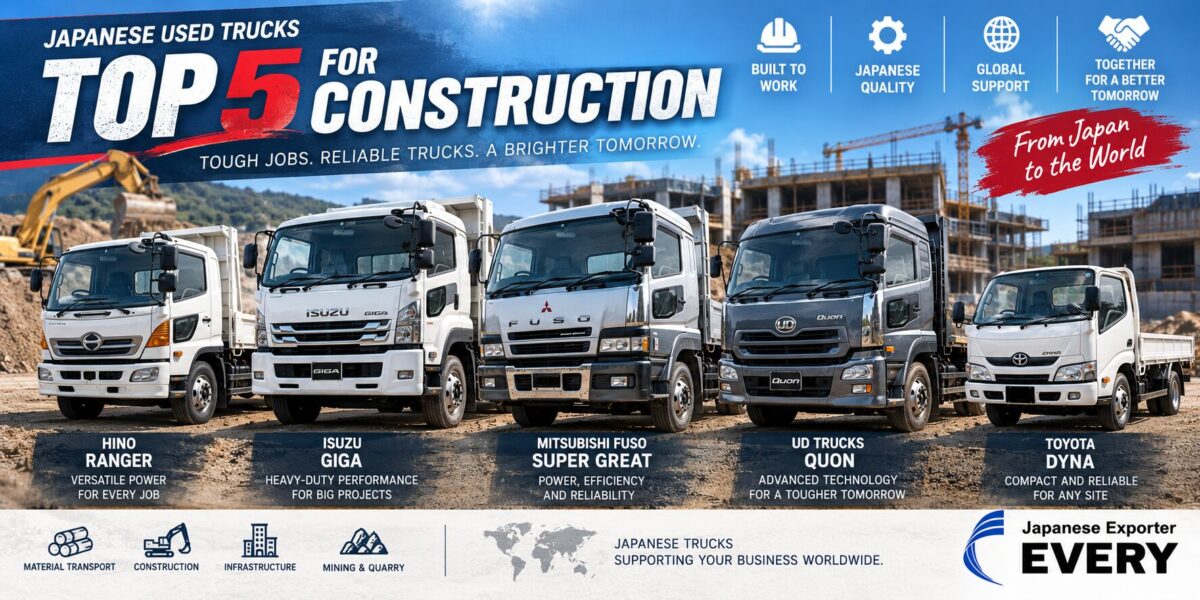

5 Japanese Used Trucks for Construction: Practical Choices for Tough Jobs
Construction work demands more from a truck than ordinary road transport. A construction truck may carry gravel, steel, timber, machinery, tools, or other heavy materials. It may also operate on narrow access roads, uneven surfaces, steep gradients, and dusty jobsites.
For overseas buyers, Japanese used trucks offer a wide range of choices. Hino, Isuzu, Mitsubishi Fuso, UD Trucks, and Toyota have produced commercial vehicles for everything from small urban projects to large-scale infrastructure work.
However, there is no single truck that is suitable for every construction business. Payload, body type, road conditions, engine specification, parts availability, and project scale all matter.
In this guide, we introduce five Japanese truck models worth considering for construction work and explain how to choose the right specification for your project.
View Japanese Used Trucks for Sale
Quick Comparison: Japanese Trucks for Construction
| Model | Truck Class | Typical Construction Role | Key Advantage |
|---|---|---|---|
| Hino Ranger | Medium-duty | Dump, crane, flatbed, equipment transport | Versatile middle-weight platform |
| Isuzu Giga | Heavy-duty | Heavy dump, mixer, bulk material transport | Heavy-duty chassis and high torque |
| Mitsubishi Fuso Super Great | Heavy-duty | Dump, mixer, heavy cargo and machinery transport | Heavy-duty performance |
| UD Quon | Heavy-duty | Dump, mixer, heavy construction logistics | Heavy-duty driveline and multiple configurations |
| Toyota Dyna | Light/medium-duty | Small dump, flatbed, crane and tool transport | Compact size and maneuverability |
These categories are general guides. Actual payload, GVW, engine, drivetrain, wheelbase, and body configuration depend on the individual truck.
1. Hino Ranger: A Versatile Medium-Duty Construction Truck
The Hino Ranger is one of Japan's well-known medium-duty commercial trucks. Used Rangers are available in many configurations, which makes the model particularly interesting for construction companies.
Depending on the year and chassis specification, buyers can find Ranger trucks with different Hino diesel engines, including J05, J07, J08, and later A05C-series applications.
Common Construction Body Types
- Dump truck
- Flatbed truck
- Crane truck
- Tipper
- Equipment carrier
- Special-purpose construction body
This flexibility is one of the Ranger's main advantages. A medium-duty Ranger can provide useful carrying capacity without the overall size of a full heavy-duty truck.
When Should You Consider a Hino Ranger?
A Ranger can be worth considering when your project requires more capacity than a light-duty truck but does not justify a larger heavy-duty vehicle.
It may work well for building-material transport, equipment movement, roadwork support, landscaping, concrete-related work, and general construction logistics.
Buyer Tip: Do not determine payload from the Ranger name alone. Confirm the chassis code, GVW, maximum payload, body dimensions, and engine model of the actual truck.
2. Isuzu Giga: Heavy-Duty Power for Large Construction Projects
When construction work moves into the heavy-duty category, the Isuzu Giga becomes an important model to consider.
The Giga is designed as a heavy-duty truck platform. Depending on generation and specification, Japanese used Giga trucks can be found as dumps, mixers, tractors, cargo trucks, tankers, and other specialized vehicles.
6UZ1 Engine Example
Modern Japanese-market Giga models use the 6UZ1 diesel engine. Current Isuzu specifications list a displacement of 9,839cc.
For example, the 6UZ1-TCS specification produces 380PS and 1,814Nm of torque. However, used Giga trucks span many generations, so older vehicles may use completely different engines.
Construction Applications
- Heavy dump operations
- Sand and gravel transport
- Crushed stone transport
- Concrete mixer applications
- Heavy machinery transport
- Large infrastructure projects
- Quarry and mining-support work
The Giga makes the most sense when the required load, body, and operating environment genuinely require a heavy-duty chassis.
Buyer Tip: Check axle configuration as carefully as engine power. A 6x4 dump truck and a 4x2 cargo truck may both carry the Giga name but serve very different purposes.
3. Mitsubishi Fuso Super Great: Heavy-Duty Construction Capability
The Mitsubishi Fuso Super Great is another major Japanese heavy-duty truck platform.
Used Super Great trucks exported from Japan cover multiple generations. As a result, engine and transmission specifications vary significantly by year.
This is important because buyers should not assume that every Super Great has the same engine technology.
Modern Super Great Engine Example
The latest Japanese Super Great uses the 6R30, a 12.8-liter inline six-cylinder turbo diesel.
Current specifications include:
- 6R30 T1: 394PS and 2,000Nm
- 6R30 T2: 421PS and 2,100Nm
These figures demonstrate the performance available in the latest generation. However, an older Japanese used Super Great may have a different engine, transmission, emissions system, and power output.
Construction Applications
- Heavy dump truck
- Concrete mixer
- Heavy flatbed
- Construction equipment transport
- Bulk material transport
- Infrastructure logistics
Buyer Tip: For older Super Great trucks, always identify the complete model code and engine code. This information is essential when checking parts compatibility and maintenance support in the destination country.
4. UD Quon: Heavy-Duty Options for Construction Logistics
The UD Quon offers another heavy-duty Japanese option for construction businesses.
Current Japanese specifications demonstrate how diverse the Quon platform can be. Depending on configuration, the lineup includes 6x2, 6x4, and 8x4 vehicles.
For example, current 6x4 Quon CW specifications include GH11-powered models designed for applications such as cargo, dump, and mixer work.
Why Configuration Matters
A construction buyer should look beyond horsepower. Axle configuration can be just as important.
- 6x2: Suitable for various road-based cargo applications
- 6x4: Commonly considered for demanding heavy-duty applications
- 8x4: Offers additional chassis configurations for specialized heavy work
Current Japanese Quon models also use electronically controlled transmissions such as ESCOT, although transmission specifications vary by model and generation.
Construction Applications
- Dump transport
- Concrete mixer work
- Heavy construction logistics
- Equipment transport
- Infrastructure projects
Buyer Tip: A used Quon can differ considerably from a current model. Verify the actual engine, transmission, axle configuration, GVW, and emissions equipment before purchasing.
5. Toyota Dyna: Compact and Practical for Smaller Jobsites
Not every construction project needs a heavy-duty truck.
For urban building work, renovation, landscaping, maintenance, and smaller contractors, a Toyota Dyna may be a more practical choice.
Its compact cab-over design can make access easier on narrow streets and confined jobsites where a large truck would be difficult to maneuver.
Useful Construction Configurations
- Flatbed
- Small dump
- Crane-equipped truck
- Double cab
- Tool and equipment transport
Japanese used Dyna trucks cover many generations and engine families. Therefore, buyers should avoid assuming that every Dyna uses the same diesel engine.
When Does a Dyna Make Sense?
Consider a Dyna when maneuverability, moderate cargo capacity, and access are more important than maximum payload.
For example, it can be useful for transporting tools, scaffolding components, bags of materials, landscaping supplies, small machinery, and construction crews.
Buyer Tip: Compare the actual cargo-bed length and payload. Two Dyna trucks that look similar can have different wheelbases, GVW ratings, and carrying capacities.
Light, Medium, or Heavy-Duty: Which Construction Truck Do You Need?
Choosing the largest truck is not always the best solution.
| Construction Requirement | Truck Type to Consider | Example |
|---|---|---|
| Narrow urban sites | Light-duty | Toyota Dyna |
| General building materials | Medium-duty | Hino Ranger |
| Medium dump/crane work | Medium-duty | Hino Ranger |
| Large-volume aggregates | Heavy-duty | Isuzu Giga / Fuso Super Great / UD Quon |
| Large infrastructure work | Heavy-duty | Giga / Super Great / Quon |
The correct truck should match the work rather than simply provide the highest possible engine output.
Dump, Crane, or Flatbed: Body Type Matters
For construction buyers, the truck body may be more important than the brand.
Dump Truck
A dump body is useful for soil, sand, gravel, aggregate, demolition material, and other loose cargo.
Crane Truck
A truck-mounted crane can help load and unload machinery, steel, construction materials, and equipment without requiring separate lifting equipment at every destination.
Flatbed Truck
A flatbed provides flexibility for pallets, steel, timber, equipment, pipes, and general building materials.
Therefore, start by identifying the work you need the truck to perform. Then compare suitable models.
7 Things to Check Before Buying a Used Construction Truck from Japan
1. Maximum Payload
Check the official vehicle documentation. Never estimate payload from truck size or engine power.
2. Chassis Condition
Construction trucks can experience severe loading. Inspect the frame for corrosion, cracks, deformation, and previous welding.
3. Body Condition
For a dump truck, inspect the floor, side panels, hinges, subframe, hydraulic cylinder, and PTO system.
For a crane truck, check the crane model, capacity information, boom condition, outriggers, controls, and hydraulic leaks.
4. Engine Condition
Check cold starting, smoke, abnormal noise, oil leakage, coolant leakage, and warning lights.
5. Transmission and Clutch
Construction work can involve frequent starts, stops, and low-speed maneuvering. Check clutch engagement and transmission operation carefully.
6. Axles, Differential, and Suspension
These components carry significant stress on loaded construction trucks. Look for leakage, abnormal noise, damaged springs, and worn mounting points.
7. Tires
Large commercial tires can represent a significant replacement cost. Check size, tread, cracking, and uneven wear before calculating the total purchase budget.
Do Not Choose a Construction Truck by Horsepower Alone
High engine output can be useful, but horsepower alone does not make a truck suitable for construction.
Overseas buyers should consider:
- Maximum payload
- GVW
- Axle configuration
- Body type
- Body dimensions
- Road conditions
- Gradient
- Daily distance
- Parts availability
- Fuel quality
- Local mechanic experience
- Import regulations
A smaller truck that perfectly matches the project can provide better business value than an oversized truck with unnecessary capacity.
FAQ: Japanese Used Construction Trucks
Which Japanese truck is suitable for a small construction company?
A Toyota Dyna or suitable Hino Ranger can be worth considering, depending on required payload and body type. A small contractor should first determine what materials and equipment need to be transported.
Which Japanese trucks are suitable for heavy construction?
Heavy-duty platforms such as the Isuzu Giga, Mitsubishi Fuso Super Great, and UD Quon offer configurations designed for demanding commercial work. The correct choice depends on the individual chassis and body specification.
What is better for construction: a dump truck or a flatbed?
A dump truck is better suited to loose materials such as soil, sand, and gravel. A flatbed is more flexible for machinery, steel, timber, pallets, and packaged construction materials.
Should I choose a 6x4 truck for construction?
A 6x4 configuration can be useful for certain heavy-duty and demanding applications. However, the correct drivetrain depends on road conditions, vehicle weight, load, body type, and intended work.
What should overseas buyers inspect before shipment?
Check the chassis, engine, transmission, clutch, suspension, axles, differential, tires, brakes, cargo body, hydraulics, PTO, and actual payload. For remote purchases, detailed photographs and operation videos are particularly useful.
Find Japanese Used Construction Trucks from Japan
Japan offers construction trucks for almost every scale of operation, from compact Toyota Dyna trucks to medium-duty Hino Rangers and heavy-duty Isuzu Giga, Mitsubishi Fuso Super Great, and UD Quon models.
The most important step is matching the truck to the actual job.
Before buying, confirm the model code, engine, maximum payload, GVW, body type, axle configuration, dimensions, mechanical condition, and parts availability.
EVERY TRADING Co., Ltd. has exported Japanese used vehicles to customers around the world since 2006. We handle used trucks, buses, tractors, machinery, and other Japanese vehicles for international buyers.
If you tell us your destination country, required payload, preferred body type, and intended construction work, our team can help you compare suitable vehicles.
View Japanese Used Trucks for Sale
Ask EVERY TRADING About a Construction Truck
Building International Partnerships
EVERY TRADING also supports the idea behind UN Sustainable Development Goal 17: Partnerships for the Goals. Reliable international trade depends on communication, transparency, and long-term cooperation between exporters, buyers, shipping companies, and local partners.
Our goal is not simply to export a truck. We aim to build lasting business relationships with customers who depend on Japanese vehicles for transportation, construction, agriculture, and infrastructure development.


Browse Reliable Used Trucks & Buses from Japan
Carefully selected vehicles ready for export worldwide
Search 100,000+ Dealer Stock Vehicles from Japan
Access a wide selection of vehicles from Japanese dealers nationwide. Updated daily.
