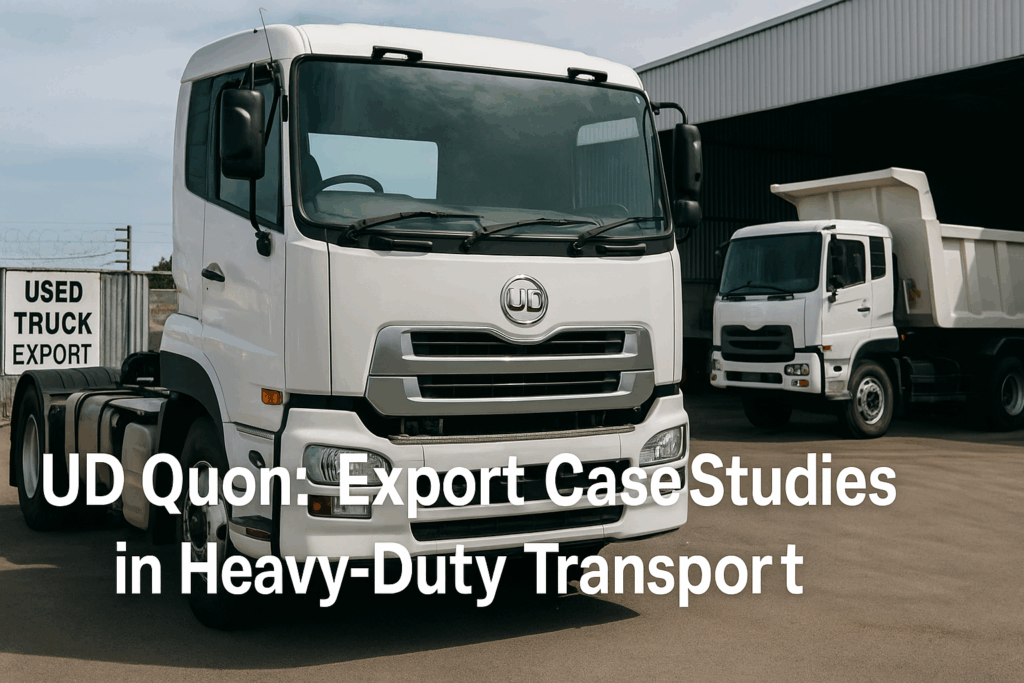

UD Quon: Export Case Studies in Heavy-Duty Transport
Introduction
The UD Quon is one of the most respected Japanese heavy-duty trucks. Known for its durability, efficiency, and advanced engineering, this model continues to serve logistics and construction businesses worldwide. Buyers from Africa, Asia, and the Caribbean consistently choose the UD Quon for their toughest transport challenges. In this article, we will examine export case studies and explain why this truck has become a global favorite in heavy-duty transport.
If you are looking for Used Nissan UD Quon, please check our latest listings here:
👉 Used Nissan UD Quon for Sale – EVERYCAR.jp
Why the UD Quon Stands Out
Japanese heavy-duty trucks are recognized for quality, but the UD Quon goes even further. It combines fuel efficiency, strong engines, and driver comfort in a package that makes long-haul and heavy-load transport easier.
-
Fuel Savings: UD Quon’s efficient diesel engines lower running costs.
-
High Reliability: Minimal breakdowns mean lower maintenance and reduced downtime.
-
Comfort and Safety: Modern cabs reduce driver fatigue and improve focus.
Because of these qualities, the UD Quon has found consistent demand across international markets.
Export Case Study 1: UD Quon in East Africa
In East Africa, countries such as Kenya and Tanzania rely heavily on the UD Quon. The trucks are used to transport construction materials, agricultural products, and containerized goods between ports and inland cities. One client in Tanzania reported that the UD Quon maintained excellent performance even on rough rural roads. Fuel efficiency played a major role in cost savings, making the truck a strong investment.
Export Case Study 2: UD Quon in Southern Africa
In Zambia and Zimbabwe, UD Quon trucks are often chosen for mining and heavy construction projects. Customers noted that the truck’s high torque and powerful engine options allowed them to move heavy loads over long distances without difficulty. Importers also appreciated the availability of spare parts and service networks in their region, which improved overall vehicle uptime.
Export Case Study 3: UD Quon in the Caribbean
In the Caribbean, where island economies depend on port logistics, the UD Quon plays a key role. In Jamaica, a fleet of UD Quon trucks was purchased to handle container transport from the harbor to distribution centers. Operators emphasized the smooth driving experience and low total cost of ownership, both critical factors for small-to-medium logistics companies.
Export Case Study 4: UD Quon in Southeast Asia
Southeast Asian markets like the Philippines and Vietnam also show strong demand for the UD Quon. The trucks are employed in infrastructure development projects such as road construction and building material delivery. Buyers highlighted the balance between Japanese engineering reliability and competitive pricing, which gave them a long-term advantage.
Key Advantages for Global Buyers
Across all regions, several themes emerge from these case studies:
-
Consistent Reliability: The UD Quon withstands extreme weather, rough roads, and heavy loads.
-
Cost Efficiency: Reduced fuel consumption and fewer repairs save money.
-
Global Trust: Buyers in more than 100 countries have chosen this model.
-
Long Service Life: With proper maintenance, the Quon remains productive for many years.
Conclusion
The UD Quon continues to prove itself as a leader in heavy-duty transport across the globe. Whether in Africa’s mining industries, the Caribbean’s port logistics, or Asia’s construction projects, the truck delivers exceptional results. For international buyers, the UD Quon represents not just a truck but a reliable business solution.
If you are exploring the Japanese used truck market, the UD Quon is a proven choice. It has already helped countless businesses expand their operations, reduce costs, and achieve long-term growth.
If you are looking for Japanese Used truck, please check our list.
The list of Used Japanese used truck for sale(*Click to open).
We do our best work for all customer's partnership.
It's for SDGs goal number 17 "PARTNERSHIP FOR THE GOALS".
Let's work together!


