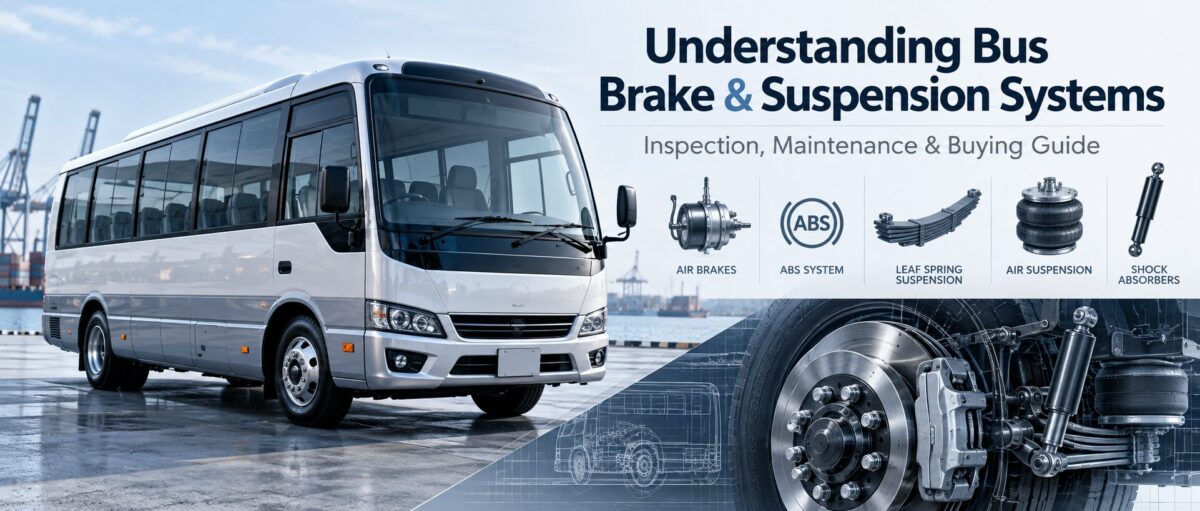

Brake and suspension condition should be treated as major purchase factors when buying a used Japanese bus. The brake system determines how safely the vehicle can slow and stop under passenger load, while the suspension affects stability, tyre wear, ride comfort and driver control. However, not every Toyota Coaster, Nissan Civilian, Mitsubishi Fuso Rosa, Hino Rainbow or full-size coach uses the same system.
Smaller buses may use hydraulic or related brake systems with leaf-spring suspension, while larger city buses and highway coaches can use full-air braking and air suspension. Equipment also changes by model code, year and grade. For overseas buyers, the practical approach is Country × Vehicle × Use: identify the road conditions, passenger duty and local repair capability first, then inspect the exact bus. This guide explains how the systems work, what warning signs matter, and what to check before importing a used bus from Japan.
Bus Brake and Suspension Systems: Quick Comparison
| System | How It Works | Common Buyer Consideration |
|---|---|---|
| Hydraulic Brakes | Brake fluid transfers pedal pressure to wheel brakes | Fluid leaks, pedal feel, hoses, master cylinder and wheel components |
| Air Brakes | Compressed air operates the service braking system | Air pressure build-up, leaks, compressor, tanks, valves and brake chambers |
| ABS | Modulates brake pressure to help prevent wheel lock | Warning lights, wheel-speed sensors and fault history |
| Leaf-Spring Suspension | Steel spring packs support vehicle weight | Broken leaves, bushes, U-bolts, sagging and corrosion |
| Air Suspension | Air springs support and level the body | Air leaks, ride height, valves, compressor supply and air bags |
| Shock Absorbers | Control suspension movement | Oil leakage, excessive bouncing and poor stability |
Do not identify the system only from the bus model name. Confirm the exact chassis, year and specification before ordering parts or making a purchase decision.
Why Brake Condition Matters More on a Bus
A bus carries passengers rather than only cargo.
That changes the inspection priority.
A passenger bus can regularly operate with:
- Multiple occupants
- Frequent stops
- Long downhill sections
- Urban traffic
- Repeated acceleration and braking
- High daily mileage
As passenger load and vehicle weight increase, the braking system must repeatedly convert more kinetic energy into heat.
For that reason, brake condition should be evaluated before purchase rather than treated as a routine repair after arrival.
How Hydraulic Bus Brakes Work
A hydraulic brake system uses brake fluid to transfer the driver's pedal force to the wheel brakes.
The basic process is:
- The driver presses the brake pedal.
- The master cylinder creates hydraulic pressure.
- Brake fluid carries that pressure through the brake lines.
- Calipers or wheel cylinders apply the brakes.
- Friction at the discs or drums slows the vehicle.
Hydraulic systems can be found on smaller buses and minibuses, depending on the exact specification.
What to Inspect on a Hydraulic Brake System
- Brake-fluid level
- Fluid condition
- Master-cylinder leakage
- Brake hoses
- Steel brake lines
- Calipers or wheel cylinders
- Brake pads or linings
- Discs or drums
- Pedal travel
- Brake warning lights
A soft pedal, fluid leakage or pulling to one side during braking should be investigated before the bus enters passenger service.
How Air Brakes Work
Large buses often use compressed-air braking.
The system typically includes:
- Air compressor
- Air dryer where fitted
- Reservoir tanks
- Valves
- Air lines
- Brake chambers
- Wheel brake assemblies
The compressor builds air pressure and stores it in the reservoirs. When the driver operates the brake pedal, valves control compressed air to the brake chambers, which apply the wheel brakes.
Unlike a simple hydraulic system, air pressure itself becomes an important inspection item.
What to Check on an Air-Brake Bus
Before buying or operating an air-brake bus, check:
- How quickly air pressure builds after startup
- Whether pressure remains stable
- Audible air leakage
- Air-tank condition
- Drain valves
- Air dryer where fitted
- Air compressor operation
- Brake chambers
- Air hoses and fittings
- Low-air warning system
- Parking brake operation
A bus that struggles to build pressure or loses pressure rapidly requires further diagnosis.
Air Brakes vs Hydraulic Brakes
| Point | Hydraulic Brakes | Air Brakes |
|---|---|---|
| Operating Medium | Brake fluid | Compressed air |
| Common Application | Smaller buses depending on model | Larger buses and coaches depending on model |
| Main Leak Concern | Brake fluid | Compressed air |
| Key Driver Check | Pedal feel and warning lamp | Air-pressure gauges and warnings |
| Workshop Requirement | Hydraulic brake servicing | Commercial air-brake knowledge |
Neither system is automatically “better.” The correct system is the one designed for the bus and supported by competent local service.
Disc Brakes vs Drum Brakes
Japanese buses can use disc brakes, drum brakes or a combination, depending on generation and axle.
Disc Brakes
Disc systems use a caliper and brake pads to clamp a rotating disc.
Inspect:
- Pad thickness
- Disc wear
- Scoring
- Heat damage
- Caliper movement
- Fluid or air-system actuation depending on design
Drum Brakes
Drum systems use brake shoes pressing against the inside of a drum.
Inspect:
- Lining condition
- Drum wear
- Adjustment
- Contamination
- Wheel-cylinder condition on hydraulic systems
- Brake-chamber and linkage condition on air-operated systems
Do not assume a bus has four-wheel disc brakes because another vehicle with the same model name does.
What Does ABS Do on a Bus?
ABS, or Anti-lock Braking System, helps prevent the wheels from locking during hard braking.
The system uses wheel-speed sensors to detect when a wheel is approaching lock-up. Brake pressure is then modulated to help maintain tyre rotation and steering control.
ABS does not remove the need for:
- Good tyres
- Correct brake adjustment
- A healthy hydraulic or air system
- Safe driving speed
ABS Warning Light: Do Not Ignore It
If the ABS warning lamp remains illuminated after the normal startup check, the system may have a stored fault.
Possible causes include:
- Wheel-speed sensor problems
- Damaged wiring
- Sensor-gap issues
- Control-unit faults
- Low system voltage
For a later-model bus, ask for diagnostic information where available.
Modern Bus Braking Technology
Later Japanese buses may include more advanced brake-assistance technology.
Depending on model and year, equipment can include:
- ABS
- Brake Assist
- Electronic stability systems
- Collision-mitigation or automatic emergency braking systems
For example, current Mitsubishi Fuso Rosa specifications include an Advanced Emergency Braking System on applicable models.
Such technology should be treated as additional support rather than a replacement for mechanical brake inspection.
What Is a Retarder or Auxiliary Brake?
Some larger buses and coaches use auxiliary braking systems to help control speed without relying only on the wheel brakes.
Depending on the vehicle, this can include:
- Engine braking
- Exhaust braking
- Retarder systems
These systems are especially useful on long descents because they can reduce heat build-up in the service brakes.
When buying a coach for mountain routes, confirm whether auxiliary braking is fitted and whether it operates correctly.
Why Brake Fade Matters on Mountain Routes
Repeated heavy braking creates heat.
If braking components become too hot, braking performance can decrease.
This is why downhill passenger routes require careful attention to:
- Correct gear selection
- Engine or auxiliary braking
- Brake condition
- Vehicle load
- Driver technique
A larger brake system does not make an overloaded or poorly driven bus safe.
What Does the Suspension System Do?
The suspension connects the vehicle body and chassis to the wheels.
Its job is not only passenger comfort.
It also affects:
- Tyre contact with the road
- Vehicle stability
- Steering response
- Braking stability
- Body control
- Passenger comfort
A bus with badly worn suspension can still move and stop, but it may handle poorly and wear tyres rapidly.
Leaf-Spring Suspension
Leaf springs use stacked steel leaves to support vehicle weight.
They are common on many older or smaller commercial vehicles and buses.
Why Leaf Springs Are Used
Advantages can include:
- Simple construction
- Good load-carrying ability
- Established repair methods
- Fewer pneumatic components than air suspension
What to Inspect
- Broken spring leaves
- Cracks
- Uneven ride height
- Spring-eye bushes
- Shackles
- U-bolts
- Mounting points
- Corrosion
A bus leaning to one side can indicate suspension wear, but the cause should be diagnosed rather than assumed.
Air Suspension
Air suspension uses pressurized air springs instead of relying only on steel springs to support the vehicle body.
It is commonly associated with larger buses and coaches where passenger comfort and ride-height control matter.
The system can include:
- Air springs / air bags
- Air lines
- Height-control valves
- Air reservoirs
- Shock absorbers
- Electronic controls on more advanced systems
Why Air Suspension Is Useful on Passenger Buses
Advantages can include:
- Smoother ride
- Better ride-height control
- Improved passenger comfort
- Reduced body movement when correctly maintained
Some buses also use kneeling or height-adjustment functions to improve passenger access.
However, air suspension adds components that must be inspected and maintained.
Common Air-Suspension Problems
Warning signs include:
- One corner sitting lower than the others
- Bus body lowering after parking
- Air compressor running unusually often
- Audible air leaks
- Ride-height warning
- Harsh or unstable ride
Possible causes include:
- Air-bag leaks
- Damaged hoses
- Faulty fittings
- Height-control valve problems
- Electronic control faults
Do not automatically replace the air bag without diagnosing the entire system.
Shock Absorbers: Often Overlooked
Springs support the bus. Shock absorbers control the movement of that suspension.
Worn shock absorbers can cause:
- Repeated bouncing after bumps
- Poor body control
- Reduced passenger comfort
- Tyre wear
- Unstable handling
Inspect shock absorbers for:
- Oil leakage
- Damaged bushes
- Bent components
- Loose mounting points
Leaf Suspension vs Air Suspension
| Point | Leaf Spring | Air Suspension |
|---|---|---|
| Basic Design | Steel spring packs | Pressurized air springs |
| Passenger Comfort | Depends on design and condition | Often selected for greater ride comfort |
| Complexity | Lower | Higher |
| Main Inspection | Leaves, bushes, shackles, U-bolts | Air bags, valves, air lines, sensors |
| Remote-Area Repair | Can be easier where spring repair is common | Requires air-system parts and knowledge |
| Typical Buyer Priority | Simplicity and robustness | Comfort and ride-height control |
Country × Vehicle × Use: Tanzania × Minibus × Tourism
A Toyota Coaster, Mitsubishi Fuso Rosa or Nissan Civilian can serve tourism, hotel or group transport in Tanzania when the exact specification matches the route.
For paved urban and regional tourism routes, inspect:
- Brake response
- Tyres
- Shock absorbers
- Leaf or air suspension condition
- Air conditioning
- Steering
For routes involving hills or long descents, brake condition deserves additional attention.
Choose the individual bus by chassis and system condition, not by assuming every Coaster, Rosa or Civilian uses the same brakes.
Country × Vehicle × Use: Zambia × Bus × Staff Transport
Staff and group transport in Zambia can involve urban routes, intercity travel and uneven road surfaces.
For a used minibus or larger bus, compare:
- Suspension simplicity
- Local availability of bushes and spring parts
- Brake parts
- Tyre sizes
- Workshop capability
- Daily passenger load
A mechanically simpler leaf-spring vehicle may be easier to support in one operating area, while an air-suspension bus may offer more passenger comfort where appropriate maintenance is available.
Country × Vehicle × Use: Fiji × Hotel or School Bus
Mixed urban, coastal and regional roads make suspension and tyre inspection important for a bus used in Fiji.
Before purchase, check:
- Shock absorbers
- Spring bushes
- Ride height
- Tyre wear
- Brake condition
- Steering play
Uneven tyre wear can provide a useful clue to alignment, steering or suspension problems.
Country × Vehicle × Use: Mountain Routes
A bus operating regularly on steep routes needs a different inspection focus from an urban shuttle.
Prioritize:
- Service brakes
- Auxiliary braking system where fitted
- Transmission
- Cooling system
- Tyres
- Suspension bushes
- Shock absorbers
On downhill sections, repeated service-brake use can create significant heat.
Country × Vehicle × Use: Urban Stop-and-Go Bus
Urban passenger service can be hard on brakes even when roads are flat.
Frequent stop-and-go operation increases wear on:
- Brake pads or linings
- Discs or drums
- Door systems
- Suspension bushes
- Tyres
For a city-bus fleet, maintenance planning should reflect operating cycles rather than only total kilometers.
Minibus vs Full-Size Bus: Different Systems, Different Maintenance
| Buyer Point | Minibus | Full-Size Bus / Coach |
|---|---|---|
| Typical Examples | Toyota Coaster, Nissan Civilian, Fuso Rosa | Hino Selega, Isuzu Gala, city buses |
| Brake System | Varies; hydraulic or other commercial systems depending on model | Air braking is common on larger vehicles |
| Suspension | Leaf or other systems depending on chassis | Air suspension common on many coaches and large buses |
| Complexity | Generally lower | Potentially higher |
| Parts Cost | Depends on model | Larger commercial components can cost more |
Always inspect the specific unit rather than purchasing based on vehicle class alone.
How Brake Problems Can Reveal Themselves During a Test
During an appropriate inspection or road test, watch for:
- Bus pulling left or right under braking
- Pedal pulsation
- Excessive pedal travel
- Slow pressure build-up on air systems
- Brake warning lamps
- Abnormal squealing or grinding
- Burning smell
- Vehicle vibration
Any unusual behavior deserves further inspection.
How Suspension Problems Reveal Themselves
Possible signs include:
- Bus leaning to one side
- Excessive bouncing
- Clunking noises
- Steering instability
- Uneven tyre wear
- Harsh ride
- Body movement under braking
These symptoms can come from suspension, steering, tyres or alignment, so the complete front and rear running gear should be inspected.
Tyres Can Tell You a Lot About the Bus
Tyres are not part of the suspension itself, but tyre wear can reveal suspension and alignment problems.
Inspect:
- Tread depth
- Inside-edge wear
- Outside-edge wear
- Cupping or scalloping
- Sidewall cracking
- Tyre age
- Correct matching across an axle
Uneven wear can indicate:
- Alignment problems
- Worn suspension joints
- Worn shock absorbers
- Incorrect tyre pressure
- Steering problems
For more detail, see the Bus Tyre Management Guide.
Do Not Use Generic Maintenance Intervals for Every Bus
The previous version of this article recommended fixed inspection intervals such as:
- Brake linings every 10,000 km
- Shock absorbers every 20,000 km
- Air suspension quarterly
These figures should not be treated as universal service intervals.
The correct schedule depends on:
- Manufacturer
- Model code
- Brake system
- Operating environment
- Passenger load
- Route type
- Maintenance history
Use the maintenance schedule for the exact chassis and shorten inspection intervals when operating conditions are severe.
A Better Brake Inspection Schedule
Rather than applying one kilometer figure to every bus, divide checks into operational levels.
Before Daily Operation
Check items that can reveal immediate safety problems:
- Brake warning lamps
- Pedal feel
- Air-pressure gauges where fitted
- Visible leaks
- Parking brake
- Tyres
Scheduled Workshop Inspection
Inspect:
- Pads or linings
- Discs or drums
- Calipers
- Wheel cylinders
- Air chambers
- Hoses and lines
- ABS sensors
Heavy-Service Operation
More frequent inspection can be appropriate for:
- Mountain routes
- Urban stop-and-go work
- High passenger utilization
- Dusty or wet conditions
A Better Suspension Inspection Schedule
Regularly inspect:
- Vehicle ride height
- Leaf springs
- Air bags
- Shock absorbers
- Suspension bushes
- U-bolts
- Mounting brackets
- Tyre-wear patterns
Inspection frequency should reflect the road environment and manufacturer requirements.
What to Inspect Before Buying a Used Japanese Bus
| Inspection Point | What to Check |
|---|---|
| Brake Type | Confirm hydraulic, air or other specification |
| Warning Lamps | ABS, brake and related warnings |
| Brake Response | Straight, predictable braking |
| Air Pressure | Build-up and leakage on air systems |
| Fluid Leakage | Hydraulic brake system condition |
| Discs / Drums | Wear, heat damage and scoring |
| Leaf Springs | Cracks, sagging, bushes and mounting |
| Air Springs | Leaks and ride-height condition |
| Shock Absorbers | Oil leakage and damping condition |
| Tyres | Uneven wear that may indicate suspension issues |
| Steering | Play, stability and abnormal noises |
Ask for Underbody Photos
Exterior photographs do not show enough of the brake and suspension system.
When evaluating a used bus remotely, request useful images where available of:
- Front suspension
- Rear suspension
- Leaf springs or air bags
- Shock absorbers
- Brake components visible from the wheel area
- Frame rails
- Air tanks on air-brake buses
- Brake hoses and air lines
Rust, oil leakage and damaged mounting points can be easier to detect from underbody photographs.
Why Model Code Matters When Ordering Parts
The bus model name alone is not enough.
For example, a Toyota Coaster can exist across several generations and model-code families with different:
- Brake components
- Suspension design
- Axles
- Tyre sizes
- ABS equipment
Keep:
- Full model code
- Chassis number
- Year
- Axle specification where available
when ordering brake or suspension parts.
What Can Make a Cheap Bus Expensive After Arrival?
A lower purchase price can be offset quickly by:
- Brake overhaul
- Air-compressor replacement
- Air-bag replacement
- Suspension bushes
- Shock absorbers
- Tyres
- Wheel alignment
Passenger buses use several large components, so the first maintenance bill can be substantial.
Brake and Suspension Parts Availability
Before importing a bus, ask local suppliers about:
- Brake pads or linings
- Brake discs or drums
- Caliper repair kits
- Brake chambers
- Air valves
- Air bags
- Shock absorbers
- Leaf-spring bushes
- U-bolts
- ABS sensors
Parts availability should be checked for the exact chassis, not merely for the manufacturer.
Should You Choose Leaf or Air Suspension?
Choose according to use and local support.
Leaf Suspension May Suit Buyers Who Prioritize:
- Simpler mechanical construction
- Remote-area repairability
- Lower dependence on pneumatic components
Air Suspension May Suit Buyers Who Prioritize:
- Passenger comfort
- Highway or tourism service
- Ride-height control
- Premium passenger operation
Air suspension is not automatically better if local parts or technicians are unavailable.
Which Brake System Is Best for Export?
There is no single best brake system for every destination.
The correct choice depends on:
- Bus size
- Passenger load
- Road conditions
- Local service capability
- Parts support
A well-maintained original system supported locally is generally preferable to choosing a more complex specification that cannot be serviced properly.
Before Putting an Imported Bus into Passenger Service
After arrival, arrange a professional safety inspection before regular passenger operation.
Priority items include:
- Service brakes
- Parking brake
- Brake fluid or air system
- ABS warning system
- Steering
- Suspension
- Tyres
- Wheel fasteners
Even when a bus passed an export inspection, local road conditions and passenger-service requirements may justify additional maintenance before commercial use.
FAQ: Bus Brake and Suspension Systems
Do all Japanese buses use air brakes?
No. Brake systems vary by bus size, chassis, generation and specification. Smaller minibuses can use hydraulic-based systems, while full air brakes are common on many larger buses and coaches. Confirm the exact model before buying.
Is air suspension better than leaf suspension?
Not automatically. Air suspension can provide better passenger comfort and ride-height control, while leaf suspension can offer simpler construction and easier repair in some markets. Local service capability and intended use should guide the decision.
How can I tell if an air-suspension bus has a leak?
Possible signs include uneven ride height, the body lowering after parking, frequent compressor operation or audible air leakage. The system should be professionally tested because leaks can occur in air bags, lines, fittings or control valves.
What brake problems should I check before buying a used bus?
Check brake response, warning lights, pedal feel or air pressure, visible leaks, discs or drums, pads or linings, parking brake operation and ABS condition where fitted.
Can uneven tyre wear mean a suspension problem?
Yes. Uneven wear can be associated with alignment, suspension, shock absorber, steering or tyre-pressure problems. It should be treated as a clue requiring further inspection rather than as proof of one specific fault.
Choose by Country × Vehicle × Use
A bus should not be selected by engine and seating capacity alone. Brake and suspension design can determine how safely, comfortably and economically the vehicle works after export.
Before buying, ask three questions:
- Country: What road conditions, inspection rules, parts supply and workshop capability exist at the destination?
- Vehicle: Does the exact bus use hydraulic or air brakes, leaf or air suspension, ABS or other safety systems?
- Use: Will it operate as a school bus, urban shuttle, staff bus, tourism vehicle or long-distance coach?
Then inspect the brake, suspension, steering and tyre systems as one connected safety package.
EVERY TRADING has exported Japanese vehicles since 2006 and supports overseas buyers with vehicle sourcing, export preparation and international shipping arrangements.
Looking for a Japanese used bus? Browse the current Japanese used bus stock and compare model code, seating, brake system, suspension and vehicle condition before purchase.
Related Used Bus and Maintenance Guides
- Japanese Used Buses for Sale
- Japanese Used Bus Models and Applications Guide
- How to Inspect Engine and Transmission in Used Buses
- Bus Tyre Management Guide
- Preventive Bus Maintenance for Passenger Safety
- Toyota Coaster Used Bus Guide


Browse Reliable Used Trucks & Buses from Japan
Carefully selected vehicles ready for export worldwide
Search 100,000+ Dealer Stock Vehicles from Japan
Access a wide selection of vehicles from Japanese dealers nationwide. Updated daily.
