
Understanding Vehicle Grading in Japanese Auctions: A Complete Guide for Solomon Islands Buyers
Japanese used vehicles have earned an excellent reputation around the world for their quality, reliability, and value. One reason buyers trust Japanese vehicles is the country's professional auction system. Every vehicle sold through a major Japanese auction receives an inspection and an auction grade before bidding begins.
For buyers in Solomon Islands, understanding these grading systems makes it much easier to choose the right truck, bus, or commercial vehicle. Auction grades provide valuable information about a vehicle's overall condition before export. Combined with professional inspections, they help buyers make informed purchasing decisions.
This guide explains how Japanese auction grading works, what each grade means, and how Solomon Islands buyers can use this information to import reliable vehicles with confidence.
Why Auction Grades Matter
Most Japanese used commercial vehicles sold for export first pass through professional vehicle auctions.
Independent inspectors examine every vehicle before assigning a grade. Buyers can then compare hundreds of vehicles using a common evaluation system.
This process creates greater transparency and helps reduce uncertainty when purchasing vehicles from overseas.
Why Solomon Islands Buyers Should Understand Auction Grades
Businesses throughout Solomon Islands depend on reliable commercial vehicles for daily operations.
Construction companies transport materials between project sites. Farmers move agricultural products from plantations. Fisheries require dependable trucks to transport seafood, while wholesalers distribute products throughout Honiara and surrounding islands.
Because every vehicle represents an important investment, understanding auction grades helps buyers reduce risk and improve long-term value.
Popular Japanese Commercial Vehicles
Japanese commercial vehicles remain popular because they combine durability, fuel efficiency, and affordable maintenance.
Popular models include the Isuzu Elf, Mitsubishi Canter, Toyota Dyna, Hino Dutro, Isuzu Forward, and Hino Ranger.
These vehicles support construction, agriculture, forestry, fisheries, transportation, retail distribution, and tourism throughout Solomon Islands.
How Japanese Auction Grading Works
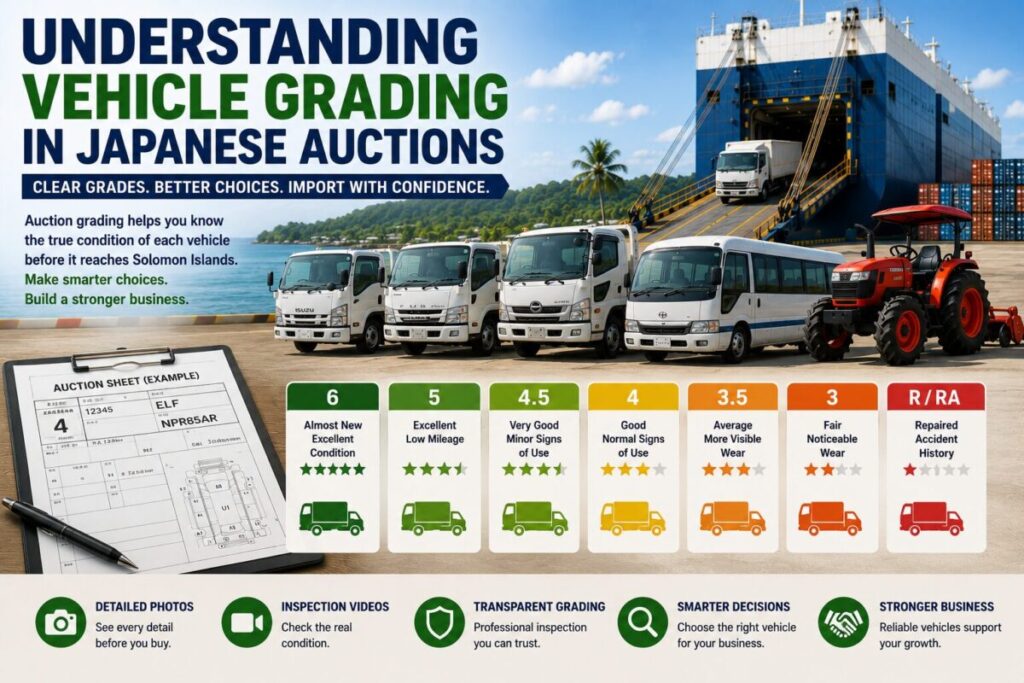
Professional inspectors evaluate each vehicle using standardized inspection procedures.
They assess the vehicle's exterior, interior, mechanical condition, mileage, repairs, and overall appearance.
The inspection result becomes the auction grade shown on the auction sheet.
Grade 6
Grade 6 usually represents an almost new vehicle with extremely low mileage.
These vehicles often appear nearly identical to new vehicles.
Grade 5
Grade 5 indicates excellent overall condition.
Vehicles usually have low mileage and very few cosmetic imperfections.
Many nearly new export vehicles receive this grade.
Grade 4.5
Grade 4.5 represents a high-quality used vehicle.
Minor scratches or small cosmetic marks may exist, but overall condition remains excellent.
Many international buyers actively search for Grade 4.5 vehicles.
Grade 4
Grade 4 is one of the most common auction grades.
These vehicles normally show ordinary signs of use while remaining in good overall condition.
Many Grade 4 commercial vehicles provide excellent value for businesses.
Grade 3.5
Grade 3.5 vehicles generally have more visible wear than Grade 4.
Small repairs, scratches, dents, or higher mileage may be present.
However, many still perform very well after export.
Grade 3
Grade 3 vehicles usually have noticeable cosmetic wear.
Additional inspection is recommended before purchase.
Experienced exporters often provide detailed photographs and inspection reports to help buyers evaluate these vehicles.
Grade R and RA
Grade R or RA indicates that the vehicle has received accident repairs.
This does not automatically mean the vehicle is unsuitable.
However, buyers should carefully review repair information, photographs, and inspection reports before purchasing.
Interior Grades
Japanese auctions also evaluate the vehicle interior separately.
Common interior grades include:
- A – Excellent condition.
- B – Good condition.
- C – Average wear.
- D – Heavy wear or damage.
Interior grades help buyers understand the condition of seats, dashboard, steering wheel, and cabin.
Auction Inspection Sheets
Along with the auction grade, inspectors prepare a detailed auction sheet.
The sheet usually includes:
- Vehicle grade
- Interior grade
- Mileage
- Equipment list
- Repair history
- Exterior damage map
- Inspector comments
Understanding the auction sheet provides much more information than relying on the auction grade alone.
Why Auction Grades Are Only One Part of the Decision
Auction grades provide valuable guidance, but buyers should never rely only on the grade itself.
Professional exporters also review:
- Vehicle photographs.
- Engine condition.
- Chassis condition.
- Maintenance history.
- Export documents.
- Additional inspection results.
Combining all of this information creates a much clearer understanding of the vehicle.
Tips for Solomon Islands Buyers
- Review the complete auction sheet.
- Request detailed photographs.
- Ask for inspection reports.
- Compare auction grades with vehicle condition.
- Do not judge a vehicle by grade alone.
- Purchase from an experienced Japanese exporter.
How EVERY Supports Buyers
EVERY TRADING Co., Ltd. has exported Japanese commercial vehicles worldwide since 2006.
Our experienced team carefully reviews auction information together with professional inspections before recommending vehicles to customers.
We explain auction grades, provide detailed photographs, prepare accurate export documents, and answer every customer question honestly.
Our goal is to help Solomon Islands buyers purchase reliable vehicles with complete confidence.
Conclusion
Japanese auction grades provide an excellent starting point when selecting a used commercial vehicle.
However, the best purchasing decisions combine auction grades with professional inspections, detailed photographs, maintenance history, and transparent communication.
By understanding how Japanese vehicle grading works, Solomon Islands buyers can confidently select high-quality commercial vehicles that support their businesses for many years.


Browse Reliable Used Trucks & Buses from Japan
Carefully selected vehicles ready for export worldwide
Search 100,000+ Dealer Stock Vehicles from Japan
Access a wide selection of vehicles from Japanese dealers nationwide. Updated daily.
