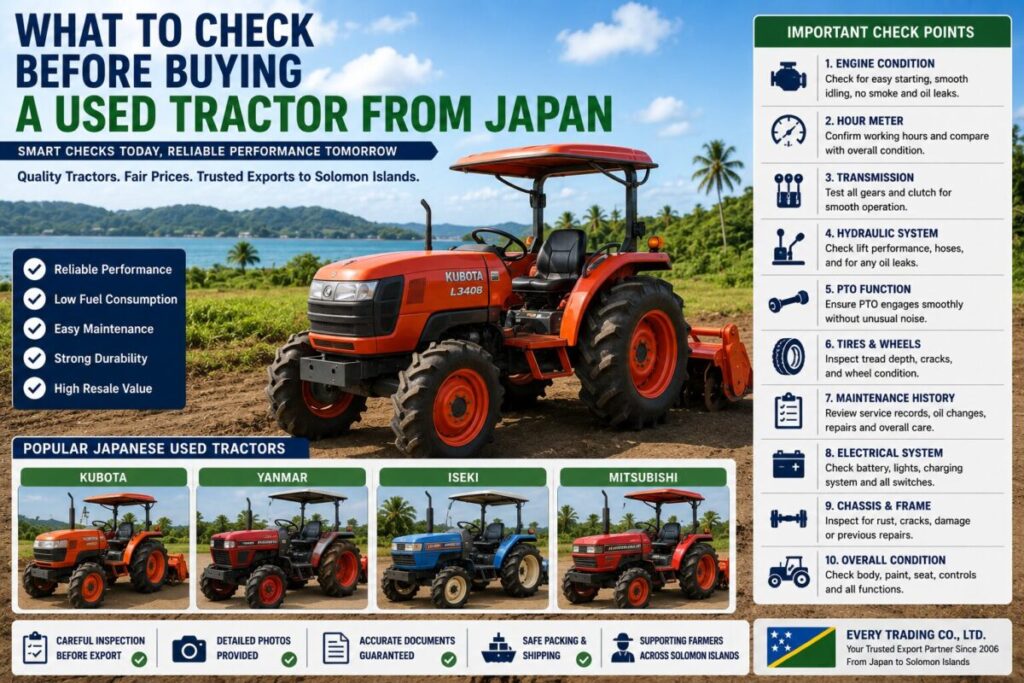

What to Check Before Buying a Used Tractor from Japan: A Complete Guide for Solomon Islands Buyers
Japanese used tractors have become increasingly popular in Solomon Islands because they combine excellent reliability, fuel efficiency, and affordable prices. Farmers, plantation owners, and agricultural contractors continue importing tractors from Japan to improve productivity while reducing operating costs.
However, buying a used tractor is different from buying a passenger car. A tractor works under heavy loads every day, often in muddy fields, steep farmland, and tropical weather. Therefore, buyers should carefully inspect several important points before making a purchase.
This guide explains everything Solomon Islands buyers should check before importing a Japanese used tractor and how to avoid costly mistakes.
Why Japanese Used Tractors Are Popular in Solomon Islands
Agriculture remains one of the most important industries in Solomon Islands. Coconut plantations, cocoa farms, oil palm estates, vegetable farms, and mixed farming operations all require reliable machinery.
Because purchasing a brand-new tractor can require a large investment, many farmers choose high-quality Japanese used tractors instead.
Japanese agricultural equipment is well known for:
- Excellent reliability
- Fuel-efficient diesel engines
- Long service life
- Easy operation
- Strong resale value
- Affordable maintenance
Choose the Correct Horsepower
The first step is selecting the correct tractor size.
Buying a tractor that is too small may reduce productivity, while buying one that is too large increases fuel consumption and operating costs.
Consider:
- Farm size
- Crop type
- Terrain
- Soil condition
- Future expansion plans
Small farms often use compact tractors, while larger plantations usually require higher horsepower models.
Inspect the Engine Carefully
The engine is the heart of every tractor.
Before purchasing, inspect:
- Cold starting performance
- Engine noise
- Exhaust smoke
- Oil leaks
- Coolant condition
- Engine oil condition
- Idle stability
A clean engine that starts smoothly often indicates good maintenance.
Check the Hour Meter
Unlike trucks, tractors usually measure operating time using an hour meter instead of an odometer.
The hour meter provides useful information about how much the tractor has worked.
However, buyers should compare the hour meter with the tractor's overall condition.
If heavy wear appears inconsistent with the displayed hours, ask the exporter for additional information.
Review the Maintenance History
Whenever possible, review the maintenance history.
Important records may include:
- Engine oil changes
- Filter replacements
- Cooling system maintenance
- Hydraulic oil service
- Battery replacement
- Clutch repairs
- Transmission servicing
Regular maintenance usually results in longer equipment life and fewer unexpected repairs.
Inspect the Transmission
The transmission transfers engine power to the wheels.
During inspection, check:
- Gear shifting
- Clutch operation
- Transmission noise
- Oil leaks
- Smooth engagement
Proper transmission performance is especially important when operating on steep farmland.
Check the Hydraulic System
Many farming operations depend on hydraulic equipment.
Inspect:
- Hydraulic lift
- Hydraulic hoses
- Hydraulic pump
- Three-point hitch
- Hydraulic oil leaks
A healthy hydraulic system allows implements to operate safely and efficiently.
Inspect the PTO (Power Take-Off)
The PTO powers many agricultural implements.
Before purchasing, confirm that the PTO operates smoothly.
Listen for unusual sounds and ensure proper engagement.
A reliable PTO is essential for rotary tillers, mowers, sprayers, and many other farming tools.
Check Tires and Wheels
Tires affect both traction and operating costs.
Inspect:
- Tread depth
- Sidewall cracks
- Uneven wear
- Wheel condition
- Proper tire size
Good tires improve performance in muddy fields and uneven terrain.
Inspect the Chassis
The tractor frame should be carefully inspected.
Look for:
- Rust
- Frame damage
- Weld repairs
- Hydraulic leaks
- Loose components
A strong chassis supports safe long-term operation.
Electrical System Inspection
Electrical components should also receive attention.
Verify:
- Battery condition
- Starter operation
- Lighting
- Charging system
- Switches
- Instrument panel
Reliable electrical equipment improves daily operation.
Choose a Trusted Japanese Exporter
Buying from an experienced exporter provides additional confidence.
A professional exporter normally provides:
- Detailed photographs
- Inspection reports
- Accurate export documents
- Honest vehicle descriptions
- Professional customer support
Transparency helps buyers make informed purchasing decisions.
Why Solomon Islands Farmers Choose Japanese Tractors
Japanese tractors perform well under Solomon Islands' tropical farming conditions.
Their dependable engines, simple operation, and affordable maintenance help farmers improve productivity throughout the year.
Whether working on coconut plantations, cocoa farms, vegetable production, or mixed agriculture, Japanese tractors continue providing dependable service.
How EVERY Supports Solomon Islands Buyers
EVERY TRADING Co., Ltd. has exported Japanese agricultural machinery worldwide since 2006.
Our experienced staff carefully inspects tractors before export and provides detailed photographs together with accurate vehicle information.
We help customers select tractors that match their farm size, crops, working conditions, and budget.
From vehicle selection through export documentation and international shipping, we support buyers throughout the entire purchasing process.
Conclusion
Buying a Japanese used tractor is an excellent investment for farmers in Solomon Islands.
However, taking time to inspect the engine, transmission, hydraulic system, PTO, tires, maintenance history, and overall condition helps ensure long-term reliability.
By working with an experienced exporter and choosing the right tractor for your farming needs, you can improve productivity while reducing maintenance costs for many years.


Browse Reliable Used Trucks & Buses from Japan
Carefully selected vehicles ready for export worldwide
Search 100,000+ Dealer Stock Vehicles from Japan
Access a wide selection of vehicles from Japanese dealers nationwide. Updated daily.
