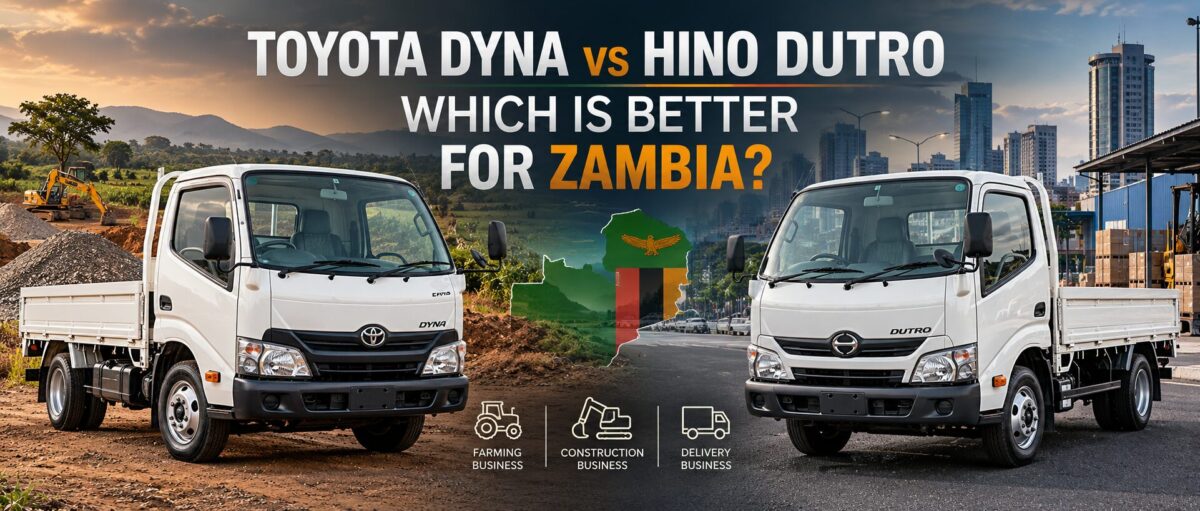

For Zambia, neither the Toyota Dyna nor the Hino Dutro is automatically the better truck. The better choice depends on the individual vehicle's model code, body type, registered payload, engine, drivetrain, condition and the work it will perform. This is especially important because many Dyna and Dutro generations are closely related vehicles developed within the Toyota Group.
For urban delivery in Lusaka or Kitwe, a compact 2WD flatbed or box truck may be the practical choice. For agriculture, construction sites or difficult access roads, body type, tyre specification and 4WD availability can matter more than the badge on the grille. This guide compares the Dyna and Dutro through Country × Vehicle × Use so Zambian buyers can select a truck for real business requirements rather than general brand reputation.
Toyota Dyna vs Hino Dutro: Quick Comparison
| Buying Point | Toyota Dyna | Hino Dutro |
|---|---|---|
| General Class | Light-duty commercial truck | Light-duty commercial truck |
| Relationship | Closely related to Dutro in multiple generations | Closely related to Dyna in multiple generations |
| Common Bodies | Flatbed, dump, box, refrigerated, double cab and specialist bodies | Flatbed, dump, box, refrigerated, crane and specialist bodies |
| 2WD / 4WD | Both available depending on model | Both available depending on model |
| Common Later Diesel Family | N04C on many 2-ton-class models | N04C on many later models |
| Urban Delivery | Well suited with the correct wheelbase and body | Well suited with the correct wheelbase and body |
| Agriculture | Flatbed and 4WD specifications can be useful | Flatbed and 4WD specifications can be useful |
| Construction | Dump and flatbed models available | Dump and flatbed models available |
| Main Buying Priority | Specification and condition | Specification and condition |
The practical difference between two individual trucks can be larger than the difference between the Dyna and Dutro names. Compare the actual trucks rather than treating every Dyna or every Dutro as identical.
Why Are the Toyota Dyna and Hino Dutro So Similar?
The Dyna and Dutro are more closely related than many used-truck buyers realize.
Toyota records show that the Dyna and Hino Dutro became twin models when the seventh-generation Dyna was introduced in 1999. The trucks were jointly developed by Toyota and Hino.
In later generations, the relationship became even closer. Toyota's current OEM information identifies Hino as the manufacturer supplying Dyna trucks to Toyota, including both the 1-ton and larger Dyna ranges.
For used-truck buyers, this has an important consequence:
Choosing between a Dyna and Dutro should often start with the individual chassis, engine and body specification rather than assuming they are completely different engineering platforms.
Common Dyna and Dutro Model Families
Japanese used stock can include chassis families such as:
- XZU-series
- XZC-series
- KDY-series Dyna models
- Older BU-series Dyna models
- Older Dutro chassis using S05-series engines
The complete model code can identify important differences in:
- Engine
- Wheelbase
- Weight class
- 2WD or 4WD
- Cab width
- Body configuration
- Production period
Keep the full model code and chassis number when requesting spare parts, freight quotations or technical information.
Engine Comparison: Dyna vs Dutro
Because the trucks share significant Toyota-Hino commercial-vehicle engineering, buyers will find several overlapping engine families.
| Engine Family | Typical Application | Buying Consideration |
|---|---|---|
| S05C / S05D | Older Dyna / Dutro commercial trucks | Age, mechanical condition and parts support |
| N04C | Many later 2-ton-class Dyna and Dutro trucks | Electronic diesel and emissions-system support |
| 1KD-family | Some lighter Toyota Dyna applications | Confirm exact chassis and specification |
The engine name should never be used alone to estimate payload or body capability.
The N04C Engine and Why It Appears in Both Trucks
The N04C is an important engine family for later Japanese light-duty commercial trucks.
Toyota introduced N04C diesel technology in Dyna commercial applications in the early 2000s, and later Dyna models supplied by Hino continued to use N04C engines.
Used Hino Dutro trucks also commonly appear with N04C engines.
Therefore, a buyer comparing an N04C Dyna with an N04C Dutro may be comparing two trucks with substantial mechanical similarities.
In that situation, focus on:
- Model code
- Year
- Engine suffix and specification
- Transmission
- Registered payload
- Body type
- Mileage
- Maintenance condition
- Chassis corrosion
Older Dyna vs Older Dutro
For older trucks, simplicity can be attractive, but age becomes a major inspection factor.
Check:
- Cold-start behavior
- Oil leakage
- Coolant leakage
- Radiator condition
- Clutch and gearbox
- Chassis rust
- Suspension
- Brake condition
- Tyres
An older truck with a clean chassis and strong maintenance history may be more useful than a newer truck requiring major repairs.
Newer Dyna vs Newer Dutro
Later trucks can offer:
- Newer engine control
- More advanced emissions equipment
- Improved safety technology
- Newer automatic or automated transmission options
- More modern cab design
However, newer technology also increases the importance of:
- Diagnostic tools
- Electronic sensors
- Fuel-system service
- Emissions-system maintenance
- Correct replacement parts
Choose a generation that local workshops can realistically maintain.
Country × Vehicle × Use: Zambia Urban Delivery
For urban businesses in Lusaka, Kitwe, Ndola and other commercial centers, the Dyna and Dutro can both work well when configured as compact light-duty trucks.
Common uses include:
- Retail delivery
- Wholesale distribution
- Food and beverage transport
- Hardware delivery
- Warehouse logistics
- Hotel and restaurant supply
What Matters Most for Urban Work?
Compare:
- Overall length
- Wheelbase
- Turning requirements
- Body width
- Transmission
- Payload
A shorter 2WD truck can make more sense than a long-body 4WD vehicle when almost all work happens on paved city roads.
Country × Vehicle × Use: Zambia Agriculture
For farming and agricultural businesses, the body specification becomes especially important.
A flatbed Dyna or Dutro can carry:
- Produce
- Bagged grain
- Animal feed
- Fertilizer
- Farm tools
- Agricultural supplies
2WD or 4WD for Farms?
Choose 4WD only when the normal route genuinely requires extra traction.
Consider 4WD for:
- Muddy farm access
- Loose surfaces
- Seasonal poor-road conditions
- Construction and agricultural sites
For normal paved roads and dry access routes, 2WD can reduce drivetrain complexity and maintenance requirements.
Country × Vehicle × Use: Zambia Construction
For construction, the body type usually matters more than whether the truck says Toyota or Hino.
Dump Truck
Choose a dump body for:
- Sand
- Soil
- Gravel
- Small construction aggregates within legal payload
- Landscaping materials
Flatbed
Choose a flatbed for:
- Timber
- Pipes
- Steel products
- Bagged materials
- Tools and equipment
For a dump truck, inspect PTO and hydraulics separately from the base vehicle.
Country × Vehicle × Use: Regional Business Transport
For routes between Lusaka, Ndola, Kitwe, Livingstone and other commercial areas, the correct truck depends on cargo weight and distance.
Check:
- Engine cooling
- Tyres
- Brakes
- Transmission
- Daily payload
- Fuel consumption under real load
- Driver comfort
If a business repeatedly reaches the legal payload of a Dyna or Dutro, it may be time to compare a medium-duty Hino Ranger, Isuzu Forward or Mitsubishi Fuso Fighter instead.
Dyna vs Dutro Flatbed
| Buying Point | Toyota Dyna Flatbed | Hino Dutro Flatbed |
|---|---|---|
| General Use | Flexible general cargo | Flexible general cargo |
| Side Loading | Possible depending on body | Possible depending on body |
| Agriculture | Well suited with correct payload | Well suited with correct payload |
| Construction Materials | Useful for timber, pipe and bagged goods | Useful for timber, pipe and bagged goods |
| Main Decision | Deck size and truck condition | Deck size and truck condition |
Measure the actual deck rather than choosing by model name.
Dyna vs Dutro Dump Truck
For dump trucks, evaluate:
- Official payload
- Dump-body dimensions
- PTO operation
- Hydraulic pump
- Hydraulic cylinder
- Hoses
- Body floor
- Rear hinges
- Subframe
A cheaper dump truck can become expensive if its hydraulic system requires repair immediately after arrival.
Dyna vs Dutro Refrigerated Truck
For food and cold-chain businesses, refrigeration equipment becomes one of the main buying factors.
Check:
- Refrigeration-unit operation
- Target temperature
- Insulation
- Door seals
- Floor condition
- Power source or compressor
- Availability of refrigeration-service parts
Do not compare a refrigerated Dutro with a normal Dyna flatbed and conclude that one model has lower operating costs. Their jobs are different.
Dyna vs Dutro 4WD
| Operating Environment | 2WD | 4WD |
|---|---|---|
| Lusaka urban delivery | Usually suitable | Often unnecessary |
| Main highways | Suitable | Usually little benefit |
| Dry rural access | Can be suitable | Useful where conditions vary |
| Muddy farm road | Limited traction | Better traction |
| Construction site | Suitable on firm ground | Useful on difficult surfaces |
Four-wheel drive does not increase legal payload. It solves a traction problem.
Which Has Better Fuel Economy?
There is no reliable brand-wide answer.
Fuel consumption depends on:
- Engine generation
- Vehicle weight
- Payload
- Body type
- Transmission
- 2WD or 4WD
- Traffic
- Road gradient
- Tyre pressure
- Engine condition
Because the Dyna and Dutro share substantial engineering in many generations, vehicle specification can influence fuel use more than brand name.
Compare equivalent trucks operating under equivalent loads.
Calculate Fuel Cost for Your Own Route
Use:
Fuel Cost per km = Diesel Price per Liter ÷ Actual Fuel Economy in km/L
For example, if a truck achieves 8 km/L in your actual operation and diesel costs 30 ZMW per liter:
30 ÷ 8 = 3.75 ZMW per kilometer
This is only an example calculation. Replace both numbers with your own local fuel price and measured consumption.
For business planning, it can be more useful to calculate cost per completed delivery rather than km/L alone.
Payload: Do Not Assume “Up to 3 Tons”
The original version of this article described both trucks as carrying “up to 3 tons.” That is too broad for a practical buying guide.
Dyna and Dutro payload differs according to:
- Model code
- Wheelbase
- GVW class
- Body weight
- Axle specification
- Mounted equipment
Use the Maximum Loading Capacity recorded on the Japanese vehicle documents for the exact truck.
Do not estimate payload from engine size or the appearance of the truck.
Transmission: Manual, Automatic or Automated
Used Dyna and Dutro trucks can use different transmission systems depending on year and specification.
Manual Transmission
Can suit operators who:
- Have experienced commercial drivers
- Have easy access to clutch repair
- Prefer familiar mechanical systems
Automatic or Automated Transmission
Can suit:
- Urban delivery
- Stop-and-go operation
- Multiple drivers
For electronically controlled transmissions, confirm local diagnostic support before buying.
Parts Availability: Compare Engine and Chassis Codes
It is too broad to say that Toyota parts are always easier to find than Hino parts, especially when many Dyna and Dutro models share related components.
Before purchase, ask local suppliers for the actual:
- Model code
- Chassis number
- Engine model
- Transmission type
Check availability for:
- Oil filters
- Fuel filters
- Air filters
- Brake parts
- Clutch parts
- Cooling-system components
- Fuel-system parts
- Electronic sensors on later trucks
What to Inspect Before Buying Either Truck
| Inspection Point | Why It Matters |
|---|---|
| Model Code | Identifies the exact truck specification |
| Engine Model | Essential for parts and maintenance |
| Official Payload | Confirms legal cargo capacity |
| Body Dimensions | Must match the cargo |
| Cold Start | Can reveal engine condition |
| Cooling System | Important for loaded operation |
| Transmission | Repair cost can be significant |
| Chassis | Structural rust or repairs can affect value |
| Tyres | Replacement adds immediate cost |
| Brakes | Critical for loaded commercial work |
| Special Equipment | Dump, refrigeration and other systems need separate testing |
Older Truck or Newer Truck?
An older Dyna or Dutro can make sense when:
- The chassis is structurally sound
- The engine and transmission operate correctly
- Parts are available locally
- Electronic simplicity is useful
- The final landed cost remains economical
A newer truck can make sense when:
- Daily utilization is high
- Newer safety technology is valued
- Local workshops support newer electronic diesels
- The business wants a newer chassis and cab
Do not compare purchase price without allowing for the first repairs and maintenance.
How to Compare Two Trucks Properly
| Check | Dyna Candidate | Dutro Candidate |
|---|---|---|
| Model Code | Confirm | Confirm |
| Engine Model | Confirm | Confirm |
| Year | Compare | Compare |
| Registered Payload | Compare | Compare |
| GVW | Compare | Compare |
| Body Type | Compare | Compare |
| Body Dimensions | Compare | Compare |
| 2WD / 4WD | Compare | Compare |
| Transmission | Compare | Compare |
| Engine Condition | Inspect | Inspect |
| Chassis Condition | Inspect | Inspect |
| Tyres and Brakes | Inspect | Inspect |
| Special Equipment | Test | Test |
| Local Parts Support | Confirm | Confirm |
| Zambia Import Cost | Calculate | Calculate |
| Shipping + Inland Transport | Calculate | Calculate |
| Total Landed Cost | Calculate | Calculate |
Importing a Dyna or Dutro to Zambia
Zambia is landlocked, so buyers should calculate more than the vehicle price and ocean freight.
A complete import budget can include:
- Vehicle price in Japan
- Japan-side export expenses
- Ocean freight
- Marine insurance where applicable
- Port expenses
- Zambian customs duties and taxes
- Clearing costs
- Inland transport
- Registration
- Initial maintenance
Zambia Revenue Authority currently lists customs duty, import VAT and applicable motor-vehicle taxes and fees as relevant parts of the import process. The exact treatment depends on the vehicle's customs classification and other specifications.
Do not use one percentage to estimate every Dyna or Dutro import.
For a more detailed calculation method, see How to Calculate Total Import Cost for Zambia.
Zambia Customs Documents and Registration
ZRA requires freighted imports to be properly declared with supporting documentation. Vehicle buyers should prepare accurate documents before the truck reaches Zambia.
Documents can include:
- Commercial invoice
- Bill of Lading
- Japanese Export Certificate
- Customs declaration documents
- Other supporting certificates or permits where required
RTSA's published registration guidance requires customs-clearance documentation and physical inspection-related procedures for first registration.
Import, inspection, tax and registration requirements can change. Confirm the latest ZRA and RTSA procedures before shipment.
Shipping Route to Zambia
Because Zambia has no seaport, vehicle imports require inland movement after ocean shipping.
The practical route depends on:
- Shipping line
- Available vessel schedule
- Port destination
- Final location in Zambia
- Inland transport price
Do not assume one port is always the cheapest or fastest.
Compare ocean freight and inland transport together.
Which Truck Fits a Small Business in Lusaka?
For local retail, hardware, food supply or service work, compare similar short- or standard-body Dyna and Dutro trucks.
Prioritize:
- Compact dimensions
- Correct payload
- 2WD unless 4WD is genuinely needed
- Easy-to-maintain engine specification
- Strong vehicle condition
The better unit may simply be the truck requiring less immediate repair.
Which Truck Fits a Zambian Farm?
For farming, compare:
- Flatbed dimensions
- Payload
- Ground clearance
- Tyre specification
- 2WD / 4WD
- Parts availability
A 4WD truck is worth considering only where farm access conditions require it.
Which Truck Fits a Construction Business?
Start with the body requirement.
- Dump: sand, soil and loose construction material
- Flatbed: timber, steel, pipe and equipment
- Double cab: workers plus tools or materials
Then compare the Dyna and Dutro candidates with the same body type.
FAQ: Toyota Dyna vs Hino Dutro for Zambia
Which is better for Zambia, Toyota Dyna or Hino Dutro?
Neither is universally better. Many Dyna and Dutro generations are closely related mechanically. Choose according to the individual truck's body type, model code, payload, drivetrain, condition and intended work.
Are the Toyota Dyna and Hino Dutro the same truck?
They are not simply the same badge in every historical generation, but Toyota and Hino jointly developed the Dyna and Dutro as twin models from the late 1990s, and later Dyna models have been supplied by Hino. This creates substantial overlap between many used models.
Which is better for Lusaka delivery work?
A compact 2WD Dyna or Dutro with the correct payload can suit urban delivery. Compare overall dimensions, body type, transmission and condition rather than choosing only by brand.
Which is better for farming in Zambia?
Either can work well. Flatbed dimensions, payload, tyre type, ground clearance and 4WD availability are more relevant than the brand name. Choose 4WD only when road conditions justify it.
Which has better fuel economy?
There is no reliable brand-wide answer. Fuel use depends on engine, payload, body, transmission, route, tyre pressure and maintenance. Compare equivalent trucks operating under similar conditions.
Choose by Country × Vehicle × Use
For Zambia, the most useful Toyota Dyna vs Hino Dutro comparison is not Toyota versus Hino. It is one individual truck versus another individual truck.
Ask three questions:
- Country: What will shipping, customs, registration, parts and maintenance look like in Zambia?
- Vehicle: What are the exact model code, engine, payload, body, drivetrain and condition?
- Use: Will it perform urban delivery, farming, construction or regional cargo work?
If two trucks have similar specifications, choose by condition, parts support and total landed cost.
EVERY TRADING has exported Japanese vehicles since 2006 and supports overseas buyers with vehicle sourcing and international shipping arrangements.
Compare available trucks: View used Toyota Dyna trucks from Japan and used Hino Dutro trucks from Japan.
If neither provides the payload or body required for your business, browse the wider Japanese used truck stock and compare the correct truck class for your work.
Related Guides
- Used Toyota Dyna Trucks for Sale
- Used Hino Dutro Trucks for Sale
- Toyota Dyna Generations and Changes
- Hino Dutro Fuel Economy and Urban Performance
- How to Calculate Total Import Cost for Zambia
- Japanese Used Trucks for Sale


Browse Reliable Used Trucks & Buses from Japan
Carefully selected vehicles ready for export worldwide
Search 100,000+ Dealer Stock Vehicles from Japan
Access a wide selection of vehicles from Japanese dealers nationwide. Updated daily.
