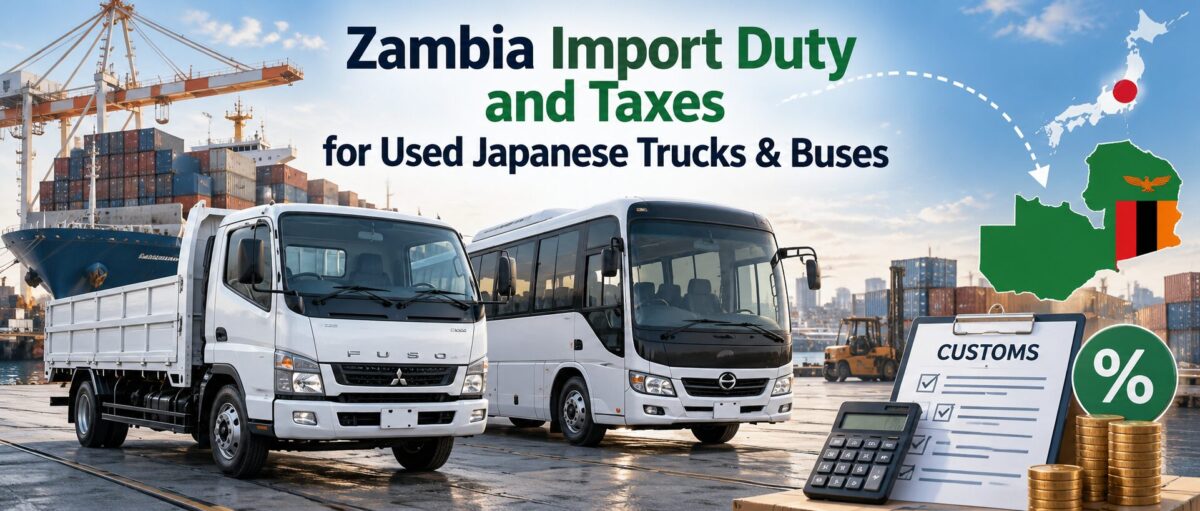

Importing a used Japanese truck or bus into Zambia requires more than adding one flat tax percentage to the Japanese purchase price. Zambia Revenue Authority calculates import charges according to the vehicle's customs classification, value, age, engine capacity and applicable motor-vehicle tax rules. Import VAT is currently charged at the standard 16% rate where applicable, while other charges can include Customs Duty, Excise Duty on selected vehicles, Motor Vehicle Surtax, Carbon Emissions Surtax, registration-related fees and customs processing costs.
For buyers, the practical rule is simple: calculate the tax for the exact truck or bus before paying for the vehicle. A Hino Ranger, Isuzu Forward, Mitsubishi Fuso Fighter, Toyota Coaster or full-size bus can fall into different tariff and valuation categories. This guide explains the current Zambia tax framework and how Country × Vehicle × Use affects the real landed cost.
Zambia Used Vehicle Taxes: Quick Facts
| Item | 2026 Buyer Information |
|---|---|
| Tax Authority | Zambia Revenue Authority (ZRA) |
| Import VAT | Standard rate is 16% where applicable |
| Customs Duty | Depends on HS classification and applicable tariff treatment |
| Excise Duty | Applies to selected motor vehicles depending on classification |
| Carbon Emissions Surtax | Can apply according to engine capacity |
| Motor Vehicle Surtax | Can apply under the used-motor-vehicle duty structure |
| Used Vehicle Duty Method | ZRA publishes specific duty schedules for used motor vehicles |
| Customs Value for Ad Valorem Taxes | Based on Value for Duty Purposes, generally linked to CIF value |
| Currency Used by Customs | Assessment is converted into Zambian Kwacha using the applicable customs exchange rate |
Do not use one percentage such as 41%, 46% or 50% for every truck or bus. The actual amount depends on the individual vehicle and the tax method applicable to its tariff category.
What Was Wrong with the Old “Flat Percentage” Method?
The previous version of this article showed simplified tax estimates such as:
- Light truck: approximately 41%
- Medium truck: approximately 46%
- Heavy truck: approximately 31%
- Passenger bus: approximately 35%
These percentages are too broad for a practical 2026 import guide.
Zambia uses several different tax mechanisms. Depending on the vehicle, charges can be:
- Ad valorem
- Specific
- Based on engine capacity
- Based on vehicle age
- Based on HS classification
Therefore, a used Hino Ranger and a used Toyota Coaster cannot safely be calculated with the same formula simply because both are commercial vehicles.
How ZRA Determines Customs Value
For taxes calculated on an ad valorem basis, Zambia Revenue Authority uses the Value for Duty Purposes (VDP).
ZRA explains that VDP is based on the Kwacha equivalent of the vehicle's Cost, Insurance and Freight value and can include:
- The price paid or payable for the vehicle
- Insurance
- International freight
- Other costs incidental to the importation up to the relevant port of entry
This means the Japanese vehicle price alone does not determine the customs assessment.
FOB, Freight, Insurance and CIF
Before estimating tax, understand these terms.
| Term | Meaning |
|---|---|
| FOB | Vehicle price plus costs up to loading at the Japanese export port under the agreed sale terms |
| Freight | International shipping cost |
| Insurance | Marine insurance cost where applicable |
| CIF | Cost + Insurance + Freight |
| VDP | Customs value used for relevant duty calculations, expressed in Zambian Kwacha |
For a landlocked country such as Zambia, the buyer must also separate ocean shipping costs from inland transport from the seaport to Zambia.
Import VAT in Zambia
Zambia Revenue Authority currently states that the standard VAT rate is 16%.
Import VAT is generally payable on imported goods unless the goods qualify for a specific exemption or relief.
For business importers, VAT treatment can also depend on whether the importer is VAT registered and whether the vehicle qualifies for input-tax treatment.
Do not assume that every business importer can automatically recover all import VAT. Confirm the treatment with ZRA or a qualified tax adviser for the specific business and vehicle use.
Customs Duty
ZRA states that Customs Duty rates on imported goods generally range from 0% to 40%, depending on tariff classification.
For vehicles, the correct HS code matters.
Examples of broad vehicle categories include:
- HS 8701 – tractors
- HS 8702 – vehicles designed to carry ten or more persons, including buses
- HS 8704 – vehicles for the transport of goods
A truck should therefore be classified according to its actual design and customs category rather than simply called a “commercial vehicle.”
Specific Duties on Used Motor Vehicles
Zambia uses a specific-duty system for many used motor vehicles.
ZRA publishes Used Motor Vehicle Specific Duty Rates that classify vehicles according to factors such as:
- HS code
- Vehicle type
- Engine size
- Passenger capacity
- Age bracket
The currently published ZRA schedule available to importers includes the revised 2025 used-motor-vehicle specific duty rates. Buyers importing in 2026 should confirm whether an updated schedule has been issued before customs entry.
This is why a generic “25% import duty + 16% VAT” calculation can be inaccurate for a used vehicle.
Vehicle Age Matters
Used vehicle taxation can differ according to vehicle age.
ZRA's specific-duty schedules separate used vehicles into defined age bands. Older schedules, for example, distinguish vehicles between two and five years from vehicles above five years because certain surtaxes can apply differently.
For a truck or bus buyer, age can therefore affect the final tax amount even when two vehicles have similar engines and bodies.
Compare:
- First registration date
- Manufacture year where relevant
- Current specific-duty age bracket
before deciding which vehicle is cheaper to import.
Carbon Emissions Surtax
ZRA also collects a Carbon Emissions Surtax on applicable motor vehicles.
The charge is linked to engine capacity under the applicable schedule.
This is particularly relevant when comparing:
- A light truck with a 3.0L engine
- A medium-duty truck with a 5.0L to 8.0L engine
- A heavy-duty truck with a large-displacement diesel
- A bus with a large engine
A larger engine may increase operating capability but can also increase certain import charges.
Excise Duty
Excise Duty applies to selected motor vehicles rather than automatically to every vehicle at one fixed percentage.
The applicable treatment depends on:
- Vehicle category
- HS classification
- Age
- Propulsion type
- Current Customs and Excise legislation
For this reason, the older article's assumption that a medium truck automatically attracts “5% Excise Duty” should not be used as a universal rule.
Motor Vehicle Surtax and Other Charges
Depending on the applicable used-vehicle schedule, additional charges can include:
- Motor Vehicle Surtax
- Carbon Emissions Surtax
- Motor vehicle registration fee
- License-related fees
- Customs processing costs
- Storage or warehouse charges if clearance is delayed
These costs are separate from the Japanese FOB price.
Country × Vehicle × Use: Why Tax Classification Matters
Zambia × Vehicle × Use affects both the business value of the vehicle and how it may be classified for customs purposes.
A vehicle should be bought according to its real commercial purpose.
Zambia × Light Truck × Urban Delivery
Light trucks such as:
- Toyota Dyna
- Hino Dutro
- Isuzu Elf
- Mitsubishi Fuso Canter
can suit:
- Lusaka deliveries
- Retail distribution
- Hardware businesses
- Food distribution
- Small construction jobs
When comparing two light trucks, include both import tax and operating costs.
Zambia × Medium Truck × Regional Freight
Medium-duty trucks such as:
- Hino Ranger
- Isuzu Forward
- Mitsubishi Fuso Fighter
can suit:
- Lusaka–Ndola freight
- Construction materials
- Agricultural produce
- Wholesale distribution
- Regional logistics
The higher-capacity truck may cost more to import and operate, but it can reduce the number of trips required.
Zambia × Heavy Truck × Long-Haul Transport
Heavy-duty trucks such as:
- Hino Profia
- Isuzu Giga
- Mitsubishi Fuso Super Great
- UD Trucks Quon
should be considered when the business genuinely requires heavy freight capacity.
Do not choose a heavy truck only because its Japanese purchase price appears attractive. Tyres, fuel, freight, taxes and maintenance can be substantially higher.
Zambia × Bus × Passenger Transport
Used buses can fall under HS heading 8702 when designed for transport of ten or more persons including the driver.
Tax treatment can vary according to:
- Passenger capacity
- Engine type
- Vehicle age
- Applicable specific-duty category
A Toyota Coaster and a full-size Hino or Mitsubishi bus should therefore not be budgeted using the same duty estimate.
Truck vs Bus: Why the Tax Calculation Can Differ
| Vehicle | Main Customs Question |
|---|---|
| Light Truck | Which HS 8704 goods-vehicle category applies? |
| Medium / Heavy Truck | What are the weight, engine and tariff specifications? |
| Minibus | What is the passenger capacity and HS 8702 classification? |
| Large Bus | What seating-capacity band and applicable specific-duty category applies? |
This is why a customs quotation should include the complete vehicle specification rather than just the make and model.
Example: How to Build a Zambia Import-Cost Estimate
Instead of using a fictional combined tax rate, build the calculation in stages.
Example vehicle:
- Japanese used medium-duty truck
- FOB price: USD 15,000
- Ocean freight and insurance: USD 4,000
Estimated CIF:
USD 15,000 + USD 4,000 = USD 19,000
From there, do not simply multiply USD 19,000 by 40%, 50% or another generic percentage.
Instead, obtain:
- The correct HS classification
- The current ZRA specific-duty or ad valorem treatment
- The vehicle's applicable age category
- Engine-capacity information
- Applicable Customs Duty
- Applicable Excise Duty
- Import VAT
- Carbon Emissions Surtax
- Motor Vehicle Surtax where applicable
- Registration and processing charges
This gives a much more reliable landed-cost estimate.
Why Two Similar Trucks Can Have Different Import Taxes
Consider two trucks:
| Factor | Truck A | Truck B |
|---|---|---|
| Year | Newer | Older |
| Engine | 4,000cc | 8,000cc |
| Body | Flatbed | Dump |
| Vehicle Class | Light / medium | Medium / heavy |
| Potential Tax Difference | Different age and engine treatment | Different age, engine and tariff treatment |
Even when their FOB prices are similar, their final Zambian landed costs can differ materially.
Documents Needed for Customs Clearance
Common import documentation for a Japanese used truck or bus can include:
- Commercial Invoice
- Bill of Lading
- Japanese Export Certificate
- Customs declaration documents
- Importer TPIN
- Inspection or conformity documents where required
- Supporting valuation documents requested by Customs
For higher-value consignments, customs clearance is normally processed through the applicable ZRA customs-entry system using the required Bill of Entry.
Why the Export Certificate Matters
The Japanese Export Certificate provides important identification information such as:
- Chassis number
- Model code
- Engine capacity
- Vehicle dimensions
- Vehicle weight
- Maximum loading capacity where recorded
- First registration details
These details can affect customs classification and should match the commercial and shipping documents.
Zambia Inspection Requirements
Before shipping a used Japanese vehicle, buyers should confirm the current Zambia Bureau of Standards inspection and conformity procedure for the exact vehicle category.
Inspection requirements and contracted service providers can change.
Before booking shipment, verify:
- Whether pre-export inspection applies
- The current authorized inspection provider
- Vehicle roadworthiness requirements
- Document requirements
- Inspection location in Japan
For additional information, see Zambia Vehicle Inspection Rules for Japanese Imports.
Shipping to Zambia: Remember That Zambia Is Landlocked
Zambia does not have a seaport, so ocean freight is only the first part of the logistics cost.
Vehicles can move through regional gateways depending on vessel schedules and inland routing.
A common route for Japanese vehicles is:
Japan → Dar es Salaam → Zambia
The buyer should budget for:
- Japan-side inland transport
- Ocean freight
- Port charges
- Transit documentation
- Clearing fees
- Inland transport to Zambia
For the wider logistics process, see How to Ship a Japanese Truck to Zambia via Dar es Salaam.
Do Not Assume Dar es Salaam Is Always the Cheapest Route
The best route depends on:
- Vessel schedule
- Vehicle dimensions
- RORO availability
- Port costs
- Transit procedures
- Inland transport rate
- Final destination in Zambia
A route with cheaper ocean freight can still have a higher total landed cost if inland transport is expensive.
How Vehicle Size Affects the Full Import Cost
Larger trucks and buses can increase costs in several ways:
- More vessel space
- Higher freight
- Larger engine-capacity surtax exposure
- Higher inland transport cost
- More expensive commercial tyres
This means the cheapest truck in Japan is not always the cheapest vehicle to put into operation in Zambia.
Should You Import a Light Truck or Medium Truck?
Choose according to the business load.
Light-Duty Truck
Consider when the business handles:
- Urban delivery
- Retail goods
- Small construction cargo
- Light agricultural loads
Medium-Duty Truck
Consider when the business regularly carries:
- Larger commercial loads
- Construction materials
- Regional freight
- Higher-volume agricultural cargo
Repeatedly overloading a small truck can cost more than buying the correct class from the beginning.
Which Bus Size Should a Zambia Operator Choose?
Passenger capacity affects both business use and customs classification.
Compare:
- Number of seats
- Engine size
- Route length
- Urban or intercity use
- Parts availability
- Current specific-duty category
A smaller Toyota Coaster or Mitsubishi Rosa may suit lower-volume passenger routes, while larger buses require a different operating and tax budget.
Can Business Importers Claim Import VAT?
VAT-registered businesses may be able to claim eligible input VAT where the import is used for taxable business activity and all legal requirements are met.
ZRA requires proper supporting records for import input-tax claims, including the relevant customs documents and receipts.
However, input-tax restrictions can apply.
Businesses should confirm recoverability before treating VAT as a temporary rather than permanent cost.
Tax Incentives and Special Cases
Zambia provides some investment incentives and customs reliefs in specific circumstances.
For example, ZRA publishes incentives for qualifying investments under Zambia Development Agency frameworks, including possible duty relief on eligible capital goods and certain commercial vehicles.
This does not mean an ordinary buyer automatically receives duty-free treatment.
Relief normally depends on:
- Investor status
- Approved sector
- Investment thresholds
- Vehicle or equipment qualification
- Formal approval
Never purchase a vehicle assuming an exemption will apply unless approval has already been confirmed.
Agricultural Tractor vs Truck Tax Treatment
A farm tractor and a cargo truck are not the same customs category.
A tractor generally falls under HS heading 8701, while a goods truck normally falls under HS heading 8704.
Therefore, do not apply a truck-tax estimate to a:
- Kubota tractor
- Yanmar tractor
- Iseki tractor
- Massey Ferguson tractor
or apply tractor treatment to a Mitsubishi Canter, Hino Ranger or Isuzu Forward.
Common Import-Cost Mistakes
1. Using Only the FOB Price
FOB does not include the full international logistics and tax burden.
2. Multiplying CIF by One Generic Tax Percentage
Used-vehicle taxation can include specific and other vehicle-specific charges.
3. Ignoring Engine Capacity
Engine size can affect Carbon Emissions Surtax and the applicable vehicle category.
4. Ignoring Vehicle Age
Age can affect the relevant specific-duty band.
5. Ignoring Passenger Capacity on a Bus
Seating capacity can affect the customs classification and specific-duty category.
6. Forgetting Inland Transport
Zambia is landlocked, so port-to-Zambia transport must be included.
7. Assuming an Exemption
Government, NGO, investor or agricultural incentives should never be assumed without formal confirmation.
How to Compare Two Vehicles Before Import
| Check | Vehicle A | Vehicle B |
|---|---|---|
| FOB Price | Compare | Compare |
| Freight | Calculate | Calculate |
| Insurance | Calculate | Calculate |
| HS Classification | Confirm | Confirm |
| Vehicle Age Band | Confirm | Confirm |
| Engine Capacity | Confirm | Confirm |
| Specific / Ad Valorem Duty Treatment | Confirm | Confirm |
| VAT | Calculate | Calculate |
| Carbon Emissions Surtax | Calculate where applicable | Calculate where applicable |
| Port / Clearing Charges | Calculate | Calculate |
| Inland Transport | Calculate | Calculate |
| Initial Maintenance | Estimate | Estimate |
| Total Landed Cost | Compare | Compare |
How to Get a More Accurate Tax Estimate Before Buying
Before sending payment for a truck or bus, prepare:
- Make
- Model
- Model code
- Chassis number
- Year / first registration date
- Engine capacity
- Fuel type
- Maximum payload
- Gross vehicle weight
- Passenger capacity for buses
- FOB or purchase price
- Freight estimate
Then ask a licensed Zambian clearing agent or ZRA for the current assessment method for that exact vehicle.
This is more reliable than relying on an online percentage table.
FAQ: Zambia Import Duty and Taxes for Used Trucks and Buses
What is the VAT rate on imported vehicles in Zambia?
Zambia Revenue Authority currently lists the standard VAT rate at 16%. Import VAT generally applies unless the specific import qualifies for exemption or another treatment.
How much import duty do I pay on a used Japanese truck?
There is no single rate that applies to every used truck. The amount depends on the truck's customs classification and the applicable current used-motor-vehicle duty schedule. Age, engine capacity and other specifications can also affect the total assessment.
Are buses taxed the same as trucks in Zambia?
No. Buses and goods vehicles fall under different HS headings. Bus passenger capacity can also affect the specific-duty category, so a bus should not be calculated using a truck estimate.
Is tax calculated from the Japanese purchase price only?
No. For ad valorem calculations, ZRA uses the Value for Duty Purposes, which generally reflects the CIF value and applicable adjustments rather than only the Japanese purchase price.
Can I know the exact landed cost before buying?
You can obtain a much more accurate estimate before buying if you have the exact vehicle specification, purchase price, freight estimate and current ZRA duty treatment. Final customs assessment remains subject to ZRA.
Choose by Country × Vehicle × Use — Then Calculate Tax
For Zambia, tax planning should happen before the vehicle purchase, not after the truck or bus has already left Japan.
Use three questions:
- Country: What current ZRA duties, VAT, surtaxes, inspection and registration requirements apply?
- Vehicle: What are the exact HS category, age, engine capacity, weight, payload or seating capacity?
- Use: Does the vehicle's commercial capacity justify its total landed and operating cost?
This method helps buyers avoid choosing a vehicle that looks inexpensive in Japan but becomes unnecessarily expensive after tax, shipping and inland delivery.
EVERY TRADING has exported Japanese vehicles since 2006 and supports buyers with vehicle sourcing, export documentation and international shipping arrangements. Customs assessment and final tax liability are determined by the relevant Zambian authorities.
Looking for a commercial vehicle from Japan? Browse Japanese used trucks for sale or view the current used bus stock and compare vehicle specifications before requesting a landed-cost estimate.
Related Guides
- Japanese Used Trucks, Buses and Tractors for Zambia
- How to Calculate Total Import Cost for Zambia
- Zambia Vehicle Inspection Rules for Japanese Imports
- How to Ship a Japanese Truck to Zambia via Dar es Salaam
- Japanese Used Trucks for Sale
- Japanese Used Buses for Sale


Browse Reliable Used Trucks & Buses from Japan
Carefully selected vehicles ready for export worldwide
Search 100,000+ Dealer Stock Vehicles from Japan
Access a wide selection of vehicles from Japanese dealers nationwide. Updated daily.
