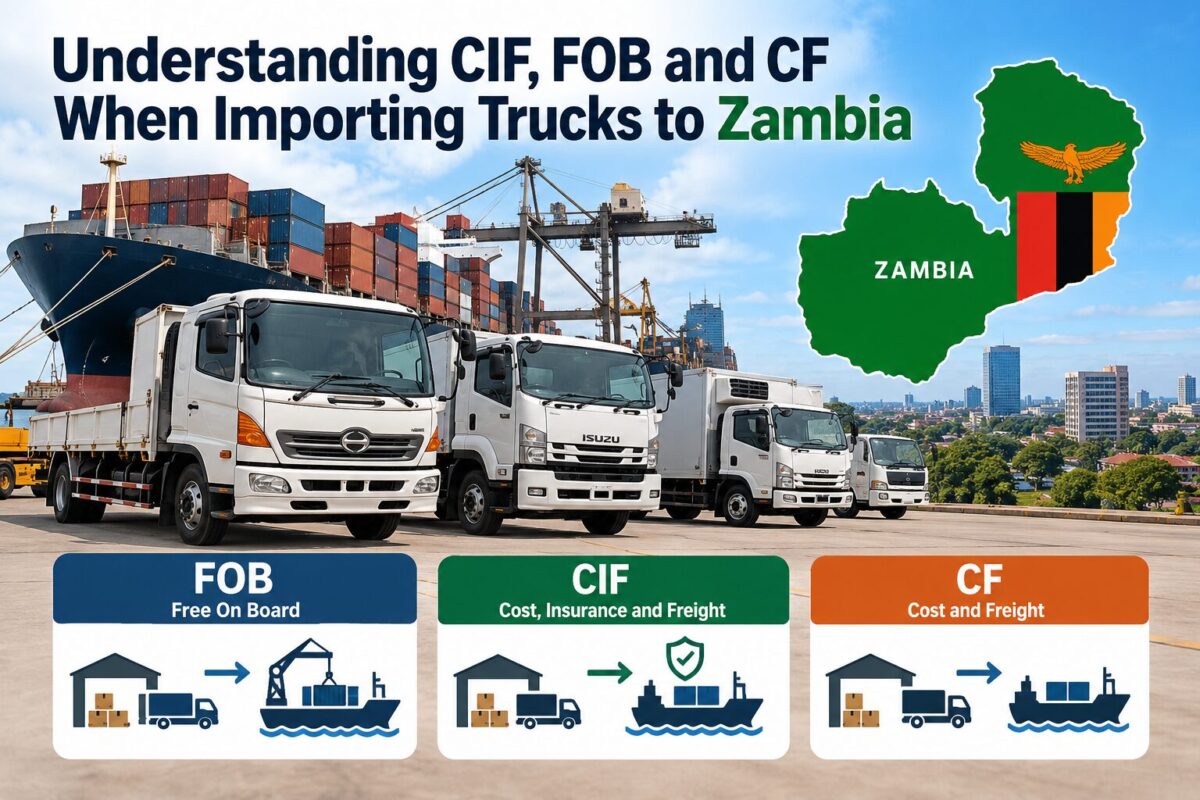

For Zambian buyers importing a Japanese used truck, CIF, FOB and CFR mainly determine who arranges and pays for ocean transport, insurance and certain shipping responsibilities. They do not determine vehicle ownership, Zambia import duty or final inland delivery by themselves. Under Incoterms® 2020, FOB, CFR and CIF are rules designed for sea or inland waterway transport. For Zambia, which is landlocked, the named port should normally be a seaport such as Dar es Salaam rather than Lusaka.
The most important difference is easy to remember: under FOB, the buyer normally arranges the main sea freight; under CFR, the seller pays the freight to the named destination port but does not have to arrange insurance; under CIF, the seller pays the freight and must also arrange the required marine insurance. However, under all three rules, the risk transfers when the goods are on board the vessel at the port of shipment. This guide explains what that means for Japanese trucks going to Zambia.
CIF, FOB and CFR: Quick Comparison for Zambia Buyers
| Item | FOB | CFR | CIF |
|---|---|---|---|
| Full Name | Free On Board | Cost and Freight | Cost, Insurance and Freight |
| Older / Informal Term | FOB | C&F is commonly used informally | CIF |
| Seller Pays Ocean Freight | No | Yes | Yes |
| Seller Arranges Marine Insurance | No | No | Yes, to the level required by the Incoterm unless the contract provides more |
| Risk Transfers | When vehicle is on board the vessel at the shipment port | When vehicle is on board the vessel at the shipment port | When vehicle is on board the vessel at the shipment port |
| Main Transport Mode | Sea / inland waterway | Sea / inland waterway | Sea / inland waterway |
| Zambia Buyer Typically Arranges | Main freight, insurance, destination and inland costs | Insurance, destination and inland costs | Destination and inland costs |
Important: The party paying the freight is not necessarily the party carrying the transport risk. Under CFR and CIF, the seller pays for ocean transport to the named destination port, but risk normally transfers much earlier when the vehicle is loaded on board the vessel in Japan.
What Are Incoterms®?
Incoterms® are standardized trade rules published by the International Chamber of Commerce.
The current edition is Incoterms® 2020.
They help buyers and sellers define responsibilities such as:
- Where delivery takes place
- When transport risk transfers
- Who arranges main carriage
- Who pays specific transport costs
- Who handles export and import formalities
- Whether the seller must arrange insurance
However, Incoterms® do not automatically determine:
- Transfer of legal ownership
- Payment method
- Vehicle condition
- Warranty
- Zambia Customs valuation
- Import tax rate
- Applicable law for every contractual dispute
Ownership should be addressed separately in the sales contract or other transaction documents.
Why “C&F” Should Be Written as CFR
Many vehicle exporters and buyers still use the expression C&F or “C&F price.”
In current ICC terminology, the official Incoterm is:
CFR — Cost and Freight
C&F may still appear in everyday vehicle-export communication, but a formal quotation or sales agreement is clearer when it uses:
CFR Dar es Salaam, Incoterms® 2020
rather than simply:
C&F Zambia
FOB: Free On Board
Under FOB, the seller delivers the vehicle on board the vessel selected or arranged according to the sale terms at the named Japanese port of shipment.
A quotation might state:
FOB Yokohama, Incoterms® 2020
Under this structure, the buyer normally arranges and pays for the main ocean freight.
Seller Responsibilities Under FOB
Depending on the sales agreement, the seller generally handles:
- Vehicle preparation
- Japanese export clearance
- Delivery to the shipment process
- Loading the vehicle on board the vessel
Buyer Responsibilities Under FOB
The buyer normally handles:
- Ocean freight
- Marine insurance if desired
- Destination-port arrangements
- Transit transport to Zambia
- Zambia Customs clearance
- Duties and taxes
- Final inland delivery
When Does Risk Transfer Under FOB?
Risk transfers when the vehicle is on board the vessel at the named shipment port.
This point is important for buyers arranging their own ocean freight.
When Does FOB Make Sense for a Zambia Buyer?
FOB can make sense when the importer:
- Already works with an international freight forwarder
- Has negotiated shipping rates directly with a carrier
- Ships several commercial vehicles regularly
- Wants control over vessel selection
- Arranges its own marine insurance
For an experienced fleet importer, controlling freight directly can provide flexibility.
For a first-time buyer, however, FOB requires more coordination than a seller-arranged freight option.
CFR: Cost and Freight
Under CFR, the seller arranges and pays the ocean freight to the named destination port.
For a Zambia-bound Japanese truck using Tanzania as the gateway, a quotation might state:
CFR Dar es Salaam, Incoterms® 2020
The seller pays the freight to Dar es Salaam, but the seller is not required by CFR to arrange marine cargo insurance for the buyer.
What Is Included Under CFR?
Typically:
- Vehicle cost according to the sales agreement
- Export arrangements in Japan
- Ocean freight to the named destination port
What Is Normally Not Included?
Unless separately agreed:
- Marine insurance for the buyer
- Dar es Salaam destination charges
- Tanzania transit processing
- Dar es Salaam to Zambia transport
- Zambia import taxes
- Zambia registration
Risk Under CFR: A Common Buyer Misunderstanding
CFR creates an important difference between cost and risk.
The seller pays the freight to the destination port.
However:
Risk transfers when the truck is on board the vessel in Japan, not when it arrives in Dar es Salaam.
This means the buyer should carefully consider marine insurance even though the seller has already paid the shipping company.
CIF: Cost, Insurance and Freight
CIF is similar to CFR, but the seller must also obtain marine insurance that meets the minimum level required under the CIF rule unless the sales contract specifies broader protection.
For example:
CIF Dar es Salaam, Incoterms® 2020
would normally mean that the seller arranges:
- Ocean freight to Dar es Salaam
- The insurance required under CIF
It does not mean that the seller automatically pays all costs from Dar es Salaam to Lusaka.
CIF Does Not Mean Risk Stays with the Seller Until Arrival
This is one of the most important corrections to the previous article.
Under CIF:
- The seller pays freight to the named destination port
- The seller arranges the required insurance
- But risk normally transfers once the goods are on board the vessel at the shipment port
Therefore:
Seller pays farther than the point at which seller's transport risk ends.
The insurance exists partly because the buyer bears the transit risk after the on-board delivery point.
Does CIF Mean Full Insurance?
No.
Under Incoterms® 2020, CIF requires the seller to arrange insurance to the minimum cover specified by the rule unless the parties agree to greater coverage.
A vehicle buyer should therefore confirm:
- Insurance provider
- Insured value
- Coverage level
- Deductible / excess
- Excluded risks
- Claim procedure
- Coverage start and end points
Do not assume the word “CIF” means every type of damage is covered.
CIF Dar es Salaam vs “CIF Lusaka”
FOB, CFR and CIF are sea / inland-waterway rules.
Because Lusaka is inland, a standard sea shipment should normally identify the relevant seaport for CIF or CFR.
For example:
CIF Dar es Salaam, Incoterms® 2020
is clearer than:
CIF Lusaka
If a seller is also arranging inland delivery from Dar es Salaam to Lusaka, the contract should clearly explain that additional service and cost.
Depending on the commercial structure, another Incoterm designed for multimodal delivery may sometimes be more appropriate.
What Happens After CIF Dar es Salaam?
CIF Dar es Salaam does not normally include the full Zambia import journey.
The remaining process can include:
- Dar es Salaam port processing
- Transit customs procedures in Tanzania
- Transport toward Tunduma
- Cross-border movement through the Tanzania–Zambia corridor
- Zambia customs declaration
- Payment of applicable ZRA duties and taxes
- Registration
- Final delivery to Lusaka, Ndola, Kitwe or another location
For the complete route, see How to Ship a Japanese Truck to Zambia via Dar es Salaam Port.
Country × Vehicle × Use: Why the Incoterm Alone Is Not Enough
A Zambia buyer should evaluate the vehicle and logistics together.
For example:
| Use in Zambia | Typical Vehicle | Important Cost Factor |
|---|---|---|
| Urban Delivery | Toyota Dyna / Hino Dutro / Isuzu Elf / Fuso Canter | Compact body and freight cost |
| Regional Freight | Hino Ranger / Isuzu Forward / Fuso Fighter | Payload, body dimensions and shipping volume |
| Construction | Dump / crane truck | PTO, hydraulics, body size and inland transport |
| Heavy Freight | Isuzu Giga / Hino Profia / Fuso Super Great | Large freight volume, tyres and operating cost |
| Passenger Transport | Toyota Coaster / Fuso Rosa | Seats, customs category and shipping dimensions |
The cheapest shipping term does not automatically produce the lowest total business cost.
Example 1: FOB Hino Ranger
Assume a buyer receives:
- FOB Japan truck price: USD 14,000
- Ocean freight arranged by buyer: USD 4,000
- Marine insurance arranged by buyer: USD 150
The buyer's pre-destination transport cost becomes:
USD 18,150
This example is only to explain the structure. Actual freight and insurance should be quoted for the individual vehicle.
Under FOB, the buyer has direct control of freight and insurance.
Example 2: CFR Hino Ranger
Suppose the exporter quotes:
- CFR Dar es Salaam: USD 18,000
The seller has included the ocean freight in that price.
The buyer should still arrange or confirm:
- Marine insurance
- Destination-port charges
- Dar es Salaam transit handling
- Inland transport to Zambia
- ZRA customs taxes
Example 3: CIF Hino Ranger
Suppose the exporter quotes:
- CIF Dar es Salaam: USD 18,150
This price includes the seller-arranged freight and the insurance required by the agreed CIF terms.
The buyer still needs to budget for the post-port journey and Zambia import costs.
FOB vs CFR vs CIF: Compare the Same Truck
| Cost / Responsibility | FOB | CFR | CIF |
|---|---|---|---|
| Vehicle | Included in agreed price | Included in agreed price | Included in agreed price |
| Japan Export Clearance | Seller | Seller | Seller |
| Ocean Freight | Buyer | Seller | Seller |
| Required Marine Insurance | Buyer decides / arranges | Buyer decides / arranges | Seller arranges minimum required cover |
| Risk After On-Board Delivery | Buyer | Buyer | Buyer, supported by seller-arranged insurance |
| Dar es Salaam Port Charges | Usually buyer unless otherwise agreed | Usually buyer unless otherwise agreed | Usually buyer unless otherwise agreed |
| Dar es Salaam–Zambia Transit | Buyer unless separately included | Buyer unless separately included | Buyer unless separately included |
| ZRA Taxes | Buyer | Buyer | Buyer |
Which Term Is Best for a First-Time Zambia Buyer?
There is no universal best Incoterm.
A first-time importer may find a seller-arranged freight quotation easier to manage because fewer shipping arrangements need to be made independently.
That can make CFR or CIF practical.
However, buyers should compare:
- Total quoted price
- Insurance coverage
- Actual shipping line
- Destination port
- Expected destination charges
- Inland transport cost
CIF should not be selected simply because it sounds safer.
Which Term Is Better for an Experienced Importer?
A buyer who already has:
- A freight contract
- A preferred shipping line
- A marine insurer
- A freight forwarder
- Regular vehicle volumes
may prefer FOB because it provides more direct control over the main transport contract.
The actual benefit depends on the rates available to that importer.
Should a Fleet Buyer Use FOB?
FOB can be useful for fleet buyers importing several trucks because they may negotiate:
- Volume freight rates
- Preferred sailings
- Insurance contracts
- Freight-forwarding arrangements
However, buyers should compare their own total transport cost with the exporter's CFR or CIF quotation.
A lower FOB vehicle price does not necessarily mean a lower landed cost.
RORO and Incoterms Are Different Things
This distinction is important.
RORO is a shipping method.
FOB, CFR and CIF are trade terms.
A truck can therefore be:
- FOB and shipped by RORO
- CFR and shipped by RORO
- CIF and shipped by RORO
The shipping method and Incoterm answer different questions.
What About Container Shipping?
FOB, CFR and CIF are designed for sea and inland-waterway transport, but ICC guidance notes that they are not always the best terms where goods are handed to a carrier before they are loaded on board the vessel.
This is particularly relevant to containerized cargo.
For container shipments, buyers and sellers may need to consider multimodal Incoterms such as:
- FCA — Free Carrier
- CPT — Carriage Paid To
- CIP — Carriage and Insurance Paid To
For example, ICC guidance recommends considering FCA rather than FOB when goods are handed over to a carrier at a container terminal before vessel loading.
CIF vs CIP: What Is the Difference?
Both rules include seller-arranged insurance, but they serve different transport structures.
| Point | CIF | CIP |
|---|---|---|
| Transport Mode | Sea / inland waterway only | Any mode / multimodal |
| Common Vehicle Use | Direct ocean shipment such as RORO | Multimodal or containerized movement |
| Seller Arranges Insurance | Yes | Yes |
| Required Insurance Level Under Incoterms 2020 | Generally minimum cover requirement | Higher default insurance requirement than CIF |
The correct term depends on how the vehicle is physically delivered to the carrier.
Incoterms Do Not Determine Zambia Customs Value by Themselves
A common buyer assumption is:
“My invoice says FOB, so Zambia Customs will tax only the FOB amount.”
That is not how the customs calculation works.
Zambia Revenue Authority explains that the Value for Duty Purposes for ad valorem taxation is generally based on the Kwacha equivalent of Cost, Insurance and Freight to the relevant point of entry, subject to Zambia's customs valuation rules.
Therefore, even when the commercial contract is FOB, Customs can still require freight and insurance information when determining the customs value.
FOB Price Is Not the Same as Customs Value
For example:
- FOB Japan: USD 14,000
- Freight: USD 4,000
- Insurance: USD 150
A buyer should not assume Zambia Customs will calculate duties only on USD 14,000.
The customs process considers the applicable Value for Duty Purposes and current vehicle taxation rules.
For detailed tax planning, see Zambia Import Duty and Taxes for Used Japanese Trucks and Buses.
Zambia VAT and Other Vehicle Taxes
Zambia Revenue Authority currently states that the standard Import VAT rate is 16%.
However, vehicle imports can involve other charges depending on the exact vehicle, including:
- Customs Duty or specific motor-vehicle duty treatment
- Excise Duty where applicable
- Import VAT
- Carbon Emissions Surtax
- Motor-vehicle-related charges
- Registration fees
Do not use the Incoterm to guess the tax rate.
CIF is a commercial delivery term. CIF is not a Zambia tax category.
Zambia Uses Specific Duty Schedules for Many Used Vehicles
ZRA publishes Used Motor Vehicle Specific Duty Rates that distinguish vehicles by characteristics such as:
- HS code
- Vehicle type
- Age
- Engine or vehicle classification
- Passenger capacity for buses
- GVW for relevant trucks
This is another reason why a buyer should not take a CIF or FOB amount and simply apply one universal percentage.
Country × Vehicle × Use: Light Trucks
For a light truck such as a:
- Toyota Dyna
- Hino Dutro
- Isuzu Elf
- Mitsubishi Fuso Canter
the buyer should compare:
- FOB price
- RORO freight
- Insurance
- Registered payload
- Overall dimensions
- Zambia customs category
- Final inland transport
A compact truck may produce a lower total transport cost than a larger body even when their FOB prices are similar.
Country × Vehicle × Use: Medium-Duty Trucks
For models such as:
- Hino Ranger
- Isuzu Forward
- Mitsubishi Fuso Fighter
body dimensions start to influence freight more significantly.
Compare:
- Flatbed vs dump
- Short vs long wheelbase
- Crane equipment
- Refrigerated body
- Overall height
The same model can produce different freight quotations depending on the body.
Country × Vehicle × Use: Heavy-Duty Trucks
For a:
- Hino Profia
- Isuzu Giga
- Mitsubishi Fuso Super Great
- UD Trucks Quon
the freight difference between FOB and CFR/CIF quotations can be substantial because the main carriage cost itself is larger.
An experienced heavy-truck importer should compare both:
FOB + own freight + own insurance
and:
CFR / CIF seller quotation
before deciding.
Country × Vehicle × Use: Construction Trucks
A dump or crane truck creates additional cost considerations.
Check:
- Overall height
- Crane dimensions
- Body length
- Vehicle weight
- Running condition
Also inspect:
- PTO
- Hydraulics
- Dump cylinder
- Crane operation
- Subframe
The Incoterm does not protect the buyer from purchasing defective working equipment.
How to Compare Two Quotations Correctly
| Cost Item | Quote A | Quote B |
|---|---|---|
| Vehicle Price | Confirm | Confirm |
| Incoterm | Confirm exact term | Confirm exact term |
| Named Port | Confirm | Confirm |
| Ocean Freight | Included / not included | Included / not included |
| Marine Insurance | Included / not included | Included / not included |
| Insurance Coverage | Confirm | Confirm |
| Destination Charges | Estimate separately | Estimate separately |
| Dar es Salaam–Zambia Transit | Estimate separately | Estimate separately |
| ZRA Duties and Taxes | Calculate separately | Calculate separately |
| Registration | Calculate separately | Calculate separately |
| Final Landed Cost | Compare | Compare |
Example: FOB USD 14,000 vs CIF USD 18,200
Suppose two sellers offer the same type of truck:
| Item | Seller A | Seller B |
|---|---|---|
| Quoted Term | FOB Japan | CIF Dar es Salaam |
| Quoted Price | USD 14,000 | USD 18,200 |
| Ocean Freight | Buyer must obtain quotation | Included |
| Insurance | Buyer must decide / arrange | Included to agreed CIF level |
The FOB quote is not automatically USD 4,200 cheaper.
If the buyer's own freight costs USD 4,100 and insurance costs USD 150, the effective pre-destination cost becomes:
USD 18,250
In this hypothetical case, the CIF quotation would actually be slightly lower.
Real decisions should use current freight and insurance quotations.
What Does “CIF Price” Not Include?
Unless the contract specifically states otherwise, a CIF port price should not be assumed to include:
- Destination-port storage
- Destination terminal charges payable by buyer
- Clearing-agent charges
- Tanzania transit procedures
- Dar es Salaam to Zambia inland transport
- ZRA import duties and taxes
- Zambia registration
- Final delivery
- Repairs after arrival
Ask for a written breakdown before payment.
What Should Be Written on the Proforma Invoice?
A clear proforma invoice should identify the trade term accurately.
For example:
CIF Dar es Salaam Port, Tanzania — Incoterms® 2020
or:
FOB Yokohama Port, Japan — Incoterms® 2020
Also confirm:
- Vehicle identification
- Chassis number
- Price
- Currency
- Payment terms
- Named port
- Shipping method
- Insurance arrangement
- Any additional services
Does the Bill of Lading Need to Show the Incoterm?
The Bill of Lading is primarily a transport document and should accurately identify the shipment details.
The commercial Incoterm should be clearly documented in the sales contract, quotation or invoice.
Do not rely on the Bill of Lading alone to define the entire commercial agreement between buyer and seller.
Marine Insurance: Questions to Ask
Before shipment, ask:
- Who is the insured party?
- What value is insured?
- What risks are covered?
- What risks are excluded?
- Is partial damage covered?
- What deductible applies?
- What documents are required for a claim?
- How quickly must damage be reported?
This matters particularly for:
- Expensive trucks
- Crane trucks
- Refrigerated vehicles
- Buses
- Heavy-duty vehicles
Common CIF, FOB and CFR Mistakes
1. Thinking CIF Means Seller Bears Risk Until Dar es Salaam
Under CIF, risk normally transfers when the vehicle is loaded on board the vessel in Japan.
2. Thinking Incoterms Decide Ownership
They define delivery, risk and cost responsibilities, not automatically legal title.
3. Writing “CIF Lusaka” for a Normal Ocean Shipment
CIF is a sea / inland-waterway rule. Use the appropriate named seaport and separately define inland transport.
4. Thinking CFR Includes Insurance
The seller is not required under CFR to purchase insurance for the buyer.
5. Assuming CIF Means Comprehensive Insurance
The default CIF insurance requirement is limited. Confirm the actual policy.
6. Treating C&F as the Current Formal Term
Use CFR in formal Incoterms® 2020 documentation.
7. Choosing FOB Only Because the Price Looks Lower
Add freight, insurance and related costs before comparing.
8. Assuming CIF Includes Zambia Duties
CIF freight and insurance do not normally include ZRA import taxes.
How to Calculate Total Landed Cost for Zambia
Regardless of Incoterm, calculate:
- Vehicle cost
- Japan-side costs not already included
- Pre-shipment inspection where required
- Ocean freight
- Marine insurance
- Destination-port charges
- Transit transport to Zambia
- ZRA duties and taxes
- Clearing-agent fees
- Registration
- Final delivery
- Initial maintenance
For a full calculation guide, see How to Calculate Total Import Cost for Zambia.
FAQ: CIF, FOB and CFR for Zambia Truck Imports
What is the difference between CIF and FOB when importing a truck from Japan?
Under FOB, the buyer normally arranges and pays the main ocean freight after the vehicle is loaded on board in Japan. Under CIF, the seller pays freight to the named destination port and also arranges the insurance required under CIF. Under both rules, transport risk transfers when the vehicle is on board the vessel at the shipment port.
Is C&F the same as CFR?
C&F is an older or informal expression commonly used in vehicle trading. CFR, meaning Cost and Freight, is the formal term used in Incoterms® 2020.
Does CIF Dar es Salaam include delivery to Zambia?
Not automatically. CIF Dar es Salaam covers the contractual costs defined by CIF up to the named seaport, including freight and required insurance. Transit clearance, inland transport to Zambia, Zambia taxes and final delivery are normally separate unless specifically included in another agreement.
Does CIF include Zambia import duty?
No. CIF is an Incoterm, not an import-tax package. Zambia import duties, VAT and other applicable charges are assessed separately by Zambia Revenue Authority.
Which is better for a Zambia buyer: CIF, CFR or FOB?
The suitable term depends on who can arrange freight and insurance most effectively. Buyers with their own shipping contracts may prefer FOB. Buyers who want the exporter to arrange ocean freight may prefer CFR or CIF. Compare the complete landed cost and responsibilities rather than the quoted vehicle price alone.
Choose the Incoterm by Country × Vehicle × Use
For Zambia, there is no single Incoterm that is automatically best for every Japanese used truck buyer.
Use three questions:
- Country: Which seaport and inland route will be used to reach Zambia, and what destination costs remain after ocean shipping?
- Vehicle: How large is the truck, what shipping method will it use and how much insurance protection is appropriate?
- Use: Is this a single small-business truck, a construction vehicle or part of a regular commercial fleet?
Then compare:
FOB + Freight + Insurance + Destination Costs
against:
CFR + Insurance + Destination Costs
and:
CIF + Destination Costs
using the same vehicle and the same destination route.
EVERY TRADING has exported Japanese vehicles since 2006 and supports overseas buyers with vehicle sourcing, export documentation and international shipping arrangements. Buyers can request quotations based on the vehicle, destination and available shipping service.
Looking for a Japanese used truck for Zambia? Browse the current Japanese used truck stock and compare vehicle price, dimensions and shipping terms before making a purchase decision.
Related Guides
- How to Ship a Japanese Truck to Zambia via Dar es Salaam Port
- Zambia Import Duty and Taxes for Used Japanese Trucks and Buses
- How to Calculate Total Import Cost for Zambia
- Toyota Dyna vs Hino Dutro for Zambia
- Japanese Used Trucks, Buses and Tractors for Zambia
- Japanese Used Trucks for Sale


Browse Reliable Used Trucks & Buses from Japan
Carefully selected vehicles ready for export worldwide
Search 100,000+ Dealer Stock Vehicles from Japan
Access a wide selection of vehicles from Japanese dealers nationwide. Updated daily.
