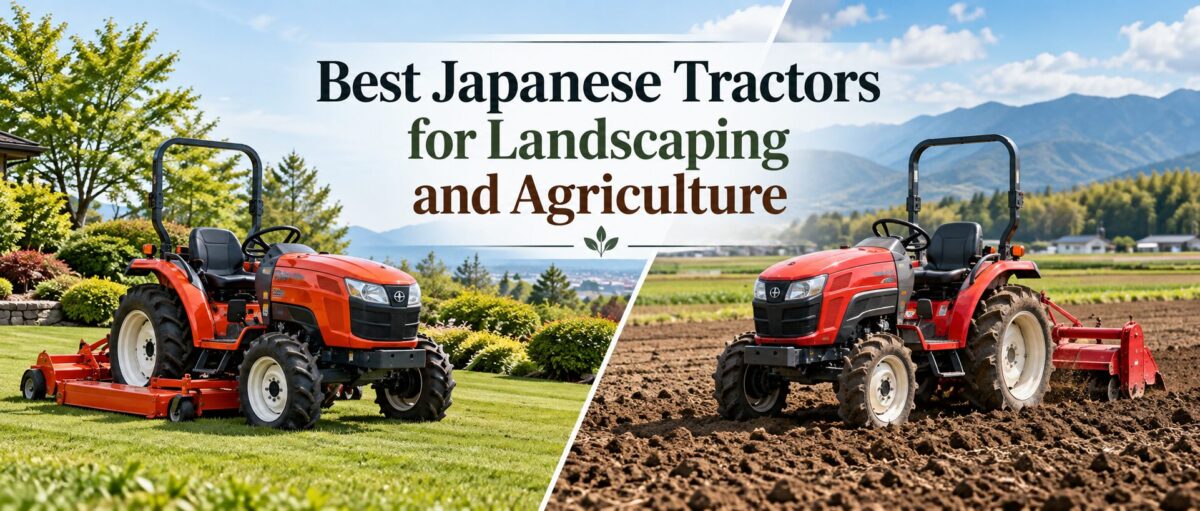

The best Japanese tractor for landscaping or agriculture is not determined by brand name alone. Buyers should first identify the work: mowing, rotary tilling, orchard maintenance, light hauling, loader work, crop production or property maintenance. Then compare tractor size, horsepower, 2WD or 4WD, transmission, PTO, three-point hitch, hydraulics, tyres and compatible implements.
Japanese used tractors from Kubota, Yanmar, Iseki and Mitsubishi give overseas buyers many compact and utility-size choices. However, two tractors with similar horsepower can perform very differently if one has 4WD, better tyres, a suitable rotary tiller or stronger hydraulic condition. The practical buying method is Country × Vehicle × Use: match the destination, individual tractor and actual job before considering price. This guide explains what to compare before importing a Japanese used tractor.
Japanese Tractors for Landscaping and Agriculture: Quick Guide
| Buying Point | Landscaping | Agriculture |
|---|---|---|
| Main Jobs | Mowing, property maintenance, grading, light loader work, hauling | Tilling, cultivation, mowing, spraying, transport, crop work |
| Tractor Size | Compact size often useful | Depends on farm size and implement |
| 4WD | Useful on loose, wet or uneven ground | Useful where additional traction is required |
| PTO | Important for mowers and other powered attachments | Important for rotary tillers, mowers, sprayers and other implements |
| Three-Point Hitch | Needed for many rear attachments | Critical for many agricultural implements |
| Hydraulics | Important for loaders and attachment control | Important for lifting and controlling implements |
| Transmission | HST or shuttle can help with frequent direction changes | Manual, shuttle or HST depending on work |
| Tyres | Turf, industrial or agricultural depending on surface | Agricultural tyres common for soil traction |
| Main Buying Rule | Choose by job and attachment | Choose by crop, implement and workload |
Do not begin with horsepower alone. Start with the implement and working environment, then select the tractor capable of operating it correctly.
Landscaping and Agriculture Need Different Tractor Specifications
Landscaping and agriculture can use the same tractor platform, but the work is often different.
Typical Landscaping Work
- Grass cutting
- Property maintenance
- Ground preparation
- Light material handling
- Trailer work
- Estate or facility maintenance
- Orchard and park maintenance
Typical Agricultural Work
- Rotary tilling
- Plowing
- Cultivation
- Mowing
- Spraying
- Crop transport
- Trailer work
- General farm utility work
A tractor used mainly for mowing around buildings may need different tyres and transmission characteristics from a tractor operating a rotary tiller in cultivated soil.
Why Compact Japanese Tractors Are Useful
Japan's used tractor market includes many compact agricultural machines.
Compact tractors can be useful where operators need to work around:
- Narrow farm roads
- Orchard rows
- Greenhouses
- Buildings
- Small fields
- Gardens
- Landscaped properties
However, compact size should not be confused with low capability.
A compact tractor can operate useful attachments when its horsepower, PTO, hitch and hydraulic system match the implement.
At the same time, a compact tractor should not be asked to perform work beyond its rated capacity.
Compact Tractor vs Larger Tractor
| Buying Point | Compact Tractor | Larger Tractor |
|---|---|---|
| Narrow Access | Usually easier | Can be limited |
| Turning Space | Usually smaller | Usually larger |
| Storage | Easier in limited space | Requires more space |
| Large Implements | More limited | Can support larger implements if rated correctly |
| Heavy Loader Work | Limited by tractor and axle capacity | Potentially more suitable |
| Shipping Size | Often smaller | Often larger |
The larger tractor is not automatically more productive. Productivity depends on whether the tractor fits the site and operates the correct implement efficiently.
Start with the Implement, Not the Horsepower
The implement often determines the tractor requirement.
Before selecting a tractor, identify whether you need:
- Rotary tiller
- Finish mower
- Rotary mower
- Front loader
- Plow
- Sprayer
- Trailer
- Transport box
Then confirm:
- Required PTO power
- PTO speed
- Three-point hitch compatibility
- Hydraulic capacity
- Implement weight
- Recommended tractor size
A tractor with more horsepower is not useful if the attachment cannot be connected or operated correctly.
PTO: One of the Most Important Checks
The Power Take-Off transfers engine power to a driven implement.
Typical PTO equipment includes:
- Rotary tillers
- Mowers
- Sprayers
- Pumps
- Other powered farm equipment
Before purchasing a Japanese domestic-market tractor, confirm the PTO arrangement carefully.
Check:
- PTO shaft condition
- PTO speed
- Rotation requirements
- PTO engagement
- Compatibility with local implements
Three-Point Hitch Compatibility
The three-point hitch carries many rear-mounted implements.
A buyer should check:
- Hitch dimensions
- Linkage wear
- Top link
- Lower links
- Lift-arm condition
- Hydraulic lift operation
Some Japanese-market machines use equipment arrangements designed around Japanese implements.
Therefore, do not assume every locally available mower or plow will fit without modification.
Hydraulic System: Critical for Both Landscaping and Farming
The hydraulic system controls the three-point hitch and, on applicable tractors, external hydraulic equipment.
Check whether the hydraulic system:
- Lifts smoothly
- Holds an implement without dropping quickly
- Responds correctly to controls
- Leaks oil
- Makes abnormal pump noise
If the tractor has a front loader, inspect:
- Loader cylinders
- Hydraulic hoses
- Pins
- Mounting frame
- Bucket
- Front axle
4WD vs 2WD for Landscaping and Agriculture
| Use | 4WD | 2WD |
|---|---|---|
| Wet Ground | Often useful | Can have less traction |
| Loose Soil | Can improve traction | Depends on soil and tyres |
| Loader Work | Often worth considering | May be adequate for lighter use |
| Flat, Dry Fields | Useful but not always necessary | Can be practical |
| Mechanical Complexity | More front-drive components | Simpler drivetrain |
4WD is valuable when there is a clear traction requirement.
However, 4WD does not increase the tractor's legal or mechanical load ratings, and it does not make unsafe terrain safe.
For difficult ground, see the Japanese Tractors for Mountain and Hilly Terrain guide.
Tyre Choice for Landscaping
Landscaping work may take place on:
- Lawns
- Gravel
- Hard ground
- Gardens
- Construction sites
Tyre type can strongly affect the surface.
Turf-Type Tyres
Can help reduce damage on grass and maintained grounds.
Agricultural Lug Tyres
Provide stronger traction in soil but can mark soft lawns.
Industrial-Type Tyres
Can suit mixed loader, property and hard-surface work depending on tractor specification.
Always use approved tyre sizes, especially on 4WD tractors where front-to-rear tyre matching affects drivetrain operation.
Tyre Choice for Agriculture
Agricultural work often needs traction in soil.
Check:
- Tread depth
- Sidewall cracks
- Correct front and rear sizes
- Tyre age
- Wheel condition
Tyres are a significant replacement cost.
A cheaper tractor with four poor tyres may not be the cheaper purchase.
Transmission: Manual, Shuttle or HST?
Used Japanese tractors can have several transmission types.
Manual Transmission
Can suit:
- Steady field work
- Tilling
- Operators familiar with geared tractors
- Markets with strong mechanical repair capability
Shuttle Transmission
Can help when changing repeatedly between forward and reverse.
This is useful for:
- Loader work
- Property maintenance
- Confined areas
Hydrostatic Transmission
HST can provide convenient variable-speed control for:
- Mowing
- Landscaping
- Orchards
- Loader work
- Frequent direction changes
Used HST tractors should be tested for smooth response, noise and correct operation.
Best Japanese Tractor Brands to Compare
Kubota, Yanmar, Iseki and Mitsubishi are all worth comparing in Japan's used tractor market.
There is no reliable universal ranking.
The better purchase is normally the individual tractor that has:
- The correct size
- The correct implement capability
- Good mechanical condition
- Available local parts
- Suitable tyres
- Reasonable landed cost
Kubota Tractors for Landscaping and Agriculture
Kubota tractors are widely represented in Japan's used market.
Depending on availability, buyers can find compact and utility-size machines from several generations.
A used Kubota can be worth comparing for:
- Mowing
- Rotary tilling
- Orchard work
- Small-farm cultivation
- Loader work where equipped and rated
Before selecting one, confirm:
- Model
- Horsepower
- 2WD or 4WD
- Transmission
- PTO
- Hydraulics
- ROPS where applicable
Do not assume every Kubota compact tractor has the same PTO, hitch or 4WD specification.
Yanmar Tractors for Landscaping and Agriculture
Yanmar also has a long history of compact diesel tractors and engines.
Used Japanese-market tractors can include several YM, F, AF, EF and other series depending on stock.
A Yanmar may be worth considering for:
- Vegetable farming
- Orchards
- Mowing
- Light cultivation
- General farm utility work
Check:
- Front axle on 4WD models
- Transmission
- Hydraulic lift
- PTO
- Tyres
- Local parts availability
Iseki Tractors for Landscaping and Agriculture
Iseki produces compact and agricultural tractors and also develops diesel engines for agricultural applications.
Used Iseki machines can be practical where the buyer needs:
- Compact dimensions
- Rotary tiller compatibility
- Mowing capability
- Small-field maneuverability
- General utility use
As with every brand, compare the exact tractor rather than relying on the manufacturer's reputation alone.
Mitsubishi Tractors for Landscaping and Agriculture
Mitsubishi agricultural tractors also appear in Japan's used market.
They can be considered for:
- Small-farm cultivation
- Property maintenance
- Orchard work
- General agricultural utility work
For older Mitsubishi models, parts research should be completed before export.
Record:
- Full model designation
- Engine model
- Filter numbers where possible
- Tyre size
- Common wear parts
Do Not Choose a Tractor by Brand Alone
Statements such as:
- “Kubota is best for landscaping”
- “Yanmar is best for orchards”
- “Iseki is always easier to operate”
- “Mitsubishi is always stronger”
are too broad.
All manufacturers produced different generations, horsepower levels and specifications.
Compare the machine, not only the badge.
Country × Vehicle × Use: Tanzania × Compact Tractor × Small Farming
For Tanzanian vegetable, mixed-farming and small commercial operations, a compact or small utility diesel tractor can be useful when matched with the correct implement.
Possible jobs include:
- Rotary tilling
- Mowing
- Trailer work
- Farm maintenance
- Light land preparation
Buyers should compare:
- Local parts supply
- 2WD vs 4WD
- Tyres
- PTO compatibility
- Cooling system
- Implement availability
Country × Vehicle × Use: Uganda × 4WD Tractor × Mixed Farming
Ugandan mixed farms can require one tractor to perform several jobs.
A compact 4WD Japanese tractor can be considered where additional traction is required.
Typical uses may include:
- Vegetable cultivation
- Coffee-farm maintenance
- Mowing
- Material transport
- Light tillage
The best value can come from a tractor that already matches the intended rotary tiller, mower or trailer.
Country × Vehicle × Use: Zambia × Tractor × Agricultural Work
For buyers in Zambia, tractor selection should start with the workload.
A compact tractor may suit:
- Orchards
- Small crop areas
- Grounds maintenance
- Light trailer use
A larger machine may be more suitable when:
- The farm uses larger implements
- Heavy tillage is regular work
- Higher hydraulic capacity is required
Because Zambia is landlocked, buyers should compare the complete landed cost, including onward inland transport.
Country × Vehicle × Use: Fiji × Compact Tractor × Landscaping
Compact tractors can also serve non-farm applications in Fiji.
Potential users include:
- Hotels
- Resorts
- Property managers
- Institutions
- Small farms
For landscaping, useful features may include:
- Compact width
- Easy transmission control
- Mower compatibility
- Suitable tyres
- Loader capability where needed
A large field tractor can be unnecessary when the main job is grass cutting and property maintenance.
Country × Vehicle × Use: Kiribati × Tractor × Land Maintenance
Kiribati is a good example of why tractor selection must follow the actual country and use.
Large-scale conventional field farming is not the only possible tractor application.
Suitable land-management uses can include:
- Grass cutting
- Coconut-area maintenance where access permits
- Light hauling
- Compost movement
- Property maintenance
- Selected small-scale crop work
For an island destination, buyers should pay particular attention to:
- Compact size
- Parts planning
- Tyres
- Simple maintenance
- Shipping dimensions
A tractor that is difficult to maintain locally can quickly lose the advantage of a low purchase price.
Best Tractor for Landscaping
For general landscaping, prioritize:
- Compact dimensions
- Maneuverability
- Suitable tyres
- Mower compatibility
- Easy transmission control
- Hydraulics if using a loader
Do not automatically buy the tractor with the highest horsepower.
For many landscaping jobs, ease of access and attachment compatibility matter more.
Best Tractor for Small Agriculture
For small farms, first identify:
- Main crop
- Soil type
- Field size
- Implement
- Transport requirement
Then select the tractor.
A compact 4WD diesel tractor may suit one farm, while a simple 2WD tractor can be adequate for another farm with flat, dry land.
Best Tractor for Orchard Work
Orchards place additional importance on tractor dimensions.
Measure:
- Row width
- Branch clearance
- Turning space
- Gate width
Also consider:
- Mower
- Sprayer
- Trailer
- ROPS height
A tractor that cannot move between the trees is not useful, even if it has ideal horsepower.
Best Tractor for Mowing
Mowing performance depends heavily on the mower.
Confirm:
- Mower type
- Working width
- PTO requirement
- Tractor horsepower
- Surface type
- Tyre choice
A wider mower can improve productivity, but it also requires enough tractor power and working space.
Best Tractor for Loader Work
A loader changes tractor requirements significantly.
Check:
- Loader compatibility
- Front axle condition
- Hydraulic system
- Bucket condition
- Rear ballast requirement
- Tyres
Do not install an oversized loader on a compact tractor simply because the attachment can physically be mounted.
Best Tractor for Rotary Tilling
Many Japanese used tractors are sold with rotary tillers.
That can be useful for crop production, but buyers should confirm:
- Tiller width
- PTO compatibility
- Blade condition
- Gearbox condition
- Hydraulic lifting capacity
A worn rotary tiller can add immediate maintenance cost even when the tractor itself is in good condition.
Front Loader vs Rear Implement: Weight Distribution Matters
Attachments change tractor balance.
A front loader places additional weight on the front axle.
A heavy rear implement increases rear loading.
Therefore, always follow approved ballast and implement recommendations for the exact tractor.
Incorrect weight distribution can affect:
- Steering
- Braking
- Tyre wear
- Stability
ROPS and Operator Safety
A tractor used on uneven terrain should be evaluated for rollover protection.
Check whether the tractor has:
- A proper ROPS structure
- Seat belt
- Secure mounting points
A simple canopy frame should not automatically be treated as a certified rollover protective structure.
For hill-related tractor selection, see the Japanese Tractors for Mountain and Hilly Terrain guide.
Fuel Type: Diesel Dominates the Japanese Used Tractor Market
Most agricultural tractors commonly found in Japan's used export market are diesel powered.
This is especially relevant because diesel-powered Kubota, Yanmar, Iseki and Mitsubishi tractors give buyers a wide range of:
- Horsepower
- 4WD choices
- Transmission types
- Implements
- Model generations
For a detailed comparison, see Diesel vs Gasoline Tractors.
Do Not Use Generic Fuel-Economy Claims
Fuel use depends on:
- Engine
- Tractor size
- Implement
- Soil
- Transmission
- Engine speed
- Mechanical condition
A useful calculation is:
Operating Fuel Cost = Actual Fuel Use per Hour × Local Fuel Price
Then compare the amount of work completed during that hour.
A smaller tractor is not automatically more economical if it needs twice as long to complete the job.
Operating Hours: Useful but Not Enough
A low hour-meter reading can be attractive, but buyers should compare it with overall wear.
Inspect:
- Pedals
- Steering wheel
- Seat
- Linkage
- PTO
- Tyres
- Paint and controls
A very low hour reading combined with heavy physical wear deserves additional investigation.
Engine Inspection
Inspect the tractor from cold where possible.
Check:
- Cold starting
- Exhaust smoke
- Abnormal engine noise
- Oil leakage
- Coolant leakage
- Radiator
- Fan belt
The engine should be evaluated together with the transmission and hydraulic system.
Transmission Inspection
Test all available ranges and gears.
For manual tractors, check:
- Clutch engagement
- Gear selection
- Noise
- Gear jumping
For HST tractors, check:
- Forward response
- Reverse response
- Abnormal noise
- Weak drive under load
4WD Front Axle Inspection
Older compact 4WD tractors can develop front-axle leaks.
Inspect:
- Hubs
- Axle seals
- Differential housing
- Steering knuckles
- Drive joints
Also test that 4WD engages and disengages correctly.
Hydraulic Lift Inspection
Where possible, test the lift with an implement.
A three-point hitch that rises without weight may still have problems under load.
Check whether it:
- Lifts smoothly
- Holds its position
- Drops at the expected rate
- Responds to controls
- Leaks externally
Used Tractor Inspection Checklist
| Inspection Point | What to Check |
|---|---|
| Model | Exact model designation |
| Engine | Cold start, smoke, noise and leaks |
| Hours | Compare meter with physical wear |
| Transmission | All gears, shuttle or HST |
| 4WD | Operation and front axle condition |
| Brakes | Left, right and parking brake |
| Steering | Play, joints and power assist |
| PTO | Engagement and abnormal noise |
| Hydraulics | Lift strength and leakage |
| Three-Point Hitch | Wear and implement compatibility |
| Tyres | Tread, cracks and matching sizes |
| ROPS | Condition and proper mounting where fitted |
Parts Availability: Check Before Export
Older Japanese tractors can offer attractive purchase prices, but parts support varies by model.
Before buying, check local or international availability for:
- Oil filter
- Fuel filter
- Air filter
- Fan belt
- Water pump
- Clutch parts
- Brake parts
- Front axle seals
- Hydraulic seals
- Electrical components
Use the exact model and engine identification when checking parts.
“Kubota tractor” or “Yanmar 25 HP” is not precise enough.
Buy the Tractor and Implement as One System
This is one of the most important purchasing rules.
A tractor without the correct implement may provide little value.
Before export, confirm:
- Tractor horsepower
- PTO requirement
- Hitch compatibility
- Hydraulic requirements
- Implement width
- Implement weight
- Shipping arrangement
This reduces the risk of discovering incompatibility after the equipment arrives.
Shipping a Used Japanese Tractor
Freight can depend on:
- Tractor length
- Width
- Height
- ROPS
- Front loader
- Attached rotary tiller
- Additional implements
Ask whether attachments will remain installed or be prepared separately.
A compact tractor without a loader can have a very different shipping profile from the same tractor fitted with loader equipment.
Container Shipping and Tractor Preparation
Compact tractors can sometimes be suitable for container shipping depending on their dimensions and the shipping plan.
Preparation can involve:
- Implement removal
- Attachment positioning
- Tyre or wheel preparation where appropriate
- Securing loose parts
Do not remove or modify safety components simply to reduce shipping size unless the procedure is appropriate and the machine can be correctly restored before operation.
Calculate Total Landed Cost
Do not compare two tractors using purchase price alone.
Include:
- Tractor price
- Implement price
- Japan inland transport
- Export preparation
- Shipping
- Marine insurance where applicable
- Import duties and taxes
- Port and clearing costs
- Inland delivery
- Initial maintenance
- Tyres or parts required after arrival
A more expensive tractor in good mechanical condition can have a lower total first-year cost than a cheap tractor needing tyres, seals and hydraulic repairs.
How to Compare Two Japanese Used Tractors
| Check | Tractor A | Tractor B |
|---|---|---|
| Exact Model | Confirm | Confirm |
| Horsepower | Compare | Compare |
| Hours | Compare with wear | Compare with wear |
| 2WD / 4WD | Confirm | Confirm |
| Transmission | Compare | Compare |
| PTO | Test | Test |
| Hydraulics | Test | Test |
| Tyres | Inspect | Inspect |
| Attachment Included | Confirm | Confirm |
| Implement Compatibility | Confirm | Confirm |
| Local Parts | Check | Check |
| Shipping Cost | Calculate | Calculate |
| Total Landed Cost | Compare | Compare |
Common Buying Mistakes
1. Choosing by Brand Alone
The individual tractor matters more than a general brand reputation.
2. Buying More Horsepower Than Necessary
Extra horsepower increases neither access nor implement compatibility automatically.
3. Ignoring the Implement
Choose the implement first, then match the tractor.
4. Assuming Every Compact Tractor Is Good for Landscaping
Tyres, transmission and mower compatibility matter.
5. Assuming 4WD Is Always Required
4WD should have a clear traction purpose.
6. Ignoring Tyre Cost
A tractor with worn tyres can require significant immediate expense.
7. Focusing Only on Operating Hours
Hours should be evaluated together with the entire machine condition.
8. Buying Before Checking Parts
Research routine service parts for the exact model before shipment.
9. Assuming a Japanese Rotary Tiller Will Match Every Local Need
Check width, PTO and soil requirements before relying on the included implement.
FAQ: Japanese Tractors for Landscaping and Agriculture
Which Japanese tractor brand is best for landscaping?
There is no single best brand. Kubota, Yanmar, Iseki and Mitsubishi all offer useful compact tractor choices in the Japanese used market. Compare the exact tractor's size, transmission, tyres, PTO, hydraulics, mower compatibility and condition.
How much horsepower do I need for landscaping?
Horsepower should follow the attachment and workload. A mowing operation may require a different tractor from loader or ground-preparation work. Check the implement manufacturer's power requirement before selecting the tractor.
Is 4WD necessary for a landscaping tractor?
Not always. 4WD can improve traction on wet, loose or uneven ground, but a 2WD tractor may be adequate for flat, dry properties. Choose according to the actual work site.
Can the same compact tractor be used for farming and landscaping?
Yes, when the tractor has suitable PTO, hydraulics, hitch and attachments. The same tractor may operate a rotary tiller for agriculture and a mower or loader for landscaping. Compatibility should be confirmed before purchase.
What should I inspect before importing a used Japanese tractor?
Check the engine, operating hours, transmission, 4WD, front axle, PTO, hydraulics, brakes, steering, tyres, three-point hitch, included implements, parts availability and total landed cost.
Choose by Country × Vehicle × Use
The best Japanese tractor for landscaping or agriculture is the machine that matches the job, not the machine with the most horsepower or the most familiar brand name.
Ask three questions before buying:
- Country: What fuel, parts, terrain, import rules and workshop support are available at the destination?
- Vehicle: What are the exact horsepower, 2WD/4WD, transmission, PTO, hydraulics, tyres and mechanical condition?
- Use: Will the tractor mow grass, operate a rotary tiller, maintain an orchard, tow a trailer, use a front loader or perform several jobs?
Then compare the tractor and implement as one working system.
EVERY TRADING has exported Japanese vehicles and agricultural machinery since 2006 and supports overseas buyers with sourcing, export preparation and international shipping arrangements.
Looking for a Japanese tractor? Browse the current Japanese used farm tractors for sale and compare model, horsepower, drive type, transmission, tyres, implements and condition before requesting a quotation.
Related Japanese Tractor Guides
- Used Japanese Farm Tractors for Sale
- Japanese Used Tractor Applications & Export Guide
- Japanese Tractors for Mountain and Hilly Terrain
- Diesel vs Gasoline Tractors
- How to Inspect a Used Japanese Tractor Before Buying
- Freight and Shipping Options for Japanese Used Tractors


Browse Reliable Used Trucks & Buses from Japan
Carefully selected vehicles ready for export worldwide
Search 100,000+ Dealer Stock Vehicles from Japan
Access a wide selection of vehicles from Japanese dealers nationwide. Updated daily.
