
CIF, FOB and C&F Guide for Trinidad Buyers: Import Used Vehicles from Japan with Confidence
Importing a used vehicle from Japan can be a smart move.
Many buyers in Trinidad and Tobago choose Japanese used trucks, vans, pickups, buses, and commercial vehicles. They want strong engines, right-hand drive layout, clean condition, and fair prices.
However, one detail can confuse many buyers.
That detail is the shipping price term.
You may see FOB, C&F, and CIF on quotations from Japanese exporters. These terms may look simple. Yet, they change what is included in the price.
They also affect your planning, your customs cost, and your final landed cost.
Therefore, Trinidad and Tobago buyers should understand these terms before buying.
This guide explains CIF, FOB, and C&F in simple English. It also explains how each term affects used vehicle imports from Japan to Trinidad and Tobago.
Why Price Terms Matter for Trinidad and Tobago Buyers
A vehicle quote is not always the full cost.
For example, a truck may look cheap when the quote says FOB. However, the buyer still needs to arrange ocean freight. If the quote says C&F, freight is already included. If the quote says CIF, freight and marine insurance are included.
Therefore, buyers must compare quotes correctly.
This matters a lot in Trinidad and Tobago.
Many imported vehicles support real business. A truck may deliver goods in Port of Spain. A van may support a shop in Chaguanas. A dump truck may work on construction projects in San Fernando. A flatbed may move farm goods or materials. In Tobago, small trucks may support hotels, shops, farms, and tourism suppliers.
So, the buyer needs a clear cost plan.
If the cost is unclear, the vehicle may become more expensive than expected.
What Is FOB?
FOB means Free On Board.
In simple terms, FOB price covers the vehicle cost until it is loaded onto the vessel at the port in Japan.
After that, the buyer normally handles the freight, insurance, and destination-side costs.
For used vehicles from Japan, FOB may include:
- Vehicle price
- Export preparation in Japan
- Transport to the port in Japan if included
- Export customs work in Japan
- Loading onto the vessel
However, FOB usually does not include:
- Ocean freight to Trinidad and Tobago
- Marine insurance
- Destination port charges
- Customs duty
- VAT
- Broker fees
- Registration costs
- Local transport after arrival
FOB can be useful for experienced importers.
It gives more control. The buyer can choose the shipping company, freight provider, and insurance option. However, it also requires more work.
For a first-time buyer, FOB may feel difficult.
You must arrange more steps yourself. You also need to understand freight schedules, port costs, and insurance.
When FOB Works Well
FOB can work well for dealers and experienced importers.
For example, a Trinidad and Tobago dealer may import several vehicles every month. The dealer may already have a shipping agent, customs broker, and insurance contact. In this case, FOB can give flexibility.
FOB may also suit buyers who want to combine several vehicles in one shipment.
It can help if the buyer has strong logistics knowledge.
However, FOB is not always the easiest choice.
A small business buyer importing one truck may prefer a simpler quote. In that case, C&F or CIF may be easier to manage.
What Is C&F?
C&F means Cost and Freight.
Some exporters also write it as CFR. In vehicle export business, many buyers say C&F.
This means the vehicle price and ocean freight are included in the quote.
For Trinidad and Tobago buyers, C&F is common and practical.
A C&F quote may include:
- Vehicle price
- Export preparation in Japan
- Freight to the destination port
- Shipping arrangement from Japan
However, C&F usually does not include:
- Marine insurance
- Customs duty
- VAT
- Port charges in Trinidad and Tobago
- Customs broker fees
- Registration fees
- Local transport
- Service after arrival
C&F is easier than FOB for many buyers.
The exporter arranges the ocean shipment. The buyer can see the vehicle cost and freight cost together. This makes the Japan-to-Trinidad cost easier to understand.
However, insurance is not included.
Therefore, buyers should think about marine insurance separately.
When C&F Works Well
C&F works well for many Trinidad and Tobago vehicle buyers.
It suits people who want the exporter to arrange shipping, but still want to control insurance or local steps.
For example, a buyer may import a Mitsubishi Canter for delivery work. The buyer may not know how to arrange freight from Japan. In this case, C&F can be helpful.
The exporter arranges shipment to the destination port. Then, the buyer works with a local customs broker for clearance.
C&F is also easy to compare.
If two exporters quote C&F to Port of Spain, the buyer can compare vehicle condition, price, freight, and support more clearly.
However, do not compare FOB and C&F as if they are the same.
A FOB quote may look cheaper because freight is not included.
What Is CIF?
CIF means Cost, Insurance, and Freight.
This means the quote includes the vehicle price, ocean freight, and marine insurance.
For many first-time buyers, CIF feels simple.
A CIF quote may include:
- Vehicle price
- Export preparation in Japan
- Ocean freight to destination port
- Marine insurance during sea transport
However, CIF usually does not include:
- Customs duty
- VAT
- Port charges
- Shipping line release fees
- Customs broker fees
- Inspection costs
- Registration costs
- Local transport
- Repairs or service after arrival
CIF can help buyers plan better because insurance is included.
However, buyers must still check what the insurance covers.
Do not assume all insurance is the same.
Ask the exporter:
- What is covered?
- What is not covered?
- What is the claim process?
- What documents are needed for a claim?
- Is the vehicle covered during sea transport?
- Is inland transport included or excluded?
These questions help avoid misunderstanding.
When CIF Works Well
CIF works well for buyers who want a more complete export-side quote.
It can suit first-time importers, small businesses, and buyers who want less stress.
For example, a Tobago hotel supplier may import a clean box truck from Japan. The buyer may want the exporter to arrange shipping and insurance together. CIF can make this easier.
CIF can also help business buyers estimate the customs value.
Since freight and insurance are included, the buyer can better understand the cost base before arrival.
However, local charges still remain.
A CIF quote is not the same as a fully road-ready cost.
CIF Is Not the Full Landed Cost
This is very important.
Many buyers think CIF means everything is paid.
That is not correct.
CIF usually stops at cost, insurance, and freight to the named port.
After the vehicle reaches Trinidad and Tobago, the buyer still needs to handle local costs.
These may include:
- Customs duty
- VAT
- Motor vehicle tax or other vehicle-related tax
- Port handling charges
- Shipping line release fees
- Customs broker fees
- Storage charges if delayed
- Inspection costs
- Insurance for road use
- Registration costs
- Number plate costs
- Local transport from port
- Basic service and repairs
Therefore, CIF is not the final total.
The final total is called the landed cost.
What Is Landed Cost?
Landed cost means the full cost to bring the vehicle into Trinidad and Tobago and prepare it for local use.
A simple landed cost may include:
Vehicle price + Freight + Insurance + Duties + VAT + Port charges + Broker fees + Registration + Local service
This is the number that matters most.
For a business buyer, landed cost helps answer the real question.
Can this truck make business sense?
For example, a delivery truck may look affordable in Japan. However, the buyer must add freight, taxes, port charges, broker fees, inspection, registration, tires, battery, and service.
Only then can the buyer see the true cost.
Therefore, always ask for a landed cost estimate before purchase.
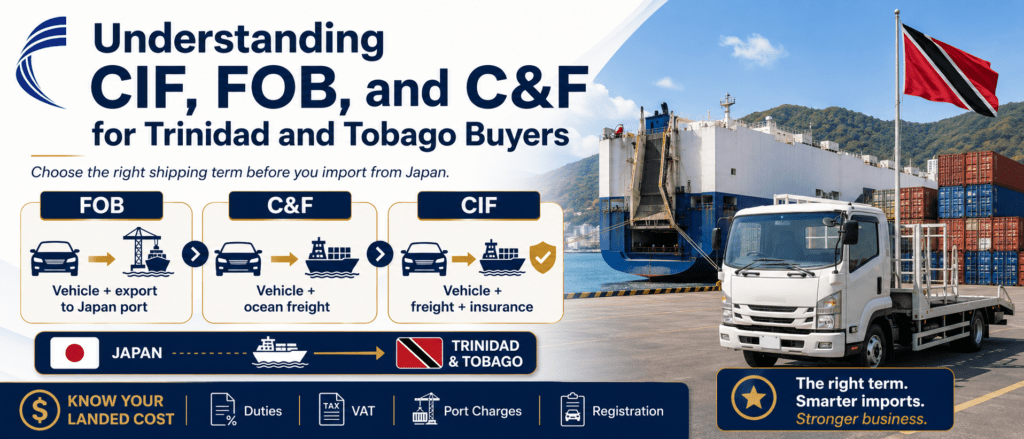
CIF, FOB, and C&F Comparison
Here is a simple comparison.
FOB includes the vehicle and export-side loading at Japan port. Freight and insurance are not included.
C&F includes the vehicle and freight to the destination port. Insurance is not included.
CIF includes the vehicle, freight, and marine insurance.
For simple planning:
- FOB gives more control.
- C&F gives easier shipping planning.
- CIF gives the easiest export-side package.
However, all three terms still need local clearance and local payment in Trinidad and Tobago.
No quote term removes the need for customs duty, VAT, port charges, broker fees, and registration.
Which Term Is Best for Trinidad and Tobago Buyers?
There is no single best term for everyone.
The best choice depends on your experience and business needs.
Choose FOB if You Have Experience
FOB may suit:
- Dealers
- Fleet importers
- Buyers with shipping agents
- Buyers who want control
- Buyers importing multiple units
- Buyers who can arrange freight directly
FOB can be flexible. However, it requires strong planning.
Choose C&F if You Want Practical Support
C&F may suit:
- Small business buyers
- Contractors
- Delivery companies
- Farm buyers
- Buyers who want the exporter to arrange freight
- Buyers who will handle insurance separately
C&F is popular because it balances support and flexibility.
Choose CIF if You Want More Simplicity
CIF may suit:
- First-time importers
- Tobago buyers
- Small companies
- Buyers who want insurance included
- Buyers who want clearer export-side cost
- Buyers who prefer simple paperwork
CIF can reduce stress. Still, buyers must check local costs.
How These Terms Affect Customs in Trinidad and Tobago
Customs needs to know the value of the imported vehicle.
Duties and taxes may depend on cost, freight, insurance, vehicle type, and other details. Therefore, the price term matters.
If your quote is FOB, freight and insurance may need to be added for customs calculation.
If your quote is C&F, freight is already included, but insurance may still need attention.
If your quote is CIF, cost, insurance, and freight are already shown together.
Your customs broker can guide you.
For commercial goods, buyers should work with a customs broker. The broker helps prepare documents and estimate charges.
Do not guess the customs cost by yourself.
Vehicle category, age, engine size, fuel type, weight, and value can all affect the final charges.
Why a Customs Broker Is Important
A customs broker helps you avoid mistakes.
For Trinidad and Tobago vehicle imports, a broker can support:
- Customs declaration
- Duty and VAT estimate
- Vehicle classification
- Document review
- Customs value checks
- Port release process
- Payment guidance
- Local import questions
This is especially useful for business vehicles.
A pickup, panel van, light truck, medium truck, heavy truck, and bus may have different rules. Also, Maximum Gross Weight can matter for commercial trucks.
Therefore, send your broker the vehicle details before shipment.
Do not wait until the vehicle arrives.
Key Documents for CIF, FOB, and C&F Imports
The price term affects documents too.
For any quote, prepare:
- Commercial Invoice
- Bill of Lading
- Export Certificate from Japan
- Import Licence
- CARICOM Area Invoice if required
- Certificate of Origin if needed
- Freight invoice if separate
- Insurance document if applicable
- Payment proof
- Broker authorization
- Business documents for commercial imports
If the quote is FOB, ask for freight details once you arrange shipping.
If the quote is C&F, ask for the freight-inclusive invoice or freight details.
If the quote is CIF, ask for insurance evidence.
Also, check the chassis number on every document.
The chassis number must match exactly.
Common Mistakes Buyers Make
Many buyers make simple but costly mistakes.
Avoid these:
- Comparing FOB and CIF prices directly
- Thinking CIF includes all local costs
- Forgetting customs duty and VAT
- Forgetting port charges
- Not asking about insurance
- Not checking freight schedule
- Not preparing a broker early
- Ignoring vehicle category
- Not confirming import eligibility
- Forgetting registration cost
- Not budgeting for service after arrival
- Assuming the lowest quote is the best deal
The lowest quote may not offer the best value.
A slightly higher quote may include better support, clearer documents, or more reliable shipping.
Therefore, compare total value.
Why Trinidad and Tobago Market Needs Clear Cost Planning
Trinidad and Tobago buyers often import vehicles for business.
This makes cost planning very important.
A contractor needs a truck that can work on time. A delivery company needs a vehicle that can run daily routes. A farmer needs reliable transport during busy seasons. A Tobago tourism supplier needs a clean and dependable vehicle.
If the import cost is unclear, the business plan may suffer.
Therefore, buyers should calculate:
- Vehicle price
- Shipping cost
- Insurance
- Duty
- VAT
- Port charges
- Broker fees
- Inspection
- Registration
- Road insurance
- Local service
- Tire or battery replacement
This gives a clearer picture.
It also helps the buyer choose the right vehicle size.
A large truck may carry more. However, it may also cost more to ship, clear, fuel, and maintain.
Best Quote Type for Used Trucks
Used trucks often need careful planning.
For light-duty trucks, C&F or CIF may be simple and practical.
For example:
These vehicles often ship well by RoRo. They suit delivery, retail, small construction, and Tobago business.
For medium and heavy trucks, buyers should check freight carefully.
Examples include:
- Isuzu Forward
- Hino Ranger
- Mitsubishi Fighter
- Nissan Condor
- Hino Profia
- Isuzu Giga
- Mitsubishi Super Great
These vehicles may cost more to ship because of size and weight.
Therefore, C&F or CIF can help buyers see the Japan-to-port cost more clearly.
Best Quote Type for Vans and Buses
Vans and buses are also popular.
Toyota Hiace, Nissan Caravan, Toyota Coaster, Mitsubishi Rosa, and Nissan Civilian can support many local needs.
They may serve:
- School transport
- Staff transport
- Hotel transport
- Tourism
- Delivery
- Church or community service
- Small fleet business
For these buyers, CIF can be useful because it includes insurance.
However, a dealer may prefer FOB if they already have freight arrangements.
Again, the best term depends on the buyer.
Best Quote Type for Tobago Buyers
Tobago buyers often need extra planning.
They may need to consider the arrival port, onward movement, and inter-island transport. Also, many Tobago businesses serve tourism, farming, retail supply, and local delivery.
For first-time Tobago buyers, CIF or C&F may be easier.
These terms reduce Japan-side arrangement work.
However, buyers should still plan local steps carefully.
Ask:
- Which port will the vehicle arrive at?
- Who will handle customs clearance?
- How will the vehicle reach Tobago?
- What local charges apply?
- Is the vehicle ready for road use?
- What registration steps follow?
Good planning helps avoid delays.
How to Ask for a Clear Quotation
When contacting a Japanese exporter, ask clear questions.
You can ask:
- Is this price FOB, C&F, or CIF?
- Which port is included in the quote?
- Is marine insurance included?
- What is the vehicle chassis number?
- What is the year of manufacture?
- What documents will you provide?
- What shipping route will you use?
- What is the estimated sailing schedule?
- Are there any known condition issues?
- Can you provide underbody photos?
- Can you provide videos?
- Can you help with export documents?
A reliable exporter should answer clearly.
Clear answers build trust.
Simple Example of Cost Difference
Let’s use a simple example.
A buyer sees a truck for USD 8,000 FOB.
That is not the final cost.
The buyer still needs freight, insurance, duties, VAT, port fees, broker fees, registration, and service.
Another exporter may quote USD 10,500 C&F.
This looks higher at first. However, it includes freight.
A third exporter may quote USD 10,800 CIF.
This includes freight and marine insurance.
Therefore, the buyer should not choose based only on the lowest number.
The buyer should compare what is included.
Then, the buyer should calculate the landed cost.
How EVERY Supports Trinidad and Tobago Buyers
EVERY helps overseas buyers purchase used vehicles from Japan with confidence.
For Trinidad and Tobago customers, we support clear communication and practical export guidance.
We can help with:
- Japanese used vehicle search
- Truck, van, bus, and pickup selection
- Auction stock checks
- Vehicle condition review
- Chassis number confirmation
- Export document support
- FOB quotation
- C&F quotation
- CIF quotation when available
- Shipping arrangement
- Photos and video requests
- Basic vehicle details before shipment
Also, we understand the local business needs.
A Port of Spain buyer may need a fast delivery truck. A San Fernando contractor may need a dump truck. A Chaguanas shop may need a box truck. A Tobago buyer may need a reliable light truck or van.
Therefore, we help customers choose based on real use.
Final Checklist Before Choosing FOB, C&F, or CIF
Before you choose a quote, check this list:
- Vehicle type is confirmed.
- Import eligibility is checked.
- Chassis number is confirmed.
- Vehicle age is confirmed.
- FOB, C&F, or CIF term is clear.
- Destination port is clear.
- Freight cost is clear.
- Insurance is clear.
- Marine insurance coverage is checked.
- Export documents are confirmed.
- Customs broker has reviewed details.
- Duty and VAT estimate is prepared.
- Port charges are expected.
- Registration budget is prepared.
- Service budget is included.
- Landed cost is acceptable.
This checklist helps protect your money.
Final Advice for Trinidad and Tobago Buyers
CIF, FOB, and C&F are not just shipping words.
They affect your real import cost.
FOB gives more control, but it needs more work. C&F includes freight, so it helps with shipping planning. CIF includes freight and marine insurance, so it gives extra simplicity.
However, none of these terms includes every local cost.
You still need to plan for customs duty, VAT, port charges, broker fees, inspection, registration, and service.
For Trinidad and Tobago buyers, Japanese used vehicles can offer excellent value. They can support construction, delivery, farming, tourism, logistics, and industrial work.
Yet, the best result comes from clear cost planning.
So, ask the right questions. Compare quotes correctly. Work with a trusted exporter and a customs broker. Then, import your vehicle from Japan with confidence.


Browse Reliable Used Trucks & Buses from Japan
Carefully selected vehicles ready for export worldwide
Search 100,000+ Dealer Stock Vehicles from Japan
Access a wide selection of vehicles from Japanese dealers nationwide. Updated daily.
