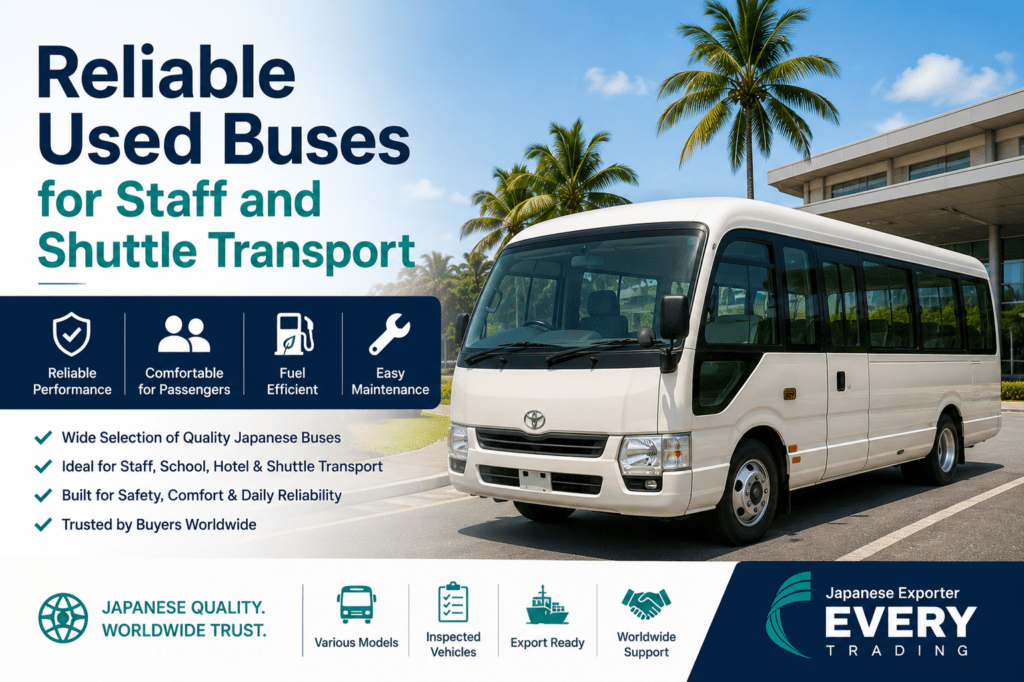

Reliable Used Buses for Public, Staff, and Shuttle Transport: Best Japanese Models for Safe, Efficient Passenger Service
Reliable passenger transport is essential for many businesses and public services. Schools need safe daily transport. Hotels need smooth shuttle service. Companies need staff buses that arrive on time. Public operators need dependable vehicles that can handle repeated daily routes. Because of that, choosing the right used bus is a major business decision.
Japanese used buses continue to attract strong demand around the world. They are trusted for reliability, fuel efficiency, practical layouts, and long-term value. In many countries, they support school transport, hotel shuttles, airport transfers, worker transport, tourism, and public route services.
In this guide, we explain why reliable used buses from Japan are a smart choice for public, staff, and shuttle transport. We also introduce popular Japanese bus models, key buying points, and the features that matter most when importing a used bus for passenger operations.
Why Reliable Used Buses Matter for Passenger Transport
A passenger bus is more than just a vehicle. It is part of daily operations, customer service, and business reputation. If a shuttle bus breaks down, guests are delayed. If a staff bus is unreliable, employees arrive late. If a public bus spends too much time in repair, route service suffers.
That is why reliability matters so much in passenger transport.
A dependable used bus helps operators:
- Keep transport schedules stable
- Reduce breakdown risk
- Lower repair and maintenance costs
- Improve passenger comfort and safety
- Support business growth with lower operating cost
- Build trust with staff, customers, students, or passengers
As a result, many importers focus on Japanese used buses that offer proven performance and long service life.
Why Japanese Used Buses Are Popular Worldwide
Japanese buses are used in many countries across Africa, the Caribbean, Asia, Oceania, and the Middle East. They are especially popular with operators who want quality, comfort, and business value in one package.
1. Strong reputation for reliability
Japanese commercial vehicles are known for dependable engineering. Buses from Japan often have durable engines, stable drivetrains, and practical interior designs that suit repeated daily use.
This is important for:
- Public transport companies
- Hotels and resorts
- Schools and universities
- Staff transport contractors
- Tourism operators
- Airport shuttle services
When a bus must operate every day, reliability is one of the most valuable features.
2. Good long-term value
A new passenger bus can be expensive. By contrast, a quality used bus from Japan can offer a much better balance of price and performance. This helps operators expand transport services without carrying the full cost of new stock.
That makes Japanese used buses attractive for:
- Fleet expansion
- New shuttle business startups
- School transport contracts
- Tourism business growth
- Staff transport outsourcing
3. Comfortable and practical passenger layouts
Japanese buses are designed for real passenger use. Many models include practical seating layouts, wide entry doors, good visibility, and comfortable cabin space. Depending on the model, buyers can also find buses with air conditioning, luggage space, high-roof interiors, or tourism-friendly seating.
4. Many size options for different transport jobs
Not every operator needs the same bus size. One company may need a 29-seat staff bus. Another may need a microbus for hotel guests. A school may want a mid-size bus with easy boarding and low running costs.
Japanese exporters offer a wide range of used bus types, including:
- Microbuses for hotels, schools, and local shuttles
- Mid-size buses for staff transport and regional passenger use
- Large buses for public route service and high-capacity movement
- Tour buses for sightseeing and long-distance comfort
Therefore, buyers can match the vehicle to the route, passenger volume, and business model.
What Makes a Used Bus Reliable for Public, Staff, and Shuttle Transport?
Not every used bus is the right bus for passenger operations. Buyers should focus on models and conditions that support long-term service.
Key things that matter most
1. Proven engine reliability
A good bus should have a strong service record, stable diesel performance, and the ability to handle daily stop-and-go operation.
2. Easy maintenance
A bus that is hard to service can create delays and higher repair costs. Popular Japanese bus models often make maintenance easier because parts support is stronger and many mechanics already know the platform.
3. Passenger comfort
For staff transport, hotel shuttles, and tourism use, comfort matters. Air conditioning, smooth ride quality, easy entry, and comfortable seating all improve the passenger experience.
4. Capacity that matches the route
Buying a bus that is too large can waste fuel and increase cost. Buying one that is too small can create scheduling problems. Therefore, the best bus is the one that fits the real passenger demand.
5. Safe body and interior condition
Passenger transport requires a clean, safe, and professional vehicle. Buyers should always check seat condition, flooring, step access, body rust, underbody condition, and window or door function.
Best Japanese Used Buses for Public, Staff, and Shuttle Transport
Below are some of the most reliable and popular Japanese bus models for passenger transport. These models are widely known in export markets and suit many business uses.
1. Toyota Coaster
The Toyota Coaster is one of the most trusted Japanese used buses in the world. It is a leading choice for shuttle transport, staff movement, school routes, and tourism use. Buyers like it because it combines Toyota reliability with practical passenger capacity and easy operation.
Best uses for the Toyota Coaster
- Hotel and airport shuttle transport
- School transport
- Staff and worker movement
- Church or community transport
- Tourism and sightseeing routes
- Regional passenger transfer
The Coaster is especially attractive because it offers a strong balance of size, comfort, and operating cost. It is not too large for many local routes, yet it still carries a useful number of passengers.
Why the Toyota Coaster is so popular
- Proven Toyota durability
- Comfortable microbus size
- Strong export reputation
- Good for shuttle and staff transport
- Easy fit for many passenger businesses
2. Mitsubishi Fuso Rosa
The Mitsubishi Fuso Rosa is another top Japanese bus for shuttle and staff transport. It is widely used for employee movement, school service, and local passenger operations.
Best uses for the Rosa
- Company staff buses
- School and training center transport
- Hotel and resort shuttle service
- Community passenger routes
- Contractor worker transport
The Rosa is known for practical commercial design and reliable performance. In addition, it is available in different seat layouts and body lengths, which gives buyers more flexibility.
Main strengths of the Rosa
- Strong passenger transport reputation
- Practical size for repeated daily routes
- Good option for fleet operators
- Useful for both business and public service transport
3. Nissan Civilian
The Nissan Civilian is a long-standing favorite in many export markets. It is often chosen for staff transport, school routes, and commercial passenger movement because it offers solid cabin space and dependable performance.
Common uses for the Civilian
- Staff commuting service
- Student transport
- Church and group transport
- Airport and hotel transfers
- Regional shuttle operations
For operators that want a practical bus with a strong history in global markets, the Civilian remains a serious option.
Why buyers choose the Civilian
- Good passenger capacity
- Reliable commercial design
- Suitable for many transport roles
- Strong value in the used bus market
4. Hino Liesse II
The Hino Liesse II is a compact Japanese bus that works well for local passenger transport and staff movement. It is a useful option for operators who need a dependable bus with manageable size and commercial-grade durability.
Best uses for the Liesse II
- Hotel guest transport
- Staff shuttle routes
- Small group transfers
- Tourism support service
- Community and institutional transport
This model can be especially useful when the route does not need a large bus but still requires more capacity than a van.
Key advantages
- Practical size for shuttle use
- Good fit for business transport
- Strong Hino commercial quality
- Useful for short and medium passenger routes
5. Isuzu Journey
The Isuzu Journey is another Japanese bus that deserves attention in used export markets. It is suitable for operators who want a bus with practical passenger capacity and solid commercial performance.
Good uses for the Journey
- Worker transport
- School routes
- Small public transport service
- Institutional shuttle use
- General passenger operations
Because Isuzu has a strong reputation in commercial vehicles, some buyers prefer the Journey when building a mixed fleet of trucks and buses from the same manufacturer.
Why it is worth considering
- Practical bus for daily transport
- Good brand trust in commercial markets
- Suitable for staff and route service
- Strong fit for business operations
6. Toyota Hiace Commuter
The Toyota Hiace Commuter is not a full-size bus, but it is one of the most useful passenger vehicles for shuttle and staff transport. It works especially well for operators who need lower capacity with excellent flexibility.
Best uses for the Hiace Commuter
- Airport pickup and drop-off
- Hotel guest shuttle
- VIP or executive staff transport
- Small tour groups
- Private school or daycare movement
- Corporate transfer service
The Hiace Commuter is easy to drive, easy to maintain, and highly respected in many export markets. Therefore, it is a smart option for businesses that do not need a larger bus.
Main reasons it is popular
- Trusted Toyota quality
- Lower running cost than a larger bus
- Comfortable for small passenger groups
- Very flexible for many business uses
Choosing the Right Bus Size for Your Transport Operation
One of the most important buying decisions is bus size. A larger bus is not always better. The best choice depends on route type, passenger volume, and operating cost.
Microbus or commuter bus: best for smaller groups
A microbus or commuter bus is often the best choice for:
- Hotels and resorts
- Airport shuttle services
- Private schools
- Staff transport for small teams
- Tour operators with small groups
- Church and community transport
Good examples:
- Toyota Coaster
- Mitsubishi Fuso Rosa
- Nissan Civilian
- Toyota Hiace Commuter
These vehicles are easier to manage, often use less fuel than larger buses, and fit more route types.
Mid-size bus: best for staff transport and route efficiency
Mid-size buses are a strong option when:
- Passenger demand is higher than a commuter van can handle
- Daily worker transport needs stable capacity
- A company runs regular shuttle routes
- Schools or institutions need more seats
These buses can give a better balance between seat count and running cost.
Large bus: best for public route service and high-capacity transport
A large bus can be the right choice if:
- You run public transport routes
- You need to move a large number of passengers every day
- The route supports larger turning space and parking
- Fuel cost and maintenance planning are already built into a larger fleet model
However, large buses are not always the best choice for hotel, private shuttle, or low-volume staff transport.
Best Japanese Used Buses by Business Type
Best for hotel and airport shuttle service
If you need guest transfer, airport pickup, or tourism shuttle service, these models are strong options:
- Toyota Coaster
- Mitsubishi Fuso Rosa
- Toyota Hiace Commuter
- Nissan Civilian
Best for staff and worker transport
If your business moves employees, factory workers, site staff, or contract teams, consider:
- Mitsubishi Fuso Rosa
- Toyota Coaster
- Nissan Civilian
- Isuzu Journey
Best for school and institutional transport
If the route supports students, trainees, or community transport:
- Toyota Coaster
- Mitsubishi Fuso Rosa
- Nissan Civilian
- Hino Liesse II
Best for tourism and group transport
If comfort, appearance, and passenger experience matter:
- Toyota Coaster
- Toyota Hiace Commuter
- Mitsubishi Fuso Rosa
What Buyers Should Check Before Importing a Used Bus from Japan
A good bus model is only part of the decision. The condition of the actual unit matters just as much.
1. Check the seating and interior layout
Passenger operations depend on usable space. Always confirm:
- Seat count
- Seat condition
- Aisle width
- Entry and exit layout
- Air conditioning setup
- Luggage space if needed
2. Review body and underbody condition
Because many buses work in different climates, it is important to check:
- Rust around steps and lower panels
- Underbody corrosion
- Floor condition
- Roof and window sealing
- Door operation
3. Ask for mechanical inspection details
A trusted exporter should provide:
- Engine condition details
- Transmission type and condition
- Mileage
- Suspension and brake condition
- Maintenance or inspection history if available
- Photos and auction sheet if available
4. Match the bus to the route, not only to the price
A cheaper bus is not always the better business decision. It is smarter to buy a bus that truly fits your route, passenger load, and service model.
5. Think about total ownership cost
Before importing, calculate:
- Purchase cost
- Shipping cost
- Import duties and taxes
- Port and clearance fees
- Registration cost
- Repairs after arrival
- Fuel use and maintenance cost
This gives a much more realistic picture of the investment.
Why Japanese Used Buses Remain a Smart Choice for Transport Operators
Japanese used buses continue to grow in popularity because they solve real transport problems. Operators need dependable vehicles that keep routes moving, support customer service, and stay affordable to run.
That is exactly where Japanese buses perform well.
They offer:
- Strong reliability for daily passenger use
- Good value compared with new buses
- Flexible sizes for different transport jobs
- Comfortable passenger layouts
- Better access to trusted used stock from Japan
Whether the goal is school transport, staff movement, public service, or shuttle operations, a quality Japanese used bus can be a strong long-term asset.
Final Thoughts
Reliable passenger transport depends on choosing the right bus. The vehicle must fit the route, the passenger volume, and the business plan. It also needs to be dependable enough for repeated daily use.
For many operators, proven Japanese bus models such as the Toyota Coaster, Mitsubishi Fuso Rosa, Nissan Civilian, Hino Liesse II, and Toyota Hiace Commuter offer an excellent mix of reliability, comfort, and value. They are well suited for public transport, worker transport, hotel shuttle service, school routes, and tourism operations.
At EVERY Japan, we help overseas buyers source quality Japanese used buses, trucks, vans, tractors, and machinery directly from Japan. If you are looking for a reliable used bus for shuttle, staff, or public transport, our team can help you compare models, review stock, and choose the right vehicle for your route and business.


Browse Reliable Used Trucks & Buses from Japan
Carefully selected vehicles ready for export worldwide
Search 100,000+ Dealer Stock Vehicles from Japan
Access a wide selection of vehicles from Japanese dealers nationwide. Updated daily.
