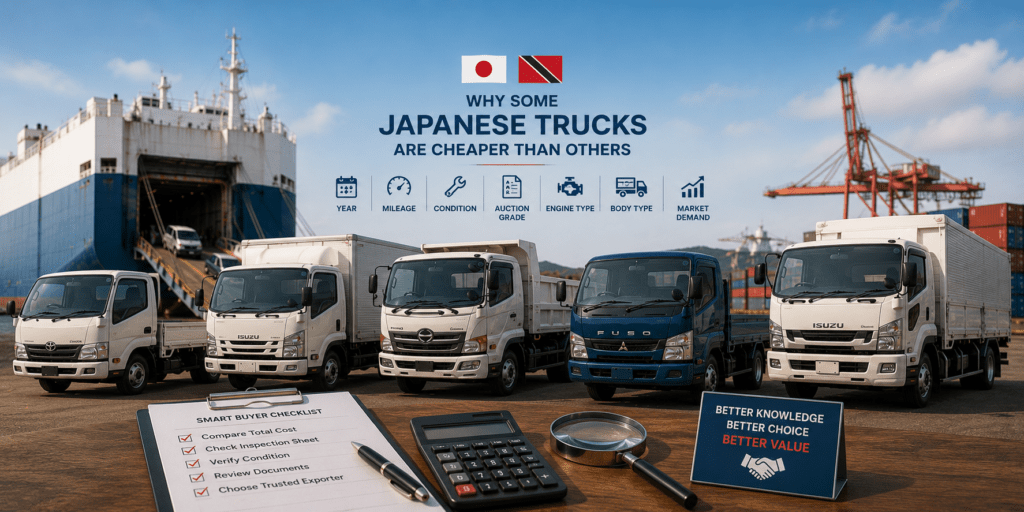

Why Some Japanese Trucks Are Cheaper Than Others: The Complete Guide for Trinidad and Tobago Buyers
Learn the Real Reasons Behind Truck Prices Before You Buy
Japanese used trucks have become one of the most popular choices for businesses in Trinidad and Tobago. They are known for their outstanding reliability, fuel efficiency, and long service life. Whether you operate a construction company, delivery service, farm, or transportation business, a quality Japanese truck can help reduce operating costs while improving productivity.
However, many buyers notice something surprising.
Two trucks that look almost identical can have very different prices.
Why does one truck cost USD 9,000 while another costs USD 14,000?
The answer involves much more than the model name.
Many factors influence the price of a Japanese used truck. Understanding these factors helps you choose the right truck without paying too much or buying a vehicle that will cost more later.
This guide explains why some Japanese trucks are cheaper than others and how buyers in Trinidad and Tobago can find the best value.
Why Japanese Trucks Are Popular in Trinidad and Tobago
Commercial vehicles are essential for many industries across Trinidad and Tobago.
Businesses use trucks every day for:
- Construction
- Agriculture
- Food distribution
- Retail deliveries
- Manufacturing
- Municipal services
- Tourism
- Logistics
Road conditions vary throughout the country. Urban areas require compact delivery trucks, while rural roads and construction sites demand stronger vehicles.
Japanese trucks perform well because they offer:
- Excellent reliability
- Fuel-efficient diesel engines
- Long operating life
- Easy maintenance
- High resale value
- Strong load capacity
These qualities make them a smart investment.
Popular Japanese Truck Models
Many Trinidad and Tobago importers search for trusted models such as:
- Toyota Dyna
- Hino Dutro
- Hino Ranger
- Isuzu Elf
- Isuzu Forward
- Mitsubishi Canter
- Mitsubishi Fighter
- Nissan Atlas
- Nissan Condor
- Toyota Toyoace
These trucks are widely respected for durability and low operating costs.
Factor 1: Manufacturing Year
One of the biggest price differences comes from the production year.
Newer trucks generally cost more because they often include:
- Lower mileage
- Updated safety equipment
- Better fuel efficiency
- Modern interiors
- Improved emissions technology
Older trucks usually cost less.
However, a well-maintained older truck may still provide excellent value.
Factor 2: Mileage
Mileage strongly affects price.
Generally:
- Lower mileage increases value.
- Higher mileage reduces price.
However, mileage does not tell the whole story.
Some trucks with moderate mileage receive excellent maintenance.
Others with lower mileage may have experienced difficult working conditions.
Always evaluate both mileage and maintenance history.
Factor 3: Vehicle Condition
Condition often explains large price differences.
Inspect:
- Engine
- Transmission
- Suspension
- Chassis
- Tires
- Body panels
- Interior
- Cargo bed
A truck requiring major repairs naturally sells for less.
Meanwhile, a clean, well-maintained truck commands a higher price.
Factor 4: Auction Grade
Many Japanese used trucks come from vehicle auctions.
Auction inspectors assign grades based on condition.
Higher grades usually indicate:
- Better exterior
- Cleaner interior
- Fewer repairs
- Lower overall wear
Consequently, higher auction grades often increase selling prices.
Factor 5: Engine Type
Different engines affect both value and operating costs.
Buyers often prefer engines that provide:
- Better fuel economy
- High durability
- Good parts availability
- Strong performance
Popular diesel engines often increase demand.
Higher demand usually raises prices.
Factor 6: Truck Body Type
The body specification also changes the price.
Examples include:
- Flatbed
- Box truck
- Dump truck
- Refrigerated truck
- Crane truck
- Tank truck
- Cargo truck
- Mixer truck
Specialized bodies usually cost more because they serve specific industries.
Factor 7: Four-Wheel Drive
Some trucks include four-wheel drive.
These models usually cost more because they perform better on:
- Construction sites
- Farms
- Muddy roads
- Mountain areas
For buyers who mainly drive on paved roads, two-wheel-drive models often provide better value.
Factor 8: Transmission
Transmission type affects both price and driver preference.
Automatic transmissions have become increasingly popular.
However, many commercial operators still prefer manual transmissions because they are:
- Simple
- Durable
- Easy to repair
Market demand influences pricing.
Factor 9: Export Demand
Some truck models remain popular worldwide.
Strong demand from Africa, the Caribbean, Oceania, and Asia increases prices.
If many countries compete for the same truck, prices naturally rise.
Less popular models often become more affordable.
Factor 10: Exchange Rates
Japanese trucks are usually priced in Japanese Yen.
When the Yen weakens, overseas buyers often enjoy lower prices.
When the Yen strengthens, prices increase.
Monitoring exchange rates before purchasing can reduce your overall investment.
Factor 11: Shipping Costs
Shipping costs also affect the final price.
Larger trucks require more shipping space.
Consequently, freight costs increase.
Buyers should compare:
- Vehicle price
- Shipping cost
- Total landed cost
The cheapest truck may not have the lowest total cost.
Factor 12: Parts Availability
Trucks with widely available replacement parts often remain more valuable.
Mechanics throughout Trinidad and Tobago commonly service popular Japanese brands.
Therefore, trucks with strong parts support usually retain higher resale values.
Factor 13: Previous Usage
A truck's previous job matters.
For example:
A truck used for light city deliveries may remain in excellent condition.
Meanwhile, another truck may have worked daily at construction sites carrying heavy loads.
Although both trucks share the same model, their condition may differ greatly.
Cheap Does Not Always Mean Good Value
Many buyers believe the cheapest truck saves money.
Unfortunately, this is not always true.
A very cheap truck may require:
- Engine repairs
- Transmission repairs
- Suspension replacement
- Tire replacement
- Electrical repairs
Repair costs quickly reduce any initial savings.
Instead, focus on overall value.
How to Find the Best Truck
Smart buyers compare several important factors.
Always evaluate:
- Vehicle condition
- Manufacturing year
- Mileage
- Auction grade
- Service history
- Body type
- Shipping cost
- Exporter reputation
Looking at the complete picture helps you make a better investment.
Why Trinidad and Tobago Businesses Choose Japanese Trucks
Japanese trucks continue supporting many industries.
Construction
Reliable trucks transport concrete, steel, and building materials.
Agriculture
Farmers move crops, fertilizer, machinery, and livestock supplies.
Retail Distribution
Delivery companies transport goods efficiently across Trinidad and Tobago.
Tourism
Hotels and tour operators use buses and service trucks every day.
Because businesses depend on these vehicles, choosing the right truck improves profitability.
Questions You Should Ask Before Buying
Before placing an order, ask your exporter:
- Why is this truck priced lower?
- Has the truck received repairs?
- Can I see the auction sheet?
- Are inspection photos available?
- What maintenance has been completed?
- What documents are included?
- What are the estimated shipping costs?
Professional exporters answer these questions openly.
Warning Signs
Be cautious if:
- The price seems unusually low.
- Vehicle photos are limited.
- The exporter avoids questions.
- Important documents are missing.
- The truck has no inspection report.
Always verify information before making payment.
Why EVERY TRADING Co., Ltd. Is a Trusted Exporter
EVERY TRADING Co., Ltd. has exported Japanese vehicles since 2006.
We have supplied customers in more than 100 countries.
Our team provides:
- Honest pricing
- Detailed inspections
- Professional customer support
- High-quality vehicle photos
- Transparent quotations
- Complete export documents
- Reliable shipping arrangements
We help customers choose trucks that deliver long-term value instead of short-term savings.
Frequently Asked Questions
Why do similar trucks have different prices?
Differences in mileage, condition, year, engine, body type, auction grade, and demand all influence pricing.
Is the cheapest truck always the best choice?
No.
A better-quality truck often costs less to own over many years.
Should I compare shipping costs too?
Yes.
Always calculate the complete landed cost before making your decision.
Which trucks are most popular in Trinidad and Tobago?
Toyota Dyna, Hino Ranger, Hino Dutro, Isuzu Elf, Isuzu Forward, Mitsubishi Fuso Canter, and Mitsubishi Fuso Fighter remain among the most trusted choices.
Final Thoughts
Japanese truck prices vary for many good reasons.
Manufacturing year, mileage, condition, engine type, auction grade, shipping costs, market demand, and previous usage all influence the final price.
Instead of choosing the lowest price, focus on the best overall value.
For businesses in Trinidad and Tobago, a reliable Japanese truck can reduce maintenance costs, improve efficiency, and provide dependable service for many years.
At EVERY TRADING Co., Ltd., we help customers find high-quality Japanese trucks at competitive prices with transparent information, professional support, and reliable export services.
When you understand why prices differ, you make smarter buying decisions and invest in a truck that delivers long-term success.


Browse Reliable Used Trucks & Buses from Japan
Carefully selected vehicles ready for export worldwide
Search 100,000+ Dealer Stock Vehicles from Japan
Access a wide selection of vehicles from Japanese dealers nationwide. Updated daily.
