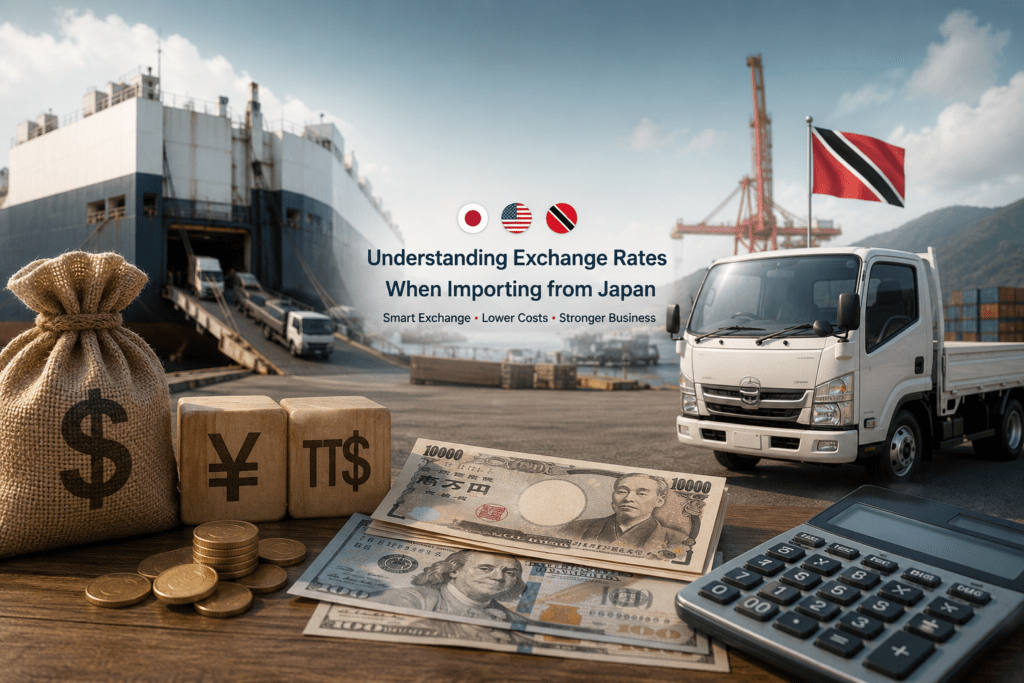

Understanding Exchange Rates When Importing from Japan: A Complete Guide for Trinidad and Tobago Buyers
Save More Money by Understanding Exchange Rates Before You Import a Japanese Used Truck
If you plan to import a used truck, bus, van, or tractor from Japan, the exchange rate can make a big difference. Many buyers focus only on the vehicle price. However, the exchange rate between the Japanese Yen (JPY) and the Trinidad and Tobago Dollar (TTD) often changes the final cost more than expected.
For importers in Trinidad and Tobago, learning how exchange rates work is one of the easiest ways to save money. Moreover, it helps you choose the best time to buy, reduce unexpected expenses, and improve your business profits.
In this guide, we explain exchange rates in simple English. We also show how they affect Japanese commercial vehicle imports and how buyers in Trinidad and Tobago can make smarter purchasing decisions.
Why Exchange Rates Matter When Buying from Japan
Every vehicle exported from Japan is priced in Japanese Yen (JPY). However, buyers in Trinidad and Tobago usually pay using Trinidad and Tobago Dollars (TTD) or sometimes US Dollars (USD).
Because of this, currency values directly affect your purchasing power.
For example:
- The same truck may cost less simply because the Yen becomes weaker.
- On the other hand, a stronger Yen makes the vehicle more expensive.
- Therefore, timing your purchase carefully can save thousands of dollars.
Even a small movement in exchange rates can significantly reduce your total import cost.
Understanding the Main Currencies
When importing from Japan, you may deal with three different currencies.
Japanese Yen (JPY)
Japanese exporters normally list vehicle prices in Yen.
Example:
- Truck Price: ¥2,500,000
US Dollar (USD)
Many exporters also provide quotations in US Dollars.
This option helps international buyers compare prices more easily.
Trinidad and Tobago Dollar (TTD)
Ultimately, your local business calculates costs and profits in TTD.
Therefore, every currency conversion affects your investment.
How Exchange Rates Affect Vehicle Prices
Imagine you want to buy a Japanese used Hino Ranger.
Vehicle Price:
¥3,000,000
Example 1
Exchange Rate:
¥150 = USD 1
Truck Price:
USD 20,000
Example 2
Exchange Rate:
¥165 = USD 1
Truck Price:
USD 18,182
The truck did not become cheaper.
Instead, the Japanese Yen became weaker.
As a result, overseas buyers paid less.
Why Trinidad and Tobago Buyers Benefit from a Weak Yen
Japan has experienced periods of a relatively weak Yen in recent years.
This creates excellent opportunities for overseas importers.
For buyers in Trinidad and Tobago, this means:
- Lower purchase prices
- Better profit margins
- More affordable fleet expansion
- Increased competitiveness
- Higher return on investment
Many importers purchase several vehicles during favorable exchange periods to maximize savings.
Trinidad and Tobago's Growing Demand for Japanese Commercial Vehicles
Businesses across Trinidad and Tobago continue to rely on dependable commercial vehicles.
Japanese trucks remain popular because they offer:
- Excellent reliability
- Strong diesel engines
- Long service life
- Easy maintenance
- Good fuel efficiency
- High resale value
These vehicles serve many industries.
Construction
Construction companies need durable dump trucks, crane trucks, and cargo trucks for infrastructure projects.
Distribution
Retail businesses require delivery trucks for moving goods throughout Trinidad.
Agriculture
Farmers use Japanese trucks to transport produce, livestock feed, and farming equipment.
Municipal Services
Government agencies often operate Japanese garbage trucks, utility trucks, and maintenance vehicles.
Because commercial vehicles work every day, reducing purchase costs through favorable exchange rates becomes even more valuable.
Why Japanese Trucks Are a Smart Investment
Many businesses in Trinidad and Tobago choose Japanese vehicles because they provide long-term value.
Popular models include:
- Isuzu Forward
- Hino Ranger
- Isuzu Elf
- Mitsubishi Canter
- Mitsubishi Fighter
- Toyota Dyna
- Hino Dutro
- Nissan Atlas
These trucks combine durability with affordable operating costs.
Even after years of service in Japan, many remain in excellent condition.
How Exchange Rates Affect Shipping Costs
Vehicle price is only one part of your total investment.
You should also consider:
- Ocean freight
- Marine insurance
- Port charges
- Customs duties
- VAT
- Registration fees
- Inland transportation
Although shipping companies often charge in US Dollars, your exporter may invoice the vehicle in Japanese Yen.
Therefore, currency movements influence your complete budget.
Trinidad and Tobago Importers Should Watch These Markets
Successful importers monitor financial markets regularly.
Useful indicators include:
- Japanese Yen
- US Dollar
- Global fuel prices
- Shipping rates
- International trade conditions
These factors often influence vehicle prices.
Even checking exchange rates once a week can help you identify better buying opportunities.
Should You Buy Immediately or Wait?
Many buyers ask this question.
The answer depends on several factors.
Buy immediately if:
- You find an excellent vehicle.
- The Yen is relatively weak.
- Shipping space is available.
- Your business needs the truck soon.
Consider waiting if:
- The market expects the Yen to weaken further.
- Freight prices remain unusually high.
- Better inventory will soon become available.
Working with an experienced exporter helps you make this decision confidently.
How Professional Exporters Help You Save Money
Reliable Japanese exporters monitor exchange rates every day.
They can:
- Provide updated quotations
- Explain currency movements
- Suggest better purchase timing
- Recommend suitable vehicles
- Arrange shipping efficiently
This guidance often saves buyers much more than negotiating the vehicle price alone.
Common Exchange Rate Mistakes
Many first-time buyers make avoidable mistakes.
Looking Only at Vehicle Price
A cheaper truck may become more expensive after currency conversion.
Always calculate the final landed cost.
Ignoring Bank Charges
Banks charge conversion fees.
International transfers also include service charges.
Include these costs in your budget.
Waiting Too Long
Excellent exchange rates do not last forever.
Meanwhile, popular vehicles may sell quickly.
Finding the right balance is important.
Forgetting Shipping Costs
Even if exchange rates improve, freight costs can still increase.
Always evaluate the complete import cost.
Tips for Trinidad and Tobago Buyers
Here are practical ways to reduce your costs.
Compare Multiple Quotations
Request quotations from trusted Japanese exporters.
Compare:
- Vehicle condition
- Auction grade
- Mileage
- Shipping options
- Currency used
Follow Currency Trends
Check exchange rates regularly before making payment.
Even small improvements create noticeable savings.
Plan Fleet Purchases
Businesses importing multiple trucks often save more during favorable exchange periods.
Buying together may also reduce shipping costs.
Choose Reliable Export Partners
Experienced exporters provide transparent pricing without hidden fees.
They also help explain exchange rate fluctuations.
Why Japanese Commercial Vehicles Continue to Dominate
Despite changing global markets, Japanese commercial vehicles remain among the most trusted worldwide.
Buyers appreciate:
- Proven reliability
- Strong diesel performance
- Quality manufacturing
- Easy parts availability
- Excellent durability
- High resale value
For Trinidad and Tobago businesses, these advantages reduce long-term operating expenses.
Frequently Asked Questions
Does the exchange rate change every day?
Yes.
Currency markets operate daily, so exchange rates constantly move.
Should I pay in Yen or US Dollars?
It depends on your exporter and your bank.
Ask which option provides the better overall cost.
Can exchange rates reduce my total import cost?
Absolutely.
A weaker Japanese Yen often allows overseas buyers to purchase vehicles at lower prices.
Why do professional importers monitor exchange rates?
Because smart timing increases profits.
Many experienced buyers purchase vehicles when exchange conditions become favorable.
Final Thoughts
Understanding exchange rates is one of the smartest skills for anyone importing vehicles from Japan.
For businesses in Trinidad and Tobago, even a small currency movement can lower the total cost of a truck, improve profitability, and make fleet expansion more affordable.
Instead of focusing only on the sticker price, calculate the complete import cost, including shipping, insurance, taxes, and currency conversion.
Most importantly, work with an experienced Japanese exporter who understands international trade and monitors exchange rates every day.
At EVERY TRADING Co., Ltd., we help customers from Trinidad and Tobago purchase high-quality Japanese used trucks, buses, tractors, and commercial vehicles with transparent pricing, competitive quotations, and professional export support.
When you understand exchange rates, you do not simply buy a vehicle—you make a smarter business investment.


Browse Reliable Used Trucks & Buses from Japan
Carefully selected vehicles ready for export worldwide
Search 100,000+ Dealer Stock Vehicles from Japan
Access a wide selection of vehicles from Japanese dealers nationwide. Updated daily.
