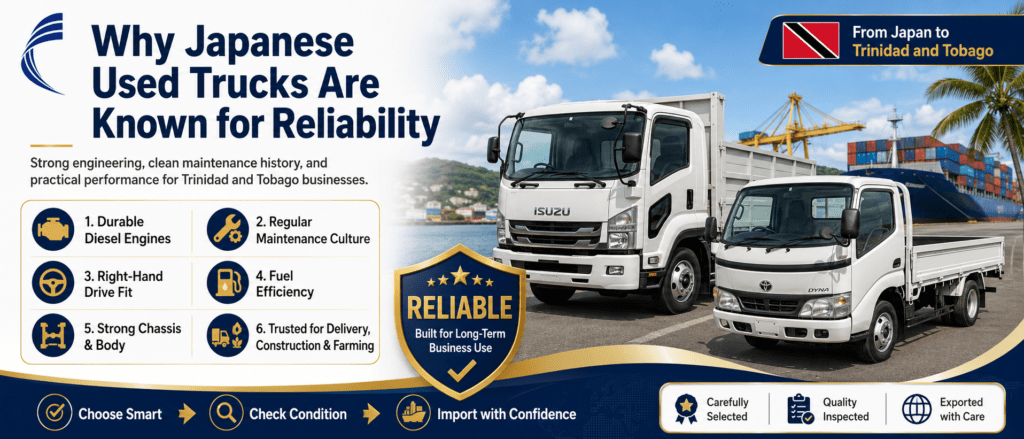

Why Japanese Used Trucks Are Reliable: A Smart Guide for Trinidad and Tobago Buyers
Japanese used trucks have a strong reputation around the world.
Many buyers choose them because they are practical, durable, and cost-effective. They also offer strong engines, good fuel economy, clean cabins, and long service life.
For Trinidad and Tobago buyers, this reputation matters.
A truck is not only a vehicle. It is a business tool. It carries goods, materials, tools, farm products, workers, and equipment. Therefore, reliability can protect income.
Across Trinidad, Japanese used trucks support delivery, construction, hardware supply, agriculture, industrial work, and logistics. In Tobago, they support hotels, shops, farms, restaurants, tourism suppliers, and local transport.
So, why are Japanese used trucks known for reliability?
This guide explains the main reasons. It also shows why they fit the real needs of Trinidad and Tobago buyers.
Why Reliability Matters in Trinidad and Tobago
Business vehicles work hard in Trinidad and Tobago.
A delivery truck may start early in Port of Spain. Then, it may move goods to Chaguanas, San Fernando, Arima, Couva, or Point Lisas. A construction truck may carry sand, gravel, steel, or tools. A farm truck may move produce from rural areas to markets.
In Tobago, a truck may serve coastal roads, hills, hotels, farms, and small communities.
Because of this, buyers need trucks they can trust.
A breakdown can cause lost time. It can also delay customers, jobs, and income. For a small company, even one day of downtime can hurt cash flow.
Therefore, many buyers choose Japanese used trucks.
They want value, but they also want confidence.
Japanese Trucks Are Built for Daily Work
Japanese truck makers understand commercial use.
Brands like Isuzu, Hino, Mitsubishi Fuso, Toyota, Nissan, and UD have built trucks for business, delivery, construction, and fleet use for many years.
These trucks focus on daily dependability.
They are not only made to look good. They are made to work.
Popular models include:
- Isuzu Elf
- Toyota Dyna
- Toyota Toyoace
- Mitsubishi Canter
- Hino Dutro
- Nissan Atlas
- Isuzu Forward
- Hino Ranger
- Mitsubishi Fighter
- Nissan Condor
- Hino Profia
- Isuzu Giga
- Mitsubishi Super Great
- UD Quon
These models serve many markets because they offer a good balance of strength, fuel economy, size, and maintenance access.
For Trinidad and Tobago buyers, this balance is very useful.
Japan Has a Strong Maintenance Culture
One major reason is maintenance.
Many vehicles in Japan receive regular service. Owners often keep records. Also, Japan has a strong inspection culture that encourages owners to maintain vehicles properly.
As a result, many used trucks from Japan remain in good condition.
Of course, every used truck is different.
Some trucks have worked hard. Some have rust. Some need tyres, batteries, or brake service. Therefore, buyers still need inspection.
However, Japan often offers cleaner and better-maintained units than many other used vehicle markets.
This helps buyers in Trinidad and Tobago find trucks that can start business use with fewer problems.
Japanese Roads Help Preserve Many Trucks
Japan has many paved roads and structured vehicle use.
Many trucks work in city delivery, company fleets, light construction, or regional transport. While some units work heavily, many trucks do not face the same rough conditions seen in some countries.
This can help preserve:
- Chassis condition
- Suspension parts
- Cabin condition
- Cargo body condition
- Steering components
- Interior cleanliness
- Electrical systems
For buyers in Trinidad and Tobago, this is a benefit.
A cleaner truck from Japan can handle local work better after arrival, especially when the buyer completes basic service and inspection.
Right-Hand Drive Fits Trinidad and Tobago
Japan uses right-hand drive vehicles.
Trinidad and Tobago also uses right-hand drive vehicles. This makes Japanese used trucks a natural fit for local roads.
Drivers can sit on the correct side for local traffic. This helps with road visibility, lane position, overtaking, and delivery stops.
This is especially useful for commercial use.
A driver in Port of Spain traffic needs confidence. A delivery driver on narrow streets needs control. A contractor on busy roads needs safe visibility.
Therefore, right-hand drive layout is a real advantage.
Diesel Engines Offer Strong Business Value
Many Japanese trucks use diesel engines.
Diesel engines are popular for commercial use because they provide strong torque. Torque helps trucks move cargo, climb hills, and operate under load.
This matters in Trinidad and Tobago.
A truck may carry heavy goods. It may climb hilly roads. It may move through traffic with stop-and-go driving. It may also work in hot weather.
A reliable diesel engine can support these conditions well.
In addition, many Japanese diesel trucks offer good fuel economy. This helps business owners control daily costs.
Fuel cost matters every week.
So, a fuel-efficient truck can improve profit over time.
Japanese Light-Duty Trucks Are Practical for Local Delivery
Light-duty trucks are very popular.
Models like the Isuzu Elf, Mitsubishi Canter, Toyota Dyna, Toyota Toyoace, Hino Dutro, and Nissan Atlas fit many businesses in Trinidad and Tobago.
They are useful for:
- Food delivery
- Retail supply
- Hardware stores
- Courier work
- Small construction
- Farm transport
- Hotel supply
- Furniture delivery
- Parts delivery
These trucks are compact enough for urban roads. Yet, they still carry useful cargo.
This makes them ideal for areas such as Port of Spain, Chaguanas, Arima, San Fernando, and Tobago communities.
Also, many drivers find them easy to handle.
Medium-Duty Trucks Support Stronger Work
Medium-duty Japanese trucks are also trusted.
Models like Isuzu Forward, Hino Ranger, Mitsubishi Fighter, and Nissan Condor serve bigger jobs.
They suit:
- Construction materials
- Industrial supplies
- Building products
- Agricultural goods
- Water tanks
- Steel and lumber
- Logistics routes
- Port support work
These trucks offer more payload and stronger frames than light-duty trucks.
For businesses near Point Lisas, San Fernando, Couva, and other industrial areas, medium trucks can be a smart choice.
However, buyers must check weight category, import rules, and local registration needs before purchase.
Japanese Trucks Have Practical Body Types
Japan offers many body types.
This helps Trinidad and Tobago buyers choose a truck for the exact job.
Common body types include:
- Flatbed
- Box truck
- Dump truck
- Crane truck
- Freezer truck
- Wing body
- Van body
- Tanker
- Service truck
- High-roof cargo body
This variety is important.
A shop may need a box truck to protect goods from tropical rain. A construction company may need a dump truck. A farm may need a flatbed. A food supplier may need a freezer truck. A contractor may need a crane truck.
Therefore, Japanese stock gives buyers many options.
The right body type can make daily work easier.
Trucks from Japan Often Have Clear Vehicle Details
A reliable purchase needs clear information.
Japanese used trucks often come with useful details such as model code, chassis number, mileage, body type, engine type, dimensions, and export documents.
This helps overseas buyers compare options.
For Trinidad and Tobago buyers, this matters for import planning.
The buyer may need information for:
- Import Licence
- Customs clearance
- Broker review
- Duty estimate
- Registration
- Insurance
- Local inspection
- Fleet records
If the chassis number is clear, the process becomes smoother. If the model and year are clear, the buyer can plan better.
Good documents support reliability.
A strong truck with unclear papers can still create problems.
Auction Sheets Help Buyers Understand Condition
Many Japanese used trucks come through auctions.
Auction sheets can show useful condition information.
They may include:
- Auction grade
- Mileage
- Exterior condition
- Interior condition
- Rust notes
- Repair history
- Accident history
- Engine notes
- Transmission notes
- Equipment comments
- Body condition notes
This helps buyers see more than photos.
However, auction sheets use short codes and Japanese terms. So, buyers should ask for explanation when needed.
A trusted exporter can help translate key points.
This support helps Trinidad and Tobago buyers make better choices.
Reliability Also Depends on the Exporter
Japanese trucks are known for reliability, but the exporter still matters.
A good exporter helps buyers avoid poor choices.
The exporter should provide:
- Clear photos
- Vehicle details
- Chassis number confirmation
- Auction sheet review
- Condition comments
- Invoice support
- Export certificate support
- Shipping guidance
- FOB, C&F, or CIF quotation
- Honest communication
This is very important for overseas buyers.
A buyer in Trinidad and Tobago cannot easily inspect the vehicle in Japan. Therefore, the exporter’s information must be clear and useful.
EVERY focuses on this point.
We help buyers check condition before export.
Why Cooling System Condition Matters
Trinidad and Tobago has a hot climate.
Traffic can also be heavy, especially around busy business areas. Therefore, cooling system condition matters.
A truck with weak cooling may overheat during daily work.
Before buying, check:
- Coolant condition if visible
- Radiator area
- Engine bay photos
- Warning lights
- Signs of leaks
- Fan condition if visible
- Temperature gauge behavior if video is available
After arrival, service the cooling system if needed.
This helps the truck survive local heat and traffic.
Brakes Are Critical for Local Roads
Brakes matter everywhere.
However, they are especially important for commercial vehicles in Trinidad and Tobago.
A truck may carry heavy cargo. It may travel on hilly roads. It may drive in rain. It may also face sudden stops in traffic.
Therefore, buyers should check brake condition carefully.
Before purchase, review auction notes and available inspection comments. After arrival, complete a local brake check before business use.
Strong brakes protect drivers, cargo, and customers.
Tyres Affect Safety and Cost
Tyres are another important part of reliability.
A truck may have a strong engine, but poor tyres can create problems.
Check:
- Tread depth
- Sidewall cracks
- Uneven wear
- Load rating
- Matching tyres
- Spare tyre if available
- Tyre age if visible
For commercial vehicles, tyre load rating matters.
A truck that carries heavy goods needs proper tyres. If tyres need replacement, include that cost in the budget.
A reliable truck needs reliable tyres.
Rust Checks Are Important for Island Markets
Trinidad and Tobago has coastal air and humidity.
Tobago buyers should pay even closer attention because coastal conditions can affect vehicles over time.
Therefore, rust checks matter.
Before buying, request underbody photos when possible.
Check:
- Chassis frame
- Cross members
- Suspension areas
- Cabin floor
- Door lower edges
- Cargo body floor
- Wheel arches
- Rear body sections
Surface rust may be normal on used trucks. However, heavy frame rust is a concern.
A truck with a strong frame can serve longer.
Reliability Depends on the Right Match
A truck can be reliable, but still wrong for the job.
For example, a small delivery truck may not suit heavy construction work. A large heavy-duty truck may be too expensive for small city delivery. A box truck may protect cargo well, but it may not suit oversized materials.
Therefore, buyers should match the truck to the work.
Ask:
- What cargo will it carry?
- How heavy is the load?
- How far will it travel?
- Will it drive in traffic?
- Will it climb hills?
- Will it work near the coast?
- Will it carry people or goods?
- Will it need special equipment?
The right match improves reliability.
The wrong match creates stress.
Why Japanese Trucks Fit Trinidad Business Sectors
Japanese used trucks can fit many local sectors.
Construction
Dump trucks, flatbeds, and crane trucks help contractors move materials and equipment.
Japanese trucks are popular because they offer strong chassis options and practical body types.
Delivery and Retail
Light-duty box trucks and vans support shops, supermarkets, hardware stores, and courier businesses.
They are easy to drive and useful in busy urban areas.
Agriculture
Flatbeds, pickups, and light trucks help move produce, tools, water tanks, and farm supplies.
Durable suspension and simple design are important here.
Industrial and Energy Services
Trinidad has important industrial and energy-related activity.
Service trucks and medium-duty trucks can support equipment movement, workshop work, and site support.
Tourism and Tobago Business
Tobago needs reliable vehicles for hotels, suppliers, farms, and small businesses.
Clean Japanese vans, pickups, and light trucks can fit this market well.
Long-Term Value Matters More Than Low Price
Many buyers search for the cheapest truck.
That is understandable.
However, the cheapest truck is not always the best value.
A low-price unit may need tyres, brakes, battery, paint, underbody repair, or engine work. It may also have unclear documents.
A better truck may cost more at first. Yet, it may save money after arrival.
For business buyers, long-term value matters.
A reliable truck reduces downtime. It helps serve customers. It also supports stable income.
Therefore, choose value, not only price.
How EVERY Helps Buyers Find Reliable Trucks
EVERY helps overseas buyers choose Japanese used vehicles with confidence.
For Trinidad and Tobago buyers, we focus on practical vehicle selection.
We can help with:
- Japanese used truck search
- Auction stock review
- Condition photo checks
- Video requests
- Chassis number confirmation
- Engine and body checks
- Undercarriage photo requests
- Export document support
- FOB, C&F, and CIF quotations
- RoRo shipping guidance
- Clear communication before shipment
Also, we help buyers compare vehicles based on real use.
A delivery buyer needs a different truck from a contractor. A farmer needs a different vehicle from a port service company. A Tobago buyer may need a compact and clean truck.
Therefore, we help buyers choose with purpose.
What Buyers Should Check Before Purchase
Before buying a Japanese used truck, check:
- Import eligibility
- Vehicle age
- Chassis number
- Auction sheet
- Mileage
- Engine condition
- Transmission type
- Tyres
- Brakes
- Rust
- Underbody
- Body type
- Cargo floor
- Special equipment
- Documents
- Shipping method
- Landed cost
- Local inspection needs
This checklist helps reduce risk.
It also helps buyers choose a truck that fits Trinidad and Tobago.
What Buyers Should Do After Arrival
After the truck arrives, inspect and service it before daily work.
Check:
- Engine oil
- Oil filter
- Fuel filter
- Coolant
- Brake fluid
- Battery
- Tyres
- Brakes
- Lights
- Wipers
- Horn
- Air conditioning
- Steering
- Suspension
- Undercarriage
- Any leaks
Then, complete inspection, insurance, and registration steps.
Even a reliable Japanese truck needs local preparation.
That final step helps protect the vehicle and the business.
Final Advice for Trinidad and Tobago Buyers
Japanese used trucks are known for reliability because they combine strong engineering, practical design, good maintenance culture, clear vehicle information, and wide model choice.
For Trinidad and Tobago buyers, this makes them very attractive.
They can support delivery, construction, farming, tourism, logistics, industrial service, and fleet growth.
However, reliability depends on smart buying.
Choose the right truck. Check the condition. Confirm the documents. Understand shipping and local costs. Then, service the vehicle after arrival.
A well-chosen Japanese used truck can become a powerful business partner.
It can help you deliver faster, work harder, and grow with confidence in Trinidad and Tobago.


Browse Reliable Used Trucks & Buses from Japan
Carefully selected vehicles ready for export worldwide
Search 100,000+ Dealer Stock Vehicles from Japan
Access a wide selection of vehicles from Japanese dealers nationwide. Updated daily.
