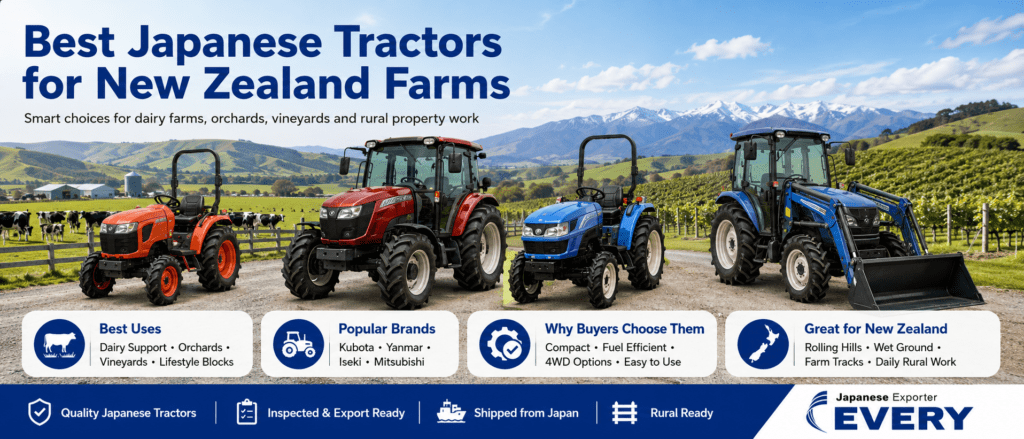

Best Japanese Tractors for New Zealand Farms
New Zealand farms need reliable machines.
Dairy farms need them.
Sheep and beef farms need them.
Orchards need them.
Vineyards need them.
Lifestyle blocks also need them.
That is why Japanese used tractors are attractive for New Zealand buyers.
They are compact, practical, fuel-efficient, and easy to use. Also, many models offer 4WD. This helps on wet grass, gravel tracks, rolling hills, and small farm roads.
New Zealand farming is diverse. Some farms need strong tractors for daily dairy support. Some growers need narrow tractors for orchard rows. Some lifestyle block owners need compact tractors for mowing, small loading jobs, and property care.
So, the best tractor depends on the work.
Japan offers many used tractor choices. Buyers can find Kubota, Yanmar, Iseki, Mitsubishi, Shibaura, and other trusted brands. These tractors often suit small to medium farm work very well.
New Zealand also has strict biosecurity rules. Used machinery can carry soil, plant material, seeds, insects, and other risks. MPI explains that vehicles, machinery, and parts often carry contaminants, and importers must meet biosecurity requirements before entry into New Zealand.
Therefore, buyers should choose the tractor carefully. They should also prepare cleaning and inspection before shipping.
This guide explains the best Japanese tractors for New Zealand farms. It also shows which tractor type fits each farm job.
Why Japanese Tractors Suit New Zealand Farms
Japanese tractors are popular because they are practical.
They are not too large.
They are easy to operate.
They use fuel well.
They can handle many small jobs.
Also, many offer 4WD traction.
This is important in New Zealand.
Many farms have mixed surfaces. A tractor may move from a shed to a paddock. Then it may drive on gravel, grass, mud, or a slope. In some areas, weather can change quickly.
Because of this, a compact 4WD tractor can be very useful.
Japanese tractors also work well for:
- Mowing
- Spraying
- Light cultivation
- Trailer pulling
- Small loader work
- Orchard support
- Vineyard work
- Property maintenance
- Feed and supply movement
- Lifestyle block management
Also, Japanese brands have a strong reputation. Kubota and Yanmar are well known around the world. Iseki, Mitsubishi, and Shibaura also offer strong small-farm machines.
For New Zealand buyers, this gives more confidence.
New Zealand Agriculture Needs Practical Equipment
New Zealand’s economy depends heavily on primary industries.
Dairy, meat, horticulture, forestry, and other rural sectors need strong equipment and steady transport. MPI forecasts dairy export revenue to reach a record NZD 28.6 billion in the year to June 2026. It also forecasts horticulture export revenue to reach NZD 9.5 billion in the same year.
This matters for tractor buyers.
When farming output stays important, reliable farm machinery also stays important. A tractor does not only help with one job. It supports many daily tasks across the property.
Stats NZ also shows the large scale of New Zealand farming. At 30 June 2025, New Zealand had 5.7 million dairy cattle and 3.8 million beef cattle.
That kind of livestock industry needs daily support work.
Tractors help with feeding, fencing, mowing, scraping, trailer work, and general maintenance. Meanwhile, horticulture growers use tractors for spraying, mowing, transport, and row work.
Therefore, a good Japanese tractor can support both production and daily farm life.
Why Used Japanese Tractors Can Be a Smart Choice
New tractors can be expensive.
For many farmers, growers, and lifestyle block owners, a used tractor can make better business sense.
Japanese used tractors offer several benefits:
- Lower purchase cost
- Compact size
- Strong brand quality
- Good 4WD options
- Simple controls
- Many horsepower choices
- Useful attachments
- Proven small-farm performance
Also, Japan has many small and medium tractors because Japanese farms often use compact machinery. This creates good export opportunities.
A New Zealand buyer may not always need a large, high-horsepower tractor.
Sometimes, a 20–50 HP tractor is enough.
Sometimes, a 60–80 HP tractor gives better flexibility.
For larger farms, a bigger model may be needed.
However, many daily jobs do not need a giant machine.
That is where Japanese tractors can fit very well.
Best Japanese Tractor Brands for New Zealand Farms
1. Kubota Tractors
Kubota is one of the most trusted Japanese tractor brands.
Many buyers know the name. The brand has a strong image for compact tractors, small farm machines, and reliable diesel engines.
For New Zealand farms, Kubota tractors can fit many jobs.
They are useful for:
- Lifestyle blocks
- Small farms
- Orchards
- Vineyards
- Dairy support
- Mowing
- Light loader work
- Trailer pulling
- Spraying
- General property care
Popular used Kubota series often include GL, GM, KL, L, B, and M series models, depending on year and market.
A smaller Kubota can suit lifestyle blocks and orchards. A larger Kubota can support dairy farms, contractors, and rural businesses.
Kubota tractors are also popular because they feel simple to use.
For buyers who want a compact, reliable tractor from Japan, Kubota is a very strong choice.
Best for New Zealand:
Lifestyle blocks, small farms, orchards, vineyards, dairy support, and general farm work.
2. Yanmar Tractors
Yanmar is another respected Japanese tractor brand.
Yanmar is known for diesel engine technology and compact farm machines. Many used Yanmar tractors from Japan are practical for small and medium farms.
For New Zealand, Yanmar tractors can suit:
- Orchard work
- Vineyard rows
- Lifestyle blocks
- Small dairy support
- Pasture mowing
- Garden and property work
- Light cultivation
- Trailer pulling
Yanmar models often feel compact and easy to manage. This helps in tight spaces.
For example, an orchard may need a tractor that can move between rows. A lifestyle block may need a small tractor that is easy to park. A grower may need a fuel-efficient tractor for daily jobs.
Yanmar can match these needs well.
Buyers should check horsepower, PTO, tire condition, hours, and hydraulic function before purchase.
Best for New Zealand:
Orchards, vineyards, lifestyle blocks, compact farm work, and fuel-conscious buyers.
3. Iseki Tractors
Iseki tractors are very popular in Japan.
They are practical, compact, and suitable for many small-farm jobs. Many Iseki tractors offer 4WD, PTO, and useful hydraulic systems.
For New Zealand buyers, Iseki can be a strong value choice.
Iseki tractors can help with:
- Mowing
- Spraying
- Tillage
- Trailer work
- Small farm maintenance
- Property care
- Orchard support
- Vineyard work
Iseki models may offer good performance at attractive used-market prices.
This matters for buyers who want value but still need a reliable Japanese machine.
However, condition and parts support are important.
Before buying, check the model, engine, hours, tires, hydraulic function, PTO, and attachments.
A clean Iseki tractor can become a strong daily machine.
Best for New Zealand:
Value-focused farms, growers, lifestyle blocks, mowing, spraying, and general farm use.
4. Mitsubishi Tractors
Mitsubishi tractors are strong, practical, and often well built.
They can suit small farms, rural properties, orchards, and general property maintenance. Many used Mitsubishi tractors from Japan offer compact size and simple operation.
For New Zealand, a Mitsubishi tractor can support:
- Small paddock work
- Mowing
- Rotary work
- Spraying
- Trailer pulling
- Lifestyle block care
- Light farm maintenance
Mitsubishi tractors may not always be as famous as Kubota. However, many models offer good value and useful power.
For buyers with a careful budget, this can be attractive.
As always, buyers should focus on condition.
Check engine start, smoke, PTO operation, transmission, hydraulics, brakes, and rust.
A good Mitsubishi tractor can serve New Zealand farms well.
Best for New Zealand:
Small farms, property maintenance, lifestyle blocks, value buyers, and light rural work.
5. Shibaura Tractors
Shibaura tractors are another Japanese option for small farm work.
They often suit buyers who need a compact and practical tractor. Many models can handle mowing, light cultivation, and general property tasks.
For New Zealand, Shibaura can be useful for:
- Lifestyle blocks
- Small farms
- Nurseries
- Orchards
- Rural properties
- Light maintenance
- Mowing
- Trailer work
Shibaura tractors can offer good value. However, buyers should check parts availability and model details before purchase.
This matters more with older tractors.
If the machine is clean and the model suits the work, a Shibaura tractor can be a practical choice.
Best for New Zealand:
Lifestyle blocks, nurseries, small farms, orchards, and light-duty rural work.
Best Japanese Tractor Types for New Zealand
Compact 4WD Tractors
Compact 4WD tractors are very useful in New Zealand.
They suit small farms, orchards, vineyards, lifestyle blocks, and rural homes.
A compact tractor can handle:
- Mowing
- Spraying
- Small trailer work
- Garden preparation
- Light grading
- Firewood movement
- Fence line maintenance
- Small loader jobs
The 4WD system helps on wet grass and uneven ground.
It also gives better traction on slopes and farm tracks.
For many New Zealand buyers, a compact 4WD tractor is the best starting point.
Mid-Size Farm Tractors
Mid-size tractors suit larger farms and stronger work.
They often give more horsepower and better pulling ability.
Good uses include:
- Pasture maintenance
- Feed transport
- Larger mowing jobs
- Bale handling
- Farm trailer work
- Light cultivation
- Contractor support
- Dairy farm maintenance
A mid-size Japanese tractor can suit farmers who need more power but still want practical size.
This type can work well in dairy regions, sheep and beef farms, and larger horticulture operations.
Orchard and Vineyard Tractors
New Zealand has strong horticulture sectors.
Kiwifruit, apples, grapes, and other crops need precise farm work. MPI forecasts horticulture export revenue to rise to NZD 9.5 billion in the year to June 2026, helped by kiwifruit and apple export volumes.
Orchards and vineyards often need compact tractors.
They must fit between rows. They also need good turning ability.
Useful features include:
- Narrow body
- 4WD
- Power steering
- PTO
- Sprayer compatibility
- Good visibility
- Low operating cost
Japanese compact tractors can be a good match.
They are often small, efficient, and easy to operate.
Tractors with Loaders
A front loader can make a tractor much more useful.
It can help move soil, gravel, feed, mulch, firewood, small bales, and farm materials.
For New Zealand farms and lifestyle blocks, this is very practical.
Loader tractors can support:
- Shed work
- Farm maintenance
- Landscaping
- Small construction
- Feed handling
- Property cleanup
However, buyers should check loader condition.
Look at pins, arms, bucket wear, hydraulic leaks, and mounting points.
A loader adds value, but it also adds wear.
Tractors with Rotary Tillers
Many Japanese used tractors come with rotary tillers.
This is useful for gardens, small farms, vegetable plots, nurseries, and property work.
A rotary tiller can prepare soil for planting. It can also help with small cultivation jobs.
For New Zealand lifestyle blocks, this can be very useful.
However, check the tiller condition.
Look at blades, gearbox, PTO shaft, frame, and rust.
A good tiller can save money after arrival.
Which Tractor Fits Each New Zealand Farm?
Dairy Farms
Dairy farms need practical support machines.
A Japanese tractor can help with:
- Feed movement
- Scraping
- Mowing
- Trailer pulling
- General maintenance
- Small loader work
- Yard and shed tasks
Best choices include:
- Kubota mid-size tractor
- Yanmar 4WD tractor
- Iseki 4WD tractor
- Mitsubishi utility tractor
For dairy farms, choose enough horsepower.
Also, check tires and hydraulics carefully.
Wet ground and daily use can be demanding.
Sheep and Beef Farms
Sheep and beef farms often need versatile machines.
A tractor may help with fencing, trailer work, mowing, feed, and property maintenance.
Good choices include:
- Kubota 4WD tractor
- Yanmar mid-size tractor
- Iseki utility tractor
- Mitsubishi tractor with loader
A 4WD model can help on hills and uneven tracks.
New Zealand had 3.8 million beef cattle at 30 June 2025, according to Stats NZ, showing the continued size of this sector.
For these farms, durability matters.
A simple tractor with good traction can be more useful than a complex machine.
Orchards
Orchards need compact tractors.
A large machine may not fit between rows.
Good choices include:
- Kubota compact tractor
- Yanmar compact tractor
- Iseki compact tractor
- Shibaura small tractor
Important features include narrow width, good steering, PTO, and sprayer compatibility.
Also, check clearance around branches and row spacing.
For apple and kiwifruit growers, the right tractor size matters every day.
Vineyards
Vineyards also need compact and careful machines.
A tractor must move between rows without damaging plants.
Good choices include:
- Yanmar compact tractor
- Kubota narrow tractor
- Iseki compact 4WD tractor
- Mitsubishi compact tractor
Vineyard tractors often support spraying, mowing, trailer work, and light cultivation.
4WD can help on slopes and wet ground.
Also, low weight can reduce soil compaction.
So, choose the size carefully.
Lifestyle Blocks
Lifestyle blocks are common in New Zealand.
Owners often need a tractor for property care, mowing, firewood, small trailers, gardens, and maintenance.
Good choices include:
- Kubota B or L series
- Yanmar compact tractor
- Iseki small tractor
- Mitsubishi compact tractor
- Shibaura compact tractor
A 20–40 HP tractor can suit many lifestyle blocks.
However, property size matters.
If the land is hilly or wet, choose 4WD.
If the buyer needs loader work, check hydraulic strength.
What New Zealand Buyers Should Check Before Importing
1. Biosecurity Cleaning
This is very important.
Used tractors can carry soil, seeds, plant material, insects, and other biosecurity risks. MPI says used vehicles, machinery, and parts often carry contaminants, pests, and diseases, so importers must meet biosecurity requirements.
Before shipping, buyers should prepare for proper cleaning.
Pay attention to:
- Tires
- Wheels
- Undercarriage
- Engine bay
- Radiator area
- Mudguards
- PTO area
- Implements
- Loader bucket
- Rotary tiller
- Cabin floor
- Seat base
A dirty tractor can face delays, cleaning costs, or inspection problems after arrival.
Therefore, cleaning is not optional.
It is part of the import plan.
2. Use Approved Cleaning Support When Needed
MPI keeps information about approved systems and cleaning providers for used vehicles and machinery. This helps importers meet New Zealand biosecurity requirements.
For tractors, this can be especially important.
Farm machinery often holds mud in hidden areas. Rotary tillers, tires, axles, and loader brackets can trap soil.
So, buyers should discuss cleaning before purchase and before shipment.
This can reduce risk at the New Zealand border.
3. Engine and Hour Meter
Always check the engine.
Ask for a start video. Listen for noise. Check smoke. Also, check the hour meter.
Important points include:
- Cold start
- Idle sound
- Exhaust smoke
- Oil leaks
- Water leaks
- Warning lights
- Battery condition
- Radiator condition
Hours are important. However, condition matters more.
A lower-hour tractor can still have problems. A higher-hour tractor can still be good if maintained well.
4. 4WD and Transmission
Many buyers want 4WD.
So, check that the system works.
Ask about:
- 4WD engagement
- Gear changes
- Clutch feel
- Hydrostatic function, if fitted
- Differential lock
- Brakes
- Steering
- Unusual noise
For hilly New Zealand farms, drivetrain condition matters.
A weak transmission can become costly.
5. PTO and Hydraulics
PTO and hydraulics make a tractor useful.
Check:
- PTO operation
- PTO shaft condition
- Hydraulic lift
- Loader function
- Remote valves
- Oil leaks
- Three-point linkage
- Top link and arms
Many farm jobs depend on these systems.
If they fail, the tractor loses value quickly.
6. Tires and Wheels
Tires affect traction and safety.
Check:
- Tire tread
- Tire cracks
- Tire size
- Front and rear matching
- Wheel rust
- Rim damage
- Tube leaks
For New Zealand, good tires are important on wet grass, slopes, and gravel.
Replacing tractor tires can cost a lot.
So, check them early.
7. Attachments and Implements
Attachments can add value.
Common attachments include:
- Rotary tiller
- Front loader
- Bucket
- Mower
- Blade
- Trailer hitch
- Sprayer equipment
However, attachments can also hide wear or mud.
Check their condition and cleaning needs.
A tractor with good implements can be a better purchase than a cheaper bare tractor.
Common Mistakes When Buying a Used Tractor
Buying Only by Horsepower
Horsepower matters. However, size, weight, tires, PTO, and hydraulics also matter.
A tractor with the right features can outperform a stronger but unsuitable machine.
Ignoring Biosecurity
This is a serious mistake.
New Zealand takes biosecurity very seriously. Dirty machinery can create delays and extra costs.
Choosing Too Large a Tractor
A large tractor may not suit orchards, vineyards, or lifestyle blocks.
It may damage soil or struggle in tight spaces.
Choosing Too Small a Tractor
A small tractor may not handle loader work, hills, or larger implements.
Always match the tractor to daily tasks.
Not Checking Implements
A rotary tiller or loader can add value.
However, worn parts can create repair costs.
Check before buying.
Why Buy Japanese Used Tractors from EVERY
EVERY helps overseas buyers find reliable Japanese used tractors and farm machinery.
We support customers who need tractors for farms, orchards, vineyards, lifestyle blocks, rural properties, and small businesses.
For New Zealand buyers, careful support is important.
You need the right tractor.
You need clear condition details.
You need correct export documents.
You also need careful cleaning support before shipping.
EVERY can help with:
- Japanese used tractor sourcing
- Auction and stock search
- Condition checks
- Detailed photos and videos
- Export document support
- Shipping preparation from Japan
- Implement and attachment checks
- Farm-use advice
- Biosecurity cleaning awareness
- Smooth communication before purchase
A tractor is a daily work partner.
So, the selection process matters.
With the right support, buyers can choose with more confidence.
Final Thoughts
Japanese used tractors are a smart choice for many New Zealand farms.
They are compact, practical, and efficient. They also fit many real jobs across dairy farms, sheep and beef farms, orchards, vineyards, and lifestyle blocks.
Kubota, Yanmar, Iseki, Mitsubishi, and Shibaura offer strong options for different farm needs.
For small farms and lifestyle blocks, a compact 4WD tractor can be ideal. For dairy and livestock support, a mid-size tractor may work better. For orchards and vineyards, a narrow and easy-turning tractor can save time every day.
However, the best tractor is not always the cheapest one.
The best tractor fits your land, work, horsepower needs, attachments, budget, and import requirements.
So, check the engine. Review the hours. Test the 4WD. Confirm PTO and hydraulics. Inspect tires and implements. Also, plan biosecurity cleaning before shipping.
With the right Japanese used tractor, New Zealand farmers can work faster, safer, and smarter across every season.


Browse Reliable Used Trucks & Buses from Japan
Carefully selected vehicles ready for export worldwide
Search 100,000+ Dealer Stock Vehicles from Japan
Access a wide selection of vehicles from Japanese dealers nationwide. Updated daily.
