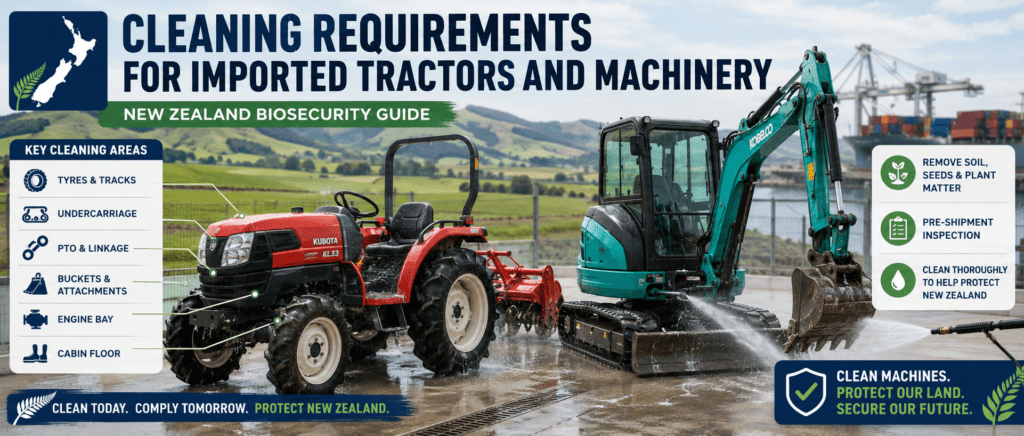

Cleaning Guide for NZ-Bound Tractors & Machinery
New Zealand takes biosecurity very seriously.
This matters for every tractor buyer.
It matters for machinery importers.
It also matters for farmers, growers, contractors, and rural businesses.
Used tractors and machinery can carry soil, seeds, plant material, insects, pests, and other contaminants. Because of this, they need careful cleaning before they arrive in New Zealand.
This is especially important when importing used machinery from Japan.
A tractor may look clean from the outside.
However, soil can hide between tyres.
Seeds can stay under mudguards.
Plant material can remain near the radiator.
Also, insects can hide in small gaps.
Therefore, cleaning is not only about appearance.
It is part of New Zealand’s import process.
MPI explains that vehicles, machinery, and parts, including tyres, often carry soil, plant matter, and animals. MPI helps importers meet biosecurity requirements to keep New Zealand free from contaminants, pests, and diseases.
So, if you plan to import a tractor, excavator, loader, mower, tiller, forklift, farm machine, or construction machine, preparation should start before shipping.
This guide explains cleaning requirements for imported tractors and machinery in New Zealand. It also shows what buyers should check before exporting from Japan.
Why Cleaning Requirements Are So Important in New Zealand
New Zealand depends on clean land.
Farming, dairy, horticulture, forestry, wine, and rural tourism all need a safe natural environment. If harmful pests or diseases enter the country, they can damage crops, pasture, animals, forests, and native ecosystems.
Used tractors and machinery can create higher biosecurity risk than normal road vehicles.
Why?
Because they often work directly with soil.
A tractor may work in fields.
A rotary tiller may turn soil.
A loader bucket may carry compost.
An excavator may dig earth.
A mower may collect grass.
A harvester may hold seeds.
A forklift may work in dusty farm yards.
As a result, dirt can hide in many places.
For New Zealand importers, this means one thing.
Clean the machine properly before shipping.
Good cleaning can reduce delays, extra costs, and inspection problems after arrival.
Biosecurity Cleaning Is Different from Mechanical Inspection
Many buyers focus on the engine.
That is understandable.
A tractor must start well.
A loader must lift properly.
An excavator must move smoothly.
A mower must operate safely.
However, New Zealand inspection also looks at biosecurity risk.
A machine can run perfectly and still cause problems if it carries soil or plant material.
So, buyers should think about two separate checks.
First, check the machine condition.
Second, check the cleaning condition.
Both matter.
MPI says importers should make sure vehicles, machinery, and parts are clean and meet requirements before import. MPI also explains that importers need to provide required information before arrival through the import process.
Therefore, cleaning should be planned early.
Do not wait until the machine arrives in New Zealand.
What Contaminants Must Be Removed?
Imported tractors and machinery should arrive free from biosecurity contamination.
This can include:
- Soil
- Mud
- Dust with organic matter
- Seeds
- Leaves
- Grass
- Plant stems
- Bark
- Insects
- Egg masses
- Nests
- Webbing
- Snails
- Animal material
- Other pests
Some contaminants are easy to see.
Others are hidden.
For example, a rotary tiller may hold soil inside the blade area. A tractor tyre may look clean on the sidewall but still hold mud deep in the tread. A loader may have dirt inside the bucket corners.
So, a quick surface wash may not be enough.
Imported machinery needs careful and detailed cleaning.
Why Tractors Need Extra Cleaning
Tractors are one of the most important machines to clean carefully.
They work in fields, orchards, vineyards, sheds, yards, and paddocks. They also carry mud into hidden places.
Common risk areas include:
- Tyres
- Rims
- Axles
- Mudguards
- PTO area
- Three-point linkage
- Drawbar
- Underbody
- Engine bay
- Radiator screen
- Loader brackets
- Bucket corners
- Cabin floor
- Seat base
- Steps
- Implements
In New Zealand, tractors often support dairy farms, sheep and beef farms, orchards, vineyards, and lifestyle blocks.
These sectors depend on clean land.
Therefore, buyers should not treat tractor cleaning as a small task.
It is a major part of import preparation.
Cleaning Areas for Used Tractors
1. Tyres and Rims
Tyres often carry the most visible soil.
Tractor tyres have deep tread. This makes them excellent for grip. However, it also makes them good at holding mud and seeds.
Clean carefully around:
- Deep tyre tread
- Sidewalls
- Bead areas
- Wheel rims
- Valve areas
- Inner wheels
- Front and rear tyres
Also, inspect between dual wheels if fitted.
Soil can hide there.
2. Axles and Undercarriage
The underside of a tractor can hold dried mud.
Check:
- Front axle
- Rear axle
- Differential area
- Steering joints
- Brake housing
- Transmission housing
- Chassis frame
- Belly area
Use strong lighting and clear photos.
Hidden dirt can remain after normal washing.
3. Mudguards and Steps
Mudguards can trap grass, soil, and plant material.
Steps can also collect mud from boots.
Check:
- Under mudguards
- Step plates
- Foot areas
- Pedal area
- Cabin entry points
- Floor mats
This matters for open tractors and cab tractors.
4. PTO and Linkage Area
The PTO and rear linkage are high-risk areas.
They sit close to soil and implements. They also have many small gaps.
Clean:
- PTO shaft area
- Three-point linkage arms
- Top link
- Stabilizers
- Drawbar
- Hydraulic connections
- Rear frame
- Grease points
This area needs close attention.
5. Engine Bay and Radiator
The engine bay can hold dust, leaves, insects, and grass.
Check:
- Radiator screen
- Fan area
- Battery tray
- Air intake
- Engine mounts
- Side covers
- Bonnet edges
- Drain channels
Do not damage electrical parts.
However, make sure organic material is gone.
Rotary Tillers Need Special Attention
Many Japanese used tractors come with rotary tillers.
This is useful for New Zealand buyers. A tractor with a rotary tiller can help with gardens, orchards, nurseries, small farms, and lifestyle blocks.
However, rotary tillers can carry high biosecurity risk.
They work directly in soil.
Soil can hide in:
- Blade area
- Rotor shaft
- Gearbox area
- Frame corners
- Side covers
- Skids
- PTO shaft
- Guard panels
- Rear flap
- Bolt holes
Therefore, the tiller must be cleaned very carefully.
A tractor may look clean, but the tiller can still hold soil.
So, buyers should request close-up photos after cleaning.
Also, ask for underside photos of the tiller.
This can help reduce New Zealand arrival risk.
Cleaning Requirements for Farm Machinery
Farm machinery includes many types of equipment.
Each machine has different risk areas.
Mowers
Mowers can hold grass, seeds, and plant material.
Check:
- Blade area
- Deck underside
- Belt covers
- Wheels
- Guards
- PTO shaft
- Grass discharge area
For New Zealand, grass and seeds matter.
So, clean under the mower deck carefully.
Sprayers
Sprayers may carry plant material, soil, or chemical residue.
Check:
- Tank exterior
- Hose areas
- Nozzles
- Boom sections
- Wheels
- Frame
- Filters
- Pump area
Also, buyers should check operational condition.
A sprayer should be clean and functional.
Harvesters
Harvesters can carry seeds and plant material.
Check:
- Cutting area
- Belts
- Conveyors
- Grain or crop tanks
- Wheels or tracks
- Guards
- Radiator screens
- Cabin floor
Harvesters need detailed cleaning because plant material can hide everywhere.
Balers and Hay Equipment
Hay equipment can carry dry plant matter.
Check:
- Pickup area
- Rollers
- Belts
- Bale chamber
- Knives
- Wheels
- Frame
- Guards
Dry grass may seem harmless.
However, it can still create biosecurity concerns.
Cleaning Requirements for Construction Machinery
Construction machinery can also carry high risk.
This is especially true for machines used on earthwork sites.
Excavators
Excavators often hold soil in hard-to-reach areas.
Clean:
- Tracks
- Track rollers
- Sprockets
- Idlers
- Buckets
- Bucket pins
- Boom joints
- Undercarriage
- Belly plates
- Cabin floor
- Radiator area
Tracked machines need more time.
So, plan cleaning early.
Wheel Loaders
Wheel loaders carry soil in the bucket and around the underbody.
Check:
- Bucket corners
- Loader arms
- Pivot points
- Tyres
- Axles
- Steps
- Engine bay
- Frame
- Cabin floor
A loader bucket can hold compacted dirt.
Remove it fully.
Forklifts
Forklifts may work in yards, warehouses, ports, and farms.
Clean:
- Tyres
- Forks
- Mast rails
- Carriage area
- Underbody
- Engine bay
- Cabin floor
- Counterweight gaps
Forklifts may look cleaner than tractors. Still, inspect hidden areas.
Bulldozers and Tracked Machines
Tracked machines need heavy cleaning.
Soil can hide deep inside the track system.
Check:
- Tracks
- Rollers
- Sprockets
- Idlers
- Blade
- Ripper
- Undercarriage
- Belly plates
- Hydraulic areas
- Cabin
For these machines, professional cleaning can be very important.
Why Japanese Used Machinery Can Be Attractive for New Zealand
Japanese used tractors and machinery are attractive because Japan offers many compact and well-built machines.
New Zealand buyers often look for:
- Compact tractors
- 4WD tractors
- Mini excavators
- Wheel loaders
- Forklifts
- Mowers
- Rotary tillers
- Farm attachments
- Small construction machines
- Landscaping equipment
These machines can suit New Zealand farms, orchards, vineyards, lifestyle blocks, civil work, and rural contractors.
Also, Japan and New Zealand both use right-hand-drive road vehicles.
For machinery, this is less important than for trucks. However, Japanese equipment still offers strong appeal because of quality, compact design, and wide stock availability.
Still, buyers must remember one point.
Used machinery needs cleaning before New Zealand import.
MPI lists approved systems and approved cleaning providers for used vehicles and machinery, including providers in Japan. This helps importers meet biosecurity requirements when importing to New Zealand.
So, when buying from Japan, ask early about cleaning support.
Best Cleaning Process Before Shipping from Japan
Step 1: Check the Machine Before Purchase
Before buying, inspect the machine’s condition.
Ask for:
- Full exterior photos
- Undercarriage photos
- Tyre or track photos
- Engine bay photos
- Cabin photos
- Attachment photos
- Implement underside photos
- Operation videos
For tractors, ask for PTO and hydraulic videos.
For excavators, ask for boom, bucket, swing, and travel videos.
For loaders, ask for bucket lift and tilt videos.
This helps check both condition and cleaning risk.
Step 2: Identify High-Risk Areas
Each machine has different cleaning risks.
A tractor needs tyre and linkage cleaning.
A tiller needs blade-area cleaning.
An excavator needs track cleaning.
A mower needs deck cleaning.
A loader needs bucket and pivot cleaning.
So, do not use one checklist for every machine.
Match the cleaning plan to the machine type.
Step 3: Clean Before Shipping
Pre-shipment cleaning can reduce delays.
Focus on soil, seeds, plant matter, and insects.
A pressure wash may help. However, some areas need manual cleaning too.
Use tools where needed:
- Brushes
- Scrapers
- Air blowers
- Water pressure
- Lights
- Mirrors
- Hand inspection
After cleaning, inspect again.
Cleaning is not finished until hidden areas are checked.
Step 4: Take Photos After Cleaning
Photos are useful.
Ask for photos of:
- Tyres
- Tracks
- Undercarriage
- Engine bay
- Cabin floor
- PTO area
- Linkage
- Bucket
- Implements
- Attachment joints
These photos can help the buyer understand the preparation level.
They also support communication between buyer, exporter, and cleaning provider.
Step 5: Prepare Documents
Cleaning is important.
However, documents also matter.
MPI’s Import Health Standard for Vehicles, Machinery and Parts says importers must provide MPI with required information before arrival in New Zealand.
So, importers should prepare details such as machine type, origin, shipment information, and required declarations.
For road vehicles, NZTA requirements may also apply.
For off-road machinery, buyers should still check import and local use needs.
Cleaning Checklist for Tractors
Use this checklist before shipping a used tractor to New Zealand.
Exterior
Check:
- Bonnet
- Fenders
- Mudguards
- Steps
- Lights
- Mirrors
- Roof, if cabbed
- Front grille
- Rear frame
Soil Contact Areas
Check:
- Tyres
- Rims
- Axles
- Underbody
- PTO area
- Drawbar
- Linkage
- Loader brackets
- Bucket
- Rotary tiller
- Mower deck
Cabin and Operator Area
Check:
- Floor
- Seat base
- Pedals
- Mats
- Storage pockets
- Door seals
- Air vents
Engine Area
Check:
- Radiator
- Battery tray
- Air intake
- Side covers
- Engine mounts
- Drain channels
Attachments
Check:
- Tiller blades
- Loader bucket
- Mower underside
- Sprayer nozzles
- Forks
- Blades
- PTO shafts
This checklist can help reduce risk.
However, use professional cleaning support when contamination is heavy.
Cleaning Checklist for Construction Machinery
Use this checklist for excavators, loaders, forklifts, and other machines.
Undercarriage
Check:
- Tracks
- Tyres
- Rollers
- Axles
- Sprockets
- Idlers
- Belly plates
- Frame
Working Parts
Check:
- Buckets
- Blades
- Forks
- Boom arms
- Pivot points
- Hydraulic cylinders
- Rippers
- Attachments
Operator Area
Check:
- Floor
- Seat base
- Pedals
- Control levers
- Mats
- Storage areas
Engine Bay
Check:
- Radiator
- Fan area
- Battery tray
- Air intake
- Covers
- Drain channels
Construction machines can hide soil in many places.
Therefore, close inspection is essential.
Common Cleaning Mistakes to Avoid
Cleaning Only Visible Areas
This is a common mistake.
Visible panels may look clean, while soil remains under the machine.
Always check hidden areas.
Forgetting Attachments
Attachments often carry more soil than the machine.
Rotary tillers, buckets, blades, forks, and mower decks need detailed cleaning.
Ignoring Tyre Tread
Deep tyre tread can hold mud.
Clean inside every groove.
Skipping the Cabin
Cabin floors can hold seeds, grass, and soil.
Clean under mats and around pedals.
Not Taking After-Cleaning Photos
Photos help confirm progress.
Without photos, buyers may not know if cleaning was done well.
Waiting Until Arrival
This can cause delays and costs.
Clean before shipping whenever possible.
What Happens If Machinery Arrives Contaminated?
If machinery arrives with contamination, the process can slow down.
Possible issues include:
- Extra inspection
- Additional cleaning
- Treatment
- Storage costs
- Delivery delay
- Higher total import cost
- Business schedule problems
For a farmer, this can delay seasonal work.
For a contractor, it can delay a project.
For a landscaper, it can delay customer jobs.
So, cleaning before shipping protects the buyer’s time and budget.
Why Cleaning Matters for Different New Zealand Buyers
Dairy Farms
Dairy farms may import tractors, loaders, feed equipment, and utility machines.
These machines often work in wet and muddy environments.
Clean tyres, underbody, linkage, and loader areas carefully.
Orchards and Vineyards
Growers may import compact tractors, sprayers, mowers, and small implements.
These machines can carry seeds and plant material.
Clean under guards, around sprayers, and between narrow parts.
Lifestyle Blocks
Lifestyle block owners may import compact tractors, mini loaders, and attachments.
Even small machines need cleaning.
Do not assume private property use removes import requirements.
Construction Companies
Construction buyers may import excavators, loaders, forklifts, dumpers, and attachments.
These machines can carry soil in undercarriages and buckets.
Plan extra cleaning time.
Landscaping Businesses
Landscapers may import compact tractors, mowers, mini excavators, and loaders.
These machines often work with soil, mulch, gravel, and plants.
Clean buckets, blades, mower decks, and tyre tread well.
Why Buy New Zealand-Bound Tractors and Machinery from EVERY
EVERY helps overseas buyers find Japanese used tractors, machinery, trucks, buses, and commercial vehicles.
For New Zealand buyers, we understand that cleaning awareness matters.
You need more than a machine that runs.
You need clear condition details.
You need photos and videos.
You need export documents.
You also need careful preparation before shipping.
EVERY can help with:
- Japanese used tractor sourcing
- Farm machinery search
- Construction machinery search
- Auction and stock support
- Detailed photos and videos
- Condition checking
- Attachment checks
- Export document preparation
- Shipping support from Japan
- Cleaning awareness before shipment
- Communication before purchase
A smooth import starts before the machine leaves Japan.
So, careful selection and preparation matter.
Final Thoughts
Cleaning requirements for imported tractors and machinery are very important in New Zealand.
They protect farms, crops, forests, animals, and the natural environment. They also help buyers avoid delays, extra costs, and inspection problems.
Used tractors, rotary tillers, loaders, excavators, forklifts, mowers, sprayers, and other machines can all carry soil, seeds, plant matter, insects, and pests.
Therefore, buyers should plan cleaning before shipping.
Check tyres, tracks, underbody, PTO, linkage, buckets, cabins, engine bays, and attachments. Request detailed photos. Ask for videos. Use approved cleaning support when needed. Also, prepare documents early.
With the right preparation and a trusted Japanese exporter, New Zealand buyers can import Japanese tractors and machinery with more confidence.


Browse Reliable Used Trucks & Buses from Japan
Carefully selected vehicles ready for export worldwide
Search 100,000+ Dealer Stock Vehicles from Japan
Access a wide selection of vehicles from Japanese dealers nationwide. Updated daily.
