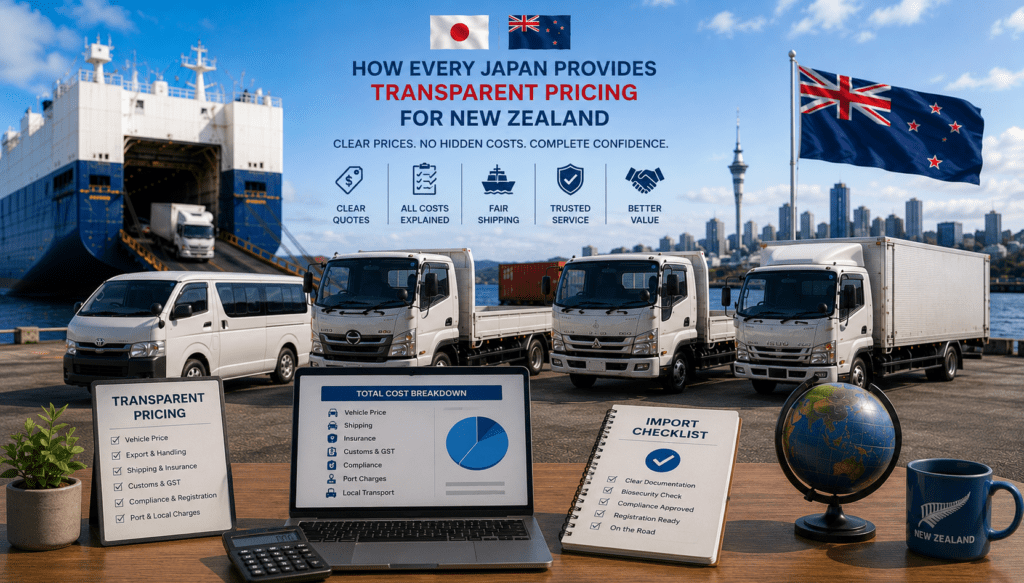

How EVERY Japan Provides Transparent Pricing for New Zealand Buyers: Clear Costs, Better Value, and Safer Imports
Buy Japanese Used Vehicles with No Hidden Surprises
Buying a Japanese used vehicle can be a smart choice for New Zealand buyers.
Japanese trucks, vans, buses, tractors, and passenger vehicles are trusted for reliability, fuel economy, and long service life. They support farms, builders, delivery companies, forestry operators, tourism businesses, and local service fleets across New Zealand.
However, price transparency matters.
A cheap vehicle price can look attractive at first. Yet, the final cost may increase after shipping, GST, biosecurity, compliance, registration, and local transport.
That is why EVERY Japan focuses on clear pricing from the beginning.
We help New Zealand buyers understand what is included, what is not included, and what may be paid locally after arrival.
Why Transparent Pricing Matters
Transparent pricing helps buyers plan with confidence.
It also helps avoid:
- Hidden fees
- Confusing quotations
- Last-minute surprises
- Wrong budget planning
- Payment stress
- Import delays
In New Zealand, buyers must also consider NZTA import requirements, MPI biosecurity checks, and Customs charges. NZTA explains that imported vehicles must meet entry and compliance requirements, while MPI checks vehicles and machinery for contaminants such as soil and plant matter.
What EVERY Japan Shows in a Quotation
A clear quotation should explain the main cost items.
At EVERY Japan, we aim to show:
- Vehicle price
- Export cost
- Shipping term
- Destination port
- Freight estimate
- Payment currency
- Vehicle details
- Document support
- Included services
- Possible local costs
This helps buyers compare vehicles fairly.
As a result, you can see the real value, not only the cheapest price.
Why New Zealand Buyers Need Full Cost Planning
New Zealand buyers often import vehicles for work.
A farmer may need a reliable tractor.
A builder may need a flatbed truck.
A delivery company may need Toyota Hiace vans.
A tourism operator may need a minibus.
In each case, the vehicle must fit the job and the budget.
Therefore, a transparent price helps protect business cash flow.
Costs That May Come After Purchase
The vehicle price is only one part of the total cost.
New Zealand buyers should also plan for:
- Ocean freight
- Marine insurance
- GST
- Customs clearance
- Port charges
- MPI biosecurity inspection
- Cleaning
- Compliance
- Registration
- Inland transport
- First service
Customs-related GST and entry charges can affect the final cost, so buyers should confirm current details before importing.
Why EVERY Japan Explains Local Costs
Some costs happen in Japan.
Other costs happen after arrival in New Zealand.
This difference matters.
For example, Japan-side costs may include vehicle purchase, export handling, and shipping arrangement.
New Zealand-side costs may include GST, port charges, MPI inspection, compliance, registration, and local transport.
By separating these items clearly, EVERY Japan helps buyers avoid confusion.
Transparent Pricing Builds Trust
Trust is important in international trade.
You may choose a vehicle online.
You may send payment before shipment.
Also, you may not see the vehicle in person until it arrives.
Therefore, clear pricing and honest communication are essential.
A reliable exporter should explain every major cost before payment.
Vehicle Information Must Be Clear Too
Transparent pricing is not only about money.
It also includes vehicle information.
Buyers should understand:
- Make
- Model
- Year
- Chassis number
- Mileage
- Engine type
- Transmission
- Body type
- Condition
- Photos
- Auction sheet if available
A fair price should match the vehicle condition.
How EVERY Japan Helps Buyers Compare Options
Sometimes the cheapest unit is not the best deal.
A lower-priced vehicle may have higher mileage, poor condition, or higher compliance risk.
Meanwhile, a slightly higher-priced vehicle may save money later.
EVERY Japan helps buyers compare:
- Price
- Condition
- Mileage
- Body type
- Use purpose
- Shipping cost
- Long-term value
This makes the buying decision easier.
Popular Japanese Vehicles for New Zealand
New Zealand buyers often search for:
Commercial Vehicles
- Toyota Dyna
- Toyota Hiace
- Hino Dutro
- Hino Ranger
- Isuzu Elf
- Isuzu Forward
- Mitsubishi Canter
- Mitsubishi Fighter
- Nissan Atlas
- Toyota Coaster
Farm and Work Vehicles
- Kubota tractors
- Yanmar tractors
- Iseki tractors
- Mitsubishi tractors
- Small trucks
- Utility vehicles
These vehicles suit New Zealand roads, farms, ports, towns, and business sites.
Why Biosecurity Costs Must Be Considered
New Zealand protects its environment and agriculture carefully.
MPI says vehicles, machinery, parts, and tyres can carry soil, plant matter, animals, pests, and diseases.
Because of this, cleaning and inspection costs may apply.
A transparent exporter helps buyers understand this risk before shipment.
Why Compliance Costs Must Be Considered
Imported vehicles must meet New Zealand entry and compliance rules before road use.
This may include safety, identity, structure, and emissions checks.
If repairs are needed, the total cost may rise.
Therefore, vehicle quality matters.
A cheap vehicle with compliance problems can become expensive.
Why Shipping Terms Matter
Shipping terms affect the quotation.
Common terms include:
FOB
The price usually covers the vehicle and export handling up to loading.
CFR
The price usually includes vehicle cost and ocean freight.
CIF
The price usually includes vehicle cost, freight, and marine insurance.
Buyers should confirm the term before payment.
This prevents misunderstanding.
How Clear Pricing Helps Fleet Buyers
Fleet buyers need strong budget control.
A business may import several vans, trucks, or tractors.
Transparent pricing helps with:
- Cash flow planning
- Loan planning
- Profit calculation
- Resale planning
- Vehicle comparison
- Maintenance budgets
Also, clear quotations make internal approval easier.
Warning Signs of Unclear Pricing
Be careful if a seller:
- Shows only a very low vehicle price
- Avoids explaining freight
- Does not mention local costs
- Gives unclear bank details
- Refuses detailed photos
- Cannot explain documents
- Pressures you to pay quickly
A trusted exporter explains costs patiently.
How EVERY TRADING Co., Ltd. Supports New Zealand Buyers
EVERY TRADING Co., Ltd. has exported Japanese used vehicles since 2006.
We support customers in more than 100 countries.
For New Zealand buyers, we provide:
- Clear quotations
- Honest vehicle information
- Secure payment guidance
- Export document support
- Shipping arrangement
- Vehicle photos
- Friendly communication
- Practical buying advice
Our goal is simple.
We help buyers understand the cost before they buy.
Frequently Asked Questions
Does transparent pricing mean the cheapest price?
No.
It means clear, honest, and complete pricing.
The best deal balances price, condition, shipping, and long-term value.
What costs should New Zealand buyers check?
Check vehicle price, shipping, insurance, GST, MPI inspection, cleaning, compliance, registration, and inland transport.
Why are local costs not always included?
Some costs depend on New Zealand authorities, port handling, vehicle condition, and local service providers.
How can I avoid surprise costs?
Ask for a clear quotation, confirm shipping terms, check import rules, and work with an experienced exporter.
Final Thoughts
Transparent pricing helps New Zealand buyers import Japanese used vehicles with confidence.
It shows the real picture before payment.
It also helps buyers compare vehicles fairly, plan budgets, and avoid surprises after arrival.
Japanese used vehicles remain a strong choice for New Zealand businesses because they offer reliability, fuel economy, parts support, and long-term value.
At EVERY TRADING Co., Ltd., we believe clear pricing creates better customer relationships.
When buyers understand the cost, they can make smarter decisions and build stronger businesses.


Browse Reliable Used Trucks & Buses from Japan
Carefully selected vehicles ready for export worldwide
Search 100,000+ Dealer Stock Vehicles from Japan
Access a wide selection of vehicles from Japanese dealers nationwide. Updated daily.
