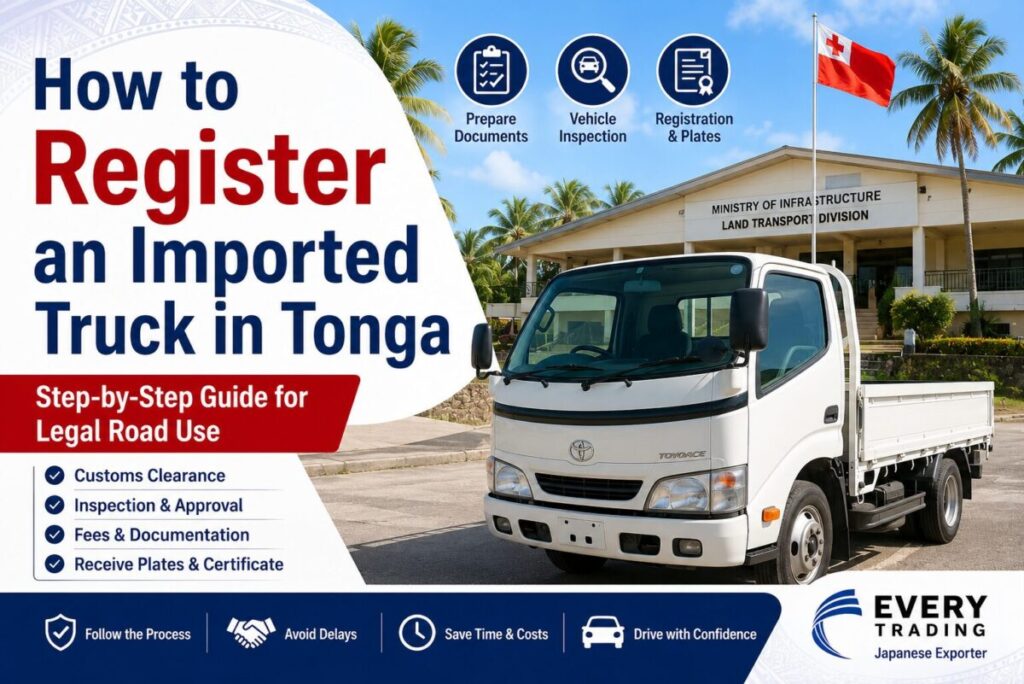

Importing a reliable Japanese used truck can create new business opportunities in Tonga.
However, clearing the truck from Nukuʻalofa Port does not automatically make it legal for public-road use.
You must also complete local registration, inspection, insurance, and licensing requirements.
Therefore, buyers should plan the registration process before the vessel reaches Tonga.
This detailed guide explains how to register an imported truck in Tonga. It also covers documents, inspections, common delays, and practical preparation.
Why Truck Registration Matters in Tonga
A registered truck can legally support daily commercial work across Tonga.
For example, farmers need trucks to move root crops, coconuts, watermelons, animal feed, and farm tools.
Meanwhile, builders carry cement, timber, roofing sheets, water tanks, and construction equipment.
Retailers also need dependable trucks for moving imported products from Nukuʻalofa to shops and storage facilities.
In addition, tourism operators use commercial vehicles for hotels, airport transfers, supplies, and maintenance work.
Registration connects the imported vehicle with its legal owner. It also confirms that the truck meets local road-use requirements.
Registration Starts After Customs and Port Clearance
First, complete the import clearance process at Nukuʻalofa Port.
The truck should not enter the normal registration process while Customs or the port still holds it.
Before registration, you will usually need to complete the following steps:
- Receive the shipping agent’s release.
- Submit the customs declaration.
- Complete the required import inspection.
- Receive final Customs approval.
- Pay the assessed duties and taxes.
- Pay applicable wharfage and port charges.
- Receive the final delivery documents.
- Obtain port security clearance.
- Collect or transport the truck from the port.
Keep every receipt and release document. The registration office may need proof that the import process has finished.
Which Authority Registers Imported Trucks in Tonga?
The Ministry of Infrastructure handles road vehicle registration services in Tonga.
Its Land Transport Division manages vehicle records, inspections, registration, and related road-use services.
Therefore, importers should contact the Ministry before visiting.
This step helps confirm current office hours, required documents, inspection procedures, and registration fees.
Documents to Prepare Before Registration
Prepare one organised file for the registration process.
Bring original documents whenever possible. Also, carry clear copies in case the office keeps one set.
1. Customs Clearance Evidence
This document proves that Tonga Customs approved the imported truck.
It also confirms that you completed the import declaration and paid the required government charges.
Without customs release evidence, the registration office may not accept the application.
2. Commercial Invoice
The Commercial Invoice records the transaction between the Japanese exporter and the Tongan buyer.
It normally shows:
- Exporter name
- Buyer or consignee name
- Vehicle make and model
- Chassis number
- Purchase price
- Invoice date
Make sure the buyer’s name matches the registration applicant.
3. Japanese Export Certificate
The Japanese Export Certificate contains key information from the truck’s former registration record.
It can show:
- Vehicle manufacturer
- Model code
- Chassis number
- Engine capacity
- Vehicle dimensions
- Former registration details
Keep this certificate in good condition because it supports the vehicle identification process.
4. Bill of Lading
The Bill of Lading proves that the shipping company carried the truck to Tonga.
It also identifies the consignee, vessel, destination, and cargo details.
Check that the chassis number matches every other document.
5. Proof of Identity
A private buyer should bring valid personal identification.
A company may also need identification from its authorised representative.
Use the same legal name shown on the import documents.
6. Business Documents
A commercial importer may need additional company records.
These may include:
- Business Licence Certificate
- Company registration records
- Tax Identification Number
- Authorisation letter
- Identification for the company representative
Prepare these documents early, especially when the truck belongs to a farm, hotel, contractor, or transport business.
7. Proof of Ownership
The invoice usually provides the main ownership evidence.
However, the authority may request more records when names differ across the documents.
Therefore, avoid purchasing or shipping the vehicle under an informal nickname.
8. Insurance Evidence
You may need valid local insurance before using the truck on public roads.
Contact a Tongan insurer before the registration visit.
Provide the correct chassis number, truck type, engine size, and intended business use.
Check Every Chassis Number Carefully
The chassis number is the most important identification detail during registration.
It should match the:
- Truck chassis plate
- Commercial Invoice
- Japanese Export Certificate
- Bill of Lading
- Customs declaration
- Insurance documents
Even one incorrect letter or number can create a delay.
Therefore, compare every character before submitting your application.
Step 1: Complete Customs Clearance
First, obtain final Customs approval for the imported truck.
Customs may review the invoice, freight cost, vehicle details, and declared value.
You must then pay the assessed duties, Consumption Tax, and other applicable charges.
Keep the official payment receipt and Customs release documents.
These records prove that the truck entered Tonga legally.
Step 2: Collect the Truck from Nukuʻalofa Port
Next, complete the shipping agent and Ports Authority requirements.
You may need to pay shipping, handling, wharfage, security, or storage charges.
Afterward, obtain the final delivery docket and required gate clearance.
Inspect the truck before moving it from the port.
Check the body, glass, mirrors, tyres, battery, lights, cargo deck, and keys.
Take clear photos before leaving. They may help if you notice shipping damage.
Step 3: Arrange Safe Transport from the Port
Do not assume the imported truck can immediately drive on public roads.
It may not yet have local registration, plates, insurance, or inspection approval.
Furthermore, the battery may be weak after a long sea journey.
The fuel level may also be very low.
Therefore, arrange towing or suitable transport when required.
For a medium-duty truck, tell the towing company its size and estimated weight.
Step 4: Prepare the Truck for Inspection
Before visiting the registration office, inspect the truck carefully.
A simple pre-check can prevent a failed inspection and another appointment.
Check the Lights
- Headlights
- Brake lights
- Indicators
- Reverse lights
- Number plate lights
- Hazard lights
Replace weak bulbs and repair damaged wiring.
Check the Brakes
Test the service brake and parking brake.
Listen for air leaks on trucks with air-brake systems.
Also, check brake fluid where applicable.
Check the Tyres
Inspect every tyre for cracks, cuts, low tread, and uneven wear.
Tonga’s warm climate can make older rubber deteriorate faster.
Therefore, do not judge tyres only by visible tread depth.
Check the Steering
The steering should not feel loose or unstable.
Check tie rods, joints, steering fluid, and wheel alignment.
Check the Windscreen and Mirrors
A clear windscreen gives the driver safe visibility during rain and night travel.
Replace damaged mirrors before the inspection.
Check the Horn and Wipers
The horn should operate clearly.
Wipers must also work well during Tonga’s heavy rain periods.
Check for Fluid Leaks
Look under the truck for engine oil, coolant, fuel, brake fluid, and transmission leaks.
Repair serious leaks before using the vehicle for business.
Check the Chassis
Inspect the chassis for major rust, cracks, damage, or unsafe repairs.
Coastal salt air can increase corrosion over time.
Therefore, apply rust protection after registration and repeat the treatment regularly.
Step 5: Visit the Land Transport Division
Bring the truck and your complete document file to the registration authority.
Arrive early because document checks and vehicle inspections may take time.
At the counter, staff may review:
- Applicant information
- Business documents
- Customs clearance records
- Proof of ownership
- Vehicle specifications
- Insurance information
- Chassis number
If any information differs, explain the reason and provide supporting evidence.
Step 6: Complete the Vehicle Inspection
The inspector may check whether the truck is safe for local road use.
The inspection can focus on:
- Vehicle identity
- Chassis number
- Braking system
- Steering
- Tyres
- Lights
- Horn
- Windscreen
- Mirrors
- Wipers
- General roadworthiness
Commercial trucks may receive extra attention because they carry heavy loads.
Therefore, repair safety problems before the official inspection.
Step 7: Confirm the Truck’s Weight and Use
Truck registration differs from normal passenger-car registration.
The authority may record the truck’s body type, carrying capacity, weight, and intended use.
For example, the truck may operate as a:
- Flatbed truck
- Dump truck
- Box truck
- Refrigerated truck
- Crane truck
- Water tanker
- Service truck
- Farm truck
Describe the vehicle accurately.
Do not register a truck under a use that differs from its actual configuration.
Step 8: Pay Registration and Licensing Fees
After document approval and inspection, pay the required registration charges.
The amount may depend on the truck’s class, weight, use, or licensing period.
Ask for an official receipt and keep it with your vehicle records.
Also, avoid relying on old fee information from other importers.
Current charges should always come from the responsible authority.
Step 9: Receive the Registration Certificate and Plates
After approval, the authority records the truck in Tonga’s vehicle system.
You may then receive:
- Vehicle registration certificate
- Registration number
- Number plates
- Licence or road-use documentation
- Inspection record
Check the certificate before leaving the office.
Confirm the owner’s name, chassis number, make, model, and vehicle class.
Step 10: Fit the Plates Securely
Install the number plates in the correct positions.
They should remain visible and secure during rough-road use.
Do not cover the plates with cargo, ropes, tools, or body attachments.
Also, check that the plate light works at night.
Step 11: Confirm Insurance Before Road Use
Do not begin commercial operations without the required insurance.
Business trucks face different risks from private cars.
For example, they carry loads, enter worksites, and operate for longer hours.
Explain the actual use to your insurer.
This may include:
- Farm transport
- Construction work
- Retail delivery
- Tourism support
- Inter-island logistics
- Paid transport services
Keep insurance documents in a safe place.
Step 12: Complete a Full Maintenance Service
Registration approval does not replace proper maintenance.
Before regular business use, complete a full service.
Consider changing:
- Engine oil
- Oil filter
- Fuel filter
- Air filter
- Coolant
- Brake fluid
- Transmission oil
- Differential oil
Also, grease the required joints and inspect all belts and hoses.
This creates a clear maintenance starting point in Tonga.
Choosing a Truck That Suits Tonga
The registration process becomes easier when the truck suits its planned work.
For small deliveries around Nukuʻalofa, compact trucks offer good turning ability and reasonable fuel use.
The Isuzu Elf is a practical choice for shops, farms, contractors, and delivery companies.
The Toyota Dyna also suits general cargo and building-material transport.
Meanwhile, the Hino Dutro supports regular commercial work with useful payload options.
The Mitsubishi Fuso Canter works well for construction, agriculture, and local logistics.
In addition, the Nissan Atlas provides a compact working size for urban and village routes.
For heavier work, an Isuzu Forward may offer more payload capacity.
However, a larger truck also brings higher fuel, tyre, registration, and maintenance costs.
Match the Truck to Tonga’s Road Conditions
Tongatapu has many paved routes, especially around Nukuʻalofa and major communities.
However, some local roads may include potholes, worn edges, narrow shoulders, or standing water.
Heavy rain can make these conditions more difficult.
Therefore, buyers should consider:
- Ground clearance
- Tyre strength
- Suspension condition
- Turning radius
- Brake performance
- Payload requirements
- Availability of spare parts
A very large truck may not suit narrow village access roads.
Likewise, a small truck may not safely carry heavy construction loads.
Registration Planning for Outer-Island Trucks
Some imported trucks will later operate in Vavaʻu, Haʻapai, ʻEua, or the Niuas.
However, most international vehicle imports first arrive on Tongatapu.
Complete customs clearance and registration planning before arranging domestic sea transport.
Also, check the truck’s:
- Length
- Width
- Height
- Empty weight
- Gross weight
Domestic vessel space may be limited.
Therefore, book early and confirm loading requirements with the carrier.
Common Registration Problems and How to Avoid Them
Different Names Across Documents
The buyer’s name should remain consistent across the invoice, Bill of Lading, Customs records, and registration application.
For a business purchase, use the company’s complete registered name.
Incorrect Chassis Number
One wrong character can delay registration.
Compare the physical chassis plate with every document before shipment.
Missing Customs Release
Port collection alone does not prove that every customs process is complete.
Keep the final Customs approval and payment records.
Poor Tyres
Old tyres may have cracks even when the tread looks acceptable.
Replace unsafe tyres before inspection.
Broken Lights
Shipping vibration and storage can affect bulbs and electrical connections.
Test every light before visiting the authority.
No Local Insurance
Marine cargo insurance only covers international shipping risks.
It does not automatically provide local road insurance.
Unapproved Vehicle Modifications
A truck may arrive with a crane, tipper body, tank, or other equipment.
Make sure the configuration matches the registration description.
Operating Before Registration
Do not begin normal business use before completing the legal process.
Arrange towing when the truck cannot legally drive from the port.
Practical Registration Checklist
Before the Truck Leaves Japan
- Confirm the chassis number.
- Check the buyer’s legal name.
- Receive the Commercial Invoice.
- Confirm the Export Certificate details.
- Request clear vehicle photos.
- Check the truck body type.
- Confirm the planned business use.
Before the Vessel Arrives
- Prepare customs documents.
- Contact the shipping agent.
- Arrange a customs broker if needed.
- Estimate import and port costs.
- Contact a local insurer.
- Ask the Ministry about current registration requirements.
After Port Clearance
- Collect all Customs receipts.
- Keep the port delivery docket.
- Inspect the truck.
- Arrange towing if needed.
- Repair basic safety items.
- Prepare original documents and copies.
At the Registration Office
- Submit the application.
- Show proof of ownership.
- Provide Customs clearance evidence.
- Complete the vehicle inspection.
- Confirm the vehicle class.
- Pay the required fees.
- Check the registration certificate.
- Receive and install the plates.
Before Starting Work
- Confirm local insurance.
- Complete a full maintenance service.
- Check brakes and tyres again.
- Protect the chassis from corrosion.
- Set a regular maintenance schedule.
- Train the driver on safe loading.
How to Control Long-Term Truck Costs in Tonga
The purchase price is only one part of truck ownership.
Registration, fuel, tyres, servicing, repairs, and corrosion protection also affect the total cost.
Therefore, choose a truck with a strong local support network.
Simple mechanical systems can also reduce repair time.
Moreover, correct loading protects the brakes, tyres, suspension, and chassis.
A cheaper truck may become expensive when it needs hard-to-find parts.
Why Accurate Export Documents Matter
Successful registration begins in Japan.
The exporter must provide clear and consistent vehicle information.
In particular, the chassis number should match the invoice, Export Certificate, and shipping documents.
Accurate paperwork reduces questions during Customs clearance and local registration.
Therefore, choose an exporter that checks documents before shipment.
How EVERY TRADING Supports Buyers in Tonga
EVERY TRADING supplies Japanese used trucks, buses, tractors, vans, and machinery to customers worldwide.
Our team provides clear vehicle details before purchase.
We also check important export and shipping information carefully.
Moreover, we understand that Tongan buyers need working vehicles for real business needs.
A truck may support a farm, construction team, shop, hotel, or community project.
Therefore, we help buyers compare vehicle size, body type, condition, and operating costs.
We also provide responsive communication throughout the export process.
Our goal is to help every customer import with confidence and prepare for smooth local registration.
Final Advice for Registering an Imported Truck in Tonga
Registering an imported truck in Tonga becomes easier with early preparation.
First, complete Customs and port clearance.
Next, organise the invoice, Export Certificate, Bill of Lading, ownership records, and identification.
Then, prepare the truck for inspection and confirm local insurance.
Finally, check every detail on the registration certificate before starting commercial work.
Rules, documents, and fees may change.
Therefore, always confirm the latest requirements with Tonga’s Ministry of Infrastructure and other responsible authorities.
With accurate documents and a reliable truck, your imported vehicle can support long-term business growth across Tonga.


Browse Reliable Used Trucks & Buses from Japan
Carefully selected vehicles ready for export worldwide
Search 100,000+ Dealer Stock Vehicles from Japan
Access a wide selection of vehicles from Japanese dealers nationwide. Updated daily.
