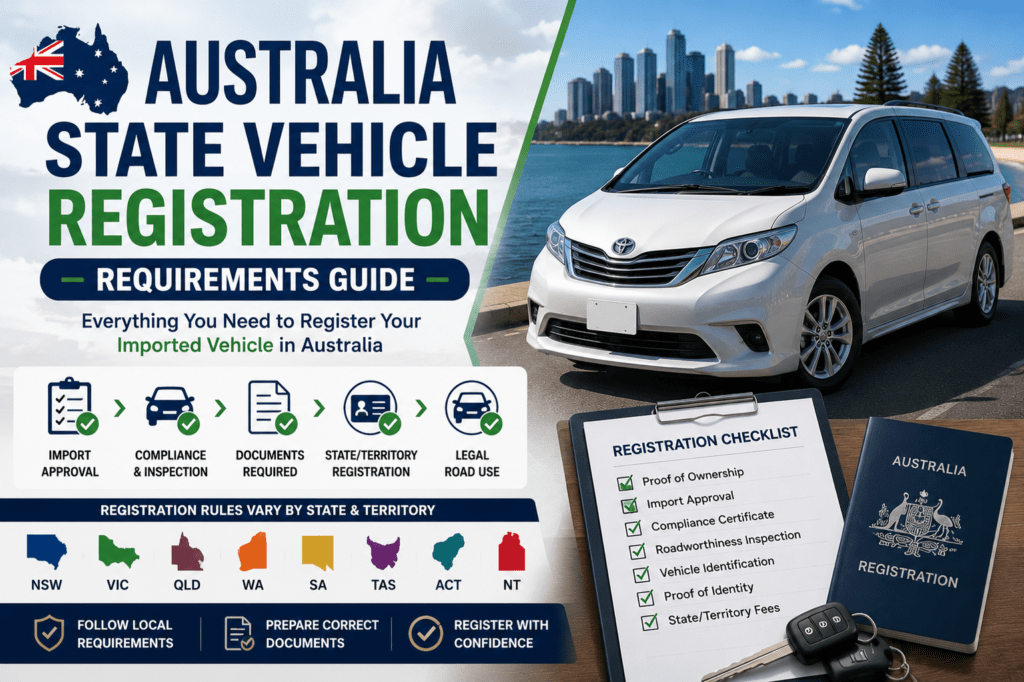

State and Territory Registration Requirements Explained: Complete Guide for Importing Vehicles into Australia
Australia is one of the most popular destinations for Japanese used vehicles. Buyers import cars, trucks, SUVs, vans, and commercial vehicles because they offer excellent quality, low mileage, and outstanding reliability.
However, importing a vehicle is only part of the process.
After customs clearance and compliance procedures, registration becomes the final step before legal road use.
Many first-time importers assume registration requirements are identical throughout Australia. In reality, each state and territory has its own registration authority and procedures.
Therefore, understanding local registration requirements is extremely important.
This guide explains how state and territory registration works in Australia and what importers should know before bringing a vehicle from Japan.
Why Registration Requirements Matter
Vehicle registration allows legal operation on public roads.
Without registration, imported vehicles cannot be driven legally.
Furthermore, registration confirms that a vehicle meets applicable safety and compliance standards.
As a result, every importer should understand the requirements before purchasing a vehicle.
Good planning helps avoid delays, additional costs, and unnecessary paperwork.
Understanding Australia's Registration System
Australia does not use a single national registration authority.
Instead, each state and territory manages its own registration process.
Consequently, requirements can vary depending on where the vehicle will be registered.
Although many requirements are similar, some procedures differ.
Therefore, buyers should always check local regulations before applying.
States and Territories That Manage Vehicle Registration
Registration authorities operate in:
- New South Wales (NSW)
- Victoria (VIC)
- Queensland (QLD)
- Western Australia (WA)
- South Australia (SA)
- Tasmania (TAS)
- Australian Capital Territory (ACT)
- Northern Territory (NT)
Each authority establishes its own procedures and documentation requirements.
As a result, preparation remains essential.
Common Registration Requirements Across Australia
Although requirements vary, most registration authorities request similar information.
Common requirements include:
- Proof of ownership
- Vehicle identification information
- Import approval documents
- Compliance records
- Inspection certificates
- Proof of identity
- Residential address details
Therefore, keeping organized records simplifies the registration process.
Proof of Ownership
Ownership documentation is one of the most important requirements.
Authorities need confirmation that the applicant legally owns the vehicle.
Common examples include:
- Purchase invoices
- Sales agreements
- Ownership certificates
Furthermore, ownership records should match all other import documentation.
Accurate information helps prevent delays.
Import Approval Documentation
Imported vehicles generally require approval before entering Australia.
Registration authorities often request evidence of this approval.
Therefore, buyers should keep copies of all import-related documents.
Organized paperwork improves efficiency throughout the registration process.
Compliance Requirements
Compliance remains an important part of vehicle registration.
Imported vehicles must satisfy Australian standards before registration approval.
Compliance procedures may include:
- Safety inspections
- Technical assessments
- Vehicle modifications
- Documentation reviews
As a result, buyers should understand compliance obligations before importing a vehicle.
Early preparation often saves time and money.
Vehicle Identification Checks
Authorities must confirm the vehicle's identity.
Therefore, identification checks often form part of the registration process.
Important information includes:
- Vehicle Identification Number (VIN)
- Chassis number
- Engine number
- Manufacturer details
All documentation should contain matching information.
Even small discrepancies can create delays.
Roadworthiness Inspections
Many states require inspections before registration.
These inspections help confirm that the vehicle is safe for road use.
Inspection areas may include:
- Brakes
- Steering
- Suspension
- Tires
- Lighting
- Structural condition
Consequently, maintaining the vehicle in good condition is extremely important.
Successful inspections support faster registration approval.
State-by-State Differences
Although many requirements are similar, some differences exist.
New South Wales (NSW)
NSW registration procedures often involve vehicle inspections and supporting documentation.
Buyers should ensure all compliance requirements are complete before applying.
Victoria (VIC)
Victoria requires documentation reviews and vehicle inspections where applicable.
Therefore, keeping complete records is highly recommended.
Queensland (QLD)
Queensland registration may include additional inspection procedures depending on vehicle type.
Early planning helps simplify the process.
Western Australia (WA)
WA authorities review compliance information and ownership documents carefully.
Consequently, document accuracy is essential.
South Australia (SA)
SA registration procedures generally focus on vehicle eligibility, inspections, and ownership verification.
Tasmania (TAS)
Tasmania follows structured registration procedures similar to many other states.
Therefore, organized documentation remains important.
Australian Capital Territory (ACT)
ACT registration involves documentation review and applicable inspections.
Northern Territory (NT)
NT authorities require ownership verification and vehicle compliance documentation.
As a result, preparation remains critical.
Registration Requirements for Imported Trucks
Commercial vehicles often require additional attention.
Many businesses import:
- Isuzu trucks
- Hino trucks
- Mitsubishi Fuso trucks
- UD Trucks
Truck registration may involve additional inspections or classifications.
Therefore, commercial vehicle buyers should research requirements carefully.
Professional support can be especially valuable.
Registration Requirements for Imported Cars
Passenger vehicle registration generally follows similar principles.
However, compliance obligations may vary depending on the vehicle type and approval pathway.
Therefore, buyers should understand the requirements that apply to their specific vehicle.
Planning ahead reduces potential complications.
Common Registration Mistakes
Many importers experience delays because of avoidable mistakes.
Fortunately, most problems are easy to prevent.
Incomplete Documentation
Missing paperwork is one of the most common causes of delays.
Therefore, create a complete document checklist.
Incorrect Vehicle Information
VIN numbers and ownership details must remain accurate.
Small errors can create significant problems.
Ignoring Inspection Requirements
Some buyers assume inspections are unnecessary.
However, inspection requirements often play an important role.
Waiting Too Long
Registration preparation should begin before the vehicle arrives.
Consequently, early planning improves efficiency.
Tips for Faster Registration Approval
Several strategies can improve the registration process.
Organize Records Early
Keep all import and ownership documents together.
Verify Information Carefully
Double-check every document before submission.
Complete Compliance Work Promptly
Address compliance requirements as soon as possible.
Work With Experienced Professionals
Professional exporters understand documentation requirements and import procedures.
Therefore, they can help reduce delays.
Why Australian Buyers Choose Japanese Vehicles
Japanese vehicles continue to attract buyers throughout Australia.
Key advantages include:
- Reliability
- Fuel efficiency
- Low mileage
- Strong resale value
- Excellent engineering
- Competitive pricing
Furthermore, Japanese vehicle auctions provide access to thousands of quality vehicles every week.
As a result, buyers enjoy greater choice and better purchasing opportunities.
Why Buy Through Japanese Vehicle Auctions?
Japanese auctions remain one of the best vehicle sourcing options.
Benefits include:
Huge Inventory
Thousands of vehicles become available every week.
Transparent Inspections
Detailed auction reports provide valuable condition information.
Competitive Prices
Auction vehicles often deliver exceptional value.
Wide Vehicle Selection
Buyers can choose from passenger vehicles, trucks, vans, SUVs, and specialty vehicles.
Therefore, auctions continue to attract importers worldwide.
How EVERY TRADING Supports Australian Buyers
EVERY TRADING helps customers import vehicles from Japan safely and efficiently.
Our services include:
- Access to Japanese vehicle auctions
- Professional vehicle inspections
- Export documentation support
- Vehicle sourcing assistance
- Worldwide shipping arrangements
- Fast customer communication
Additionally, our experienced team helps buyers understand registration requirements and prepare necessary documents.
This support reduces delays and improves the importing experience.
Conclusion
Understanding state and territory registration requirements is an essential part of importing vehicles into Australia.
Although registration systems vary between jurisdictions, most authorities require proof of ownership, import approval documentation, compliance records, and vehicle inspections.
Therefore, early preparation is the key to success.
Buyers who organize their documents, understand compliance requirements, and work with trusted exporters often enjoy a much smoother registration experience.
If you are looking for quality Japanese vehicles, professional inspections, export support, and shipping expertise, EVERY TRADING is ready to help you import and register vehicles from Japan with confidence.


Browse Reliable Used Trucks & Buses from Japan
Carefully selected vehicles ready for export worldwide
Search 100,000+ Dealer Stock Vehicles from Japan
Access a wide selection of vehicles from Japanese dealers nationwide. Updated daily.
