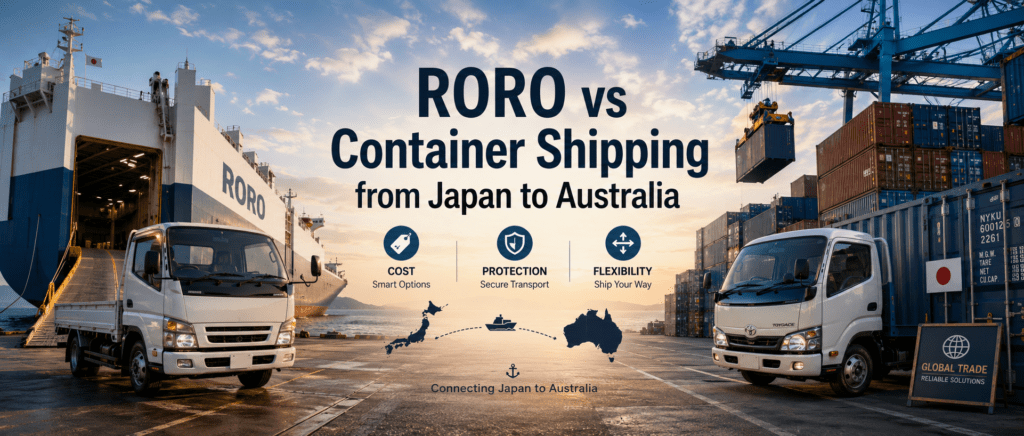

RORO vs Container Shipping from Japan to Australia
Which Shipping Method Offers the Best Value for Japanese Used Vehicles?
Importing a used vehicle from Japan can offer strong value for Australian buyers.
However, choosing the right vehicle is only one part of the process.
You must also choose the right shipping method.
For most buyers, the main options are:
- RORO shipping
- Container shipping
Both methods can move Japanese used cars, vans, trucks, buses, and commercial vehicles to Australia.
However, they do not offer the same cost, protection, flexibility, or port process.
RORO often gives better value for standard running vehicles. Meanwhile, container shipping may suit valuable vehicles, spare-parts shipments, or smaller specialist units.
Still, the cheapest freight quote may not create the lowest total import cost.
Australian buyers must also consider:
- Vehicle import approval
- Marine insurance
- Japanese port charges
- Australian terminal fees
- Biosecurity inspection
- Cleaning or treatment
- Customs clearance
- Local transport
- Vehicle compliance
- State registration
- Storage risk
Therefore, the best shipping method depends on the exact vehicle and business purpose.
This guide compares RORO and container shipping from Japan to Australia. It also explains which option may suit different Australian industries.
Why Shipping Method Matters in Australia
Australia has a large commercial vehicle market.
Businesses use trucks and vans across:
- Urban delivery
- Construction
- Farming
- Mining support
- Refrigerated transport
- Regional distribution
- Tourism
- Trade services
- Local government work
- Equipment maintenance
Japanese used vehicles can suit these needs very well.
Many offer:
- Right-hand drive
- Strong diesel engines
- Compact cab-over designs
- Useful specialist bodies
- Good fuel economy
- Reliable build quality
- Practical turning circles
However, Australia also has strict vehicle import and biosecurity controls.
Therefore, shipping must support more than ocean transport.
The method should also help the vehicle:
- Arrive clean
- Avoid damage
- Clear port efficiently
- Reach a compliance workshop
- Enter service without major delay
For business buyers, every delay affects cash flow.
A truck at the terminal cannot earn income.
Confirm Import Approval Before Booking Shipping
Before comparing RORO and container rates, confirm that the vehicle can legally enter Australia.
Australia requires import approval for road vehicles.
The buyer should not ship the vehicle before approval.
Different pathways may apply, including:
- Single road vehicle approval
- Concessional RAV entry
- Registered Automotive Workshop pathway
- Older vehicle pathway
- Personal effects pathway
- Special-purpose vehicle pathway
- Vehicle type approval
- Non-RAV approval for limited use
Not every Japanese model qualifies.
Moreover, two trucks with similar names may have different chassis codes.
That difference may affect eligibility.
Therefore, confirm:
- Exact chassis number
- Build date
- Model code
- Engine type
- Gross vehicle mass
- Body type
- Compliance pathway
Only then should you choose the shipping method.
What Is RORO Shipping?
RORO means Roll-on/Roll-off.
The vehicle drives onto a specialised vessel in Japan.
Port staff then secure it inside the ship. After arrival, the vehicle drives off at the Australian port.
RORO vessels carry many types of rolling cargo.
These may include:
- Passenger cars
- Commercial vans
- Light trucks
- Medium-duty trucks
- Heavy trucks
- Buses
- Motorhomes
- Construction vehicles
- Running machinery
RORO is one of the most common methods for shipping used vehicles.
Main Advantages of RORO Shipping
1. Lower Freight Cost for Standard Vehicles
RORO is often cheaper than container shipping.
The vehicle does not need:
- Container packing
- Timber bracing
- Container transport
- Container lifting
- Unpacking
- Empty-container return
Therefore, handling costs may remain lower.
For a standard Japanese used truck, this can create a meaningful saving.
2. Better for Large Commercial Vehicles
Many commercial vehicles cannot fit inside a standard container.
Examples include:
- Tall box trucks
- Refrigerated trucks
- Dump trucks
- Crane trucks
- Large buses
- Long flatbeds
- Medium-duty trucks
RORO can handle these vehicles more easily.
Therefore, it is often the only practical option for larger units.
3. Simple Loading and Unloading
The vehicle drives on and off the vessel.
This reduces the need for cranes or container loading equipment.
As a result, the process can be simpler.
Fewer loading steps may also reduce certain handling risks.
4. Good for Running Vehicles
RORO works well when the vehicle:
- Starts correctly
- Drives safely
- Steers properly
- Has working brakes
- Has no major fluid leak
Japanese auction and dealer vehicles often meet these basic conditions.
However, the exporter should confirm the running condition before booking.
5. Practical for Single-Vehicle Buyers
A private buyer or small business may import only one vehicle.
RORO allows that buyer to ship the vehicle without paying for a full container.
Therefore, it often gives a simpler cost structure.
Possible Disadvantages of RORO Shipping
1. Limited Protection During Port Handling
The vehicle remains outside a sealed container.
Although it stays inside the vessel during the voyage, port staff still move it before and after sailing.
Therefore, minor handling risks may include:
- Small scratches
- Minor dents
- Missing loose items
- Weather exposure at the terminal
Marine insurance remains important.
2. Personal Items and Spare Parts May Be Restricted
Shipping lines often prohibit loose items inside RORO vehicles.
This includes:
- Spare parts
- Tools
- Personal goods
- Boxes
- Tyres
- Unlisted accessories
Therefore, do not assume you can fill the truck body or cabin with cargo.
Ask the shipping line for written rules.
3. The Vehicle Must Usually Run
A non-running vehicle can create problems.
Some carriers may refuse it.
Others may charge extra for towing or special handling.
Therefore, confirm:
- Battery condition
- Fuel level
- Brake function
- Steering function
- Tyre condition
- Fluid leaks
A vehicle that fails at the port may miss its vessel.
4. Shipping Schedules May Be Less Flexible
RORO vessels follow specific routes and schedules.
A service may not call at every Australian port.
Therefore, the buyer may need to use:
- Brisbane
- Sydney
- Melbourne
- Adelaide
- Fremantle
Then, local transport may move the vehicle to another state or region.
As a result, the cheapest freight port may not produce the lowest final cost.
What Is Container Shipping?
Container shipping places the vehicle inside a steel shipping container.
The exporter secures the vehicle before sealing the container.
The container then travels on a container vessel.
Common options include:
- 20-foot container
- 40-foot container
- 40-foot high-cube container
- Shared container
- Full container load
However, the vehicle must fit safely.
Dimensions are critical.
Main Advantages of Container Shipping
1. Better Physical Protection
A sealed container protects the vehicle from:
- Rain
- Salt spray
- Dust
- Open-terminal exposure
- Casual access
- Some handling risks
This may suit valuable, rare, or collectible vehicles.
It can also suit trucks with sensitive equipment.
2. Spare Parts Can Travel with the Vehicle
Container shipping may allow the buyer to include declared spare parts.
Examples may include:
- Filters
- Tyres
- Wheels
- Tools
- Service parts
- Vehicle accessories
- Replacement panels
However, all items must appear on the packing list.
They must also meet Australian biosecurity rules.
Loose or undeclared items can delay clearance.
3. Useful for Non-Running Vehicles
A non-running vehicle can enter a container with suitable loading equipment.
This may help with:
- Restoration vehicles
- Damaged specialist units
- Project vehicles
- Vehicles without a working battery
- Vehicles with engine faults
However, loading and unloading may cost more.
4. Better Security for High-Value Vehicles
A sealed container reduces access during transit.
Therefore, container shipping may suit:
- Collectible vehicles
- Rare specialist trucks
- High-value campers
- Motorsport vehicles
- Vehicles with expensive equipment
Still, insurance remains essential.
5. Flexible Mixed-Cargo Options
A business may import a vehicle with equipment or parts.
For example:
- A refrigerated van with service parts
- A trades vehicle with body components
- A workshop truck with tools
- A project vehicle with replacement panels
Container shipping can support this type of shipment.
However, detailed customs and biosecurity documentation is necessary.
Possible Disadvantages of Container Shipping
1. Higher Total Handling Cost
Container shipping involves more steps.
Possible costs include:
- Container delivery in Japan
- Vehicle loading
- Securing and bracing
- Export terminal handling
- Ocean freight
- Australian terminal charges
- Container transport
- Unpacking
- Depot fees
- Empty-container return
- Demurrage
- Detention
Therefore, a low ocean freight quote may not show the real total.
2. Vehicle Size Limits
Many trucks cannot fit inside a container.
You must check:
- Length
- Width
- Height
- Wheelbase
- Mirror width
- Roof equipment
- Refrigeration unit
- Crane equipment
- Ground clearance
A small difference can make loading impossible.
For example, a tall box truck may exceed the container door height.
Therefore, check the door opening, not only the internal height.
3. More Complex Biosecurity Access
Inspectors must access the vehicle and container contents.
If the truck sits tightly inside the container, inspection may require unpacking first.
This can add:
- Depot movement
- Labour
- Facility fees
- Waiting time
- Repacking or storage
Therefore, container shipping does not remove biosecurity risk.
4. Demurrage and Detention Risk
A container comes with time limits.
If customs, biosecurity, or transport takes too long, charges may apply.
Demurrage usually relates to time at the terminal.
Detention usually relates to late container return.
These costs can increase quickly.
Therefore, documents and transport bookings must be ready before arrival.
RORO vs Container: Quick Comparison
| Point | RORO | Container |
|---|---|---|
| Standard freight cost | Usually lower | Usually higher |
| Large truck suitability | Strong | Limited |
| Physical protection | Moderate | Higher |
| Vehicle must run | Usually yes | Not always |
| Spare parts allowed | Often restricted | Possible if declared |
| Loading complexity | Low | Higher |
| Unpacking cost | Usually lower | Often higher |
| Demurrage risk | No container detention | Higher |
| Biosecurity inspection | Direct vehicle access | May require unpacking |
| Best for | Standard running vehicles | Valuable or mixed shipments |
This table gives a broad guide.
Actual costs depend on the route, carrier, port, and vehicle.
Which Method Is Usually Cheaper?
For a standard running vehicle, RORO is usually cheaper.
This is especially true for:
- Light-duty trucks
- Commercial vans
- Standard cars
- Buses
- Medium-duty trucks
- Dump trucks
However, container shipping may become competitive when:
- Several small vehicles share one container
- Spare parts are included
- RORO service is unavailable
- The vehicle needs high protection
- A freight forwarder has a strong container rate
Therefore, compare total destination cost.
Do not compare ocean freight alone.
How RORO Freight Is Often Calculated
RORO rates often depend on vehicle volume.
A common volume formula is:
Length × Width × Height = Cubic Metres
Example:
- Length: 6.0 metres
- Width: 2.0 metres
- Height: 2.6 metres
Volume:
6.0 × 2.0 × 2.6 = 31.2 cubic metres
The shipping line may multiply that volume by its rate.
Therefore, vehicle height matters greatly.
A tall box truck may cost much more than a flatbed built on the same chassis.
How Container Costs Are Calculated
Container cost often includes a fixed container freight rate.
However, total cost may include many extra items.
These can include:
- Container type
- Vehicle loading
- Securing materials
- Crane or forklift work
- Japan trucking
- Terminal handling
- Australian unpacking
- Depot use
- Empty-container return
Therefore, ask for a full door-to-depot estimate.
A simple port-to-port container rate may hide major costs.
Best Shipping Method for Light-Duty Trucks
Popular Japanese light trucks include:
These trucks support:
- Urban delivery
- Trade services
- Farming
- Small construction
- Furniture transport
- Food delivery
RORO often works best.
It offers simple loading and practical freight rates.
However, a small low-roof truck may fit in a container.
Container shipping may suit a valuable unit with spare parts.
Best Shipping Method for Box Trucks
Box trucks are common in Japanese delivery fleets.
Australian buyers may use them for:
- Retail distribution
- Furniture delivery
- Parcel delivery
- Food transport
- Mobile workshop service
The body height is the main issue.
Many box trucks cannot fit through a container door.
Therefore, RORO is usually more practical.
Always request exact dimensions.
Best Shipping Method for Refrigerated Trucks
Refrigerated trucks can support:
- Food delivery
- Seafood
- Meat
- Dairy
- Catering
- Medical transport
- Florists
These trucks often have tall bodies and roof-mounted equipment.
Therefore, RORO may offer easier loading.
However, container shipping may suit smaller refrigerated vans.
Before shipping, check:
- Refrigerant type
- Cooling unit condition
- Body height
- Marine insurance
- Biosecurity cleanliness
- Australian compliance
The refrigeration unit may also need separate import attention.
Best Shipping Method for Dump Trucks
Dump trucks often have large or tall bodies.
Therefore, standard container shipping may not work.
RORO is usually the better option.
This suits Australian buyers in:
- Construction
- Landscaping
- Road maintenance
- Farming
- Local government work
However, confirm the truck’s overall height with the body lowered.
Also, check for hydraulic leaks before shipping.
Best Shipping Method for Crane Trucks
Crane trucks need special planning.
Important measurements include:
- Total height
- Total width
- Boom position
- Outrigger width
- Vehicle weight
- Front and rear overhang
RORO often provides the most practical method.
A container may not fit the vehicle.
In some cases, the crane or boom may need special securing.
Therefore, use an exporter with commercial vehicle experience.
Best Shipping Method for Vans
Japanese vans may include:
- Toyota Hiace
- Nissan Caravan
- Mazda Bongo
- Mitsubishi Delica
- Refrigerated vans
- Camper vans
Both methods may work.
RORO may offer lower cost.
Container shipping may offer better protection and spare-parts flexibility.
Therefore, compare:
- Vehicle value
- Container fit
- Destination charges
- RORO schedule
- Insurance
- Biosecurity process
Best Shipping Method for Buses
Japanese buses may include:
- Toyota Coaster
- Mitsubishi Rosa
- Nissan Civilian
- Hino route buses
- School buses
- Tourist buses
Small buses usually ship by RORO.
Larger route buses may require RORO or special cargo handling.
Container shipping rarely suits full-size buses.
Therefore, RORO is generally the practical choice.
Australian Biosecurity Requirements
Australia treats imported used vehicles as biosecurity risks.
Vehicles may carry:
- Soil
- Mud
- Seeds
- Leaves
- Insects
- Animal material
- Plant material
- Organic waste
The importer must ensure the vehicle arrives clean.
This applies to both RORO and container shipments.
Common Contamination Areas
Important cleaning areas include:
- Wheel arches
- Tyres
- Chassis rails
- Engine bay
- Radiator
- Suspension
- Spare wheel
- Cabin floor
- Seat rails
- Door seals
- Toolboxes
- Cargo floor
- Underbody
- Fuel tank area
Commercial vehicles often have more hidden spaces than passenger cars.
Therefore, cleaning can take time.
Does Container Shipping Reduce Biosecurity Inspection?
No.
A sealed container does not remove inspection requirements.
In fact, undeclared parts or dirty cargo can make the process more complex.
All items must be:
- Clean
- Declared
- Accessible
- Properly documented
If contamination appears, authorities may direct:
- Cleaning
- Treatment
- Re-inspection
- Storage
- Re-export
Therefore, professional cleaning before shipment is essential.
Offshore Cleaning Can Reduce Risk
Australia recognises certain offshore cleaning and pre-inspection arrangements.
A recognised provider may clean and inspect vehicles before export.
This can reduce some onshore inspection activity when the vehicle meets the required standards.
However, the vehicle still needs to arrive clean.
Therefore, buyers should not rely on paperwork alone.
Ask for:
- Cleaning photographs
- Cleaning report
- Inspection evidence
- Provider details
- Final condition photos
Marine Insurance for RORO
RORO vehicles remain exposed to some handling risks.
Therefore, check whether insurance covers:
- Total loss
- Major transit damage
- Loading damage
- Unloading damage
- Theft
- Natural events
Also, check exclusions.
Many policies exclude:
- Mechanical failure
- Pre-existing damage
- Minor scratches
- Rust
- Loose cargo
- Personal items
Therefore, inspect the vehicle before shipping.
Keep dated photographs.
Marine Insurance for Containers
Container shipping may reduce some physical risks.
However, it creates other risks.
Examples include:
- Poor securing
- Vehicle movement inside the container
- Moisture
- Container damage
- Loading damage
- Unpacking damage
Therefore, use professional loading and lashing.
Ask for loading photographs before the container closes.
FOB, C&F, and CIF with RORO or Container
RORO and container are shipping methods.
FOB, C&F, and CIF are trade terms.
They are not the same thing.
You can receive:
- FOB RORO quote
- CIF RORO quote
- FOB container quote
- CIF container quote
FOB usually excludes ocean freight and insurance.
C&F includes freight but excludes insurance.
CIF includes freight and marine insurance.
However, Australian destination charges remain separate in many cases.
Therefore, ask for a detailed quotation.
Australian Customs Duty and GST
Both RORO and container imports may attract customs charges.
The shipping method does not remove tax obligations.
Possible charges include:
- Customs duty
- GST
- Luxury Car Tax, if applicable
- Import processing charge
- Broker fees
GST generally applies at 10% to the value of the taxable importation.
This may include:
- Customs value
- Customs duty
- International freight
- Marine insurance
Therefore, a higher freight cost can also increase GST.
Port and Terminal Charges
Australian port costs vary.
Common arrival locations include:
- Brisbane
- Sydney
- Melbourne
- Adelaide
- Fremantle
RORO costs may include:
- Vehicle handling
- Terminal release
- Port service fee
- Storage
- Security charges
Container costs may include:
- Terminal handling
- Container lift
- Delivery order
- Depot transfer
- Unpacking
- Storage
- Demurrage
- Detention
Therefore, obtain destination charges before booking.
Local Transport After Arrival
After release, the vehicle must move to:
- A compliance workshop
- A storage yard
- A mechanic
- The buyer’s business
- A registration inspection site
An unregistered vehicle may require:
- Tilt tray
- Tow truck
- Vehicle carrier
- Heavy haulage
- Low-loader
Large commercial vehicles can cost more to move.
Therefore, consider port distance.
A cheaper arrival port may create higher inland transport costs.
How Australian Roads Affect Vehicle Choice
Australia has very different driving conditions from Japan.
These may include:
- Long highway distances
- High temperatures
- Dust
- Gravel roads
- Remote areas
- Heavy loads
- Large gaps between service centres
Therefore, buyers should check more than shipping cost.
Important factors include:
- Cooling capacity
- Fuel tank size
- Tyre availability
- Engine parts
- Transmission ratios
- Payload
- Ground clearance
- Service support
A cheap imported truck may not save money if it cannot suit Australian work.
Urban Delivery Needs
Australian cities need efficient commercial vehicles.
Compact Japanese trucks can suit:
- Retail delivery
- Food distribution
- Furniture transport
- Trade services
- Parcel work
- Waste collection
RORO often gives the best value for these standard running vehicles.
However, a container may suit a high-value specialist unit.
Regional and Rural Needs
Regional operators may need:
- Flatbeds
- Tippers
- Dual-cab trucks
- Four-wheel-drive trucks
- Refrigerated vehicles
- Service bodies
RORO is often best for larger work vehicles.
However, businesses should confirm:
- Compliance
- Parts support
- Cooling
- Payload
- Local registration category
The shipping saving should not create long-term operating problems.
Mining and Remote Support
Remote operations need high reliability.
Suitable imports may include:
- Service trucks
- Crane trucks
- Crew-cab vehicles
- Equipment carriers
- Workshop vehicles
These units often have large bodies or added equipment.
Therefore, RORO may be more practical.
Still, Australian site standards and compliance can be strict.
Confirm the vehicle specification before purchase.
Worked Example: Light Truck by RORO
The following figures are illustrative.
- Vehicle and Japan charges: AUD 24,000
- RORO freight: AUD 4,200
- Insurance: AUD 250
- Australian destination fees: AUD 1,100
- Biosecurity and broker costs: AUD 1,300
Shipping and arrival-related subtotal:
AUD 30,850
This excludes compliance, GST, duty, registration, and local transport.
Worked Example: Light Truck by Container
Assume the same truck fits a container.
- Vehicle and Japan charges: AUD 24,000
- Container freight: AUD 3,600
- Loading and securing: AUD 1,200
- Insurance: AUD 300
- Australian terminal and unpacking: AUD 2,400
- Biosecurity and broker costs: AUD 1,500
Shipping and arrival-related subtotal:
AUD 33,000
In this example, RORO is cheaper.
However, container shipping gives more protection and allows declared spare parts.
When RORO Is the Best Choice
Choose RORO when:
- The vehicle runs
- The truck is too large for a container
- You want lower freight cost
- You import one vehicle
- Spare parts are not included
- The vehicle has standard value
- A suitable service reaches your port
RORO often suits most commercial vehicle buyers.
When Container Shipping Is the Best Choice
Choose container shipping when:
- The vehicle fits safely
- Extra protection matters
- Spare parts travel with the vehicle
- The vehicle does not run
- The unit has high value
- RORO service is unavailable
- Several small vehicles can share a container
Container shipping can add flexibility.
However, total handling costs must remain clear.
Questions to Ask Before Choosing RORO
Ask the exporter:
- Is the vehicle accepted by the RORO carrier?
- Must it start and drive?
- What are the exact dimensions?
- Which Japanese port will load it?
- Which Australian port will receive it?
- Are loose items prohibited?
- Is marine insurance included?
- What happens if the battery fails?
- Are Japanese storage fees possible?
- What destination charges apply?
Questions to Ask Before Choosing Container Shipping
Ask:
- Does the vehicle fit through the container door?
- Which container size is required?
- Who loads and secures the vehicle?
- Are loading photos provided?
- Can spare parts be included?
- Is a packing list prepared?
- What are the unpacking fees?
- Where will unpacking take place?
- How many free container days apply?
- What detention charges may apply?
- Is biosecurity access easy?
- Who returns the empty container?
Common Shipping Mistakes
Choosing by Ocean Freight Alone
Destination charges may change the result.
Ignoring Vehicle Height
A tall body may not fit inside a container.
Loading Undeclared Parts
This can delay customs and biosecurity.
Skipping Professional Cleaning
Poor cleanliness can create treatment and storage costs.
Shipping Before Import Approval
This can cause serious port problems.
Forgetting Marine Insurance
Shipping risk remains under both methods.
Ignoring Local Transport
The arrival port may sit far from the compliance workshop.
Using an Incomplete Quote
Ask for Japanese and Australian charges.
Total-Cost Comparison Formula
Use this formula:
Total Shipping and Import Cost =
Vehicle Price
- Japan Inland Transport
- Export Fees
- Cleaning
- RORO or Container Freight
- Marine Insurance
- Loading and Securing
- Australian Terminal Charges
- Broker Fees
- Customs Duty
- GST
- Biosecurity Inspection
- Cleaning or Treatment
- Storage
- Local Transport
- Compliance
- Registration
- Initial Service
- Contingency
This gives a better decision than freight alone.
Final Shipping Checklist
Before booking, confirm:
- Import approval granted
- Exact chassis code confirmed
- Vehicle dimensions checked
- Running condition confirmed
- RORO acceptance checked
- Container fit checked
- Japanese port confirmed
- Australian port confirmed
- Freight quote received
- Destination fees received
- Marine insurance confirmed
- Biosecurity cleaning arranged
- Packing list prepared, if needed
- Spare parts declared
- Customs broker contacted
- Compliance provider confirmed
- Local transport quoted
- Registration location chosen
- Contingency fund prepared
Only then should you select the shipping method.
Final Recommendation
For most running Japanese used vehicles, RORO offers the best balance of cost and simplicity.
It is especially suitable for:
- Light-duty trucks
- Medium-duty trucks
- Vans
- Buses
- Dump trucks
- Box trucks
- Refrigerated trucks
- Crane trucks
Container shipping offers stronger protection and more cargo flexibility.
It may suit:
- High-value vehicles
- Smaller specialist units
- Non-running vehicles
- Spare-parts shipments
- Multiple small vehicles
Therefore, neither option is always best.
The correct choice depends on:
- Vehicle size
- Vehicle condition
- Freight route
- Australian port
- Protection needs
- Spare-parts needs
- Destination costs
- Biosecurity planning
- Business use
Final Thoughts
RORO and container shipping both offer practical ways to move Japanese used vehicles to Australia.
RORO usually provides lower costs, easier handling, and better support for large commercial vehicles.
Container shipping provides more protection, stronger security, and room for declared spare parts.
However, the ocean freight price shows only one part of the total.
Australian buyers must also plan for import approval, biosecurity, customs duty, GST, port fees, compliance, local transport, and registration.
Therefore, start with vehicle eligibility.
Next, confirm dimensions and shipping availability.
Then, compare complete Japanese and Australian costs.
Finally, choose the method that delivers the best registered and operational value.
For many Australian businesses, RORO will remain the most practical choice.
Still, container shipping can be the smarter option when protection, spare parts, or specialist cargo matter more than the lowest freight price.


Browse Reliable Used Trucks & Buses from Japan
Carefully selected vehicles ready for export worldwide
Search 100,000+ Dealer Stock Vehicles from Japan
Access a wide selection of vehicles from Japanese dealers nationwide. Updated daily.
