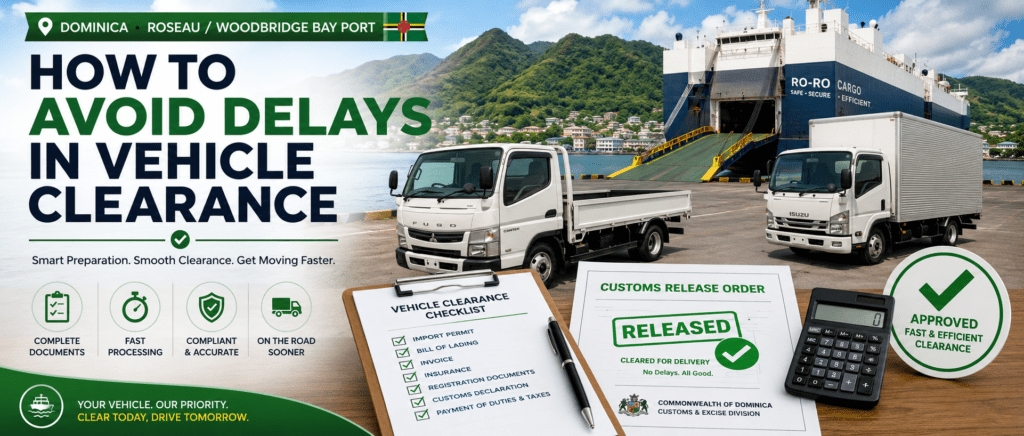

How to Avoid Delays in Vehicle Clearance
A Practical Guide for Importing Japanese Used Trucks to the Commonwealth of Dominica
Importing a used vehicle to the Commonwealth of Dominica can be a smart business move. However, delays during vehicle clearance can quickly create extra costs.
For truck buyers, this is especially important.
A truck is not just a vehicle. It is a working tool. It can carry farm produce, construction materials, retail goods, hotel supplies, water tanks, equipment, and daily cargo.
Therefore, every day of delay matters.
If your truck stays too long at the port, your business may lose time and money. In addition, port storage charges may increase. As a result, your total landed cost may become higher than expected.
The good news is simple.
Most vehicle clearance delays are preventable.
With the right documents, early planning, clear communication, and a trusted exporter, you can move through the process with more confidence.
This guide explains how to avoid delays in vehicle clearance in Dominica. It also focuses on Japanese used trucks and real local transport needs.
Why Vehicle Clearance Delays Happen in Dominica
Vehicle clearance involves several steps.
The importer, exporter, shipping agent, customs broker, port authority, and customs office may all take part. Because many people and documents are involved, small mistakes can create delays.
Common delay causes include:
- Missing original documents
- Wrong chassis number
- Incorrect importer name
- Unclear invoice value
- Late duty and tax payment
- No ASYCUDA information
- Poor communication with broker
- Late shipping agent release
- Unpaid port charges
- No pickup plan after release
Fortunately, these problems are easy to avoid.
The key is preparation.
Why Speed Matters for Dominica Businesses
Dominica has a unique business environment.
The island has mountain roads, coastal routes, steep climbs, and many narrow community roads. Because of this, dependable trucks are essential for daily business.
Many sectors rely on commercial vehicles.
Agriculture
Farmers and produce dealers need trucks for:
- Bananas
- Plantains
- Dasheen
- Citrus
- Vegetables
- Fertilizer
- Farm tools
If a truck waits at the port, produce movement may slow down.
Construction
Contractors need trucks for:
- Cement
- Sand
- Blocks
- Timber
- Gravel
- Tools
- Small machinery
A delay can affect project schedules.
Tourism and Hospitality
Hotels, guesthouses, restaurants, and suppliers need steady delivery.
They often move:
- Food
- Drinks
- Linen
- Furniture
- Cleaning supplies
- Maintenance items
Therefore, a delayed box truck or refrigerated truck can affect service quality.
Retail and Wholesale
Shops and distributors need trucks to move goods from the port area to Roseau, Portsmouth, and other communities.
So, fast clearance supports the whole supply chain.
Step 1: Choose the Right Vehicle Before Shipment
Clearance problems can begin before the truck even leaves Japan.
Therefore, start with the right vehicle.
Dominica’s roads are not always easy. The island has steep routes, sharp bends, wet road surfaces, and compact village roads.
Because of this, many buyers prefer Japanese used trucks.
Good options include:
These models are popular because they are right-hand drive, fuel-efficient, and easy to operate.
However, the truck must match the business use.
A light-duty truck may suit retail delivery. Meanwhile, a dump truck may suit construction. A refrigerated truck may support hotels and food suppliers.
Choosing the right vehicle helps avoid later problems with inspection, registration, and use.
Step 2: Work with a Trusted Japanese Exporter
A reliable exporter can reduce many risks.
A professional exporter should provide:
- Clear vehicle photos
- Accurate invoice
- Correct chassis number
- Export certificate
- English translation
- Shipping details
- Condition information
- Freight support
- Timely communication
This matters because Dominica is far from Japan.
If documents are wrong after shipment, correction may take time. Therefore, accuracy before shipping is very important.
A good exporter checks details before the vessel leaves Japan.
As a result, customs clearance becomes smoother.
Step 3: Check the Chassis Number Carefully
The chassis number is one of the most important details.
It appears on many documents.
For example:
- Commercial Invoice
- Bill of Lading
- Export Certificate
- Customs declaration
- Insurance documents
- Registration documents
If the chassis number does not match, customs may delay clearance.
Therefore, compare it before shipment.
Check every letter and number.
This simple step can save several days.
Step 4: Prepare the Required Documents Early
Do not wait until the vehicle arrives.
Prepare documents before the ship reaches Dominica.
Important documents may include:
- Commercial Invoice
- Original Bill of Lading
- ASYCUDA Bill of Lading
- Japanese Export Certificate
- English translation
- Freight invoice
- Marine insurance certificate
- Proof of payment
- Importer ID
- Company registration, if applicable
- Authorization letter, if using an agent
Each document should show consistent information.
The importer name should match. The vehicle details should match. The value should also be clear.
If customs needs more proof, clearance may slow down.
Therefore, organize a complete document file in advance.
Step 5: Confirm the Original Bill of Lading Status
The Bill of Lading is a key shipping document.
Without proper Bill of Lading release, you may not claim the vehicle.
Before arrival, confirm:
- Whether the original Bill of Lading is available
- Whether telex release applies
- Whether freight has been paid
- Whether the consignee name is correct
- Whether the shipping agent has all details
If the Bill of Lading is late, the vehicle may sit at the port.
Therefore, follow up with the exporter and shipping agent early.
Step 6: Use a Customs Broker or Clearing Agent
A customs broker can help prevent mistakes.
This is especially useful for first-time importers.
A broker can assist with:
- ASYCUDA procedures
- Customs declaration
- Duty and tax calculation
- Vehicle classification
- Document checking
- Customs communication
- Port release process
In Dominica, customs procedures can involve technical steps. Therefore, a broker can save time.
However, the importer still has responsibility.
You must provide correct documents. You must also prepare funds for duties, taxes, and charges.
A good broker helps, but good preparation is still essential.
Step 7: Confirm Vehicle Classification
Vehicle classification affects duties and taxes.
Different vehicles may fall under different categories.
For example:
- Light-duty cargo truck
- Medium-duty truck
- Dump truck
- Refrigerated truck
- Van
- Bus
- Special-purpose vehicle
A wrong classification may delay assessment.
Therefore, confirm the likely classification before import.
This helps you estimate total cost more accurately.
It also helps avoid customs questions after arrival.
Step 8: Calculate Duties and Taxes Before Arrival
Many clearance delays happen because buyers are not ready to pay.
Before the truck arrives, estimate the total cost.
Your calculation should include:
- Vehicle price
- Ocean freight
- Marine insurance
- Import Duty
- Customs Service Charge
- Environmental Surcharge
- Excise Tax
- VAT
- Port charges
- Shipping agent fees
- Broker fees
- Local transport
- Inspection
- Registration
- Insurance
This gives a realistic landed cost.
If you only focus on the vehicle price in Japan, you may face a cash shortage later.
Therefore, plan the full budget before purchase.
Step 9: Prepare Payment Funds in Advance
After customs assessment, payment must be made.
If you cannot pay quickly, the vehicle may remain at the port.
This can lead to storage charges and delay.
Therefore, keep funds ready for:
- Customs duties
- Taxes
- Port fees
- Broker fees
- Shipping agent release
- Local movement costs
For business buyers, this is part of cash flow planning.
A truck cannot earn money until it leaves the port and enters service.
So, fast payment helps your business start faster.
Step 10: Track the Vessel Schedule
Shipping schedules can change.
Weather, port congestion, transshipment, and vessel routing can affect arrival dates.
Therefore, track your shipment.
Ask your exporter or shipping agent for:
- Vessel name
- Estimated arrival date
- Transshipment details
- Arrival notice
- Port contact details
When you know the arrival date, you can prepare earlier.
This helps your broker submit documents faster.
As a result, clearance becomes smoother.
Step 11: Communicate with the Shipping Agent
The shipping agent controls important release steps.
Before the vehicle arrives, contact the agent.
Confirm:
- Arrival notice
- Bill of Lading status
- Freight status
- Delivery order process
- Local charges
- Required ID
- Pickup procedure
If you ignore the shipping agent until the last moment, release may take longer.
Therefore, communication is essential.
Step 12: Avoid Invoice Problems
The invoice must be clear and honest.
It should include:
- Exporter name
- Importer name
- Vehicle make
- Model
- Year
- Chassis number
- FOB price
- Freight cost, if included
- Insurance cost, if included
- Total CIF value, if applicable
Customs may review the invoice value.
If the value looks unclear, they may request more information.
Therefore, ask the exporter for a professional invoice.
Also, keep proof of payment.
This can help support the transaction value.
Step 13: Prepare English Translations
Japanese export documents may be in Japanese.
Therefore, English translations help local processing.
The translation may show:
- Make
- Model
- Chassis number
- Engine size
- Fuel type
- Weight
- First registration date
- Vehicle category
A clear translation reduces confusion.
It also helps during registration after customs clearance.
Therefore, ask for an English translation before shipment.
Step 14: Check Age and Environmental Charges
Vehicle age can affect cost and clearance planning.
Older used vehicles may attract additional environmental charges. They may also need more repair before road use.
Therefore, do not choose only the cheapest truck.
Compare:
- Vehicle age
- Mileage
- Engine condition
- Rust condition
- Expected taxes
- Parts availability
- Resale value
- Business use
A newer or better-condition truck may save money over time.
This is especially true in Dominica, where roads can be steep and demanding.
Step 15: Inspect Vehicle Condition Before Shipping
A poor-condition truck can create delays after arrival.
It may need repairs before inspection or registration.
Therefore, check condition before shipment.
Ask for photos of:
- Engine
- Cabin
- Chassis
- Underbody
- Tires
- Truck bed
- Dashboard
- Odometer
- Lights
- Body panels
Also, ask about:
- Oil leaks
- Rust
- Brake condition
- Transmission condition
- Battery condition
- Hydraulic system, if applicable
This protects your investment.
It also helps the truck start work faster after clearance.
Step 16: Plan Pickup Before Release
Do not wait until the vehicle is cleared to plan pickup.
Prepare early.
Check:
- Who will collect the truck
- Whether the truck can drive
- Whether towing is needed
- Whether temporary movement permission is needed
- Whether insurance is active
- Where the truck will go after release
This is important because port storage charges can increase.
If your pickup plan is ready, you can move the vehicle quickly after release.
Step 17: Keep Digital and Paper Copies
Always keep copies of every document.
Save digital copies on your phone or computer.
Also, keep printed copies in a folder.
Important records include:
- Invoice
- Bill of Lading
- Export Certificate
- English translation
- Insurance certificate
- Freight invoice
- Proof of payment
- Customs release
- Duty receipts
- Port release
- Registration papers
These records may help with future registration, resale, accounting, or company asset management.
Common Mistakes That Cause Delays
Avoid these common problems.
Missing Documents
Missing original documents can stop clearance.
Prepare everything early.
Wrong Chassis Number
One wrong number can create major delays.
Check carefully.
Late Payment
If duties and taxes are not paid, release cannot proceed.
Prepare funds in advance.
Poor Communication
If the broker, agent, and importer do not communicate, delays may happen.
Stay active.
Unclear Invoice Value
Customs may request more proof.
Use a clear invoice and keep payment records.
No Pickup Plan
After release, delays can still happen.
Arrange pickup early.
How Dominica’s Roads Affect Vehicle Choice
Dominica’s roads influence import decisions.
A truck that works well in Japan may still need to suit Dominica’s terrain.
Consider:
- Steep mountain roads
- Tight village access
- Wet road surfaces
- Sharp bends
- Coastal air
- Heavy cargo routes
Because of this, many buyers choose Japanese trucks with strong diesel engines and compact size.
For example, an Isuzu Elf may suit small delivery routes. A Hino Ranger may work better for construction. A Mitsubishi Fuso Canter may fit many general business needs.
Choosing the right truck reduces future problems.
Best Truck Types for Fast Business Use
If you want to start business quickly, choose a practical model.
Flatbed Trucks
Good for:
- Farm produce
- Building supplies
- General cargo
- Hardware delivery
Box Trucks
Good for:
- Retail goods
- Dry cargo
- Furniture
- Office supplies
Dump Trucks
Good for:
- Sand
- Gravel
- Soil
- Construction work
Refrigerated Trucks
Good for:
- Food suppliers
- Hotels
- Restaurants
- Seafood
- Supermarkets
Utility Trucks
Good for:
- Public works
- Maintenance
- Electrical service
- Water service
Each truck type has different import and registration needs.
Therefore, confirm details before purchase.
Why Japanese Used Trucks Help Reduce Risk
Japanese used trucks are popular for good reasons.
They often offer:
- Right-hand drive
- Strong diesel engines
- Compact body sizes
- Good fuel economy
- Reliable build quality
- Good parts support
- Strong resale value
These features match Dominica’s market well.
Moreover, many Japanese exporters understand Caribbean shipping needs.
A trusted exporter can help with documents, photos, and shipping guidance.
This reduces clearance risk.
Practical Timeline for Smooth Clearance
Here is a useful timeline.
Before Purchase
- Choose the right truck
- Estimate total landed cost
- Confirm vehicle age
- Check condition
- Ask about documents
Before Shipment
- Confirm invoice
- Check chassis number
- Confirm shipping method
- Arrange insurance
- Request export certificate
During Shipping
- Track the vessel
- Contact broker
- Contact shipping agent
- Prepare payment funds
- Organize documents
Before Arrival
- Confirm arrival notice
- Submit documents to broker
- Check release requirements
- Plan pickup
After Arrival
- Pay duties and taxes
- Obtain customs release
- Complete shipping agent release
- Collect the vehicle
- Prepare for registration
This timeline helps prevent delays.
Final Checklist to Avoid Clearance Delays
Before the vehicle arrives in Dominica, confirm this checklist:
- Correct Commercial Invoice
- Original Bill of Lading ready
- ASYCUDA Bill of Lading arranged
- Export Certificate ready
- English translation ready
- Freight cost confirmed
- Insurance certificate ready
- Proof of payment ready
- Importer ID ready
- Company documents ready
- Broker contacted
- Duty estimate checked
- Tax funds prepared
- Shipping agent contacted
- Pickup plan ready
- Vehicle condition checked
If you complete this checklist, your clearance process can move faster.
Final Thoughts
Avoiding vehicle clearance delays in the Commonwealth of Dominica depends on preparation.
The process becomes much easier when your documents are correct, your broker is ready, and your payment funds are prepared.
For Dominica buyers, Japanese used trucks offer strong value. They suit the island’s right-hand drive traffic, steep roads, compact communities, and demanding business needs.
They also support key sectors such as agriculture, construction, tourism, retail, and public services.
However, even the best truck cannot start working until clearance is complete.
Therefore, plan early. Check every document. Confirm the chassis number. Communicate with your exporter, broker, and shipping agent. Also, prepare your duties, taxes, and pickup plan before arrival.
With the right approach, vehicle clearance in Dominica can be smooth, fast, and profitable.
A well-prepared importer can move from port delay to business success with confidence.


Browse Reliable Used Trucks & Buses from Japan
Carefully selected vehicles ready for export worldwide
Search 100,000+ Dealer Stock Vehicles from Japan
Access a wide selection of vehicles from Japanese dealers nationwide. Updated daily.
