
Buying a Japanese used vehicle can improve a business in Solomon Islands.
However, choosing the vehicle is only one part of the purchase.
You must also choose a safe, practical, and affordable payment method.
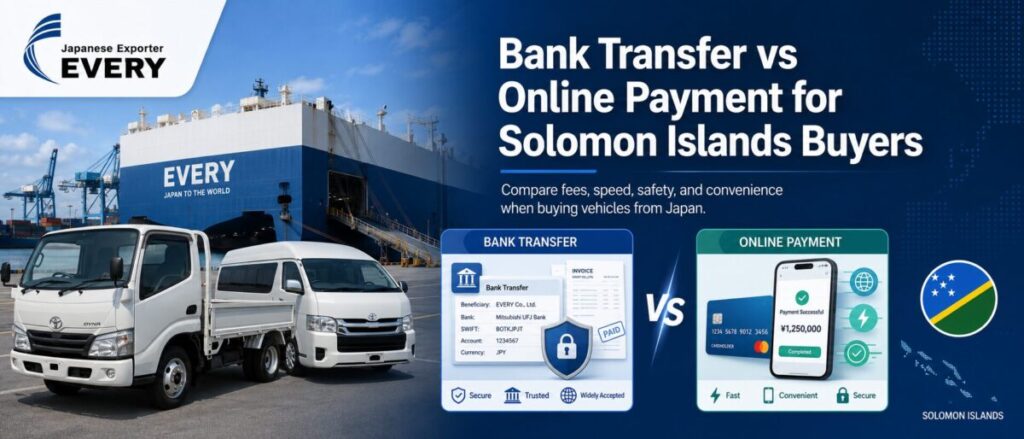
Most buyers compare two main options. These are an international bank transfer and an online payment service.
Both options can move money overseas. However, they work in different ways.
A bank transfer often suits large commercial payments. Meanwhile, online payment can offer faster and simpler processing.
Still, speed should never replace safety.
Solomon Islands buyers must consider transfer limits, exchange rates, fees, documents, fraud risks, and payment records.
Moreover, buyers need enough funds for customs clearance after the vehicle arrives.
This detailed guide compares bank transfers and online payments. It also explains which method may suit different Solomon Islands buyers.
Why Payment Choice Matters in Solomon Islands
An imported vehicle often requires a large business investment.
The buyer may use savings, company funds, bank finance, or income from an existing operation.
Therefore, a payment problem can affect more than the vehicle purchase.
It may reduce money available for freight, customs duty, port charges, registration, fuel, and repairs.
For example, a contractor may need a truck for a road project.
A retailer may need a van for daily deliveries around Honiara.
A school may need a bus for students and staff.
Likewise, a farmer may need a 4WD vehicle for plantation access.
In each case, delayed payment can delay shipment.
Then, delayed shipment can affect business income and project schedules.
Consequently, buyers should compare payment options before reserving a vehicle.
What Is an International Bank Transfer?
An international bank transfer sends money from your bank to the exporter’s bank.
Banks often call this a telegraphic transfer, wire transfer, or overseas remittance.
The buyer provides the exporter’s banking details to a licensed Solomon Islands bank.
The local bank then sends the payment through the international banking system.
The exporter receives the funds in its nominated company account.
For many Japanese vehicle purchases, bank transfer remains the standard payment method.
It works well for large payments. It also creates a formal record of the transaction.
Details Needed for a Bank Transfer
Your bank may request the following information:
- Exporter’s legal company name
- Beneficiary bank name
- Beneficiary bank address
- Bank branch name
- Account number
- SWIFT or BIC code
- Payment currency
- Proforma invoice number
- Vehicle make and model
- Vehicle chassis number
- Purpose of payment
- Total invoice amount
In addition, the bank may request identification or company documents.
Requirements can depend on the payment value and buyer type.
Therefore, contact your bank before the payment deadline.
What Is an Online Payment?
An online payment uses an internet-based payment platform.
The buyer may pay through a card, account balance, or linked bank account.
Some services also offer international business transfers.
Online payment platforms can feel easier than a traditional bank process.
For example, a buyer may complete payment from a mobile phone or computer.
The platform may also show the exchange rate before confirmation.
However, not every Japanese vehicle exporter accepts online payment.
Furthermore, some platforms limit large vehicle transactions.
Therefore, buyers must confirm the payment method before reserving a vehicle.
Bank Transfer vs Online Payment at a Glance
- Bank transfers usually suit large vehicle invoices.
- Online payments may suit deposits or smaller transactions.
- Bank transfers often require more supporting documents.
- Online payments can offer faster digital processing.
- Bank transfers may have bank and correspondent charges.
- Online platforms may charge percentage-based fees.
- Both methods require exporter verification.
- Neither method makes an unknown seller automatically safe.
Why Bank Transfers Suit Many Vehicle Purchases
A vehicle purchase often involves a large amount.
Therefore, banks usually provide a suitable structure for the transaction.
The payment record shows the sender, beneficiary, amount, currency, and reference.
This record can support later discussions with the exporter or bank.
It can also support customs and accounting records.
Moreover, a registered company exporter should normally receive funds through a company bank account.
This creates a clearer connection between the invoice and the beneficiary.
Bank Transfers Work Well for Commercial Buyers
A commercial buyer may import a truck, bus, van, or several vehicles.
The invoice value can quickly exceed an online card limit.
For instance, a construction company may order a HINO RANGER.
A wholesaler may choose an ISUZU FORWARD.
Likewise, a delivery company may purchase several light-duty trucks.
In these cases, a bank transfer can offer a practical payment trail.
It also allows the buyer to use a clear invoice reference.
Bank Transfers Support Document-Based Trade
Vehicle imports depend on correct documents.
Therefore, a bank transfer fits well with normal import procedures.
The buyer can present a proforma invoice to the bank.
Later, the commercial invoice can support customs clearance.
The buyer should keep all documents together.
These may include:
- Proforma invoice
- Bank transfer receipt
- Payment confirmation
- Commercial invoice
- Export certificate
- Bill of lading
- Marine insurance certificate, when applicable
- Vehicle inspection information
Possible Disadvantages of Bank Transfers
Bank transfers also have disadvantages.
First, the bank may require several documents.
Second, processing may take longer than an online payment.
Third, several banks may handle the transfer.
As a result, fees may come from more than one institution.
The buyer’s bank may charge a sending fee.
A correspondent bank may also deduct a fee.
Finally, the beneficiary bank may charge another amount.
Therefore, the exporter may receive less than the invoice total.
Buyers should ask who will pay all transfer charges.
Exchange Rates Can Affect the Final Cost
Japanese exporters may quote vehicles in Japanese yen or United States dollars.
However, Solomon Islands buyers usually hold Solomon Islands dollars.
Therefore, the exchange rate can change the true purchase cost.
A small rate change can create a noticeable difference on a large invoice.
Ask your bank for the full conversion cost.
Do not look only at an online market rate.
The bank’s customer rate may include an exchange margin.
Also, confirm how long the quoted rate remains valid.
Bank Transfers Are Difficult to Reverse
A completed international bank transfer can be difficult to recover.
This becomes a serious problem when the beneficiary details belong to a scammer.
Therefore, verify every bank detail before payment.
Do not send money because a seller creates pressure.
Also, never accept a sudden account change without direct confirmation.
Advantages of Online Payments
Online payment platforms can offer convenience.
The buyer may complete the transaction without visiting a bank branch.
This can help buyers who operate outside central Honiara.
It may also help a buyer who travels often between islands.
Furthermore, some platforms provide quick transaction updates.
The buyer may see whether a payment remains pending or has completed.
Some platforms also show the fee before payment.
As a result, the buyer can compare the final cost more easily.
Online Payment May Suit a Vehicle Deposit
An online payment may work well for a smaller reservation deposit.
For example, a buyer may reserve a MITSUBISHI CANTER.
The exporter may accept a small deposit before requesting the balance.
However, the buyer must read the deposit terms first.
Ask whether the deposit is refundable.
Also, ask how long the exporter will hold the vehicle.
Finally, confirm when the remaining balance becomes due.
Online Records Can Be Easy to Manage
Many platforms provide digital receipts.
They may also provide a payment reference and transaction history.
This helps buyers organise purchase records.
However, a platform receipt does not replace the exporter’s invoice.
Keep both records.
Possible Disadvantages of Online Payments
Online payment can appear simple. Still, several limits may apply.
First, the platform may not support the invoice amount.
Second, it may not support the required currency.
Third, it may block a vehicle payment for security review.
Fourth, the exporter may not accept the platform.
Finally, fees may become high on a large purchase.
Percentage Fees Can Become Expensive
Some online services charge a percentage of the payment.
This may seem small on a deposit.
However, the cost can become large on a full vehicle invoice.
For example, a percentage fee affects both the vehicle price and freight amount.
Therefore, compare the complete fee with a bank transfer.
Do not compare only the basic transfer charge.
Card Limits May Block the Payment
A card payment may have daily or monthly limits.
The card provider may also treat the transaction as unusual.
As a result, it may decline the payment.
This can happen even when the buyer has enough funds.
Therefore, contact the card issuer before a large payment.
Also, confirm whether overseas transactions remain active.
Chargeback Protection Has Limits
Some buyers assume that every online payment offers full buyer protection.
That assumption can create risk.
Vehicle transactions may fall outside some protection programmes.
Commercial goods, overseas exports, and freight services can have special rules.
Therefore, read the payment platform’s current terms.
Do not rely on a chargeback as your main safety plan.
Which Method Is Safer?
Neither method is safe when the seller is fake.
Likewise, both methods can work when the exporter is genuine.
Safety depends on verification, documents, and careful communication.
However, a bank transfer often suits full vehicle payments better.
It supports large amounts and formal trade records.
Meanwhile, an online payment may suit a smaller deposit.
It may also suit a service fee or another limited payment.
The best choice depends on:
- Total invoice value
- Exporter’s accepted payment methods
- Your bank’s overseas payment process
- Available currencies
- Transfer limits
- Exchange rate
- Total fees
- Required payment speed
- Available supporting documents
- Buyer protection rules
Solomon Islands Foreign Exchange Considerations
Vehicle payments require foreign currency.
Therefore, buyers must use an authorised financial channel.
Your bank may ask for proof of a genuine import purchase.
Usually, the proforma invoice provides the main evidence.
The bank may also request more details for a larger payment.
Consequently, submit clear and matching documents.
The exporter’s name should match the bank beneficiary.
The invoice amount should also match the transfer request.
Furthermore, the vehicle details should remain consistent.
A mismatch can delay bank processing.
Prepare for Higher-Value Payment Review
Large overseas trade payments may need additional approval.
Therefore, ask your bank about current limits before buying.
Do not divide one payment into many smaller transfers to avoid a review.
This can create more questions and higher fees.
Instead, explain the transaction clearly.
Provide the real invoice and complete vehicle details.
How Solomon Islands Business Conditions Affect Payment Choice
Solomon Islands businesses face unique transport costs.
The country includes many islands and scattered communities.
Therefore, imported vehicles may require further transport after arrival in Honiara.
A buyer in Western Province may need coastal shipping.
A buyer in Malaita may also need separate sea transport.
Likewise, a buyer in Makira-Ulawa may face additional wharf and unloading costs.
Consequently, the vehicle payment should not use the complete project budget.
Keep funds for the final journey.
Honiara Businesses Need Reliable Daily Vehicles
Honiara remains the main centre for government, trade, and imported goods.
Businesses often need compact commercial vehicles for congested urban routes.
A TOYOTA HIACE VAN can support staff movement and deliveries.
A TOYOTA DYNA can carry food, hardware, furniture, and general cargo.
Similarly, an ISUZU ELF may suit daily commercial transport.
When buying these vehicles, buyers should compare the full landed cost.
A fast online payment may save time.
However, a lower-cost bank transfer may preserve more working capital.
Construction and Infrastructure Buyers Need Larger Budgets
Road, building, and infrastructure work requires dependable commercial vehicles.
Construction companies may need dump trucks, flatbeds, tippers, or crew vehicles.
A MITSUBISHI FUSO FIGHTER can suit medium-duty work.
A HINO DUTRO can support lighter urban projects.
However, heavy vehicle invoices often exceed normal online payment limits.
Therefore, a formal bank transfer may provide a better option.
Passenger Transport Buyers Need Clear Vehicle Details
Churches, schools, tour operators, and companies may import buses.
Common choices include the TOYOTA COASTER, MITSUBISHI ROSA, and NISSAN CIVILIAN.
Before payment, confirm the seating layout.
Also, check the air-conditioning system and emergency exits.
Furthermore, confirm the chassis number on every document.
A correct payment for the wrong vehicle still creates a serious problem.
Rural Buyers Need Stronger Vehicles
Road quality varies across Guadalcanal and the provinces.
Some routes have gravel, mud, potholes, and water crossings.
Therefore, rural buyers often prefer higher ground clearance.
A TOYOTA HILUX may support farm, plantation, and contractor work.
A TOYOTA LAND CRUISER PICK UP may suit heavier rural use.
Still, buyers should check more than the purchase price.
Tyres, suspension, cooling, brakes, and 4WD operation also matter.
How to Compare the Real Payment Cost
Use the same invoice amount when comparing payment methods.
Then, add every related cost.
Bank Transfer Cost Checklist
- Sending bank fee
- Foreign exchange margin
- Correspondent bank fee
- Beneficiary bank fee
- Document processing fee
- Possible amendment fee
Online Payment Cost Checklist
- Platform transaction fee
- Card processing fee
- Currency conversion margin
- International payment fee
- Receiving fee charged to the exporter
- Withdrawal fee
Next, confirm the exact amount the exporter will receive.
This point is important.
A payment platform may show one total to the buyer.
However, it may deduct a receiving fee from the exporter.
The exporter may then request the missing balance.
Therefore, agree on fees before payment.
Verify the Exporter Before Using Either Method
Payment technology cannot prove that a seller is genuine.
Therefore, verify the Japanese exporter first.
Check the following information:
- Official company name
- Registered business address
- Official website
- Company telephone number
- Company email domain
- Vehicle stock page
- Export history
- Customer reviews
- Invoice format
- Company bank beneficiary
Moreover, compare the seller’s email address with the official website.
A scammer may change only one character.
For example, the scammer may add a hyphen or another letter.
Therefore, inspect the complete address.
Confirm the Vehicle Before Payment
Ask for enough information to confirm that the vehicle exists.
Useful evidence includes:
- Recent exterior photographs
- Interior photographs
- Engine photographs
- Chassis plate photograph
- Odometer photograph
- Cold-start video
- Engine-running video
- Walk-around video
- Japanese vehicle documents
- Inspection details
Next, compare the chassis number across all records.
The invoice, photos, and documents must show the same number.
Do not accept a partial number when the complete number is available.
Watch for Fake Bank Account Changes
Payment fraud often starts with a believable email.
The message may claim that the exporter changed banks.
It may also claim that the first account cannot receive funds.
Never follow new instructions immediately.
Instead, stop the payment.
Then, contact the exporter through a previously verified channel.
Call the official company number.
Do not call a new number shown only in the suspicious email.
Also, compare the new invoice with the original invoice.
A small beneficiary change can redirect the full payment.
Do Not Pay an Unknown Personal Account
A vehicle exporter should normally use a company bank account.
Therefore, a personal beneficiary requires careful investigation.
Ask why the beneficiary differs from the exporter.
Request written proof of the relationship.
Also, confirm the arrangement directly with an authorised manager.
Do not accept pressure or vague explanations.
A lower price does not justify an unsafe payment.
What Payment Reference Should You Use?
Use a clear reference on every transaction.
The best reference usually includes:
- Proforma invoice number
- Buyer’s name
- Vehicle stock number
- Chassis number, when space allows
This helps the exporter identify the payment quickly.
It also creates a link between the bank record and invoice.
After payment, send the receipt to the exporter.
However, hide sensitive bank information before sharing it widely.
Should You Pay a Deposit or the Full Amount?
The answer depends on the exporter’s terms.
Some exporters require full payment before shipping.
Others accept a deposit to reserve the vehicle.
Before paying a deposit, ask:
- Is the deposit refundable?
- How long will the vehicle remain reserved?
- When must I pay the balance?
- Can another buyer purchase the vehicle?
- What happens if shipping space is unavailable?
- What happens if the vehicle fails an agreed inspection?
Request written answers.
Do not rely only on a telephone conversation.
Payment Does Not Cover Every Import Cost
The exporter’s invoice may include the vehicle and ocean freight.
However, it may not include Solomon Islands destination charges.
Therefore, ask whether the price uses FOB, C&F, or CIF terms.
FOB
FOB generally covers the vehicle and export handling in Japan.
The buyer normally arranges the main ocean freight.
C&F
C&F generally includes the vehicle and ocean freight.
Marine insurance usually remains separate.
CIF
CIF generally includes the vehicle, freight, and marine insurance.
However, insurance terms can vary.
Therefore, ask what the policy covers.
Keep Money for Arrival and Clearance
Do not use every available dollar for the exporter’s invoice.
The vehicle will create more costs after arrival.
These may include:
- Customs duty and taxes
- Customs broker fees
- Port handling charges
- Shipping agent fees
- Biosecurity costs
- Storage charges
- Registration fees
- Local transport
- Fuel
- Initial maintenance
- Provincial sea transport
Moreover, delays can increase storage costs.
Prepare clearance funds before the vessel arrives.
Recommended Payment Method by Buyer Type
First-Time Individual Buyer
A bank transfer can provide a clear formal record.
However, the buyer should ask the bank for support.
Do not complete the transfer without checking the beneficiary.
Small Business Buyer
An online deposit may offer convenience.
Then, a bank transfer may suit the remaining balance.
Still, confirm that both payments appear on the final invoice.
Large Commercial Buyer
A bank transfer usually suits a truck, bus, or multiple-vehicle order.
It supports larger values and business accounting records.
Provincial Buyer
Online access may reduce travel to Honiara.
However, platform limits and internet reliability can affect the process.
Therefore, start payment preparations early.
Dealer or Regular Importer
A regular importer should create a standard payment checklist.
Use the same exporter verification process for every order.
Also, keep supplier bank details in a secure internal record.
Safe Bank Transfer Checklist
- Verify the exporter’s company name
- Confirm the beneficiary name
- Check the SWIFT code
- Check the account number
- Compare the invoice with previous records
- Confirm the vehicle chassis number
- Confirm the payment currency
- Ask about all bank fees
- Use the invoice number as a reference
- Keep the transfer receipt
- Confirm receipt with the exporter
- Reject unverified bank changes
Safe Online Payment Checklist
- Confirm that the exporter accepts the platform
- Check the platform’s transaction limit
- Check the supported payment currency
- Review buyer protection rules
- Confirm all percentage fees
- Check the card or account limit
- Use the exporter’s official payment request
- Confirm the receiving company name
- Save the digital receipt
- Request exporter confirmation
- Use two-step account security
- Avoid public or shared devices
What to Do After Payment
First, send the payment receipt to the exporter.
Next, ask for written confirmation.
Then, request regular shipping updates.
These should include:
- Payment received date
- Vehicle preparation status
- Japanese port delivery
- Shipping booking status
- Vessel name
- Estimated departure date
- Estimated arrival period
- Bill of lading status
Keep all messages in one folder.
Also, save copies outside your email account.
This protects important records if you lose account access.
Final Verdict: Bank Transfer or Online Payment?
For most full vehicle purchases, a bank transfer offers the stronger option.
It handles larger amounts and supports formal import records.
It also connects the invoice with a company bank beneficiary.
However, buyers must still verify every detail.
An online payment can suit a smaller deposit.
It may also offer convenience for some Solomon Islands buyers.
Nevertheless, fees and transaction limits can reduce its value.
Therefore, compare the total cost rather than the advertised fee.
Most importantly, never choose a method only because it looks fast.
Choose a method that provides clear records, correct documents, and a verified beneficiary.
Then, keep enough money for customs, port charges, registration, and provincial transport.
With careful planning, Solomon Islands buyers can purchase Japanese used vehicles with greater confidence.


Browse Reliable Used Trucks & Buses from Japan
Carefully selected vehicles ready for export worldwide
Search 100,000+ Dealer Stock Vehicles from Japan
Access a wide selection of vehicles from Japanese dealers nationwide. Updated daily.
