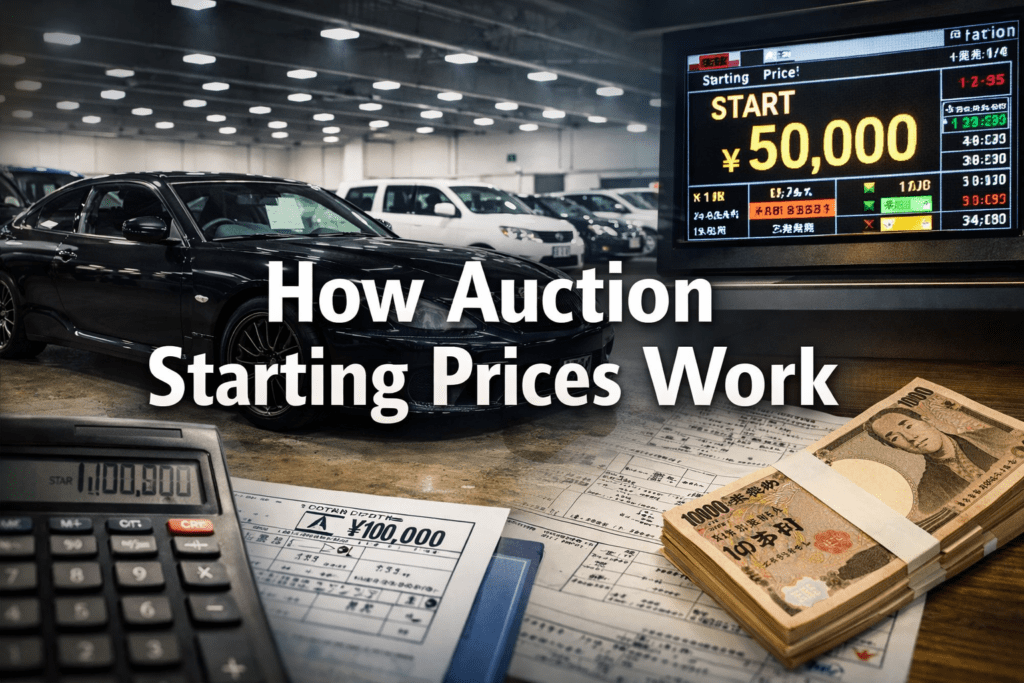

How Auction Starting Prices Work
Japanese car auctions are one of the most effective ways for overseas buyers to source used vehicles from Japan. Every week, a huge number of cars, SUVs, vans, trucks, buses, and other vehicles are listed through dealer-only auction networks. Because of this, many importers use Japanese auctions to secure better stock for export.
However, many first-time buyers do not fully understand one important part of the process: the auction starting price. They often see a starting price on an auction listing and assume it shows the real market value of the vehicle. In reality, that is not always true.
The starting price is only the opening point of bidding. It is a useful signal, but it does not automatically show what the final selling price will be. In some cases, the car may sell far above the starting price. In other cases, it may not sell at all.
This guide explains how auction starting prices work in Japan, why they matter for overseas buyers, how they affect bidding decisions, and why working with a professional export company helps you buy more safely and effectively.
Search available auction vehicles here:
Browse Auction Vehicles
Understanding the Japanese Car Auction System
Before looking at starting prices, it is important to understand the Japanese used car auction system. Japanese auctions are wholesale markets where licensed dealers and exporters buy and sell vehicles through fast bidding systems.
These auctions are usually not open to general public buyers. Instead, overseas customers normally work through exporters or auction agents in Japan. These companies search vehicles, explain auction details, place bids, and arrange export procedures.
Vehicles enter the auction system from many sources. These include trade-ins, lease returns, fleet vehicles, dealer stock, rental companies, and corporate vehicles. Once a vehicle arrives at an auction house, staff inspect it, prepare an auction sheet, and list it for sale.
Main parts of the auction system
- Auction house: Organizes listings, inspections, and bidding
- Seller: The dealer or company offering the vehicle
- Buyer: The dealer or exporter placing the bid
- Auction sheet: The vehicle condition report
- Starting price: The opening price shown before bidding begins
- Reserve price: The minimum level the seller wants to achieve
This system gives buyers access to a very large number of vehicles in a short time. It also creates a competitive environment where prices are shaped by supply, demand, condition, and bidder interest.
What Is an Auction Starting Price?
An auction starting price is the price where bidding begins when the vehicle enters the auction lane. It is the first visible price in the live auction process. Buyers see this number before the bidding starts to rise.
Many buyers think the starting price is close to the seller’s final target. However, that is not always correct. The starting price is often set lower than the expected selling price in order to attract attention and create bidding movement.
In simple terms, the starting price is the opening bid level, not the final market value.
Why auction houses use starting prices
- To start the bidding process smoothly
- To attract buyer interest
- To create competition early in the sale
- To help vehicles move through auction lanes quickly
Because Japanese auctions are fast, the starting price helps create momentum. A good opening level can encourage more buyers to join the bidding.
How Starting Prices Are Decided
The starting price is not random. It is usually based on the auction house system, seller strategy, vehicle type, and expected demand. Still, it does not always match the reserve price or the final selling price.
Factors that influence the starting price
- Vehicle age: Newer vehicles may attract stronger opening attention
- Condition: Better vehicles can receive more competitive bidding even from a low start
- Demand: Popular export models may start low but rise quickly
- Seller strategy: Some sellers prefer aggressive low starts to create momentum
- Auction house format: Different auction groups may use slightly different pricing styles
For example, a popular used SUV with strong export demand may start at a low price to attract many bidders. In contrast, a niche unit with weaker demand may have a higher opening level but less real competition.
This is why experienced buyers do not judge value only by the starting price. They study the full vehicle details first.
Why Starting Prices Matter to Overseas Buyers
Starting prices matter because they influence bidding psychology. A low opening number may make a vehicle look like a bargain. Yet that does not mean it will end at a bargain price.
For overseas buyers, this point is very important. If you misunderstand the starting price, you may build the wrong budget, expect unrealistic results, or bid too emotionally.
Main benefits of understanding starting prices
- Better budget control: Buyers can avoid unrealistic expectations
- Stronger bidding discipline: You focus on final value, not opening numbers
- Improved vehicle selection: You compare true business potential
- Lower risk: You avoid chasing units that will likely rise far above your target
When buyers understand how starting prices work, they make calmer and smarter bidding decisions. That improves profitability in the export business.
How Starting Prices Relate to Final Selling Prices
The starting price and the final selling price are often very different. This happens because the final result depends on competition between buyers, not only on the opening number.
A vehicle may start low and sell high if many bidders want it. On the other hand, a vehicle may start higher and still fail to sell if interest is weak or the reserve price is not reached.
Common auction outcomes
- Low start, high finish: Popular vehicles often follow this pattern
- Low start, no sale: Interest may be weak or reserve may be too high
- Moderate start, steady finish: Common for average market vehicles
- Start near reserve: Sometimes sellers want tighter price control
This is why strong buyers focus on likely market range, not on the first number they see on the screen.
Step-by-Step Buying Flow for Overseas Buyers
Most overseas buyers join Japanese auctions through professional exporters. The exporter handles access, translation, bidding, payment, and export procedures.
Step 1: Choose a trusted export company
The exporter becomes your partner in Japan. They help you access dealer-only auction stock and explain the details that matter before bidding.
Step 2: Search auction vehicles
You share your target model, year range, mileage limit, budget, and destination market. The exporter then searches suitable auction listings for you.
Step 3: Review vehicle details
Before bidding, you should review the auction sheet, photos, equipment, repair history, and estimated total cost. This step matters much more than the starting price alone.
Step 4: Set your maximum bid
Your maximum bid should be based on total landed cost, not the starting price. You need to include auction fees, inland transport, export handling, freight, insurance, and destination charges.
Step 5: Bid at auction
The exporter places the bid during the live auction or through advance bidding. If your maximum bid is the highest accepted level, the vehicle is secured.
Step 6: Complete payment
After winning, payment must usually be made quickly. Auction schedules and release deadlines are strict, so speed is important.
Step 7: Arrange export and shipment
The exporter collects the vehicle, handles documentation, books shipping, and prepares the vehicle for export to your country.
Important Cautions About Starting Prices
Starting prices are useful, but they can also mislead buyers who do not understand auction behavior. Therefore, overseas buyers should stay careful and disciplined.
1. Do not treat the starting price as the expected buying price
This is one of the most common mistakes. A vehicle that starts low may still finish well above your budget.
2. Do not judge value from one number
Condition, mileage, specification, auction grade, and demand all matter. The starting price is only one part of the picture.
3. Watch out for emotional bidding
Some buyers get excited when they see a low start. Then they keep bidding higher than planned. This can damage profit.
4. Check the reserve risk
Even if bidding rises from a low start, the vehicle may still not sell if the seller’s reserve price is higher than the final bid.
5. Compare recent market results
Auction history and recent sale trends often give a better price guide than the opening number on one vehicle.
Why Professional Export Companies Help So Much
For overseas buyers, the biggest challenge is not only accessing the auction. It is interpreting the auction correctly. This is where a professional export company adds real value.
They understand auction behavior
Experienced exporters know that a starting price is only an opening tool. They can judge whether the vehicle is likely to attract strong competition or weak demand.
They read the full vehicle picture
Good exporters look at the auction sheet, market demand, condition, repair history, and likely final price. This helps buyers avoid poor decisions.
They help set practical budgets
Instead of reacting to low starting prices, exporters help customers build realistic bid limits based on total business cost.
They manage the full export process
After the auction, the exporter handles payment, inland transport, documents, shipping arrangements, and communication. This saves time and reduces risk.
- Access to dealer-only auction systems
- Accurate reading of auction sheets and pricing behavior
- Support with realistic maximum bids
- Lower risk for first-time international buyers
- Complete export and shipping assistance
Simple Tips for Overseas Buyers
If you want better results at Japanese auctions, focus on value and discipline rather than on the first number shown on the screen.
- Study the full auction sheet before approving any bid
- Use starting price as a signal, not as a final value guide
- Set a firm maximum bid before auction time
- Calculate full landed cost in advance
- Work with a reliable exporter who understands your market
These simple habits can improve buying accuracy and support stronger long-term import business results.
Conclusion
Understanding auction starting prices is an important part of buying vehicles from Japan. The starting price is the opening point of bidding, not the real final value. It can help buyers understand auction movement, but it should never be the only number used for decision-making.
For overseas buyers, the smartest approach is to combine starting price awareness with full vehicle analysis, strong budget control, and experienced exporter support. That way, you can avoid emotional bidding, reduce risk, and source better vehicles for your market.
EVERY TRADING is a Japanese used vehicle export company serving customers around the world. We help overseas buyers search Japanese auction stock, understand auction pricing, and move from bidding to shipment with confidence.
Whether you are buying passenger cars, SUVs, vans, or commercial vehicles, our team can help you search available auction stock and make better export buying decisions from Japan.
Learn more about Japanese auctions:
Japanese Car Auction Guide
Start searching your vehicle from Japan today:
Search Auction Vehicles Now
If you are looking for any Japanese vehicles, cars and truck and bus for sale, please check our list.
The list of Japanese Used Truck, Bus, cars, and tractor exporter EVERYCAR.jp (*Click to open).We do our best work for all customer's partnership.
It's for SDGs goal number 17 "PARTNERSHIP FOR THE GOALS".
Let's work together!


