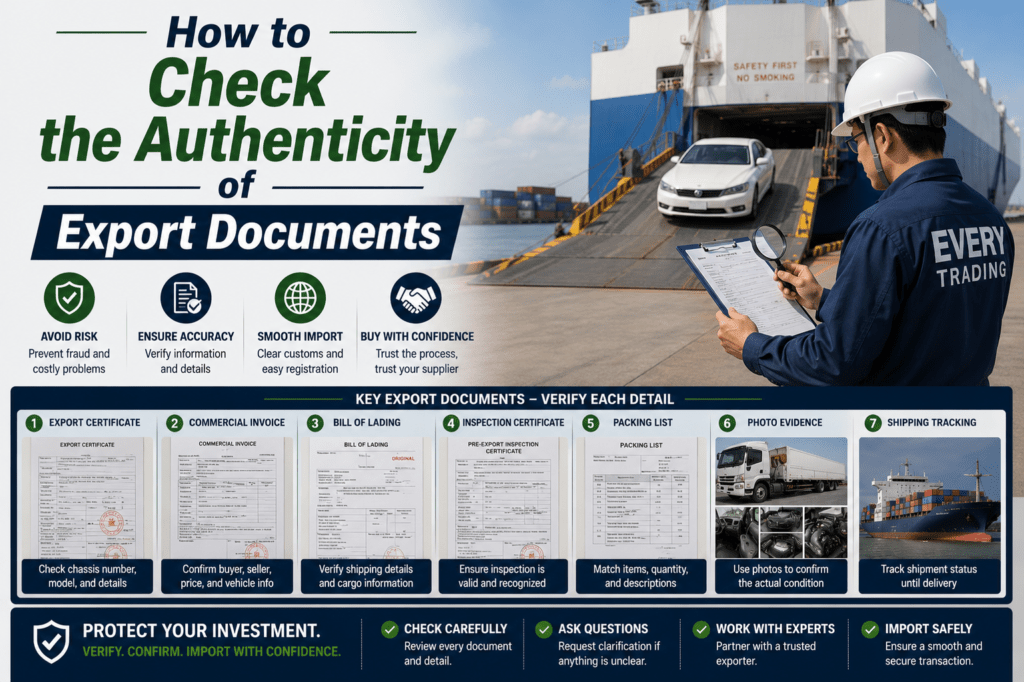

How to Check the Authenticity of Export Documents
Quality, Trust & Inspection
When importing a used truck, bus, tractor, machinery, or commercial vehicle from Japan, documentation is just as important as vehicle quality.
Even if a vehicle is in excellent condition, incorrect or fraudulent documents can create serious problems. Delays, customs issues, registration difficulties, and financial losses may occur when buyers fail to verify export paperwork.
Therefore, understanding how to check the authenticity of export documents is essential for every international buyer.
In this guide, we explain the most important export documents, how to verify them, and how trusted exporters help buyers import vehicles safely and confidently.
Why Export Document Verification Matters
International vehicle purchases involve significant investments.
Therefore, buyers must protect themselves from unnecessary risks.
Authentic documents help ensure:
- Legal ownership
- Smooth customs clearance
- Accurate vehicle information
- Successful registration
- Secure international transactions
Consequently, document verification should always be part of the buying process.
Common Risks of Fake Documents
Unfortunately, international trade sometimes attracts dishonest sellers.
Fraudulent documents can create problems such as:
- Customs delays
- Vehicle seizure
- Registration rejection
- Financial loss
- Ownership disputes
Therefore, buyers should carefully review every document before making payment.
Moreover, working with trusted exporters greatly reduces these risks.
Key Export Documents You Should Verify
Several documents play important roles in vehicle exports.
Let's examine each one.
1. Export Certificate
The Export Certificate is one of the most important documents when exporting vehicles from Japan.
It contains critical information including:
- Chassis number
- Vehicle model
- Registration history
- Owner information
- Export details
Therefore, buyers should compare all vehicle details with the actual vehicle information.
Any discrepancy should be investigated immediately.
2. Commercial Invoice
The Commercial Invoice confirms the transaction between buyer and seller.
It normally includes:
- Buyer details
- Seller details
- Vehicle description
- Purchase price
- Payment terms
Furthermore, all information should match the sales agreement and shipping documents.
Consistency is an important sign of authenticity.
3. Bill of Lading (B/L)
The Bill of Lading is issued by the shipping company.
This document confirms cargo shipment and transportation details.
It usually contains:
- Shipper information
- Consignee information
- Vessel name
- Port of loading
- Destination port
- Cargo details
Therefore, buyers should verify that all information matches the purchased vehicle.
4. Inspection Certificates
Some countries require inspection certificates before import.
These certificates may include:
- Roadworthiness inspections
- Safety inspections
- Pre-export inspections
- Country-specific compliance checks
Consequently, buyers should verify that certificates come from recognized inspection organizations.
5. Packing List
The Packing List provides details about shipped items.
For vehicles and machinery, it may include:
- Vehicle identification
- Equipment descriptions
- Quantity information
- Shipping details
Moreover, the information should match both the invoice and shipping documents.
Step 1: Verify the Chassis Number
The chassis number is one of the most important verification tools.
Every vehicle has a unique chassis number.
Therefore, buyers should confirm that the chassis number appears correctly on:
- Export Certificate
- Commercial Invoice
- Bill of Lading
- Inspection Documents
Furthermore, the number should match photographs of the actual vehicle.
This simple step helps prevent many problems.
Step 2: Check Consistency Across Documents
Authentic documentation should present consistent information.
Compare details such as:
- Vehicle model
- Year of manufacture
- Chassis number
- Engine information
- Exporter details
- Buyer details
If information differs between documents, ask questions immediately.
Therefore, consistency remains one of the strongest indicators of document authenticity.
Step 3: Confirm Exporter Information
A professional exporter should provide transparent company information.
Verify:
- Company name
- Business address
- Website
- Email address
- Contact information
Moreover, trusted exporters maintain established business histories and professional communication channels.
As a result, buyers can verify company legitimacy more easily.
Step 4: Review Shipping Information
Shipping details provide another important verification opportunity.
Buyers should confirm:
- Vessel name
- Voyage details
- Port information
- Cargo description
Furthermore, shipping companies often provide tracking services that help verify shipment status.
Consequently, buyers gain additional confidence in the transaction.
Step 5: Request Clear Document Copies
Professional exporters willingly provide document copies when appropriate.
Review documents carefully before shipment.
Look for:
- Clear printing
- Consistent formatting
- Accurate vehicle information
- Official stamps when required
Moreover, poor-quality or altered documents should raise concerns.
Step 6: Verify Inspection Providers
If inspection certificates are included, confirm that the inspection provider is legitimate.
Recognized inspection companies generally have:
- Established reputations
- Official websites
- Verification systems
- Professional documentation
Therefore, buyers should review inspection sources carefully.
Why Trusted Exporters Reduce Risk
Document verification becomes much easier when working with reputable exporters.
Professional exporters provide:
- Accurate documentation
- Transparent communication
- Professional support
- Inspection assistance
- Reliable shipping coordination
Consequently, buyers face fewer risks throughout the purchasing process.
How EVERY Supports Safe Vehicle Imports
At EVERY, transparency and trust are core business values.
Since 2006, we have exported Japanese trucks, buses, tractors, machinery, and commercial vehicles to customers in more than 100 countries.
Our team helps customers by providing:
- Clear vehicle information
- Accurate documentation
- Professional support
- Inspection guidance
- Export assistance
Moreover, we respond quickly and help buyers understand every step of the export process.
As a result, customers can purchase with greater confidence.
Warning Signs Buyers Should Never Ignore
Several warning signs may indicate potential problems.
Be cautious if a seller:
- Refuses to provide documents
- Provides inconsistent information
- Avoids verification requests
- Uses unprofessional communication
- Offers unrealistic pricing
Therefore, buyers should always conduct careful due diligence.
Trustworthy exporters welcome reasonable verification requests.
Benefits of Proper Document Verification
Verifying export documents helps buyers:
- Reduce fraud risks
- Improve transaction security
- Simplify customs clearance
- Ensure legal compliance
- Protect investments
Consequently, document verification becomes one of the most valuable steps in international vehicle purchasing.
Final Thoughts
Export documents are the foundation of every successful international vehicle transaction.
By carefully reviewing Export Certificates, Commercial Invoices, Bills of Lading, inspection reports, and shipping information, buyers can reduce risks and import vehicles with confidence.
Furthermore, working with a trusted Japanese exporter provides additional protection throughout the process.
EVERY has proudly supported customers worldwide since 2006. We continue helping buyers source quality Japanese trucks, buses, tractors, machinery, and commercial vehicles with transparency, professionalism, and reliable export support.
When quality, trust, and accurate documentation matter, EVERY is ready to support your business every step of the way.


Browse Reliable Used Trucks & Buses from Japan
Carefully selected vehicles ready for export worldwide
Search 100,000+ Dealer Stock Vehicles from Japan
Access a wide selection of vehicles from Japanese dealers nationwide. Updated daily.
