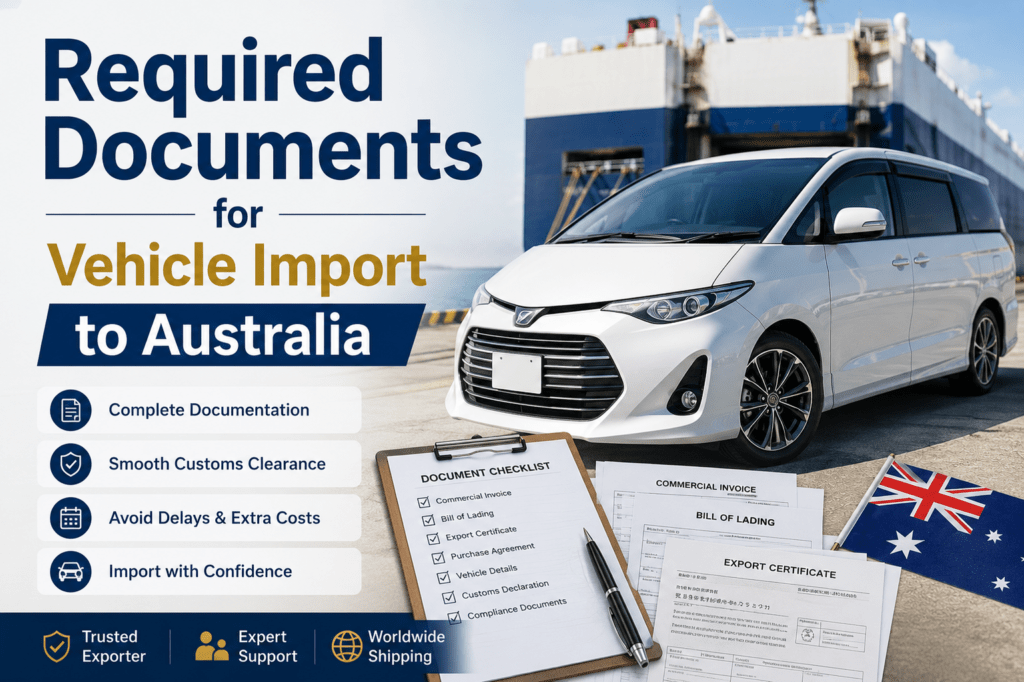

Required Documents for Vehicle Import to Australia: Complete Guide for Smooth Customs Clearance
Importing a vehicle from Japan to Australia can be a smart investment. Japanese used cars, trucks, SUVs, and commercial vehicles are known for their quality, reliability, and low mileage.
However, many importers face delays because of missing paperwork. Even a great vehicle can become a problem if the required documents are incomplete.
Therefore, understanding the necessary documents before shipping is extremely important.
This guide explains the essential documents needed for vehicle import to Australia. In addition, it shows how proper preparation can help you avoid delays, reduce costs, and enjoy a smoother import process.
Why Proper Documentation Matters
Australia has strict import regulations. These rules help maintain safety, environmental standards, and vehicle quality.
As a result, authorities carefully review import paperwork.
Complete documentation helps you:
- Speed up customs clearance
- Avoid unnecessary delays
- Reduce additional costs
- Meet compliance requirements
- Complete registration more easily
Therefore, document preparation should begin before the vehicle leaves Japan.
Overview of the Vehicle Import Process
Before discussing each document, it helps to understand the overall process.
The standard import process usually follows these steps:
- Purchase a vehicle from Japan
- Prepare export documents
- Arrange shipping
- Submit import paperwork
- Complete customs clearance
- Meet compliance requirements
- Register the vehicle in Australia
Each stage requires specific documentation.
Therefore, organized record keeping is very important.
Import Approval Documentation
Import approval is one of the most important requirements.
Without proper approval, importing a vehicle can become difficult and expensive.
For this reason, buyers should always verify requirements before purchasing a vehicle.
Furthermore, approval requirements may vary depending on vehicle type and eligibility category.
Proper preparation can prevent major problems later in the process.
Commercial Invoice
The commercial invoice is a key document during importation.
This document confirms important purchase details.
Typically, it includes:
- Buyer information
- Seller information
- Vehicle description
- Vehicle identification number (VIN)
- Purchase price
- Date of sale
Customs authorities use this information to assess the shipment.
Therefore, accuracy is essential.
Any mistakes may create unnecessary delays.
Bill of Lading
The Bill of Lading is one of the most important shipping documents.
The shipping company issues this document after loading the vehicle.
It normally includes:
- Shipping company details
- Port of departure
- Port of arrival
- Vehicle information
- Container or shipment details
In addition, the Bill of Lading serves as proof that the vehicle has been shipped.
Without this document, customs processing may become difficult.
Export Certificate from Japan
Japan issues an Export Certificate when a vehicle leaves the country.
This document confirms that the vehicle was legally exported.
It also contains valuable information such as:
- Vehicle registration details
- Chassis number
- Engine information
- Ownership history
Consequently, Australian authorities often use this document during import processing and registration procedures.
Purchase Agreement or Sales Contract
A sales contract helps verify ownership transfer.
Although requirements may vary, keeping a copy of the purchase agreement is always recommended.
This document provides additional proof of:
- Vehicle ownership
- Purchase date
- Purchase value
- Seller information
Furthermore, it helps resolve potential questions during customs review.
Vehicle Identification Documents
Vehicle identification documents help authorities verify the imported vehicle.
Important information includes:
- Vehicle Identification Number (VIN)
- Chassis number
- Engine number
- Manufacturer details
Matching information across all documents is extremely important.
Therefore, buyers should review every document carefully before shipment.
Shipping Documents
Several shipping-related documents may also be required.
Examples include:
- Shipping instructions
- Freight invoices
- Cargo manifests
- Port handling records
These documents help track the shipment throughout the transportation process.
As a result, they can assist customs officials when verifying cargo information.
Customs Declaration Documents
Customs authorities require detailed information about imported vehicles.
Importers must provide accurate declarations regarding:
- Vehicle type
- Vehicle value
- Vehicle origin
- Shipping information
Therefore, honesty and accuracy are essential.
Incorrect information may lead to delays or additional inspections.
Compliance Documentation
Australia applies strict vehicle standards.
Consequently, imported vehicles may require compliance verification.
Compliance-related documents may include:
- Vehicle specifications
- Safety information
- Modification records
- Technical reports
These documents help demonstrate that the vehicle can meet Australian standards.
Therefore, buyers should gather compliance information as early as possible.
Proof of Identity
Importers often need to provide identification documents.
Common examples include:
- Passport
- Driver's licence
- Business registration documents
These records help verify ownership and importer identity.
Furthermore, they support customs and registration procedures.
Proof of Address
Many import processes also require proof of address.
Examples include:
- Utility bills
- Bank statements
- Government correspondence
These documents help verify residency and ownership records.
As a result, they often play an important role during registration.
Vehicle Inspection Reports
Professional inspections can provide valuable information.
Many Japanese exporters offer detailed inspection reports before shipment.
These reports may include:
- Mechanical condition
- Exterior condition
- Interior condition
- Auction grade
- Damage history
Therefore, inspection reports help buyers purchase with confidence.
They also create transparency throughout the transaction.
Insurance Documentation
Although insurance requirements vary, many importers arrange insurance during shipping.
Insurance documents may include:
- Marine insurance certificates
- Cargo insurance records
- Coverage details
Insurance protection reduces financial risk during transportation.
Consequently, many buyers consider it a valuable investment.
Common Documentation Mistakes
Many delays occur because of simple paperwork errors.
Fortunately, most problems are preventable.
Missing Information
Incomplete forms often create processing delays.
Therefore, review every document carefully.
Incorrect Vehicle Numbers
VIN and chassis numbers must match across all documents.
Even small mistakes can cause problems.
Inconsistent Names
Buyer information should remain consistent on all paperwork.
Different spellings may trigger additional reviews.
Last-Minute Preparation
Some buyers wait until shipping begins.
However, early preparation usually leads to a smoother process.
Tips for Faster Customs Clearance
You can improve clearance speed by following several best practices.
Organize Documents Early
Create a document checklist before purchasing the vehicle.
Work with an Experienced Exporter
Professional exporters understand documentation requirements.
Therefore, they can help prevent costly mistakes.
Keep Digital Copies
Store scanned copies of every document.
This makes sharing information much easier.
Double-Check Every Detail
Small errors often create big delays.
Consequently, careful review is always worthwhile.
Why Buyers Choose Japanese Vehicle Exporters
Many international buyers work directly with Japanese exporters because they provide valuable support.
Experienced exporters can assist with:
- Vehicle sourcing
- Auction purchases
- Inspections
- Documentation
- Shipping arrangements
As a result, buyers enjoy a simpler and more reliable importing experience.
How EVERY TRADING Supports Australian Buyers
EVERY TRADING helps customers import vehicles from Japan with confidence.
Our services include:
- Access to Japanese vehicle auctions
- Professional vehicle inspections
- Export documentation support
- Worldwide shipping solutions
- Fast communication
- Expert customer assistance
Furthermore, our experienced team helps buyers prepare all necessary paperwork before shipment.
This reduces delays and improves overall efficiency.
Conclusion
Importing a vehicle from Japan to Australia offers many benefits. Buyers gain access to reliable vehicles, competitive pricing, and a wide selection of quality inventory.
However, proper documentation is critical for success.
Commercial invoices, Bills of Lading, Export Certificates, compliance records, and customs documents all play important roles.
Therefore, preparing documents early and working with an experienced exporter can make the entire process much smoother.
With the right support and complete paperwork, importing a vehicle from Japan to Australia can be simple, efficient, and highly rewarding.


Browse Reliable Used Trucks & Buses from Japan
Carefully selected vehicles ready for export worldwide
Search 100,000+ Dealer Stock Vehicles from Japan
Access a wide selection of vehicles from Japanese dealers nationwide. Updated daily.
