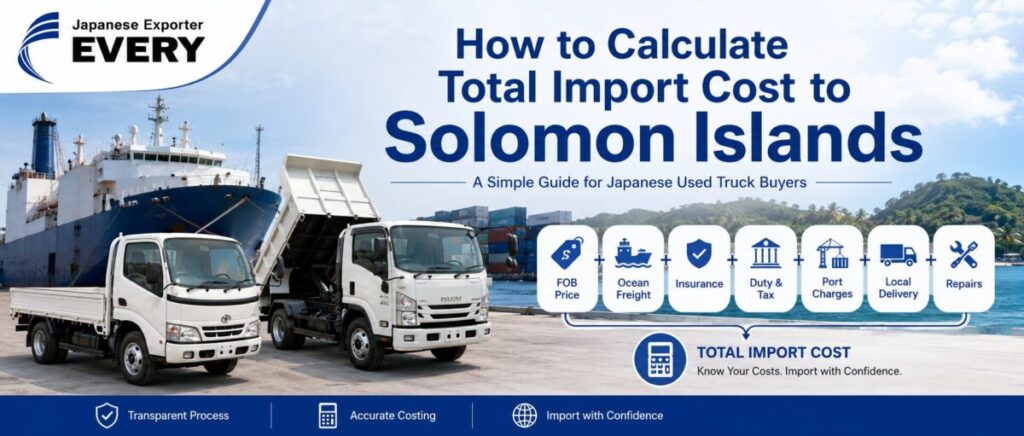

How to Calculate Total Import Cost to Solomon Islands
Buying a Japanese used truck is an important business decision.
However, the truck price in Japan is only one part of the total cost.
For Solomon Islands buyers, the real cost includes the vehicle price, ocean freight, insurance, port charges, customs costs, local transport, and possible repairs.
Therefore, buyers should calculate the total import cost before making payment.
This guide explains how to estimate the total cost of importing used trucks from Japan to Solomon Islands. It also helps buyers understand how different truck types, body sizes, and shipping plans can affect the final budget.
The cost examples in this article are general guide examples only. Actual costs can change due to exchange rates, shipping schedules, customs classification, truck size, port charges, and local rules.
Why Total Import Cost Matters for Solomon Islands Buyers
Many Solomon Islands buyers compare trucks by FOB price first.
FOB means the vehicle price in Japan before ocean freight and local costs.
However, FOB is not the final cost.
A truck with a low FOB price may still become expensive after shipping, clearance, repairs, and local charges.
Also, a larger truck can cost more to ship. A crane truck can cost more than a simple flat deck truck. A dump truck may need extra checks before it starts work.
So, buyers should look at the full landed cost.
The landed cost is the estimated total cost to bring the truck into Solomon Islands and make it ready for use.
Why Japanese Used Trucks Are Useful in Solomon Islands
Solomon Islands needs strong and practical commercial vehicles.
Trucks support shops, farms, construction sites, fisheries, timber work, hardware supply, port movement, and provincial transport.
In Honiara, businesses often need delivery trucks for goods, food, building materials, and daily stock movement. In provincial areas, buyers may need stronger trucks for mixed roads, heavy loads, and village access.
Also, Solomon Islands is an island country.
Many goods move through ports first. Then, trucks move them to shops, worksites, farms, and communities.
Because of this, the right truck can improve daily business.
Japanese used trucks are popular because they offer:
- Right-hand-drive layout
- Reliable diesel engines
- Many body types
- Strong chassis options
- Practical sizes for island roads
- Good value for business buyers
- Known brands and easy daily operation
However, buyers still need a clear budget plan.
Basic Formula for Total Import Cost
The total import cost is easier to understand when you break it into parts.
A simple formula is:
Total Import Cost = FOB Price + Ocean Freight + Marine Insurance + Customs Duty + Goods Tax + Port Charges + Clearance Fees + Local Transport + Repairs or Service
Some buyers may also add registration, inspection, storage, and bank charges.
Therefore, it is better to prepare extra budget.
A safe budget plan can reduce stress after the truck arrives.
Step 1: Start with the FOB Price in Japan
The FOB price is the starting point.
It usually includes the vehicle cost in Japan and export preparation up to the shipping point.
However, the exact meaning can depend on the seller’s quotation.
So, buyers should confirm what is included.
Before comparing FOB prices, check these points:
- Vehicle model
- Year or first registration
- Mileage
- Body type
- Transmission
- Engine condition
- Chassis condition
- Tyre condition
- Export document support
- Truck location in Japan
A cheaper truck may look attractive.
However, condition is very important.
A cleaner truck may cost more at first. Still, it may reduce repair costs after arrival.
Step 2: Estimate Ocean Freight
Ocean freight is a major cost for Solomon Islands buyers.
Many used trucks from Japan move by RORO shipping when space and routes are available.
RORO means roll-on, roll-off. The truck drives onto the vessel in Japan and drives off after arrival.
Freight cost often depends on the truck size.
Shipping companies usually look at:
- Length
- Width
- Height
- Weight
- Running condition
- Departure port in Japan
- Arrival port in Solomon Islands
- Vessel space
- Shipping schedule
For example, a light flat deck truck usually costs less to ship than a heavy crane truck.
Also, very tall trucks can need special freight confirmation.
Therefore, buyers should confirm dimensions before purchase.
Step 3: Add Marine Insurance
Marine insurance protects the buyer during transport.
It is usually a small cost compared with the truck value.
However, it can be very important if damage or loss happens during shipping.
Buyers should ask whether insurance is included in the quotation.
If it is not included, they should ask for the extra cost.
For business buyers, insurance can add peace of mind.
Step 4: Check Customs Duty and Tax
Customs duty and tax can change the final cost.
Solomon Islands import costs may depend on customs classification, vehicle type, declared value, and local rules.
Because of this, buyers should confirm the latest duty and tax with a licensed customs broker or Solomon Islands Customs before importing.
As a general idea, customs costs may include:
- Import duty
- Goods tax or similar tax
- Customs entry charges
- Documentation charges
- Broker service fees
Buyers should not guess these costs.
Instead, they should calculate them before buying.
This is especially important for higher-value trucks, heavy trucks, and special body trucks.
Step 5: Add Port Charges in Solomon Islands
After the truck arrives, local port costs may apply.
Solomon Islands has important port facilities such as Honiara Port and Noro Port.
For many vehicle imports, Honiara is an important entry point. However, the best port can depend on the shipping route and final business location.
Port-related costs may include:
- Port handling charges
- Wharf charges
- Storage charges
- Gate or access charges
- Document processing charges
- Other local service fees
Storage can become expensive if documents are delayed.
Therefore, buyers should prepare documents early.
They should also work closely with their clearing agent.
Step 6: Add Customs Clearance Fees
Most buyers use a customs broker or clearing agent.
This can make the process smoother.
The agent may help with documents, customs entry, duty calculation, port handling, and release steps.
Clearance fees can vary.
So, buyers should ask for an estimate before the truck arrives.
It is also wise to send documents to the agent early.
This can reduce delays and storage costs.
Step 7: Add Local Transport After Arrival
The truck may not start work at the port.
It may need local transport to a yard, workshop, farm, construction site, or business location.
For Honiara buyers, this cost may be smaller.
However, buyers in other areas may need extra movement by road or domestic shipping.
Solomon Islands has many islands.
So, local delivery planning matters.
Buyers should ask:
- Where will the truck arrive?
- Where will the truck be used?
- Will domestic sea transport be needed?
- Will the truck need road transport from the port?
- Will a driver or mechanic need to collect it?
- Will fuel or temporary service be needed?
These costs may look small at first.
However, they can affect the real budget.
Step 8: Add Repair, Service, and Preparation Costs
A used truck may need some service after arrival.
This is normal for commercial vehicles.
Buyers should prepare a repair budget for:
- Engine oil
- Filters
- Battery
- Tyres
- Brake check
- Lights
- Wipers
- Cooling system
- Hydraulic oil
- Body repair
- Cleaning
- Minor rust treatment
For dump trucks, buyers should check the hydraulic lift.
For crane trucks, they should check the crane, PTO, outriggers, and hydraulic lines.
For freezer trucks, they should check cooling performance.
These checks help the truck start work safely.
Example Cost Calculation for a Light Truck
Here is a simple example.
This is not a real quotation.
It only shows how to calculate.
| Cost Item | Example Amount |
|---|---|
| FOB price in Japan | US$12,000 |
| Ocean freight | US$3,000 |
| Marine insurance | US$150 |
| Estimated customs duty and tax | Confirm locally |
| Port and clearance charges | Confirm locally |
| Local transport and service | Confirm locally |
In this example, the buyer should not think the truck costs only US$12,000.
The buyer should add freight, insurance, taxes, port costs, and local preparation.
That gives a more realistic budget.
Example Cost Calculation for a Dump Truck
A dump truck often costs more than a light flat deck truck.
It may also cost more to ship because of size and weight.
| Cost Item | Example Amount |
|---|---|
| FOB price in Japan | US$25,000 |
| Ocean freight | US$5,000 |
| Marine insurance | US$250 |
| Estimated customs duty and tax | Confirm locally |
| Port and clearance charges | Confirm locally |
| Hydraulic and service check | Prepare extra budget |
This example shows why total cost matters.
A dump truck can support construction, road work, and material transport. However, buyers should include service and hydraulic checks in the budget.
Example Cost Calculation for a Crane Truck
A crane truck can be very useful in Solomon Islands.
It can load and unload heavy items at job sites, shops, and remote areas.
However, it can cost more to buy and ship.
| Cost Item | Example Amount |
|---|---|
| FOB price in Japan | US$35,000 |
| Ocean freight | US$6,500 |
| Marine insurance | US$350 |
| Estimated customs duty and tax | Confirm locally |
| Port and clearance charges | Confirm locally |
| Crane and hydraulic inspection | Prepare extra budget |
For a crane truck, buyers should ask for operation videos before purchase.
They should also check the crane brand, capacity, boom condition, outriggers, and PTO operation.
Truck Models and Cost Differences
Different truck models can have different prices.
For light-duty business use, popular choices include ISUZU ELF, HINO DUTRO, MITSUBISHI CANTER, TOYOTA DYNA, and NISSAN ATLAS.
These trucks can suit shop delivery, hardware supply, farm support, and small contractor work.
For medium-duty work, buyers may consider ISUZU FORWARD, HINO RANGER, MITSUBISHI FUSO FIGHTER, and NISSAN CONDOR.
These trucks can support larger loads, construction materials, and regional supply.
For heavy commercial needs, buyers may look at ISUZU GIGA, HINO PROFIA, MITSUBISHI SUPER GREAT, and NISSAN QUON.
However, heavy trucks need careful cost planning.
They can cost more for freight, tyres, fuel, service, and local movement.
How Body Type Changes the Total Cost
The truck body type can change the total cost a lot.
A simple flat deck is usually easier to manage.
A dump truck, crane truck, or refrigerated truck has more equipment. Therefore, it may cost more to buy and maintain.
Flat Deck Trucks
Flat deck trucks are flexible.
They can carry timber, produce, building materials, tools, and general cargo.
They are often a good choice for small businesses and rural buyers.
Box Trucks
Box trucks protect goods from rain and dust.
They suit shops, food supply, household goods, and delivery work.
However, buyers should check roof leaks, rear doors, and floor condition.
Dump Trucks
Dump trucks are useful for construction and road work.
They can carry gravel, soil, sand, and waste.
However, hydraulic condition is very important.
Crane Trucks
Crane trucks are useful when loading equipment is limited.
They can help in remote areas and job sites.
However, buyers should check crane operation before purchase.
Refrigerated Trucks
Refrigerated trucks can support fish, meat, frozen food, and fresh produce.
They may help businesses that serve hotels, restaurants, shops, and markets.
However, cooling unit condition can affect value.
Why Solomon Islands Road Conditions Matter
Road conditions can affect truck choice and total cost.
Some roads around Honiara are busy. Some provincial roads can be rough or narrow. Worksites and rural access roads may also need stronger suspension and good tyres.
Therefore, buyers should consider the real route before buying.
For rougher use, check:
- Chassis strength
- Suspension condition
- Ground clearance
- Tyre condition
- Brake condition
- Cooling system
- Engine power
- Load capacity
- Body strength
A truck that looks cheap may cost more if it needs tyres, suspension work, or cooling system repairs.
So, road conditions should be part of the cost calculation.
Common Mistakes When Calculating Import Cost
Looking Only at FOB Price
FOB price is important.
However, it is not the final cost.
Always add freight, insurance, local charges, taxes, and service costs.
Forgetting Truck Dimensions
Truck size affects freight.
A longer, taller, or heavier truck can cost more to ship.
Ignoring Local Port and Clearance Costs
Port and clearance charges can affect the final budget.
Ask your local agent for an estimate before shipping.
Not Preparing for Repairs
Used trucks may need service after arrival.
Prepare extra budget for tyres, battery, fluids, and minor repairs.
Not Checking Body Equipment
Dump, crane, and freezer trucks need special checks.
Body equipment problems can become expensive.
Simple Import Cost Checklist
Before buying a Japanese used truck, Solomon Islands buyers should check each cost item.
- FOB price in Japan
- Ocean freight
- Marine insurance
- Truck dimensions
- Customs duty estimate
- Goods tax estimate
- Port charges
- Clearance agent fee
- Storage risk
- Local transport after arrival
- Repair and service budget
- Registration or local use cost
- Exchange rate risk
- Bank charges
This checklist helps buyers avoid surprise costs.
It also helps compare trucks more fairly.
How EVERY Japan Helps Solomon Islands Buyers
EVERY Japan supports overseas buyers who need Japanese used trucks, buses, tractors, machinery, and commercial vehicles.
For Solomon Islands buyers, we understand that the total budget matters.
A buyer may need one light truck for shop delivery. Another buyer may need a dump truck for construction. Another may need a crane truck for loading work.
Each buyer has a different cost plan.
EVERY Japan can help with:
- Used truck sourcing
- Stock vehicle information
- Japanese auction support
- FOB price guidance
- Truck condition checks
- Photos and videos
- Body type advice
- Export document support
- Shipping preparation
- Dimension confirmation
- Long-term sourcing support
Also, we help buyers compare value, not only price.
A low-cost truck may look attractive. However, a better-condition truck may save money after arrival.
Therefore, we aim to help buyers make practical decisions.
Final Thoughts
Calculating total import cost to Solomon Islands is an important step.
The FOB price in Japan is only the beginning.
Buyers should also include freight, insurance, customs duty, tax, port charges, clearance fees, local movement, and service costs.
This is especially important for business trucks.
A truck should not only be cheap. It should fit the job, the road, the cargo, and the buyer’s real budget.
Japanese used trucks can support Solomon Islands shops, farms, contractors, fisheries, port businesses, and provincial transport.
With a clear cost plan, buyers can choose better vehicles and avoid surprise expenses.
EVERY Japan is ready to help Solomon Islands buyers find reliable Japanese used trucks with clear information, practical cost guidance, and trusted export support.


Browse Reliable Used Trucks & Buses from Japan
Carefully selected vehicles ready for export worldwide
Search 100,000+ Dealer Stock Vehicles from Japan
Access a wide selection of vehicles from Japanese dealers nationwide. Updated daily.
